By Kyle Orton (@KyleWOrton) on August 7, 2016
This post is drawn from a recent report I published profiling the leadership of the Islamic State.
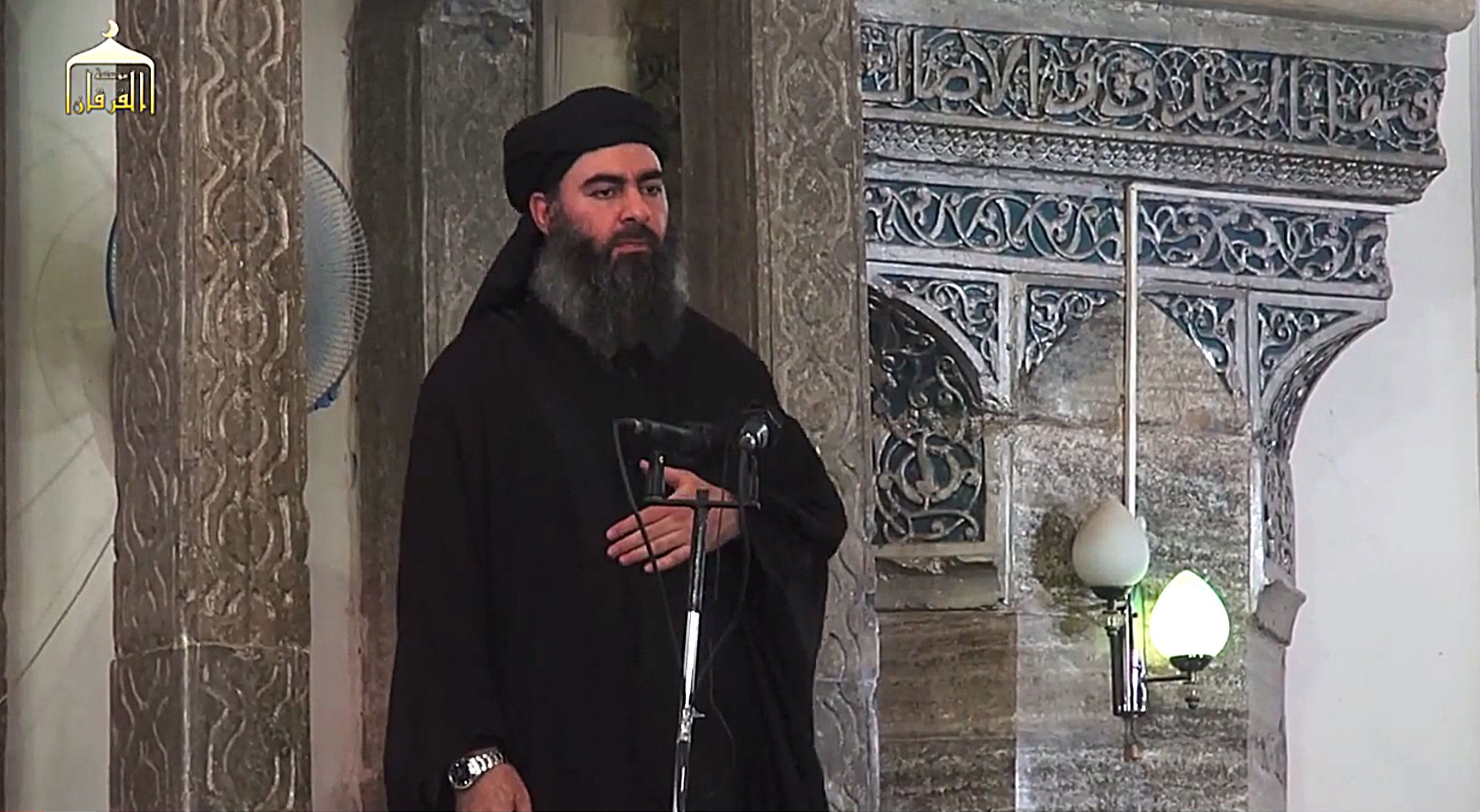
The leader of the Islamic State (IS) since 2010 has been Abu Bakr al-Baghdadi, previously known as Abu Dua or Abu Awad, and his real name—acknowledged by IS itself since the declaration of the so-called Caliphate in 2014—is Ibrahim Awwad Ibrahim Ali Muhammad al-Badri al-Samarrai.
Early Life
Al-Badri was born in Samarra on 1 July 1971, the third of four boys. Al-Badri’s was a lower middle-class, religious, and well-connected farming family. Two brothers were in Saddam Hussein’s army; one of them was killed during the long war with the Iranian Revolution. Two of al-Badri’s uncles worked in the Saddam regime’s security sector. Al-Badri’s poor eyesight meant he never went into the military.[1]
In 1996, al-Badri enrolled on a master’s course at the Saddam University for Islamic Studies, which required family connections to the Ba’ath Party for entry. Al-Badri had not achieved the necessary grades in law so he moved into shari’a, and then switched to Qur’an studies. While at graduate school, al-Badri joined the Muslim Brotherhood under the persuasion of his paternal uncle and his mentor Muhammad Hardan, a veteran of the Afghan jihad. Al-Badri quickly moved beyond the Brotherhood, however, seeing them as “people of words, not action”. He graduated in 1999 and by 2000 was committed to Jihadi-Salafism in its most virulent form.
He is said to have received a PhD in Islamic Studies, although it is unclear when. One account has al-Badri receiving his PhD in 2007, defending his thesis at a university in Baghdad despite the mayhem overcoming Iraq, which meant even his teacher could not make it to the appointment. Evidence that might have been helpful to corroborate such an unlikely story is unavailable: all copies of the PhD dissertation have apparently been stolen.
When al-Badri was 18 years old (c. 1989), he moved from Samarra to Tobchi, a mixed neighbourhood on the western outskirts of Baghdad. Living in a room attached to a mosque, he remained in Tobchi until 2003.
The Insurgency and American Prison
Within months of the American-led invasion of Iraq in March 2003, al-Badri had founded an Islamist insurgent group, Jaysh Ahl al-Sunnah wal-Jamaah (The Army of the People of the Sunni Community), which operated around Samarra, Baghdad, and Diyala.
The exact nature of al-Badri’s role in the insurgent group is unclear. His prison file indicates that he was a “civilian detainee”, i.e. not assessed to be a member of an insurgent group, who was nonetheless held because he was believed to pose a danger to Iraq’s security. Al-Badri’s “civilian occupation” was listed as an administrator/secretary. Whether al-Badri deceived his captors or the deception is IS presenting al-Badri as being involved in the insurgency earlier than he really was might never be known. His prison records show that he was captured in Fallujah by the United States on 4 February 2004 and released on 8 December 2004. He was held at several detention facilities, including the Imam Ali Airbase near Nasiriya, commonly known as Camp Adder, and the now-notorious Camp Bucca in Basra Province.
Some media reports claimed that al-Badri was released in 2009, saying to guards at Camp Bucca, “See you … in New York,” as he left. These are mistaken. Al-Badri was imprisoned once, for ten months, in 2004.
When al-Badri was arrested he was “visiting a friend of his in Fallujah named Nessayif Numan Nessayif”, according to Hisham al-Hashimi, an analyst who works closely with the Iraqi government and claims to have met al-Badri in the late 1990s. “With [al-Badri] was another man, Abdul Wahed al-Semayyir. The U.S. Army intelligence arrested all of them. Baghdadi was not the target—it was Nessayif.”[2] In prison, al-Badri was treated by the authorities as something of a problem-solver.
Al-Badri is said to have met with numerous former regime elements (FREs), the soldiers and spies of the Saddam regime, in prison, and to have met up again with them outside the wire. How reliable this is, given the briefness of al-Badri’s stay, is difficult to say. Samir al-Khlifawi (Haji Bakr) was imprisoned between 2006 and 2008, and had been a major figure in the group before the pledge to al-Qaeda; this is strongly indicative that al-Khlifawi was not radicalised in prison. Adnan al-Suwaydawi (Abu Muhannad al-Suwaydawi or Haji Dawood) was said by IS in his eulogy to have taken part in both battles in Fallujah in 2004—it is likely therefore that he did not overlap with al-Badri in prison. Al-Suwaydawi is additionally said to have been very close to Adnan al-Bilawi (Abu Abdulrahman al-Bilawi), who was a childhood friend, and both al-Suwaydawi and al-Bilawi were supposedly close to IS’s founder, Ahmad al-Khalayleh (Abu Musab al-Zarqawi). Other sources agree with this, placing al-Suwaydawi’s prison term between 2007 and 2010. Again, a role for al-Badri in radicalising either al-Suwaydawi or al-Bilawi is hard to detect by the timeline.
Al-Badri was in prison when al-Khalayleh publicly swore allegiance to Osama bin Laden on 17 October 2004, changing the name of his organisation from Jamaat al-Tawhid wal-Jihad (The Monotheism and Holy War Group) to Tanzim Qaidat al-Jihad fi Bilad al-Rafidayn (The Base of Jihad Organisation in the Land of the Two Rivers (Mesopotamia), more commonly known as al-Qaeda in Iraq (AQI).
Al-Badri had been free for nearly three weeks when bin Laden accepted al-Khalayleh’s pledge of allegiance on 27 December 2004, in an audio message distributed by Al-Sahab Institute for Media Productions and published by al-Jazeera.
Jaysh al-Mujahideen and Joining Al-Qaeda in 2005
The lead shari’a official and emir of Jaysh al-Mujahideen, Abu Abdullah Muhammad al-Mansour, has claimed that al-Badri was a member of his organisation from sometime in 2005 to the end of that year.
Jaysh al-Mujahideen was a Ba’athi-Salafist faction of a particularly hardline kind, strongly emphasising its Salafism and anti-Shi’ism, and committed to the total destruction of the Iraqi government. If al-Badri, a committed Jihadi-Salafist since 2000, was going to join a non-AQI faction, Jaysh al-Mujahideen would be a good candidate.
Interestingly, Jaysh al-Mujahideen contained a notable Fedayeen Saddam contingent.[3] Indeed, according to Malcolm Nance, a former naval intelligence officer who has worked the Iraq file since 1987 and spent a lot of time in post-Saddam Iraq dealing with the insurgency, Jaysh al-Mujahideen was an “armed insurgent wing formed by Saddam Fedayeen, SRG [Special Republican Guard], and former intelligence agencies”.[4] Jaysh al-Mujahideen was rooted in al-Karma, ten miles northeast of Fallujah, where it had good connections with the local tribes. Jaysh al-Mujahideen remained important in al-Karma right up to August 2014, when it was expelled by IS.
What is known of al-Badri’s profile makes it plausible that he joined Jaysh al-Mujahideen—and possible that al-Badri joined Jaysh al-Mujahideen as an agent of AQI, or was recruited as an AQI agent while remaining within Jaysh al-Mujahideen’s ranks.
Not long after al-Khalayleh was killed in June 2006, al-Badri was made chief shar’i for al-Karma and soon all of al-Anbar Province.[5] Thus, al-Badri was based in and around the area in which Jaysh al-Mujahideen was operating as late as 2006. When al-Badri wanted to join an insurgent faction after leaving prison, in other words, Jaysh al-Mujahideen was close to hand.
As to where al-Badri’s actual allegiances were—i.e., when he joined AQI—there is suggestive evidence that by May 2005 he had already joined AQI, so if al-Mansour is correct that al-Badri was “with us ’till the end of 2005”, it is likely al-Badri was working for AQI for some time before he joined them publicly.
The U.S. arrested AQI’s “emir of Rawa” (a town in Anbar about 50 miles from the Syrian border), Ghassan Muhammad Amin al-Rawi, on 26 April 2005. Ghassan Amin was an associate of al-Khalayleh’s who helped “arrange meetings” for AQI and “move foreign insurgents” into Iraq. Amin gave up Abu Dua, identified by the United States as a foreign fighter facilitator and the head of a local AQI cell—a “tier-three” AQI leader, below tier-one, which had direct access to al-Khalayleh, and tier-two, consisting of men who “plan and facilitate operations in a region of Iraq” and “are responsible for flow of money, for flow of information, for flow of munitions, and flow of foreign fighters”.[6] Abu Dua was al-Badri’s kunya before he became caliph.
On 26 October 2005, using information gleaned from Amin, the U.S demolished a building in Ushsh with an airstrike and believed they had killed Abu Dua, Amin’s successor as “emir of Rawa” and a foreign fighter facilitator, though the U.S. did not recover a body. Assuming there are not two Abu Duas and that the man targeted in this raid was al-Badri, that was obviously wrong.
The elements of Abu Dua’s biography that the U.S. gave suggest that the targeted Abu Dua was al-Badri. Abu Dua “held religious courts to try local citizens charged with supporting the Iraqi government and coalition forces”, the Pentagon statement said, which tracks closely with al-Badri’s verifiable role as a shari’a leader in AQI and IS’s other predecessors between 2006 and 2010. In this role, Abu Dua had overseen the intimidation, kidnapping, torture, and murder of Iraqi civilians who had in some way irked AQI, the Pentagon added.
According to the Pentagon, Abu Dua was “a senior al-Qaeda member” and “a known close associate” of Amin’s, thus if this Abu Dua is al-Badri and al-Badri was still within Jaysh al-Mujahideen, he had already gone over to AQI in the spring of 2005. Abu Dua also “set up and ran a system that funnelled foreign fighters from Syria into the Qaim area”, fighters who “were then sent to local terrorist cells”. These “ratlines” were supervised by Syrian intelligence, and Abu Dua cannot have been unaware of that fact. If Abu Dua is al-Badri, it means he had some degree of collaborative contact with the Assad regime.
If the Abu Dua described by the Pentagon—Amin’s successor as emir of Rawa, imposing the shari’a on the local population, and the facilitator of foreign jihadists coming into Iraq from Syria—is al-Badri, then it means al-Badri was also involved in the murder of the governor of al-Anbar Province in May 2005.
The Islamic State
Al-Qaeda in Iraq joined with five other insurgent groups—some of them probably fronts for AQI itself—on 15 January 2006 to form al-Majlis Shura al-Mujahideen (The Mujahideen Shura Council or MSC). At the time, this was interpreted as AQI putting an Iraqi face on a foreign-led group that was provoking more and more resistance even in Sunni Arab areas of Iraq. Al-Badri’s militia, Jaysh Ahl al-Sunna wal-Jamaah, joined MSC about a week after it was formed, and al-Badri served on the shari’a committee. AQI had something more ambitious in mind, however.
Al-Khalayleh had appeared in an AQI video, showing his face for the first time, in April 2006, and announced that MSC was “the starting point for establishing an Islamic state”. The U.S. had killed al-Khalayleh in June 2006, but his vision was realised nonetheless. On 12 October 2006, MSC joined with three more insurgent groups and the six Anbar tribes (out of 31) who had not joined with the Iraqi government to hunt down AQI/MSC, took a pledge, Hilf al-Mutayibeen (Oath of the Scented Ones). Three days later, the Islamic State of Iraq (ISI) was announced, and Hilf al-Mutayibeen was invoked as helping to meet the criteria for the foundation of a caliphal state—namely, consensus. In November 2006, AQI dissolved itself within ISI.
Al-Badri was made the head of religious affairs in Anbar Province at the foundation of ISI, and in early 2010 was made head of all the shari’a committees in ISI’s “provinces”, making him technically the third highest official in the organisation.[7]
There is much controversy and propaganda surrounding al-Badri’s role in ISI during the period before he became the group’s leader—and indeed afterwards. One oft-told story is that al-Badri, while officially rather senior in the organisation, was in fact a mere functionary who helped ISI move its mail around, and when the emir of ISI, Hamid al-Zawi (Abu Umar al-Baghdadi), and his deputy were killed in April 2010, ISI’s chief of staff, al-Khlifawi, a former intelligence official in Saddam’s regime, tricked the Shura Council into electing al-Badri.[8] The problem is that there is no evidence for this—or, more exactly, the evidence offered is deeply suspect.
Ostensible ISI defectors, “WikiBaghdady” and “Abu Ahmad”, are the originators of the story that al-Khlifawi wrote to each of the 11 members of the Shura Council and told them that all the others had voted for al-Badri, ultimately securing nine votes for al-Badri’s appointment. It does appear that al-Badri’s home was a node in ISI’s communications network, but while Abu Ahmad claims that al-Badri “did not know … the sender and the receiver”, a senior official in IS in late 2014 said that al-Badri was “the closest aide” to al-Zawi, whose letters “always started” al-Badri, and al-Badri “sometimes drafted” al-Zawi’s letters to bin Laden.
Al-Badri’s personal closeness to al-Zawi is suggestive that narratives portraying him as a mere cut-out for other actors within the organisation are untrue, and documents captured when ISI’s number three, Mohamed Moumou (Abu Qaswara), was killed in October 2008 list al-Badri as ISI’s emir in Mosul, its most important stronghold.[9]
Though al-Badri came to power in the context of the rapid elimination of a large percentage of ISI’s most senior leadership, he ascended to the helm of an organisation that is actually recovering. A lot of the gains of the Surge had been whittled down by a massive campaign of assassination against the Awakening leaders, the Sunni tribesmen who rose against ISI and worked with the U.S. and the Iraqi government. The Iraqi government’s descent into authoritarian sectarianism, the eruption of a rebellion in neighbouring Syria and Damascus’s decision to respond with indiscriminate violence and a cynical gambit to empower jihadis within the insurgency, and the U.S. political disengagement from and then military withdrawal at the end of 2011 presented al-Badri with a very favourable operating environment to expand his group’s power.
During the U.S.-led occupation of Iraq, the Assad regime’s collaboration with AQI/ISI had provided the organisation a hinterland. As late as 2010, named senior ISI officials were receiving medical treatment in Damascus, for example. (Al-Badri tried to get one of these officials to assassinate his old mentor, Hardan, who was also based in Damascus by this time.) The mobilisation of this old infrastructure allowed ISI to insert itself into the developing dynamics of Syria’s war quickly in 2011. In addition, Assad freed hundreds of jihadi prisoners at the outset of the uprising, who joined numerous groups and helped—as the regime desired—tarnish the uprising with terrorism and extremism. Among the terrorists Assad freed from Sednaya who went on to help IS become a threat to global security were Awad al-Makhlaf (Abu Hamza), IS’s emir in Raqqa; Abu Sarah al-Ansari, an IS field commander; and, most importantly of all, Amr al-Absi (Abu al-Atheer).
In addition to the pre-existing Assad-overseen infrastructure and the prisoners freed by the Assad regime, ISI’s then-deputy, al-Khlifawi, dispatched agents into Syria in the summer of 2011 to help bring together these threads into an ISI front organisation, Jabhat al-Nusra.
Jabhat al-Nusra would eventually split in April 2013 from its parent organisation and join al-Qaeda, which formally severed all links with ISI in February 2014. After a concerted effort at state-building in northern and eastern Syria in late 2013, and a public invasion of Iraq, conquering Mosul and other areas in central Iraq where ISI had long exerted considerable de facto governing authority, ISI declared it was now simply “the Islamic State” and that the caliphate had been re-established on 29 June 2014.
Five days after the caliphate declaration, on 4 July 2014, al-Badri made his first public appearance at the Great Mosque in Mosul, giving a sermon while dressed in a way clearly meant to be reminiscent of the Abbasid caliphs. In February 2016, undated images were circulated of al-Badri making a public appearance in Fallujah. To date these are al-Badri’s only public appearances.
Al-Badri was said to have been severely injured by a coalition airstrike in March 2015, and, while this remains unconfirmed, it does now appear to be true. From the vantage point of mid-2016, when it appears that the demise of IS’s statehood project is merely a matter of time, the possible impact of al-Badri’s death has taken on a new salience.
The caliph is by no means a figurehead, but the structure of the caliphate is not dependent on individuals. Al-Badri’s control is more strategically influential than micro-management, though he can arrange local operations when needed. It would be a considerable blow to morale if IS lost al-Badri at this point, but the group would survive, as would its territorial control. IS’s institutions are mature enough that a replacement would be selected relatively quickly.
But what if al-Badri is left a caliph without a caliphate? There is an argument that this would “represent a catastrophe for [IS’s] strategy, core ideological tenets, and propaganda campaign which is built on projecting strength and success as a manifestation of divine sanction”. On the other hand, if al-Badri falls with the caliphate, he will be spared the need to explain himself—including his decision to break with al-Qaeda and hastily declare the caliphate in the first place, which provoked a reluctant United States to re-engage with the organisation—and the group can more easily morph into a new form.
It is likely that this is true, and for IS the best outcome would be that when it loses Mosul and Raqqa it also loses al-Badri. IS, indeed, is already preparing the ground for such a scenario, explaining its loss of territory as a cyclical phenomenon. After it was defeated in 2008, then ISI was driven into the deserts of western Iraq, and from those sanctuaries it waged a shadow war against the tribes who had driven it from its urban areas and brought many of the tribes back to its banner. Helped by political developments in Baghdad, ISI returned to its old haunts and became more powerful than ever within five years. The manner in which the caliphate is being unravelled has given IS a greater degree of legitimacy as the region’s Sunni vanguard. In other words, IS’s claim that its defeat this time around will be merely the resetting of the cycle is not solely a means of consoling itself.
____________________________________
NOTES
[1] McCants, W., The ISIS Apocalypse: The History, Strategy, and Doomsday Vision of the Islamic State (New York City: St. Martin’s Press, 2015), Kindle location 1240.
[2] Hassan, H. and Michael Weiss, ISIS: Inside the Army of Terror, pp. 118–119.
[3] Hallums, R., Buried Alive: The True Story of Kidnapping, Captivity, and a Dramatic Rescue (New York: Thomas Nelson, 2010), p. 45.
[4] Nance, M. W., The Terrorists of Iraq: Inside the Strategy and Tactics of the Iraq Insurgency 2003–2014, Second Edition (Boca Raton: CRC Press, 2014), p. 81.
[5] Warrick, J., Black Flags: The Rise of ISIS (New York: Doubleday, 2015), p. 258.
[6] Cordesman, A. H., ‘The Islamists and the “Zarqawi Factor”’, Center for Strategic and International Studies, 23 June 2006, available here, last visited: 20 June 2016, pp. 4–5.
[7] Warrick, J., Black Flags: The Rise of ISIS, p. 258.
[8] McCants, W., The ISIS Apocalypse: The History, Strategy, and Doomsday Vision of the Islamic State, Kindle location 1322.
[9] Johnston, P. B., Jacob N. Shapiro, Howard J. Shatz, Benjamin Bahney, Danielle F. Jung, Patrick K. Ryan, and Jonathan Wallace, ‘Foundations of the Islamic State: Management, Money, and Terror in Iraq, 2005–2010’, RAND Corporation, 19 May 2016, available here, last visited 18 June 2016, p. 6.
 Kyle Orton's Blog