By Kyle Orton (@KyleWOrton) on January 23, 2017
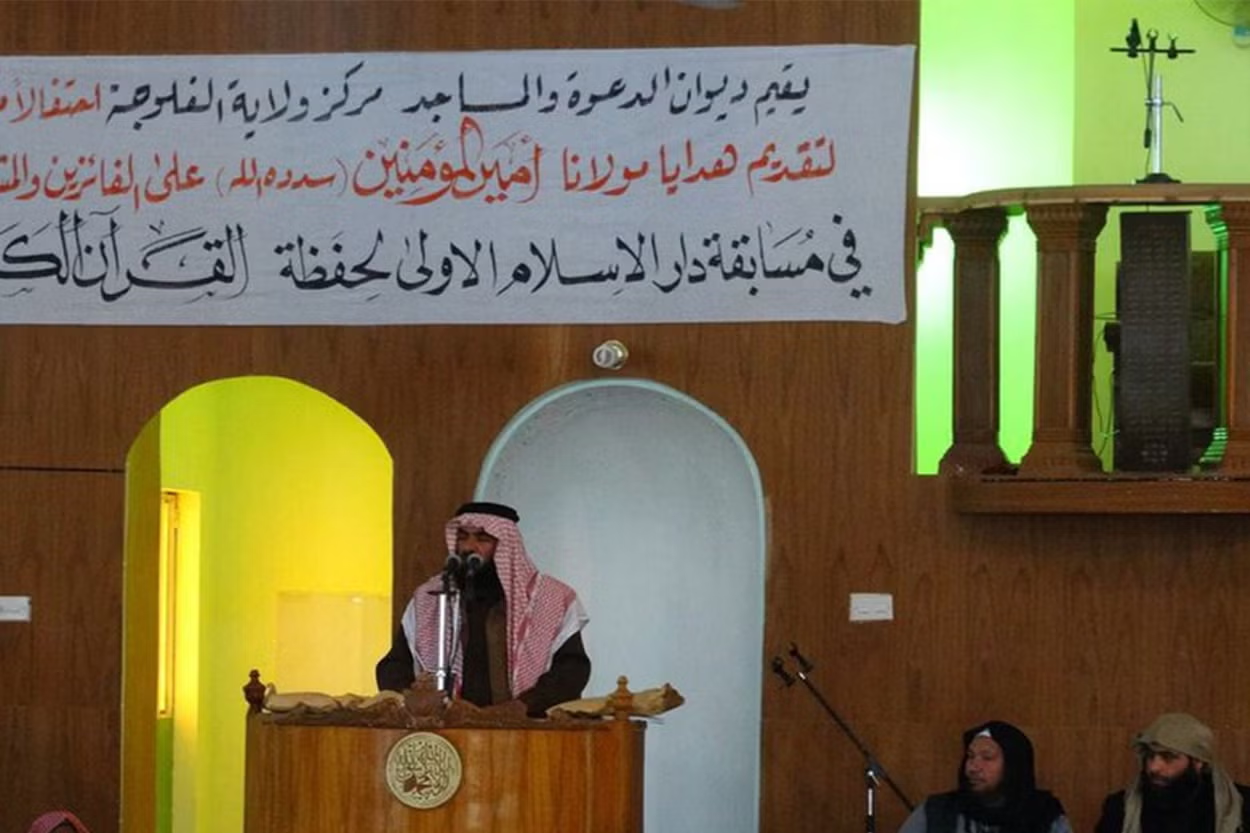
A short biography of the “Caliph” of the Islamic State (IS), Ibrahim al-Badri (Abu Bakr al-Baghdadi), was leaked online by the group in July 2013. A rough translation is reproduced below.
THE CONTEXT OF THE BIOGRAPHY’S RELEASE
IS’s online media ecosystem includes an array of “unofficial” sources. It is reasonably clear that IS’s media department steers these networks, but most of them do not need much guidance: these are dedicated ideologues, committed to disseminating the group’s message—the propaganda-recruitment material, intended to convince people of the truth of IS’s doctrine, and the defences of IS against its enemies, whether that is the West or rival jihadists.
There are a number of advantages to IS in having this unofficial apparatus, of which two stand out.
First, it is, so to speak, free advertising—free in the sense of not costing anything, and free in the sense of without risk. Whatever points of contact IS “proper” has with this ecosystem, they are minimal and at enough steps removed that they do not endanger the organisation. The media department is central to IS, and breaches of security there have proven lethal to its leadership. The ability to have IS media work done by an apparatus that is sealed off from the media department is very valuable.
Second, and not unrelatedly, it gives IS the ability to do “deniable” agitprop—another variant of cost and risk reduction. One use for deniable statements is trying to discredit anti-IS jihadists without sullying IS’s hands by engaging in intra-jihadist faction fighting. Admittedly, this is not a frequent occurrence since IS’s leaders show little aversion to getting into the polemical mud. For example, the recently departed official IS spokesman, Taha Falaha (Abu Muhammad al-Adnani), seemed to positively relish savaging Al-Qaeda’s emir, Ayman al-Zawahiri. Deniability is more often useful for IS in launching trial balloons, preceding some ideological step or action, to test the reaction of its own loyalists, and—most relevant to our purposes today—to circulate information that the group wants to be public but does not want to be seen to release, i.e., “official leaks”.
About three-and-a-half years ago—the earliest version I can find is 14 July 2013—IS’s “unofficial” networks started circulating a biography of Abu Bakr al-Baghdadi, then-emir of the Islamic State of Iraq (ISI), the man known since June 2014 as “Caliph Ibrahim”. The document was the first to reveal that Abu Bakr’s real name was Ibrahim al-Badri. The context for this was the escalating dispute between ISI and Jabhat al-Nusra in Syria, the episode that proved to be the proximate cause of the total rupture in relations between the IS movement and Al-Qaeda.
Al-Nusra was the cover name for ISI’s cadres operating in Syria after January 2012, but along the way the ISI emir overseeing the Syrian department, Ahmad al-Shara (Abu Muhammad al-Jolani), acquired ambitions of his own. In April 2013, when ISI publicly asserted its ownership over Al-Nusra—and the unification of its forces with the parent branch, to create the Islamic State of Iraq and Syria (ISIS)—Al-Shara fought against this by swearing allegiance to Al-Qaeda and appealing to Al-Zawahiri. This was the period where ISI’s relationship with Al-Qaeda was ambiguous: formally separated in 2006, nobody had believed this, and it seems they were correct not to. ISI agreed Al-Zawahiri was the rightful authority to rule on this dispute, an implicit admission that ISI had covertly remained subordinate to Al-Qaeda.
Then Al-Zawahiri did rule in early June 2013: ISIS was to be dissolved, ISI under Al-Badri would return to being Al-Qaeda’s “affiliate” in the Iraq theatre, Al-Nusra was recognised as an “independent” branch of Al-Qaeda under Al-Shara that would operate in Syria, the two sides were to help each other with materiel, men who switched between the two organisations were not apostates, and veteran jihadist Muhammad al-Bahaya (Abu Khalid al-Suri) was appointed as Al-Zawahiri’s representative in the Fertile Crescent to oversee the implementation of this ruling and resolve any time-sensitive disputes that arose. Al-Zawahiri’s ruling was immediately rejected by ISI—politely by Al-Badri, less politely by Falaha.
Thus began six months of confusion, a no-man’s land of ideological uncertainty and struggle. One of the key disputes, which extended back to 2006, when the ISI was declared, was whether Al-Dawla (“The State”) was merely the name of a jamaa (group) or whether it meant a claim to actual statehood. Al-Qaeda had always said clearly that it was just a name. ISI, albeit with more ambiguity, clearly thought it was an actual State. This was to become more apparent in Syria, as ISIS refused cooperation with other jihadist and rebel groups in governing insurgent-held territory. When challenged about this exclusivism, ISIS’s high-handed response was that no State shares its monopoly of power with armed bandits.
Many jihadists were shocked at ISIS’s claim to an exclusive right to rule in the “liberated” areas: initially, it seemed like the pretext for a power-grab. As anti-ISIS jihadists began to comprehend that ISIS really believed what it said, various forms of ideological attack were formulated against the legitimacy of what were already pretty obviously caliphal pretensions from ISIS. A popular objection, and a cutting one since Islamic Tradition is so clear on the point, was that a Caliph had to be known to his subjects, and Al-Badri was completely mysterious—his face, name, qualifications, and all other aspects of his biography hidden. It was to counter this ideological warfare that ISIS leaked the biography of Al-Badri that is reproduced below. As can be seen when reading the biography, it is mostly a record of Al-Badri’s life; one of the few pieces of commentary is stressing the extenuating circumstances that have meant Al-Badri cannot show his face.
ISIS was not relying on persuasion alone, of course. Behind the public ideological contest, and the skirmishes between ISIS and other insurgents (particularly the “Free Syrian Army”-branded mainstream Syrian rebels) that had already broken out by July 2013, ISIS was running down the clock. While ISIS went through the motions of engaging Al-Qaeda’s loyalists as they made repeated efforts to find a formula for ISIS-Nusra reconciliation in Syria, on the ground ISIS was laying the groundwork for its State. Areas captured from the regime were overtly taken over by ISIS, most importantly Raqqa city: the first provincial capital to fall in March 2013 was the caliphal capital-in-waiting by August–September 2013. ISIS eliminated rivals via assassination and subversion, intimidating and inducing insurgent commanders to become their agents. Whole jihadist and rebel groups were infiltrated and coopted, ISIS’s secret soldiers ready to declare themselves when the moment came.
In January 2014, a rebel offensive ejected ISIS from north-west Syria. ISIS’s losses were serious, but far from fatal: the takfiris were too entrenched in Raqqa and the east to be moved from there. This was more an extension of pre-existing dynamics than it was an innovation. With a handful of exceptions, the Syrian rebellion and ISIS had maintained separation, and the borders between them had become ever-more bloody. Nor was this much of an ideological development: by September 2013, ISIS barely concealed its view that the FSA rebels were apostates that it was licit to slaughter. February 2014 was the turning point: Al-Zawahiri expelled ISIS from Al-Qaeda’s ranks, clarifying eight years of uncertainty, and ISIS struck down Al-Bahaya. The battle lines had been drawn most starkly.
THE CALIPH’S BIOGRAPHY
For the first time … Biography of Shaykh Abu Bakr al-Baghdadi […]
In the name of God, the Most Gracious, the Most Merciful
Biography of Abu Bakr al-Baghdadi al-Qurayshi al-Husayni, may God protect him
Emir of the Islamic State in Iraq and Syria [al-Dawla al-Islamiya fi al-Iraq wa-Sham]
The biography as it came to me:
Name: Abu Dua, Ibrahim bin Awad bin Ibrahim al-Badri al-Ridawi al-Husayni al-Samarrai
Descends From: the noble clans of Al-Badareen (Al-Bubadri), Al-Radawiya, Al-Husayni, Al-Hashemi, Al-Qurayshi, and Al-Nizari
Marital status: married.
A Historical Overview of Him
He is a former professor, teacher, educator, and well-known preacher. He graduated from the Islamic University in Baghdad [a.k.a. Saddam University for Islamic Studies, founded in 1989], where he completed the various stages of his academic studies (bachelor’s, master’s, and doctorate). He was known as a preacher well-versed in Islamic culture, al-ilm [(religious) knowledge, learning, or science(s)], and shari’a [legal] jurisprudence, and had wide-ranging knowledge of the ulum [sciences] of history and ansab al-sharifa [the genealogies of the nobles or noble lineages].
He also had extensive alaqat [relationships] and clear influence over members of his tribe in Diyala and Samarra, eventuating in them announcing, of their own free will and with complete certainty, their bay’a [oath of allegiance] to the Islamic State of Iraq and its first emir (Abu Umar al-Baghdadi al-Qurayshi). They gave their bay’a to the emir and his State upon its establishment and its appearance on the jihadist scene in Iraq with the official announcement of the appearance of the State in the last ten days of Ramadan in 2006 [13-22 October 2006].[1] It has long been known that Dr. Ibrahim Awad was one of the most prominent leaders of jihadi-Salafism and one of its most prominent theorists in Diyala and in the city of Samarra through the Imam Ahmad bin Hanbal Mosque, may God have mercy on him.[2]
He is a man from a devout family.[3] His brothers and uncles include da’a deen [preachers or advocates or missionaries or proselytisers of Islam] and professors of the Arabic language, rhetoric, and logic. Their creedal doctrine is Salafism. Shaykh Awad’s mother is one of the notables of the Bubadri tribe, a lover of the deen, a da’a of modesty and virtue, and a supporter of commanding good and forbidding evil. His grandfather, Haj Ibrahim Ali al-Badri, was a man known for his regular attendance at communal prayers, maintaining family ties, and taking care of the needs of impoverished families. Haj Ibrahim passed away a few years ago, during the post-occupation period [i.e., after 2003], after spending a lifetime in this world devoted to obedience, upholding the ties of kindship, and doing good deeds. God, by His grace and generosity, extended the life of the late Haj until he was close to the middle of his nineties.[4]
The absence of Dr. Abu Dua from video or audio recordings is not due to his lack of eloquence or the weakness of his bayan [lucidity, exposition, powers of explanation] or the like. These things are untrue, no matter who says or promotes them. The man’s oratory is eloquent, his bayan is beautiful, and his intelligence and brilliance are evident. He combines the qualities of the previous two emirs of the State, bringing together the calmness and foresight of Abu Umar al-Baghdadi and his formidable sense of security, and the great intelligence and perseverance of Abu Ayyub al-Masri [a.k.a. Abu Hamza al-Muhajir].
Military Experiences
Dr. Abu Dua’s security and military experience on the ground has increased in the last eight years [i.e., since Al-Badri was released from prison in December 2004]. This security and military experience has clearly developed and matured through practice on the ground, where he had to cope with the difficulties and sacrifices [to sustain] eight-and-a-half years of real-world fighting and guerrilla warfare.[5]
He has instigated fighting, gathered forces [together], toured, fought, was captured, then got out and fought many [more] battles. He founded groups, contributing to their establishment and support, and subsequently joined and served on the majlis al-shura [lit. consultation council, the executive committee] of Al-Majlis Shura al-Muhajideen [or the Mujahideen Shura Council, MSM or MSC] and the Islamic State of Iraq, until he became, in the official State announcement of 16 May 2010, the emir of the Islamic State of Iraq. He reached the current emirship only after advancing through many stages, each achieved on merit.
He began with his work, with a number of comrades, by establishing, according to his manhaj [methodology, doctrine, i.e., jihadi-Salafism], Jaysh Ahl al-Sunna wal-Jamaa, which was active, particularly in the governorates of Diyala, Samarra, and Baghdad), becoming head of its Shari’a Committee [Hay’at al-Shari’a] when he took over as emir of the Shari’a Department [al-Qism al-Shari’a] for the group.
This group—by which I mean Jaysh Ahl al-Sunna wal-Jamaa—later gave bay’a [or pledged allegiance] and joined al-Majlis Shura al-Mujahideen, about a week after it was established [in mid-January 2006].
After this, Dr. Abu Dua was appointed to the shari’a committees of Al-Majlis [i.e., MSM] and was a member of the majlis al-shura [i.e., the executive committee of MSM], until the declaration of the Islamic State of Iraq [in October 2006], whereupon he assumed the role of Al-Musharaf al-Amm [General Supervisor or General Administrator] of the shari’a committees in the wilayat [provinces] and had membership on the majlis al-shura of the Islamic State of Iraq.
In addition, he had an obvious and influential role in bringing part of the Samarra tribes to give bay’a to the first Al-Baghdadi [or Al-Baghdadi I], and he contributed to inducing his tribe and the youth of his tribe in Diyala to give bay’a to the State
After the passage of several years, it was logical for Abu Umar al-Baghdadi al-Husayni al-Qurashi (Hamid Dawud) to take him [Al-Badri] under his wing and prepare him for the succession.[6] There is no doubt about this at all considering the type of person Abu Mahmud was.[7] With his [Abu Umar’s/Abu Mahmud’s] formidable sense of security, and shrewdness in weighing options and anticipating all eventualities, he chose him [Al-Badri] and recommended that Dr. Abu Dua be his successor.
This account was brought together in support of fairness [or justice: Insaf] for Emir al-Baghdadi, who has been slandered by the tongues of blacksmiths. They forget his zeal, determination, and support for the people of Syria, with blood and treasure, despite the difficulties, and they copy those who do not know the people of jihad and their virtue and value …
After all this, will the people of theorizing and sitting be ashamed and stop their tongues from attacking the men of jihad???!!!
[1] The phrase translated as “jihadist scene” is “sahat al-jihadiya”. It could also be translated as “jihadist field” or “in the jihadist arena”.
[2] Ibn Hanbal (d. c. 855) founded one of the four main schools of Sunni Islam. Hanbalism and the Hanbalis are concentrated in Saudi Arabia, and underwrites the Saudi State Salafism, known as Wahhabism, which is one thread in the ideological matrix of jihadi-Salafism.
[3] The word translated as “devout” is “mutadayeen”, which is sometimes translated as “religious”, but Islam is not “a religion”—that is a Christian concept. Islam is a “deen”—the root of “mutadayeen”—and, though “deen” is often translated as “religion”, this is misleading, since it refers to Islam, which recognises no sacred-secular division and encompasses proscriptions for life that go far beyond areas like personal beliefs and worship that would be considered “religious” in Christendom. Islam defines public conduct, custom, and practice in areas that Christians would call “political” and “legal”, which are, and have been for half-a-millennium in the Latin West, considered separate to the “religious” sphere. As such, “deen” is better translated “lifeway” or “creed” (albeit there is another word, “aqeeda”, which more literally means “creed”).
[4] The Wikipedia page for Al-Badri claims his grandfather lived until the age of 94, but the reference it points to, page 122 of Andrew Hosken’s 2015 book, Empire of Fear: Inside the Islamic State, says no such thing. Hosken quotes from the biography to which this is a footnote about the Haj’s attendance at communal prayers and then in his own voice writes: “Haj apparently lived to the age of almost ninety-five”.
[5] The word “fighting” was translated from “al-qital” and “guerrilla warfare” from “hurub al-kar wal-far”, literally “hit-and-run wars” (or, even more literally, “wars [of] hit and run”).
[6] Abu Umar al-Baghdadi’s real name was Hamid Dawud Muhammad Khalil al-Zawi.
[7] “Abu Mahmud” or “Abu Mahmoud” is another kunya used by Abu Umar al-Baghdadi.
 Kyle Orton's Blog