By Kyle Orton (@KyleWOrton) on 20 April 2018
Since the uprising in Syria began in 2011, Bashar al-Asad’s regime has followed a tried and trusted script to destroy the opposition by eliminating all engageable elements, creating a binary choice for the population and the world—the despotism or a terrorist takeover.
Asad bolstered extremists within the insurgency: letting Islamists out of prison while imprisoning secular activists, pushing a peaceful protest movement into violence, heightening sectarian tensions, and financial schemes of various kinds. Asad then then left IS alone for a year to build its caliphate, while obliterating rebel-held areas that could provide an attractive alternative to the dictatorship.
Asad’s deputies have hardly been shy in underlining what they have done, so confident are they that they have left outside powers no choice but to side with them in suppressing a jihadist insurrection.
There is a long backstory to Asad’s manipulation of jihadi-Salafist terrorism for his own ends. There is a mountain of evidence, including from U.S. court cases, documenting Asad’s use of the Islamic State (IS) to destabilize Iraq after the fall of Saddam Husayn—a project that actually began before the Iraq invasion in March 2003.
AL-NABA 127
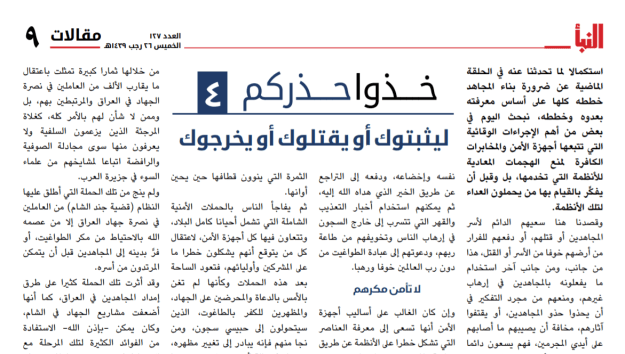
The 127th issue of Al-Naba, IS’s weekly newsletter, was released on 13 April 2018. On page 9, it contained an article, entitled, “Take Your Precautions: ‘[They Seek] To Imprison You, or Kill You, or Expel You’,” which, for perhaps the first time ever in IS’s official literature, admitted the group had worked with the intelligence services of the Asad regime.
The Naba 127 article is framed as a lesson for IS’s soldiers and loyalists on the need to base all their plans for action on “knowledge of [the] enemy”. To that end, the piece “examine[s] some of the most important preventive measures followed by the disbelieving security and intelligence services” in stopping jihadists pursuing the overthrow of the governments. The two primary methods used by the mushrikeen (idolaters) and their taghuti regimes can be categorised as “detention and discouragement”, says Al-Naba: on the one hand, there is a “constant effort to capture the mujahideen or kill them, or to force them to flee from their land out of fear of capture or killing”, and on the other hand this treatment serves to “terrorise” and deter those who are considering taking up jihadism.
Muslim populations are monitored to detect anyone who is drawn to jihadist ideology, their connections to such groups, and particularly if they try to make hijra (emigration). This often results in arrest, or if caught early on the security forces will try to intimidate a would-be jihadist into desisting, says Al-Naba. Sometimes nascent jihadists will be threatened to encourage or pressure them to flee the country so their “jihad ends up being directed at other mushrikeen, not them.” But this is rare, Al-Naba contends, because the priority is generally to capture jihadists, as this brings “benefits that exceed those obtained through killing or banishment”. Captured jihadists can be tortured and humiliated into divulging information harmful to themselves or the wider organisation, Al-Naba goes on. Moreover, the regimes can “break [the] spirit” of an individual jihadist through torture, turning him away from jihadism, and the leaked accounts of torture in the prisons to frighten the broader population into subservience.
“[M]onitoring suspects, infiltrating the ranks of enemies, and uncovering the connections” between anti-regime elements is standard practice for the intelligence services of the Arab governments, Al-Naba points out, but argues this mostly applies to groups that have already shown themselves to be hostile, whether by inciting jihad against the regime, or showing their support for the jihadists in some other way, such as sending money. To uncover hidden enemies, the security services set “traps and snares”, Al-Naba explains, such as allowing areas of freedom that lead al-muwahideen (the monotheists) to reveal themselves. The regimes will arrest youths who are drawn into extremism when space is opened up, but they tend to do so only for “limited periods”, releasing them “as it is confirmed that they currently pose no danger”.
Al-Naba says that during these periods of greater laxness, the infidel systems might appear as if they “have decided to change their policy toward the muwahideen”, they might even present themselves as seeking to make a deal with the jihadists against a common foe, internal or external, or at the very least desirous of a non-aggression pact while the regime deals with larger issues. “Some of this may be true”, Al-Naba says, which is what makes the apparent opportunity so attractive to so many. Jihadi da’wa (proselytism) and its preachers can come out into the open, and space can be created for anti-regime activism, “all … under the ears and eyes of the regimes”, who not only “do not move a muscle [to stop it]”: “at times, they may even encourage it further”.
Then the trap is sprung. Sweeping security operations that “harvest” what the regimes “cultivate”. Afterwards, the field of jihad is barren: its members in prison or driven so far underground they may never emerge again. Those jihadists who try to resist the crackdown by bringing forward their plans will usually fail due to a lack of preparation, and this only plays into the regimes’ hands further. The thwarted operations allow the regime to “portray all those captured as if they had been preparing for ‘terrorist operations’,” no matter if some of the detained “had not even reached the stage of contemplating jihad against the regime.”
Most intriguing is the last section of the article under the subheading, “A Lesson From the Mistakes of Some Muwahideen in Syria”.
As evidence of the above-described problems of flirting with Arab intelligence agencies, writes Al-Naba, one can look to “what happened in Syria at the beginning of the jihad in Iraq, where the security services of the Nusayri regime turned a blind eye to the many young people eager to support the mujahideen in Iraq”. There were “hundreds of young men in Syria” who tolerated this implicit agreement with the regime, Al-Naba says, and “most of them, unfortunately, considered security precautions to be an unnecessary burden, reasoning that there was no need to endure hardship so long as the regime’s intelligence services were leaving them alone.” In addition to creating a security problem, IS essentially dismisses the value of these fighters to the jihadists’ cause. “Many” who came into Iraq from Syria in early 2003, says Al-Naba, “despite loudly calling for jihad and counting themselves among the supporters of the mujahideen, were not engaged in any meaningful activity to assist them.” The compromise with the regime was, therefore, not worth it, since there was no payoff.
This is a self-serving and self-justifying judgment, of course. Among those whom Asad bussed over the border in the early days of the Iraq invasion was Ahmad al-Shara (Abu Muhammad al-Jolani), a senior leader in IS’s Mosul stronghold until he led IS’s intrusion into Syria in late 2011, forming Jabhat al-Nusra (now Hay’at Tahrir al-Sham), a significant extremist problem to this day, based in northern Syria, which appears to have dabbled in anti-Western terrorism.
Even worse, says Al-Naba, just after the declaration of the Islamic State of Iraq in late 2006, the trap that had been set up was initiated: the Asad regime cracked down, and nearly 1,000 jihadists were arrested. This matches other sources, which note a roundup by the Asad regime around this time that imprisoned future IS leaders like Amr al-Absi (Abu al-Atheer). Al-Naba writes that this was named “The Jund al-Sham Case” by Asad, a reference to the jihadist organisation that apparently carried out the attack on the U.S. Embassy in Damascus in September 2006.
Al-Naba does not get into the murky links Jund al-Sham had with the regime, nor how useful it was for Asad at that moment for jihadists to be attacking American targets in Syria. Taking place shortly after Asad had collaborated with Hizballah jihadists to assassinate Lebanese Prime Minister Rafik Hariri and with the regime under pressure from the Bush administration to turn off the flow of suicide bombers into Iraq, the attack on the U.S. Embassy in Syria shifted the narrative to one where Asad was the victim—and a potential partner against—Islamist terrorism, rather than its sponsor.
IS claims Asad’s 2006-07 crackdown had a devastating effect. “None were saved from that campaign”, Al-Naba says: the support structure for IS inside Syria was stripped bare, and those who escaped the regime’s clutches had to go dormant underground or get out of the country. The crackdown was so widescale, according to Al-Naba, that it caught up those with “no connection to the [jihadists] whatsoever, such as the extremist Murji’ah, who claim to be Salafists but know nothing of Salafiyya except debating Sufis and Rafidites [derog. Shi’is] in imitation of their shaykhs from among the evil scholars on the Arabian Peninsula.”
“That campaign had a significant impact on the supply routes to the mujahideen in Iraq, and it also weakened the jihad projects in Syria”, Al-Naba says. “It would have been possible—with God’s permission—to benefit from the many advantages of that period while taking precautions to minimise anticipated harms, had most of the mujahideen not fallen into the trap of the Nusayri intelligence services, feeling secure that they were no threat, neglecting to exercise caution regarding them, and forgetting that this enemy is even more hostile to them than the Crusaders, even if it temporarily appeared to have ceased hostilities.”
The interesting thing is that, despite the effort of Al-Naba 127 to argue broadly that the collusion with Asad was a terrible mistake that did immense damage to IS—a highly dubious proposition—in this paragraph IS is tacitly arguing that collusion could have been beneficial if only proper caution had been exercised. In other words, the mistake was tactical, not strategic or moral. The concluding paragraph—between the lines—hits on the same theme.
“It is the duty of every Muslim to always keep his enmity toward the disbelieving regimes, their allies, and their security apparatuses before his eyes—to treat them on the basis of this enmity, and to know that they harbour toward him enmity many times greater than what he carries in his heart toward them”, Al-Naba states. Jihadists are consequently warned to “beware” of the regimes and adhere to what God said in the Qur’an [Anfal (8): 30]: “Remember how the disbelievers plotted against you, to imprison you, or kill you, or expel you. But they plot, and Allah plots, and Allah is the best of plotters”. Thus, Muslims should “not aid [the regimes] against himself by neglecting the means of protection from their harm, thereby enabling them to capture or kill him”, Al-Naba concludes, and only trust and rely on God. Note that the emphasis here is on caution and self-protection in engaging state intelligence agencies; there is no recommendation, let alone command, to avoid entanglement altogether.
The ambiguity over whether IS regrets working with Asad per se, rather than just how it was done in the Iraq war years, to one side, the crucial substance in Al-Naba 127 is the admission—in some detail—that IS consciously collaborated with the Asad regime from the start of the jihad in Iraq in 2003 and for some years afterwards.
CONCLUSION
The current dynamics of the Syrian war, particularly the strategic defeat of the rebellion, have led to another round of suggestions that reconciling with Asad is the best way forward. This has come from some unexpected places, as well as some longstanding advocates of rehabilitating Asad. This would be a strategic calamity, underwriting the Iranian Revolution’s imperial sphere in the Middle East and Russia’s position, and a reward for Asad’s cynical jihadi gambit and genocidal statecraft.
Post has been updated
 Kyle Orton's Blog
Pingback: The Islamic State Spokesman Directs His Fury At Regional Governments | The Syrian Intifada