By Kyle Orton (@KyleWOrton) on 6 November 2018
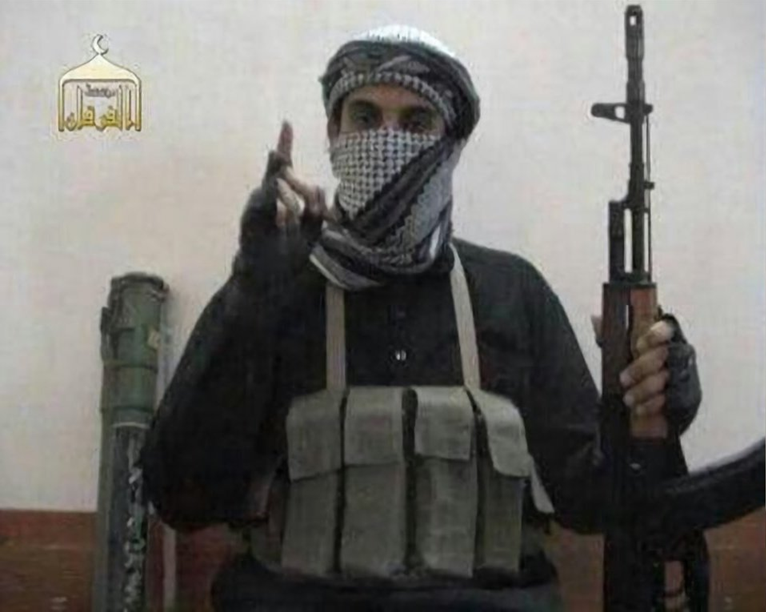
Abu Sulayman al-Utaybi, a Saudi who abandoned his Islamic studies to journey to Iraq in 2006, was appointed chief judge, of the Islamic State movement in March 2007, six months after the Statehood declaration. Between April and June 2007, Abu Sulayman released some public sermons—the picture above is from the first—for what was then called the Islamic State of Iraq (ISI), which had publicly dissolved its bonds to Al-Qaeda when it became a “State” in October 2006, while in fact retaining its bay’a (oath of allegiance) to Al-Qaeda in private.
Abu Sulayman quickly became critical of ISI’s leadership and wrote missives to their theoretical boss, Usama bin Laden, detailing his complaints. On 25 August 2007, Abu Sulayman was unceremoniously defenestrated and replaced by one Abu Ishaq al-Juburi in a brief statement.[1] While the statement did not directly attack Abu Sulayman, it did strongly imply that the decision was taken so ISI could continue “implementing God’s law …, especially in matters of thieves, highway robbers, fornicators, promoters of magic and fortune-telling, … and the destruction of idols and graves that are worshipped besides God”. It is fair to say that if ISI’s leaders felt Abu Sulayman’s removal necessary to prevent an outbreak of witchcraft, sexual deviance, and idolatry, it does not leave much room for doubt that they considered him a wrong’n.
Abu Sulayman soon defected and went to Pakistan to represent his case against “the two shaykhs”, the emir Abu Umar al-Baghdadi and his inseparable deputy Abu Hamza al-Muhajir, to Al-Qaeda “Central” (AQC) in person. When exactly Abu Sulayman arrived in “Khorasan” is uncertain—it seems to have been in the October-November 2007 period—and he was killed fighting U.S. forces in Afghanistan on 10 May 2008.
Abu Sulayman has become in death much more significant than he ever was in life. Abu Sulayman’s “insider” testimony has been used in scholarly settings to assess the Islamic State’s leadership in the Abu Umar era, and even more often it has been used by the Islamic State’s opponents to criticise and ridicule the organisation. This was done contemporaneously: snippets of Abu Sulayman’s testimony were included in letters from Bin Laden’s deputy, Ayman al-Zawahiri, to the two shaykhs asking what was going on in Iraq, and some of those letters were intercepted by the U.S. military in late April 2008, then made public that September. And half-a-decade later, in November 2013, amid the turmoil as relations between AQC and the Zarqawists ruptured for real, Al-Qaeda—deniably, through a Twitter account (@rakan_77)—released the whole of Abu Sulayman’s testimony as part of its political warfare against the Islamic State.
Abu Sulayman’s testimony has become the central pillar for two arguments in particular, advanced by both anti-jihadists and Western analysts.
First, that Abu Umar was a figurehead for Abu Hamza, an Egyptian Al-Qaeda veteran named Abd al-Munim al-Badawi. Abu Sulayman claims that Abu Hamza declared the Islamic State without even selecting an Commander of the Faithful; he just had a name, “Abu Umar al-Baghdadi”. Abu Hamza is said to have stated outright to Abu Sulayman that he would audition someone for the role of proto-caliph for a month, and would remove them and get someone else if they were no good.
This is something of a continuation of the U.S. military’s confusion about whether Abu Umar even existed—or the related belief that he had not, and the role was “back-filled” by Abu Hamza once the ruse was exposed by the capture of ISI’s media emir Khaled al-Mashadani (Abu Zayd al-Mashadani) in July 2007. Not even Abu Umar being killed alongside Abu Hamza in April 2010 and shown to be quite real, a man named Hamid al-Zawi from near Haditha, could dispel this latter narrative.
The problem always was that this view was strongly rooted in what the U.S. wanted to believe: that the jihadist insurgency was a foreign imposition on Iraq, and could be discredited and destroyed if only its leadership was recognised by Sunni Arabs as coming from outside. Which is what made it so easy for Al-Mashadani to feed disinformation to the U.S., as we now know he did, albeit with perhaps less success on the Abu Umar front than he wished. There is evidence the U.S. knew from relatively early on Abu Umar was a real person; if so, why this was obfuscated publicly is unclear, but in either case it does seem that much of the U.S. military-intelligence system assessed Al-Zawi as a subordinate front-man for Abu Hamza all the way along. This is not true, but the general sense that it is has infected analysis ever since, and when footnotes are needed it is to Abu Sulayman people look.
Second, that ISI’s leadership in the 2006 to 2010 period—between the killing of the founder, Abu Musab al-Zarqawi, in 2006, and the current caliph, Abu Bakr al-Baghdadi, taking office in 2010—was besotted with apocalyptic ideology, and made disastrous decisions on that basis. This is often applied to Abu Hamza, who, per the first point above, and in Abu Sulayman’s testimony, is argued to have been running the show in that timeframe; sometimes it is applied to him and Abu Umar, if the latter is accorded any agency in ISI policymaking.
The astonishing thing about this argument is that it relies almost entirely on Abu Sulayman’s word—with a smattering of propaganda statements from the caliphate era about Dabiq—yet it is plainly, demonstrably contradicted by the visible conduct of the Islamic State movement and the concrete internal records that show a most careful stewardship of resources to wage a long-term, very temporal revolutionary war. The counter-example of an actually apocalyptic group can be seen with Juhayman al-Utaybi, whose followers seized the Grand Mosque in Mecca in 1979 with less than a fortnight’s food supply, so sure were they that the advent of the Mahdi was at hand.
There are other charges Abu Sulayman makes, which show up from time to time in descriptions of the IS movement in 2006-10—sometimes with attribution to Abu Sulayman, sometimes not (a number of these have become such common currency “everyone knows” factoids that citation is not always considered necessary). The charges include: that the groups who joined with Al-Qaeda in Mesopotamia to forge the Islamic State were basically fictional, just a few people who signed their names in exchange for positions in “the State” without having any manpower behind them; that there was extensive corruption up to senior levels in ISI; and that ISI recirculated old footage to claim it had carried out new operations. (Abu Sulayman’s objection to the Islamic State flag as bid’a or “innovation” has a better factual basis—though historicity was not the grounds of his complaint—but it gives a sense of Abu Sulayman’s political intelligence that, left to him, IS would have abandoned what is now a global symbol.)
What should always have prevented Abu Sulayman’s testimony being taken at face value is that he was in the Islamic State for a total of about a year, and held the post that gave him access to the leadership for just five months, with strong hints that he was being frozen out for the last couple of those months. Before ever examining the nature and details of the dispute between Abu Sulayman and the two shaykhs, the fact that Abu Sulayman had such a limited window onto the organisation—and not-incidentally that he was a foreigner entering Iraq at a moment of enormous and rapid politico-military upheaval—should have induced caution about how much he could know. The likelihood that Abu Sulayman, even if he testified in complete good-faith, was misunderstanding the ISI leaders and the situation they were dealing with should have been reckoned as high, and then, of course, as in any dispute that involves basically hearsay evidence, the probability had to be that Abu Sulayman was guilding his own case, misrepresenting—either by exaggeration or fabrication—his opponents to make them look worse.
When looked at more closely, the irony of the Abu Sulayman episode is that the conventional story is essentially upside-down: it was Abu Sulayman, not the two shaykhs, who was the “extremist”. Abu Umar and Abu Hamza, as his “first minister” and “war minister”, realised that the Sahwa (Awakening), the uprising against them by Sunni Arab insurgents and tribes, had resulted from their own missteps, including excessive harshness, and set about reformulating their approach to the tribes especially. The two shaykhs adopted a carrot-and-stick approach of mixing selective terror—namely, the threat of assassination for intransigent Sunni leaders—with a general policy of inducement, going to quite considerable lengths to try to win back insurgent and tribal leaders, and being ever-mindful of (though never subservient to) the court of Sunni Arab mass opinion. This proved very successful and helped lay the foundations for the caliphate declaration in 2014.
Abu Sulayman was unalterably opposed to this course, as you can see when you read his testimony, which, again, has been public since 2013, yet always seems to be omitted when he is mentioned as a source. Abu Sulayman talks about an episode where he took matters into his own hands with three tribesmen the two shaykhs were trying to deal with: insisting the three men were homosexuals and spies, Abu Sulayman had them burned alive and enclosed the video of this atrocity—foreshadowing one of IS’s most shocking actions in 2015—with the evident expectation that AQC would approve. (The video was never officially released, but you can see it on the internet, a grisly spectacle of three bound men doused in petrol and thrown into a flaming pit.) Abu Sulayman’s doctrinal criticism of the ISI leaders is for diluting the creed by bringing in these other groups. In Abu Sulayman’s view, it was compromise that got ISI into the Awakening mess, and the moves towards “amnesty” and reconciliation with the tribesmen and insurgents who wanted to quit the Awakening were religious betrayals.
It was this issue in the spring and summer of 2007 over whether to accept repentant Sahwat back into the fold, or to stick to the letter of jihadi-Salafist ideology that designated them apostates who had to be killed, that caused the rift in ISI’s leadership, with the two shaykhs advocating the former and Abu Sulayman advocating the latter. As Craig Whiteside summarised in a recent paper: “Abu Umar and Abu Hamza overruled their sharia chief Abu Sulayman’s objections, no small matter in a religiously oriented militant organization. … [T]he Islamic State’s leaders took their own counsel over a stranger’s and slowly righted a sinking ship.”
Abu Sulayman’s complete testimony is reproduced below (I found it on a jihadist forum): it is dated “Rabi al-Thani 1428” (mid-April to mid-May 2007), with an addendum indicating that the final version was completed in late October 2007. The addendum also suggests Abu Sulayman’s real name is Muhammad al-Thubayti.[2] The key sections of the testimony, related to the above and some other interesting sections, are highlighted in bold.
* * * * *
Letter of Shaykh Abu Sulayman al-Utaybi to the Leadership in Khorasan
[Risalat al-Shaykh Abu Sulayman al-Utaybi lil-Qiyada fi Khorasan]
In the Name of God, the Most Gracious, the Most Merciful,
All praise is due to God, and peace and blessings be upon the Messenger of God, our Prophet Muhammad, and upon his family, his companions, and those who follow them.
To proceed:
This is a brief letter, carrying within it greetings, longing, love, and brotherhood. It has been authentically reported from our Prophet Muhammad (peace and blessings be upon him) that he said: “Seven are shaded by God in His shade on the Day when there is no shade but His”, and he mentioned among them: “two men who love each other for the sake of God, meeting upon it and parting upon it” (agreed upon from the narration of Abu Hurayra, may God be pleased with him).
God knows that I, and my brothers in the Al-Qaeda Organisation in the Land of the Two Rivers [i.e., Al-Qaeda in Iraq (AQI)], have longed intensely to meet you. We bear witness before God to our love for you. I ask God to gather us with you in this world in the best of states and in the Hereafter in the Gardens of Bliss.
It is not hidden from you that among the conditions of this love for the sake of God is that it must be purely for His noble Face, and among its necessary consequences are sincere advice and honesty. For it is reported in Sahih Muslim from Jarir (may God be pleased with him) that he said: “We pledged allegiance to the Messenger of God (peace and blessings be upon him) to hear and obey in ease and hardship, and to offer sincere advice to every Muslim.”
There is no good in brotherhood that is not based upon truthfulness, nor surrounded by sincere advice. I do not exaggerate when I say that Tanzim al-Qaeda [the Base of Jihad Organisation] is, in the world today, to the best of my limited knowledge, the only group that was founded upon truthfulness and sincere advice and stands upon nothing else. And it is by God that I was compelled to join this group in the Land of the Two Rivers, which we deem to be the victorious group, whose head was the patient hero of Islam, Abu Musab al-Zarqawi—may God accept him among the martyrs.
It is upon this principle that I write this letter, emulating the pious ancestors [salaf al-salih] of this umma in offering sincere counsel to the leaders, while refraining from spreading it among the soldiers to avoid fitna. I seek to clarify the current state of jihad in the Land of the Two Rivers, and what the situation has become, turning from a period of strength and nearness to tamkeen [lit. “empowerment”; jihadists ruling territory], to weakness and the loss of territory in one area after another.
As an example: the city of Ramadi, which was the first city where the brothers were able to declare an emirate—not that we had complete control over it, but the word there belonged to the mujahideen, and there was no presence of these other banners therein. It was also the residence of Shaykh Abu Musab for several months before his martyrdom [in June 2006]. After the declaration of the State [in October 2006], it has become a refuge for apostasy—we seek refuge with God—and around it are now about thirty checkpoints manned by the National Guard and the Americans. There is no might nor power except with God.
Thus I say, seeking success through God:
The main reason for this [disaster] was the declaration of the State in this manner. People believe the truth is that the establishment of the State came after the bay’a [oath of allegiance] from the factions of the Mujahideen Shura Council [al-Majlis Shura al-Mujahideen] to Al-Qaeda, followed by the allegiance of the tribal shaykhs in Hilf al-Mutayibeen [the Alliance of the Scented Ones]. But this is absolutely not the case.
What actually happened is that the heads of these factions who gave bay’a [to the Islamic State]—such as Saraya al-Jihad, Saraya al-Ghuraba [Brigades of the Strangers], Jaysh Ahl al-Sunnah, Kataib al-Ahwal [Horrors Brigade], Jaysh al-Ta’ifa al-Mansura [Army of the Victorious Sect]—were individuals who had no connection whatsoever to real jihad on the ground. Some of them had never carried a weapon in their lives; some of them had no followers at all—it was only empty names. They gave bay’a, either explicitly or implicitly, on condition that they be given positions in the State that was to be declared. And things proceeded exactly as they wished.
I bear witness by God Almighty to this, due to my closeness to Abu Hamza al-Muhajir. The well-known tribal shaykhs were not involved, as Abu Hamza himself often claims. As a result of this, there was: deviation from the manhaj [methodology]; weakness in confronting major methodological errors due to flattery and appeasement; a rise in security breaches, and we lost many brothers, some killed, others captured; the disappearance of correct operations; and the theft of people’s wealth in the name of the State.
I personally witnessed incidents of this kind, among them what was done by the former emir of Saraya al-Jihad, who is now the deputy of the Commander of the Faithful [Emir al-Mu’mineen], Abu Abd al-Rahman al-Falahi. His group seized twenty-six trucks, the cargo in each truck valued at two-and-a-half notebooks [i.e., a large amount of money], not to mention the value of the trucks themselves. When the owner complained, and his grievance reached me, I summoned this man. He excused the seizure by saying the goods belonged to the Rafida [derog. Shi’is]. However, he was unable to prove that. When we confirmed that they belonged to a Sunni, he said to me: “Yes, they are Sunni-owned goods, but their owner owes a debt to the Islamic State.” When I demanded an accounting of the debt, we found that the debt did not even reach the value of one truck, let alone twenty-six.
Then this man—the deputy of the Commander of the Faithful—told me: “I took this money as a punitive measure. I have an order from Abu Hamza to seize any merchant’s goods heading to Baghdad.” When I investigated this, Abu Hamza denied issuing such an order, but he subsequently told me, verbatim: “Shaykh Abu Sulayman, you are the general judge [al-qadi al-’am] of the State, so do not involve yourself in any case unless we refer it to you, lest your prestige be diminished.” I understood that this was an evasion of responsibility in confronting the man [Al-Falahi]. This is the weakness we are complaining about, stemming from the patchwork of allegiances [on which the State was founded].
It should be noted that this merchant is a well-known figure who previously helped the brothers in Al-Qaeda with smuggling explosive materials and remote detonation devices. He is known as Abu [redacted] and everyone in Anbar knows him. Now, because of this incident, he has been left burdened with debt.
Among the causes of this deteriorating situation are a series of errors—some grave, some which, if left unaddressed, will lead to great disasters. Some of them relate to the methodology of the State. Among the examples: their leniency with the tribe that burned three of the brothers alive after they had stormed a police station in Salah al-Din. The wali [governor] of Salah al-Din negotiated with them, despite having the ability to implement the law of God upon them. We raised this matter to Abu Hamza al-Muhajir, and he approved the negotiation. So, this poor slave, the chief judge of the State, went and discovered that the governor of Salah al-Din had signed an agreement with this tribe: that no police station would not be attacked without the tribe’s permission. Thus, in reality, the situation became one where the Islamic State had pledged allegiance to the tribe, not the other way around, contrary to what was being reported to Abu Hamza al-Muhajir.
It is worth mentioning that the main reason for all this was the complete absence of Abu Hamza al-Muhajir from the field [of battle] and his reliance only on the reports submitted to him, even though the governors and regional emirs openly admitted to not reporting the situation accurately to the leadership. They would only send pleasing news. Among them was the wali of Salah al-Din province, Abu Safa, whose real name is Najm.
As for Abu Umar al-Baghdadi, he does not know what is happening around him. He relies solely on the opinions of those around him and never opposes them in anything whatsoever.
So the judge—this poor slave, Abu Sulayman—executed by burning three of the apostates involved in this matter, praise be to God, as you can see in the recording number (2), and no harm resulted.
Another example: his leniency, rather his flattery and defence of, the so-called Abu Usama (Abu Abd al-Rahman al-Falahi), when he, as deputy Commander of the Faithful, fiercely defended the criminals, as recorded in discs (3), (4), and (5). He [Al-Falahi] claimed that these people were innocent and that the men of the organisation were unjust in applying the law of God upon them, though he had not reviewed the details of the cases. The brothers refuted him, praise be to God. The crimes of those men included espionage, adultery, and sodomy—as they themselves confessed.
Among the errors that affect the creed: their misunderstanding of some of the signs of the Hour [i.e., the End of Days, the apocalypse]. If the matter had stopped at that, it would have been easy to resolve. But the problem is that it went beyond that and began affecting activities on the field of jihad. For example, he [Abu Hamza] was certain that the Mahdi would appear within less than a year—that is, by Ramadan 1427 AH [24 September – 23 October 2006]. Based on that, he declared that we would control all the Land of the Two Rivers within three months. So he issued an order [for ISI’s troops] to remain on the frontlines and not to withdraw for one week, until the command came to withdraw—something extremely dangerous for the brothers. At the time I write these lines, a year has passed [from the time Abu Hamza believed the apocalypse would begin], and we have not take control of the land, let alone seen the appearance of the Mahdi.
This incorrect understanding also resulted in hastiness in decision-making, as if the Hour would occur tomorrow. One example is the premature and weak declaration of the State, with all the errors it contains, which I will clarify in their proper place. More than once, after discussing such matters with him, he said to me: “There is hardly any time left before the Mahdi appears.” He believed this to the extent that he ordered some brothers to build a pulpit for the Mahdi to ascend in al-Masjid al-Aqsa, another for the Mosque of the Prophet, and a third for the Umayyad Mosque in Damascus!!!!
Yet, anyone who casts even the briefest glance at the situation on the ground, will realise that it is merely a gathering of various banners under one banner [or flag: raya], while the hearts and methodologies are [still] different. This is no longer a secret. They openly (as with Abu Usama al-Falahi) that the methodology of the organisation, not merely the mistakes of individuals, will disappear, and that “al-manhaj al-wasat [the centrist or middle-way or moderate methodology]” will remain. He said: “I guarantee the dissolution of the organisation.” How I wish I knew what “centrism [or moderation]” they mean. It is the compromises [or concessions: al-tanazulat] we now see from our brothers, regrettably. When this was reported to Abu Hamza al-Muhajir, he initially doubted it; but if the evidence [in a case] is too strong, he rationalises it or postpones speaking about it. More detail will come regarding his stance toward the other banners.
Among the shar’i [legal] errors: imitating the tawaghit of the Arabs and non-Arabs in announcing the State. Included in this is the ministerial formation [i.e., cabinet] that was announced [in April 2007] (and there is no power nor strength except with God). Also included is the commitment to a specific flag [alamin khass] for the State, and [Abu Hamza] becoming angry if it is called a symbol [or logo: shi’aran]. He would say: “We are a State, not a group.” From a shar’i standpoint, this is bid’a, and we seek refuge in God.
Another of these errors: the adherence to the [provincial] borders set by the tawaghit, such that no one is allowed to operate outside his assigned sector. Had this been a matter of organisational coordination, we could say this was the ijtihad of the man, and he is the emir. But it appears he went to excess [or exaggerated: ghala] on this matter, to the point where he said: “If you find [Iraqi Prime Minister] Nuri al-Maliki outside your sector, do not kill him”—just like that, unconditionally. I said to him: “Perhaps you mean to emphasise discipline and order among the brothers?” He replied: “No, do absolutely nothing, and whoever does [otherwise] will be punished.”
Among the errors that affect manhaj is the concept of the Islamic State. Is it the “declaration” of the Islamic State or the “establishment” of the Islamic State? Abu Hamza is inconsistent on the point. At one point, he said to me, “It is merely a declaration,” and this is what is in the minds of most of the brothers, that it is a State in the sense of an Emirate, as in the case of the declaration of the Taliban Emirate, and that we are followers of our shaykhs and emirs, Mullah Muhammad Umar and Shaykh Usama (may God preserve them all). This was his opinion before he assumed leadership of the organisation (that is, during Abu Musab’s time).
Yet on another occasion, in a different gathering, he said, “It is the establishment of a State, not merely a declaration,” and [claimed] that we had transitioned from being a secret organisation to being an established State. This, however, contradicts reality, let alone the shari’a, by what I believe I am obligated to before God [adeenu Allah], and I advised him accordingly that we should announce an Islamic Emirate without specifying a map, territory, ministries, or the like, because, in truth, we had reached that stage long ago, not just at that time.
His later opinion resulted in the “dissolution [dhawban],” as he himself expressed it, of the organisation [i.e., AQI] into other groups for the purpose of declaring the Islamic State. The ahl al-hall wal-aqd [lit. “people who loose and bind”, the executive committee that chooses the caliph] within the organisation disagreed with him on this matter, and he did not even consult them. He said to me afterwards that Abu Umar al-Baghdadi is Emir al-Mu’mineen al-A’zam [Supreme Commander of the Faithful] (Caliph)—but only after the occupier leaves. When I reviewed the matter with him and mentioned the hadith where the Prophet said, “If two Caliphs are given allegiance, kill the latter,” he replied: “One of the two emirs pledged allegiance to the other.”
And among the most astonishing things here is that the declaration of the State was made in such haste, without even specifying who the Commander of the Faithful actually was in the first place—on top of all the other problems with this very concept. Instead, he was given an alias, “Abu Umar al-Baghdadi”. His real identity was not clarified. Indeed, he [Abu Hamza] said to me verbatim: “There is a person we will test for a full month. If he proves suitable, we will keep him as Commander of the Faithful; otherwise, we will look for someone else.” And God is witness to what I say.
Among the errors that affect manhaj is appointing those who do not satisfy the requirements of dhima [legal-religious responsibility] and are not fit to be entrusted [with authority]. This is widespread, unfortunately, but to give just one example: the shari’a judge for al-Karmah area, “Abu Hajar,” who is the masked man shown in recording number (6). This man is extremely wicked [or malignant: khabith], and I take responsibility for saying that. He holds deviant views that may even amount to disbelief [kufr], and we seek refuge with God.
In summary, regarding this great calamity—and I am responsible before God the Exalted, and I do not fear the blame of any blamer for the sake of God, and also before you—I desire only reform to the best of my ability. This is a testimony I will be questioned about on Yawm al-Qiyamah [the Day of Resurrection].
Alongside me, there are other witnesses to the general situation of jihad in Iraq, that it is deteriorating due to the leadership by around eighty percent (80%) or ninety percent (90%). Many of the members of Al-Qaeda [in Iraq], a large number of them, are muhajireen [foreign fighters], and many of those are from the Arabian Peninsula (around sixty mujahideen from the Arabian Peninsula).
So, the conclusion is: the situation is heading towards the abyss—may God protect us from that—and as of the date 6/11/1428 AH [16 November 2007], we are very close to the edge. Our condition before the declaration of the State was many times stronger and more stable than it is now. This is not simply a matter of God’s decree [taqdeer Allah, i.e., predestination] despite us taking all proper measures. Rather, it is because of what our own hands have earned and by our neglect of the trust [bi-tadyi’ina lil-amana].
Much of what is shown of the brothers’ operations in the media outlet al-Furqan Foundation is either old footage that is re-edited and re-released—such as the “Free the Captive” [Fukku al-‘Ani] raid, an operation to free prisoners which happened during the time of Abu Musab (may God have mercy on him) and is now being released as a new production under the Islamic State of Iraq—or it is authentic but greatly exaggerated. Much of what is announced [by ISI] is either false or overblown, as when they announced that the mujahideen stormed Badush Prison in Mosul and freed the prisoners. This is not true. Rather, they negotiated with the police, paid them money, and made it appear as if it were a raid and a conquest. The enemy knows it was not a raid, so the lie here is upon the brothers, not the enemy. And there are many, many, many such cases.
It is also worth mentioning that the noble brothers running the al-Fajr Media Centre—which is one of the best institutions that have served the mujahideen—requested to conduct a general interview with me during these days. After istikhara [praying for God’s guidance], I agreed, and praise be to God. However, I was surprised by the questions that were sent to me, and I could not answer them because I would only answer according to what I believe is the truth before God, and that would cause fitna.
The brothers told me: “This is what is actually being discussed in the field.” These were the questions:
(I erased them because they are off-topic, although the Shaykh replied to them, and he ordered that they not be published. Al-Fajr Centre did not publish them.)
I ask God to provide this umma with righteous leadership, and to rectify the conditions of the leaders [qada] and governors [wula]. Ameen.
Our final prayer is that all praise is due to God, Lord of the Worlds.
My message is complete.
From your brother,
Al-Mu’tasim bi-Allah [The One Who Seeks Refuge in God] Abu Sulayman al-Utaybi,
Judge of the group [Qadi al-jama’a] Al-Qaeda in the Land of the Two Rivers previously, and current Judge of the State.
Rabi al-Thani, 1428 AH [20 April – 18 May 2007].
Important Addendum:
In the middle of Sha’ban 1428 AH [14 August – 12 September 2007; the exact date was 25 August], approximately two months ago, a statement was issued by our brother Abu Hamza, announcing the dismissal of the Shari’a Judge (i.e., this poor slave) and his replacement by an Iraqi brother, Abu Ishaq al-Juburi.
I had previously requested brother Abu Hamza to replace me and relieve me of this responsibility, but he refused because of his good opinion of me, may God reward him. However, after the situation worsened and he learned that I wished to send this message to you, he proceeded with this action. Since he refused my original request, I have not met with him at all. So what drove him to do this?
Here is the full text of the statement from one of the [news] websites:
“The office of ‘the Commander of the Faithful,’ Abu Umar al-Baghdadi—leader of Al-Qaeda in the Land of the Two Rivers—announced that it had been decided to dismiss the organisation’s Shari’a Judge in Iraq, the Saudi Abu Sulayman al-Utaybi, and to appoint Abu Ishaq al-Juburi as the new general judge [qadiyan amman] in his place, according to what was published on a jihadist website yesterday (Sunday [this would be 26 August]). Al-Qaeda in the Land of the Two Rivers had announced last March the appointment of Muhammad al-Thubayti, known as Abu Sulayman al-Utaybi, to the position from which he has now been dismissed. His masked photo was distributed online. The statement from Al-Qaeda in Iraq did not mention the reasons for al-Thubayti’s dismissal, stating only that it was ‘based on the requirements of shar’i interest.’ The office also announced the appointment of a Minister of Education, Dr. Muhammad al-Badri, coinciding with the start of the academic year, in an effort to safeguard the curriculum from deviation.”
_______________________________________________
NOTES
[1] The ISI statement, entitled, “Dismissal of the Chief Judge and Appointment of a Minister of Education”, said: “The office of the Commander of the Faithful, Shaykh Abu Umar al-Baghdadi (may Allah grant him victory), has decided to dismiss the brother Judge Abu Sulayman al-Utaybi and to appoint the brother Shaykh Abu Ishaq al-Juburi [or Abu Is-Haq al-Juburi] as the Chief Judge [al-Qadi al-Awwal] of the Islamic State of Iraq.”
The statement went on: “And we give glad tidings to the umma of Islam that the shari’a courts and the judges in all the provinces of the Islamic State of Iraq are proceeding in implementing the shari’a of Allah and the establishment of the hudud, especially in matters of thieves, highway robbers, fornicators, promoters of magic and fortune-telling [or augury], and cases concerning the blood and wealth among the people, and the destruction of idols and graves that are worshipped besides Allah, and other issues and cases. And that is the bounty of Allah, which He gives to whom He wills.”
The statement adds: “For the safeguarding of our sons from doctrinal and moral deviation, and to raise a new generation of sons of Islam who are nurtured on the concepts of sound Islamic creed [aqeeda], far from the filth of secularism and other deviant creeds—and on the occasion of the start of the new academic year—it pleases the Islamic government of our blessed State to announce the appointment of Dr. Muhammad Khalil al-Badri as Minister of Education. And from Allah is success and guidance.”
[2] Can also be transliterated Muhammad al-Thubaiti (محمد الثبيتي).
 Kyle Orton's Blog