By Kyle Orton (@KyleWOrton) on 5 March 2021
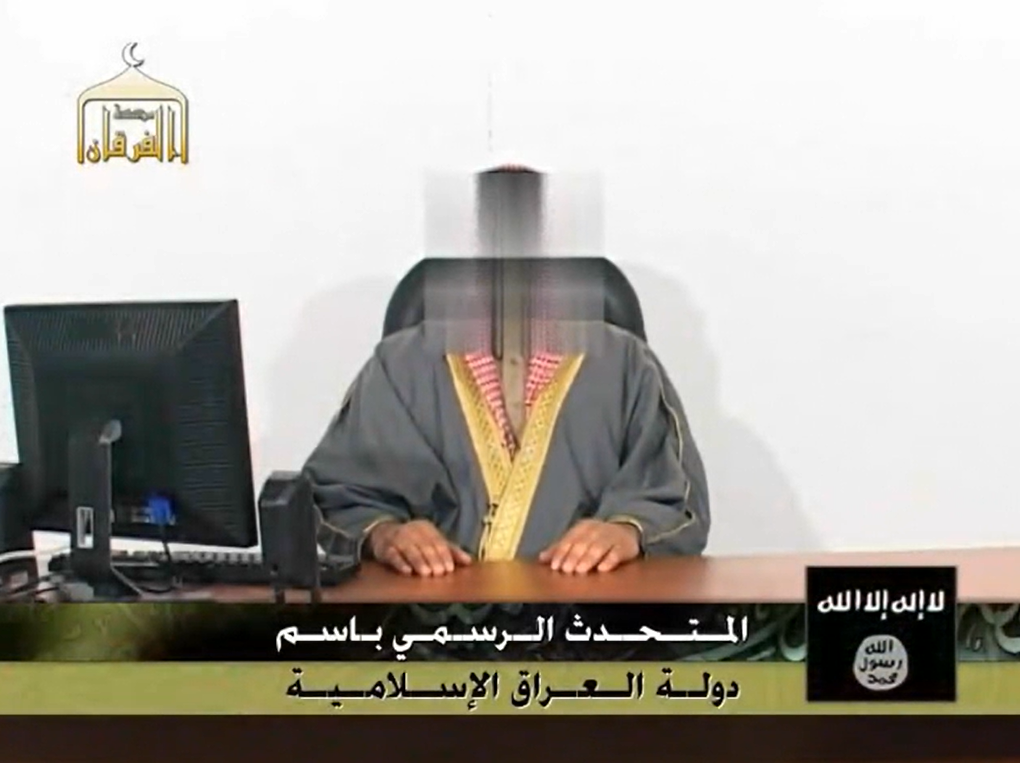
On 19 April 2007, seven months after the Islamic State (IS) movement declared its “State”, the official spokesman, Muharib al-Jaburi, announced the first “cabinet” for this “state”, appointing leaders for various “ministries”. Unusually for IS in this era, the speech was delivered as a video address—albeit (as can be seen) with Muharib’s face blurred out—rather than as an audio address. The reason for this was clearly to push back against the criticism of the IS movement that its leader could not be the “caliph” of all the Muslims, which at this stage IS was not overtly claiming, while being faceless and nameless, known only by his kunya.
CABINET APPOINTMENT
Muharib, in a five-minute speech entitled, “The First Cabinet Selection for the Islamic State of Iraq”, says that “it has become one of the duties of this phase [towards a caliphate] for your brothers in the Shura Council of the Islamic State to announce a cabinet line-up for the first Islamic government that … believes in God and strives in His path to govern by His law”.
Muharib says that “the Crusaders” have tried to rule Mesopotamia “with the help of the apostates from among the secularists [al-almaniyeen], nationalists, Communists, Ba’thists, and Alqamiyeen”, i.e. Shi’is. The reference is one IS had made before—as had Saddam Husayn—to Muhammad ibn al-Alqami, the last vizier of the Abbasid caliphate, a Shi’i, who, in sectarian historiography, was accused of opening the gates of Baghdad to the Mongols in 1258.
To counter this, Muharib says, “here is the Islamic State of Iraq, the State of Islam and the mujahideen, to bring the umma [worldwide Islamic community] the glad tidings of the choosing its ministers, after God has enabled your mujahideen brothers in Hilf al-Mutayibeen [the Alliance/Oath of the Scented Ones] to announce this state and choose an emir, Shaykh Abu Umar al-Baghdadi [real name: Hamid al-Zawi], … and this ministerial formation can be defined as the next stage:
First: Shaykh Abu Abd al-Rahman al-Falahi, Wazir Awal [First Minister or Prime Minister, i.e. deputy] of the Emir al-Mu’mineen [Commander of the Faithful];
Second: Shaykh Abu Hamza al-Muhajir [real name: Abd al-Munim al-Badawi], Minister of War;
Third: Professor [Al-Ustad] Shaykh Abu Uthman al-Tamimi, Wazir lil-Hay’at al-Shari’a [Minister of the Shari’a Committees or Sharia Commissions, the religious courts];
Fourth: Professor Abu Bakr al-Jaburi, Minister of Public Relations;
Fifth: Professor Abu Abd al-Jabbar al-Janabi, Minister of Amn al-Amm [General Security or Public Security];
Sixth: Shaykh Abu Muhammad al-Mashadani, Minister of Information [or Media Emir];
Seventh: Professor Abu Abd al-Qadir al-Issawi, Minister of Martyr and Prisoners Affairs [Wazir li-Shuwn al-Shuhada wal-Asra];
Eighth: The Engineer [Al-Muhandis] Abu Ahmad al-Janabi, Minister of Oil [Naft];
Ninth: Professor Mustafa al-Araji, Minister of Agriculture and Fisheries;
Tenth: Professor Doctor Abu Abdallah al-Zaydi, Minister of Health.”
AFTERMATH
Muharib had become the IS spokesman some time in 2006 after the first spokesman, Abu Maysara al-Iraqi, had been killed. It was Muharib who made the initial announcement of “the State” in October 2006, before Abu Umar made his first speech that December. Muharib was killed less than two weeks after this speech announcing the “cabinet”, on 1 May 2007. Abu Umar would largely take over the spokesman duties after this—IS only returned to having an official spokesman in 2011, with Taha Falaha (Abu Muhammad al-Adnani)—though with an interesting exception in the case of the “second cabinet” or “reshuffle” that was announced on 21 September 2009.
 Kyle Orton's Blog