By Kyle Orton (@KyleWOrton) on 6 August 2023
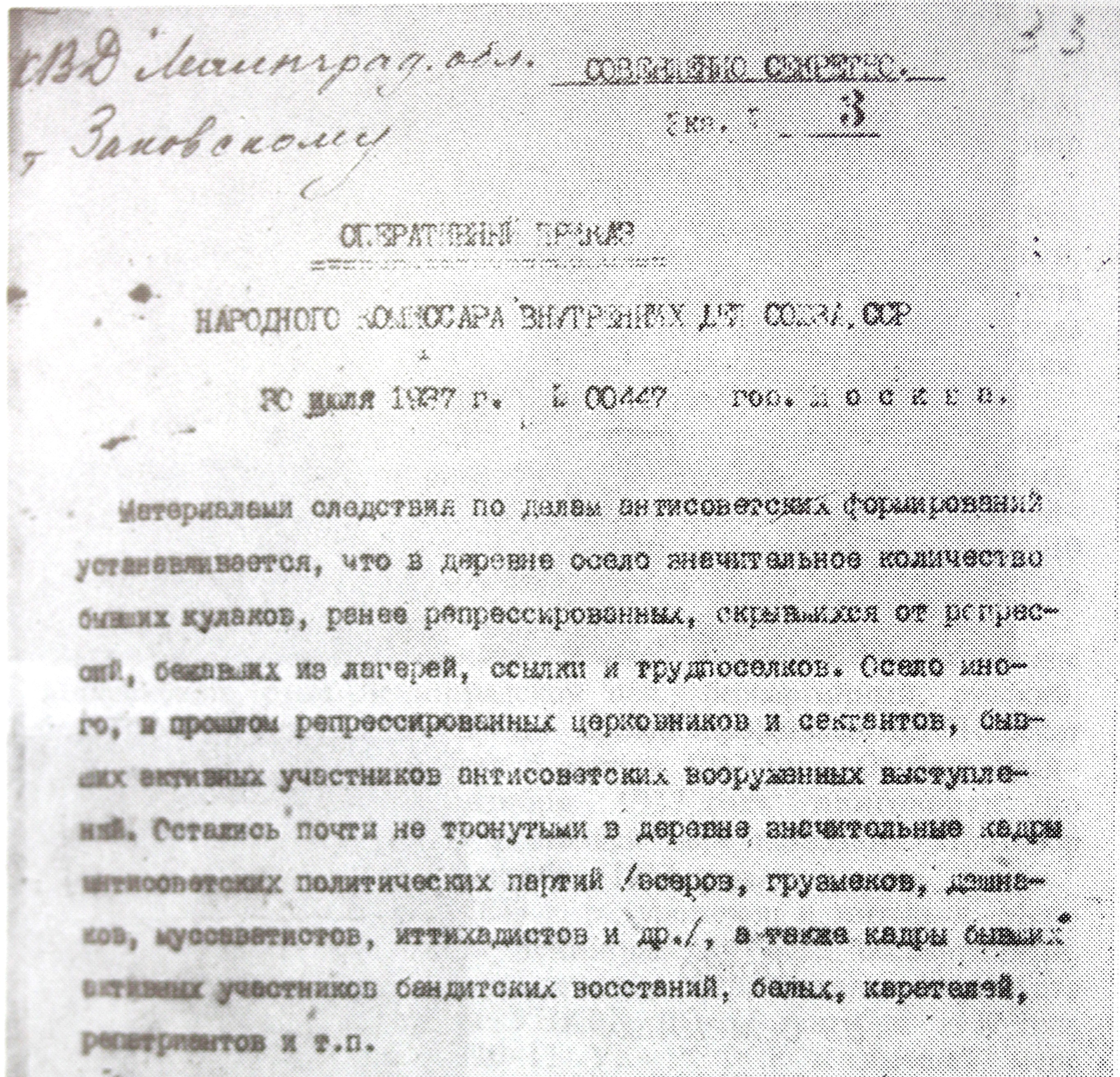
The head of the Soviet NKVD, Nikolai Yezhov, issued Prikaz (Order) Number 00447 on 30 July 1937, a secret instruction soon signed-off by Joseph Stalin, which vastly expanded the scope and scale of the Great Terror within the Soviet Union. The 2008 book, The Road to Terror: Stalin and the Self-Destruction of the Bolsheviks, 1932-1939, by J. Arch Getty and Oleg V. Naumov, as translated by Benjamin Sher, contains nearly the full text of the order (pp. 473-80), which is reproduced below.
A few clarifying notes:
The Terror or Yezhovshchina was a process of State persecution in the Soviet Union—purges, torture, confinement to the GULAG concentration camps, and judicial murder—that began in 1936, built to the peak represented by this Order in 1937, and ran until the end of 1938. The whole thing was orchestrated and entirely controlled by the General Secretary of the Communist Party, Joseph Stalin (r. 1922-53). Yezhovshchina is often remembered for the show trials, where broken men publicly confessed to literally incredible crimes as part of a non-existent effort to overthrow the Soviet system in a conspiracy with elements outside the country, particularly Leon Trotsky, the leader of the Bolshevik army during the civil war who had been declared a heretic and deported in 1929. Behind this public dimension overseen by the infamous judge Andrey Vyshinsky—later a leading figure in the Nuremberg “trials”—there was a remorseless, secret bureaucratic machinery, which Order 00447 put into high gear. Roughly one million people were murdered directly by Yezhovshchina (usually shot by the NKVD) and seven million people were sent to the GULAG in 1937-38, where two million of them perished because of the inhuman conditions.
The People’s Commissariat for Internal Affairs (NKVD) was the then-current incarnation of the All-Russian Extraordinary Commission (VČK or VChK), better known as the Cheka, founded the month after the Bolshevik coup of November 1917. The various version of the Cheka—the OGPU, NKVD, NKGB, MGB, and KGB—are often called the Soviet “secret police”, and that was, indeed, one of their roles. But the Soviet system should not be misunderstood as a synonym for “the Russian government”: it was a transnational movement—a Revolution—that happened to hold Russia as one of its pieces of territory on the way to bringing the whole world under Communism. The Cheka was “the sword and the shield” of the Revolution, charged with the defence of those areas already under Communist rule and the expansion of this zone wherever possible. As such, neither the neat conceptual distinctions of Western intelligence services (domestic and foreign, defensive and offensive), nor the operational distinctions (recruitment, propaganda, counter-intelligence, sabotage, assassination) applied: the Cheka was all of these things simultaneously.
The copy of the document from the Soviet archives that Getty and Naumov reproduce has a memo attached to the front, which is written by Mikhail Frinovsky, Yezhov’s deputy at the NKVD, and it is addressed to Alexander Poskrebyshev, Stalin’s personal secretary, formally the head of the “Special Sector” of the Central Committee, one of the most important instruments used by Stalin to assert his will over the State. Frinovsky was asking for Yezhov’s order to be approved by the Politburo. The Politburo members—never numbering more than fifteen men—were Central Committee members. In theory, the Politburo was to act as a rapid-action, deliberative policy-making body for the Central Committee when its full 140 members were not in session. In reality, the Politburo wielded supreme power within the Soviet system, and even within the Politburo the theory of “democratic centralism” was generally by-passed: the General Secretary ruled. This was especially true under Stalin and at this time: two months earlier, with the arrest of Janis Rudzutaks, Yezhovshchina had begun consuming Politburo members. The Politburo’s approval of 00447 on 5 August—the date specified as the start date of the order—is, therefore, to be understood as Stalin rubber-stamping something he had demanded in the first place.
In terms of the content of Order 00447, the primary target is the repressed “former kulaks” who have “evaded repression, escaped from camps, exile, and labour settlements”, and who are now said to be stirring up trouble in the countryside, along with bandits and habitual criminals. There are also various elements said to have “infiltrated industrial enterprises, transport, and construction projects” in urban zones to sabotage them (“wreckers”, as they would come to be called). The subtext is a confession that the Soviet regime has been unable to gain control of the peasants in the rural areas after the upheaval created by the collectivisation and dekulakisation policies that Stalin began in 1929, and that the industries in the cities are likewise malfunctioning.
The singling out of the kulaks—the peasants from Ukraine, Kazakhstan, and elsewhere who had already survived being starved, uprooted, and imprisoned in concentration camps—has led to 00447 being called the “kulak order” and its consequences the “kulak operation”. But the terrifying thing about 00447 is that it opened the way to imprisoning and murdering anyone.
Yezhov says the NKVD is taking on the “task of mercilessly crushing this entire gang of anti-Soviet elements”, which includes kulaks and other “socially dangerous elements who were members of insurrectionary, fascist, terroristic, and bandit formations”; “anti-Soviet political parties”, including various national minorities, “Whites” (those who fought the Bolsheviks in the civil war) and “Cossack-White Guard insurrectionary organizations”, bureaucrats from the former Imperial Government, Russian Orthodox Church officials, “sectarians” (i.e., Protestants and other small Christian sects), and “fascist, terroristic, and espionage-saboteur counterrevolutionary formations”; and “criminals”: “bandits, robbers, recidivist thieves, professional contraband smugglers, recidivist swindlers, cattle and horse thieves”.
The Order then gets to what to do about this: the First Category of the “most active of the above-mentioned elements” are “to be shot”; the Second Category of “less active but nonetheless hostile elements” are to suffer “confinement in concentration camps for a term ranging from eight to ten years”. To make these decisions, 00447 creates the “troikas”, the three-man panels of NKVD officers. The order also sets out quotas for people in various regions who are to be shot and imprisoned.
The operation initiated by Order 00447 was supposed to last for four months and apply to a little over a quarter-of-a-million people, murdering 76,000 of them and sending the rest to the GULAG. In reality, the operation lasted fifteen months—running until November 1938—and involved the slaughter of nearly 400,000 people, with another 350,000 sent to the Soviet concentration camps.
_________________________________________________
Below is a translation of Order No. 00447, written by NKVD chief Nikolai Yezhov and dated 30 July 1937. The basic skeleton is taken from Getty and Naumov in ‘The Road to Terror’ (pp. 473-80), with the gaps filled in and some edits made using the Russian original.
To Comrade Poskrebyshev,
I am sending you operational order No. 00447 concerning the punishment of former kulaks, criminals, and other anti-Soviet elements. In addition, I am sending you the decree. I ask that you send the decree to members of the Politburo for their vote, and please send an extract of relevant items to Comrade Yezhov.
Frinovsky
30 July 1937 …
[TOP SECRET] Copy no. 1.
OPERATIONAL ORDER of the people’s commissar for internal affairs of the USSR. No. 00447 concerning the punishment of former kulaks, criminals, and other anti-Soviet elements.
30 July 1937. City of Moscow.
It has been established by investigative materials on the cases of anti-Soviet formations that a significant number of former kulaks, previously repressed, have settled in the countryside, having evaded repression, escaped from camps, exile, and labour settlements. A large number of previously repressed clergymen and sectarians, as well as former active participants of anti-Soviet armed campaigns, have also settled. In addition, significant cadres of anti-Soviet political parties (SRs [Socialist-Revolutionaries], Georgian Mensheviks, Dashnaks [Armenians], Mussavatists [Azeris], Ittihadists [Turks, refers to the ideology of the Committee of Union and Progress], and others), as well as former participants in bandit uprisings, Whites [i.e., anti-Bolsheviks in the Civil War], punishers [or punitive units (karatel)], repatriates, and similar groups remain virtually untouched in the countryside.
Some of the elements listed above, having left the countryside for the cities, have infiltrated industrial enterprises, transport, and construction projects.
Moreover, significant cadres of criminal offenders still entrenched in both countryside and city. These include horse and cattle thieves, recidivist thieves, robbers, and others who had been serving their sentences, escaped from places of confinement, and are now in hiding from repression. The inadequacy of the struggle to combat these criminal contingents has created a state of impunity, enabling their criminal activities.
As has been established, all of these anti-Soviet elements constitute the chief instigators of every kind of anti-Soviet crimes and sabotage in the kolkhozy [collective farms] and sovkhozy [state farms] as well as in the field of transport and in certain spheres of industry.
The organs of state security are faced with the task of mercilessly crushing this entire gang of anti-Soviet elements, of defending the working Soviet people from their counterrevolutionary machinations, and, finally, of putting an end, once and for all, to their base undermining of the foundations of the Soviet state.
In accordance with this, I ORDER — FROM 5 AUGUST 1937, ALL REPUBLICS, TERRITORIES, AND REGIONS, TO COMMENCE AN OPERATION FOR THE REPRESSION OF FORMER KULAKS, ACTIVE ANTI-SOVIET ELEMENTS, AND CRIMINALS.
IN THE UZBEK, TURKMEN, TAJIK, AND KYRGYZ SSRs, THE OPERATION IS TO COMMENCE FROM 10 AUGUST OF THE CURRENT YEAR, AND IN THE FAR EASTERN AND KRASNOYARSK TERRITORIES AND THE EAST SIBERIAN REGION — FROM 15 AUGUST OF THE CURRENT YEAR.
In organizing and conducting these operations, the following guidelines should be observed:
I. CATEGORIES SUBJECT TO REPRESSION.
1. Former kulaks who have returned home after having served their sentences and who continue to carry out active, anti-Soviet sabotage.
2. Former kulaks who have escaped from camps or from labour settlements, as well as kulaks who have been in hiding from dekulakization, who carry out anti-Soviet activities.
3. Former kulaks and socially dangerous elements who were members of insurrectionary, fascist, terroristic, and bandit formations, who have served their sentences, who have been in hiding from punishment, or who have escaped from places of confinement and renewed their anti-Soviet, criminal activities.
4. Members of anti-Soviet parties (SRs, Georgian Mensheviks, Dashnaks, Mussavatists, Ittihadists, etc.), former Whites, gendarmes, bureaucrats, punishers, bandits, gang abettors, transferees, re-émigrés, who are in hiding from punishment, who have escaped from places of confinement, and who continue to carry out active anti-Soviet activities.
5. Persons unmasked by investigators and whose evidence is verified by materials obtained by investigative agencies and who are the most hostile and active members of Cossack-White Guard insurrectionary organizations slated for liquidation and fascist, terroristic, and espionage-saboteur counterrevolutionary formations. In addition, repressive measures are to be taken against elements of this category who are kept at the present under guard, whose cases have been fully investigated but not yet considered by the judicial organs.
6. The most active anti-Soviet elements from former kulaks, punishers, bandits, Whites, sectarian activists, church officials, and others, who are presently held in prisons, camps, labour settlements, and colonies and who continue to carry out in those places their active anti-Soviet sabotage.
7. Criminals (bandits, robbers, recidivist thieves, professional contraband smugglers, recidivist swindlers, cattle and horse thieves) who are carrying out criminal activities and who are associated with the criminal underworld. In addition, repressive measures are to be taken against elements of this category who are kept at the present under guard, whose cases have been fully investigated but not yet considered by the judicial organs.
8. Criminal elements in camps and labour settlements who are carrying out criminal activities in them.
9. All of the groups enumerated above, to be found at present in the countryside—i.e., in kolkhozy, sovkhozy, on agricultural enterprises, as well as in the city, i.e., at industrial and trade enterprises, in transport, in Soviet institutions, and in construction, are subject to repression.
II. CONCERNING THE PUNISHMENT TO BE IMPOSED ON THOSE SUBJECT TO REPRESSION AND THE NUMBER OF PERSONS SUBJECT TO REPRESSION.
1. All kulaks, criminals, and other anti-Soviet elements subject to repression are broken down into two categories:
a. To the first category belong all the most active of the above-mentioned elements. They are subject to immediate arrest and, after consideration of their case by the troikas, to be shot.
b. To the second category belong all the remaining less active but nonetheless hostile elements. They are subject to arrest and to confinement in concentration camps for a term ranging from 8 to 10 years, while the most vicious and socially dangerous among them are subject to confinement for similar terms in prisons as determined by the troikas.
2. In accordance with the registration data presented by the people’s commissars of the republic NKVD and by the heads of territorial and regional boards of the NKVD, the following number of persons subject to repression is hereby established:
| Region / Republic | First Category | Second Category | Total |
| Azerbaijan SSR | 1,500 | 3,750 | 5,250 |
| Armenian SSR | 500 | 1,000 | 1,500 |
| Belorussian SSR | 2,000 | 10,000 | 12,000 |
| Georgian SSR | 2,000 | 3,000 | 5,000 |
| Kirghiz SSR | 250 | 500 | 750 |
| Tadzhik SSR | 500 | 1,300 | 1,800 |
| Turkmen SSR | 500 | 1,500 | 2,000 |
| Uzbek SSR | 750 | 4,000 | 4,750 |
| Bashkir ASSR | 500 | 1,500 | 2,000 |
| Buryat-Mongolian ASSR | 350 | 1,500 | 1,850 |
| Dagestan ASSR | 500 | 2,500 | 3,000 |
| Karelian ASSR | 300 | 700 | 1,000 |
| Kabardino-Balkar ASSR | 300 | 700 | 1,000 |
| Crimean ASSR | 300 | 1,200 | 1,500 |
| Komi ASSR | 100 | 300 | 400 |
| Kalmyk ASSR | 100 | 300 | 400 |
| Mari ASSR | 300 | 1,500 | 1,800 |
| Mordvinian ASSR | 300 | 1,500 | 1,800 |
| German-Povolzhia ASSR | 200 | 700 | 900 |
| Northern Ossetian ASSR | 200 | 500 | 700 |
| Tatar ASSR | 500 | 1,500 | 2,000 |
| Udmurt ASSR | 200 | 500 | 700 |
| Chechen-Ingush ASSR | 500 | 1,500 | 2,000 |
| Chuvash ASSR | 300 | 1,500 | 1,800 |
| Azov-Black Sea territory | 5,000 | 8,000 | 13,000 |
| Far Eastern territory | 2,000 | 4,000 | 6,000 |
| Western Siberia territory | 5,000 | 12,000 | 17,000 |
| Krasnoyarsk territory | 750 | 2,500 | 3,250 |
| Ordzhonikidze territory | 1,000 | 4,000 | 5,000 |
| Eastern Siberia territory | 1,000 | 4,000 | 5,000 |
| Voronezh region | 1,000 | 3,500 | 4,500 |
| Gorky region | 1,000 | 3,500 | 4,500 |
| Western region | 1,000 | 5,000 | 6,000 |
| Ivanovo region | 750 | 2,000 | 2,750 |
| Kalinin region | 1,000 | 3,000 | 4,000 |
| Kursk region | 1,000 | 3,000 | 4,000 |
| Kuibyshev region | 1,000 | 4,000 | 5,000 |
| Kirov region | 500 | 1,500 | 2,000 |
| Leningrad region | 4,000 | 10,000 | 14,000 |
| Moscow region | 5,000 | 30,000 | 35,000 |
| Omsk region | 1,000 | 2,500 | 3,500 |
| Orenburg region | 1,500 | 3,000 | 4,500 |
| Saratov region | 1,000 | 2,000 | 3,000 |
| Stalingrad region | 1,000 | 3,000 | 4,000 |
| Sverdlovsk region | 4,000 | 6,000 | 10,000 |
| Northern region | 750 | 2,000 | 2,750 |
| Cheliabinsk region | 1,500 | 4,500 | 6,000 |
| Yaroslavl region | 750 | 1,250 | 2,000 |
| UKRAINIAN SSR | |||
| 1. Kharkov region | 1,500 | 4,000 | 5,500 |
| 2. Kiev region | 2,000 | 3,500 | 5,500 |
| 3. Vinnitsa region | 1,000 | 3,000 | 4,000 |
| 4. Donetsk region | 1,000 | 3,000 | 4,000 |
| 5. Odessa region | 1,000 | 3,500 | 4,500 |
| 6. Dnepropetrovsk region | 1,000 | 2,000 | 3,000 |
| 7. Chernigov region | 300 | 1,300 | 1,600 |
| KAZAKH SSR | |||
| 1. North Kazakhstan region | 650 | 300 | 950 |
| 2. South Kazakhstan region | 350 | 600 | 950 |
| 3. West Kazakhstan region | 100 | 200 | 300 |
| 4. Kustanai region | 150 | 450 | 600 |
| 5. East Kazakhstan region | 300 | 1,050 | 1,350 |
| 6. Aktobe region | 350 | 1,000 | 1,350 |
| 7. Karaganda region | 400 | 600 | 1,000 |
| 8. Alma-Ata region | 200 | 800 | 1,000 |
| CATEGORY | |||
| NKVD Camps | 10,000 | ——- | 10,000 |
| [TOTAL] | [75,750] | [192,500] | [268,250] |
3. The approved figures are provisional. However, People’s Commissars of Republican NKVDs and heads of regional and provincial NKVD departments are not authorized to exceed them independently. Any unauthorized increase in figures is not permitted.
If circumstances necessitate an increase in the approved figures, the People’s Commissars of Republican NKVDs and heads of regional and provincial NKVD departments must submit corresponding motivated requests to me.
Reduction of figures, as well as reassigning individuals initially designated for repression under the first category to the second category, and vice versa, is permitted.
4. Families of individuals sentenced under the first and second categories are generally not subject to repression, except in the following cases:
a. Families whose members are capable of active anti-Soviet actions. Members of such families, by special decision of the troika, are to be sent to camps or labour settlements.
b. Families of individuals repressed under the first category who reside in border zones must be relocated beyond the border zone within the republics, territories, and regions.
c. Families of individuals repressed under the first category who reside in Moscow, Leningrad, Kyiv, Tbilisi, Baku, Rostov-on-Don, Taganrog, and the regions of Sochi, Gagra, and Sukhumi must be resettled from these locations to other regions of their choice, excluding border areas.
5. All families of individuals repressed under the first and second categories must be registered and systematically monitored.
III. PROCEDURE FOR CARRYING OUT THE OPERATION
1. Begin the operation on 5 August 1937 and complete it within a four-month period.
In the Turkmen, Tajik, Uzbek, and Kirghiz SSRs, begin the operation on 10 August of the current year, and in East Siberian Oblast, Krasnoyarsk Krai, and the Far Eastern Krai—from 15 August of the current year.
2. In the first instance, the contingents assigned to the first category are subjected to repression.
The contingents assigned to the second category, until a special order to that effect, are not subjected to repression.
In the event that the People’s Commissar of a republican NKVD, the chief of an administration, or of an oblast department of the NKVD, having completed the operation concerning the contingents of the first category, considers it possible to proceed to the operation concerning the contingents assigned to the second category, he is obliged, before actually proceeding with this operation, to request my sanction and only after receiving it, to begin the operation.
With respect to all those arrested who will be sentenced to confinement in camps or prisons for various terms, as sentences are handed down, report to me how many persons have been sentenced and for what prison or camp terms. Upon receipt of this information, I will give instructions as to by what procedure and to which camps the convicted are to be sent.
3. In accordance with the situation and local conditions, the territory of the republic, krai, and oblast is divided into operational sectors.
For the organisation and conduct of the operation in each sector, an operational group is formed, headed by a responsible worker of the republican NKVD, krai administration, or oblast administration of the NKVD, capable of successfully coping with the serious operational tasks entrusted to him.
In some cases, the most experienced and capable chiefs of district and city departments may be appointed as heads of operational groups.
4. Operational groups are to be staffed with the necessary number of operational workers and provided with means of transport and communication.
In accordance with the requirements of the operational situation, military or militia units are to be attached to the groups.
5. The heads of operational groups are charged with directing the registration and identification of persons subject to repression, directing the investigation, approving indictments, and carrying out the sentences of the troikas.
The head of the operational group bears responsibility for the organisation and conduct of the operation in the territory of his sector.
6. Detailed identifying information and compromising materials are collected on each person to be repressed. On the basis of the latter, arrest lists are drawn up, which are signed by the head of the operational group and sent in two copies for review and approval to the People’s Commissar of Internal Affairs, the chief of the administration, or the chief of the oblast department of the NKVD.
The People’s Commissar of Internal Affairs, the chief of the administration, or the chief of the oblast department of the NKVD reviews the list and gives sanction for the arrest of the persons listed therein.
7. On the basis of the approved list, the head of the operational group carries out the arrest. Each arrest is formalised by a warrant. A thorough search is conducted at the time of arrest. The following are mandatorily seized: weapons, ammunition, military equipment, explosives, chemical-warfare agents and poisonous substances, counter-revolutionary literature, precious metals in coin, bullion, and manufactured articles, foreign currency, duplicating devices, and correspondence.
Everything seized is entered into the search protocol.
8. The arrested are concentrated at points designated by the People’s Commissars of Internal Affairs, chiefs of administrations, or chiefs of oblast departments of the NKVD. At the concentration points there must be premises suitable for housing the arrested.
9. The arrested are kept under strict guard. All measures guaranteeing against escapes or any kind of excesses are organised.
IV. PROCEDURE FOR CONDUCTING THE INVESTIGATION.
1. Investigation shall be conducted into the case of each person or group of persons arrested. The investigation shall be carried out in a swift and simplified manner. During the course of the trial, all criminal connections of persons arrested are to be disclosed.
2. At the conclusion of the investigation, the case is to be submitted for consideration to the troika.
The following documents must be attached to the case:
- Arrest warrant,
- Search protocol,
- Materials seized during the search,
- Personal documents,
- Detainee’s questionnaire,
- Intelligence and registry materials,
- Interrogation protocol,
- A brief indictment.
V. ORGANIZATION AND WORK OF THE TROIKAS
1. I approve the following personnel composition of the troikas for the republics, territories, and regions:
Azerbaijan SSR
- Chairperson: Sumbatov
- Members: Teymurkuliyev, Jangir Akhund Zade
Armenian SSR
- Chairperson: Mugdusi
- Members: Mikvelyan, Ternakalov
Belarus SSR
- Chairperson: Berman
- Members: Seliverstov, Potapenko
Georgian SSR
- Chairperson: Rapava
- Members: Talakhadze, Tsereteli
Kyrgyz SSR
- Chairperson: Chetvertakov
- Members: Jienbayev, Gutsuyev
Tajik SSR
- Chairperson: Tarasyuk
- Members: Ashurov, Baykov
Turkmen SSR
- Chairperson: Nodev
- Members: Anna Mukhamedov, Tashly Anna Muradov
Uzbek SSR
- Chairperson: Zagvozdin
- Members: Ikramov, Baltabayev
Bashkir ASSR
- Chairperson: Bak
- Members: Isanchurin, Tsypnyatov
Buryat-Mongolian ASSR
- Chairperson: Babkevich
- Members: Dorzhiev, Gross
Dagestan ASSR
- Chairperson: Lomonosov
- Members: Samursky, Shiperov
Karelian ASSR
- Chairperson: Tenison
- Members: Mikhailovich, Nikolsky
Kabardino-Balkarian ASSR
- Chairperson: Antonov
- Members: Kalmykov, Khagurov
Crimean ASSR
- Chairperson: Pavlov
- Members: Trupchu, Monakov
Komi ASSR
- Chairperson: Kovalev
- Members: Semichev, Litin
Kalmyk ASSR
- Chairperson: Ozerkin
- Members: Khonhoshev, Kilganov
Mari ASSR
- Chairperson: Karacharov
- Members: Vrublevsky, Bystryakov
Mordovian ASSR
- Chairperson: Veizager
- Members: Mikhailov, Polyakov
Volga Germans ASSR
- Chairperson: Dalinger
- Members: Luft, Anisimov
North Ossetian ASSR
- Chairperson: Ivanov
- Members: Togoyev, Kokov
Tatar ASSR
- Chairperson: Alimasov
- Members: Lepa, Mukhamedzyanov
Udmurt ASSR
- Chairperson: Shlenov
- Members: Baryshnikov, Shevelkov
Chechen-Ingush ASSR
- Chairperson: Dementyev
- Members: Yegorov, Vakhaev
Chuvash ASSR
- Chairperson: Rozanov
- Members: Petrov, Elifanov
Territorial and Regional Administrations
Azov-Black Sea Territory
- Chairperson: Kagan
- Members: Yevdokimov, Ivanov
Far Eastern Territory
- Chairperson: Lyushkov
- Members: Ptukha, Fedin
Western Siberian Territory
- Chairperson: Mironov
- Members: Eikhe, Barkov
Krasnoyarsk Territory
- Chairperson: Leonuk
- Members: Gorchayev, Rabinovich
Ordzhonikidze Territory
- Chairperson: Bulakh
- Members: Sergeyev, Rozit
Eastern Siberian Region
- Chairperson: Lupekin
- Members: Yusup Khasimov, Gryaznov
Regional Divisions of the RSFSR
Voronezh Region
- Chairperson: Korkin
- Members: Anfimov, Yarygin
Gorky Region
- Chairperson: Lavrushin
- Members: Ogurtsov, Ustyuzhaninov
Western Region
- Chairperson: Karutsky
- Members: Bilinsky, Korotchenko
Ivanovo Region
- Chairperson: Radzivilovsky
- Members: Nosov, Karasik
Kalinin Region
- Chairperson: Dombrovsky
- Members: Rabov, Bobkov
Kursk Region
- Chairperson: Simanovsky
- Members: Piskaryov, Nikitin
Kuibyshev Region
- Chairperson: Popashenko
- Members: Nelke, Klyuyev
Kirov Region
- Chairperson: Gazov
- Members: Mukhin, Naumov
Leningrad Region
- Chairperson: Zakovsky
- Members: Smorodin, Pozern
Moscow Region
- Chairperson: Redens
- Members: Maslov, Volkov
2. At the sessions of the troikas, the republican, territorial, or regional prosecutor may be present (where they are not part of the troika).
3. The troikas conduct their work either at the location of the relevant NKVD, UNKVD, or regional NKVD departments, or by traveling to the operational sectors.
4. The troikas review the materials submitted for each arrested individual or group of individuals, as well as for each family subject to resettlement, separately.
Depending on the nature of the materials and the degree of social danger posed by the arrested individual, the troikas may reclassify individuals initially designated for repression under the second category to the first category, and vice versa.
5. The troikas keep records of their sessions, where they document the sentences issued for each convicted individual.
The session protocol is sent to the head of the operational group for execution of the sentences. Extracts from the protocols concerning each convicted individual are attached to the investigative cases.
VI. PROCEDURE FOR IMPLEMENTATION OF SENTENCES.
1. Sentences are carried out by persons acting on the instructions of the chairmen of the troikas, that is, the People’s Commissars of the republican NKVDs, the chiefs of administrations, or the chiefs of oblast departments of the NKVD. The basis for carrying out a sentence is a certified extract from the protocol of the troika session setting forth the sentence with respect to each convicted person, and a special directive bearing the signature of the chairman of the troika, handed to the person carrying out the sentence.
2. The sentences included under the first category are to be carried out in places and in the order as instructed by the people’s commissars of internal affairs, by the heads of governing boards, or by the regional departments of the NKVD, with strict confidentiality regarding the time and place of execution.
Documents concerning the implementation of the sentence are attached in a separate envelope to the investigative dossier of each convicted person.
3. The assignment to camps of persons condemned under the second category is to be carried out on the basis of warrants communicated by the GULAG of the NKVD of the USSR.
VII. ORGANISATION OF THE LEADERSHIP OF THE OPERATIONS AND REPORTING
1. I assign the overall leadership of the conduct of the operations to my deputy, the Chief of the Main Directorate of State Security [GUGB], Corps Commander [Komkor] Comrade Frinovsky. A special group is to be formed under him for tasks related to managing the operations.
2. Protocols from the troikas, after sentences are carried out, are to be immediately sent to the head of the 8th Department of the GUGB NKVD USSR, along with registry cards in Form No. 1.
For those convicted under the first category, investigative cases are to be sent along with the protocol and registry cards.
3. Reports on the progress and results of the operation must be submitted in five-day summaries by the 1st, 5th, 10th, 15th, 20th, and 25th of each month via telegraph and detailed mail correspondence.
4. All newly uncovered counter-revolutionary formations, incidents, border escapes, bandit or robbery group formations, and other extraordinary events arising during the operation must be reported via telegraph immediately.
***
In organising and carrying out the operation, thoroughgoing measures are to be taken to prevent: persons being repressed from going underground; flight from their places of residence and especially across the border; the formation of bandit and robber groups; the occurrence of any excesses.
Promptly uncover and swiftly suppress attempts to carry out any active counter-revolutionary actions.
PEOPLE’S COMMISSAR OF INTERNAL AFFAIRS OF THE UNION OF SSR
GENERAL COMMISSAR OF STATE SECURITY
(N. YEZHOV)
TRUE COPY: M. FRINOVSKY
__________________________________________________________
Strictly secret, All-Union Communist Party (Bolshevik) Central Committee
No. P-51/442 31 July 1937.
To Comrade Yezhov: all items; To Comrade L. Kaganovich: #6; To Comrade Ivanov: #8, #9, #10, #15; To Comrade G. Smirnov: #10; To Comrade Arbuzov: #5, #10, #11; To Comrade Voroshilov: #13; To Comrade Propper-Grashchenkov: #14.
Extract from Protocol #51 of the Politburo of the CC, DECISION of 31 July 1937.
442- Re: THE NKVD.
1. To confirm the plan presented by the NKVD of an operational order concerning the imposition of punitive measures on former kulaks, criminals, and other anti-Soviet elements.
2. To commence operations in all regions of the USSR on 5 August 1937; in the Far Eastern territory, in Eastern Siberia region, and in Krasnoyarsk territory as of 15 August 1937; in Turkmen, Uzbek, Tajik, and Kirghiz republics as of 10 August 1937. The entire operation is to be completed within a period of 4 months. …
5. To issue to the NKVD 75 million rubles from the reserve fund of the Council of People’s Commissars (SNK) to cover operational expenses associated with the implementation of the operation, of which 25 million rubles is to be earmarked for payment of rail transport fees.
6. To require the NKPS [People’s Commissariat for Transport and Communications] to grant the NKVD rolling stock in accordance with its demands for the purpose of transporting the condemned within the regions and to the camps.
7. To utilize as follows all of the kulaks, criminals, and other anti-Soviet elements condemned under the second category to confinement in camps for periods of time:
a) on construction projects currently under way in the GULAG of the NKVD of the USSR;
b) on constructing new camps in the remote areas of Kazakhstan;
c) on the construction of new camps especially organized for timber works undertaken by convict labor.
8. To propose to the People’s Commissariat for Forestry that it forthwith transfer to the GULAG of the NKVD the following forest tracts for the purpose of organizing camps for forest works. [List follows] …
9. To propose to the People’s Commissariat for Forestry and to the GULAG of the NKVD of the USSR to determine within a period of ten days which additional forest tracts, other than those enumerated above, ought to be transferred to the GULAG for the purpose of organizing new camps.
10. To commission the State Planning Commission (Gosplan) of the USSR, the GULAG of the NKVD, and the People’s Commissariat for Forestry to work out within a period of 20 days and to present for confirmation to the Council of People’s Commissars (SNK) of the USSR:
a) plans for the organization of timber cuttings, the labor force needed for this purpose, the necessary material resources, the funds and the cadres of specialists;
b) to define the program of timber cuttings of these camps for the year 1938. …
11. To issue to the GULAG of the NKVD an advance of 10 million rubles from the reserve fund of the Council of People’s Commissars (SNK) of the USSR for the purpose of organizing camps and for the carrying out of preliminary works. To consider that in the 3rd and 4th quarters of 1937 convicts will be utilized for the production of preparatory works for the fulfillment of the program for the year 1938.
12. To propose to the regional and territorial committees of the VKP(b) and of the All-Union Leninist Communist Union of Youth (VLKSM) in regions where camps are being organized, to assign to the NKVD the necessary number of Communists and Komsomol members in order to bring the administrative and camp security apparat to full strength (as demanded by the NKVD).
13. To require the People’s Commissariat for Defence to summon from the RKKA [Workers’ and Peasants’ Red Army] reserves 240 commanding officers and political workers in order to bring the cadres of the supervisory personnel of the military security forces of newly organized camps to full strength.
14. To require the People’s Commissariat for Health to issue to the GULAG of the NKVD 150 physicians and 400 medical attendants for service in the newly organized camps.
15. To require the People’s Commissariat for Forestry to issue to the GULAG 10 eminent specialists in forestry and to transfer 50 graduates of the Leningrad Academy of Forest Technology to the GULAG.
Secretary of the CC
 Kyle Orton's Blog
Has details which I didn’t know. Thank you!
“Horse thieves” makes it sound like the American Wild West. 🙂 In the old days here, if you couldn’t get ’em on anything else, you called it “horse theft”.
LikeLiked by 1 person
why is II) 3. Missing? It establishes the numbers as limits and provides other crucial information. I can’t help but suspect its omission was due to bias
LikeLike
I can assure you it was not. I had known Sher had omitted parts in his translation, but I had not realised quite how much. I have been working for a while on the missing pieces, and have now added them in.
LikeLike
Thank you for the quick reply. I apologize for the assumption and thanks for adding them in
LikeLike