By Kyle Orton (@KyleWOrton) on 23 July 2026
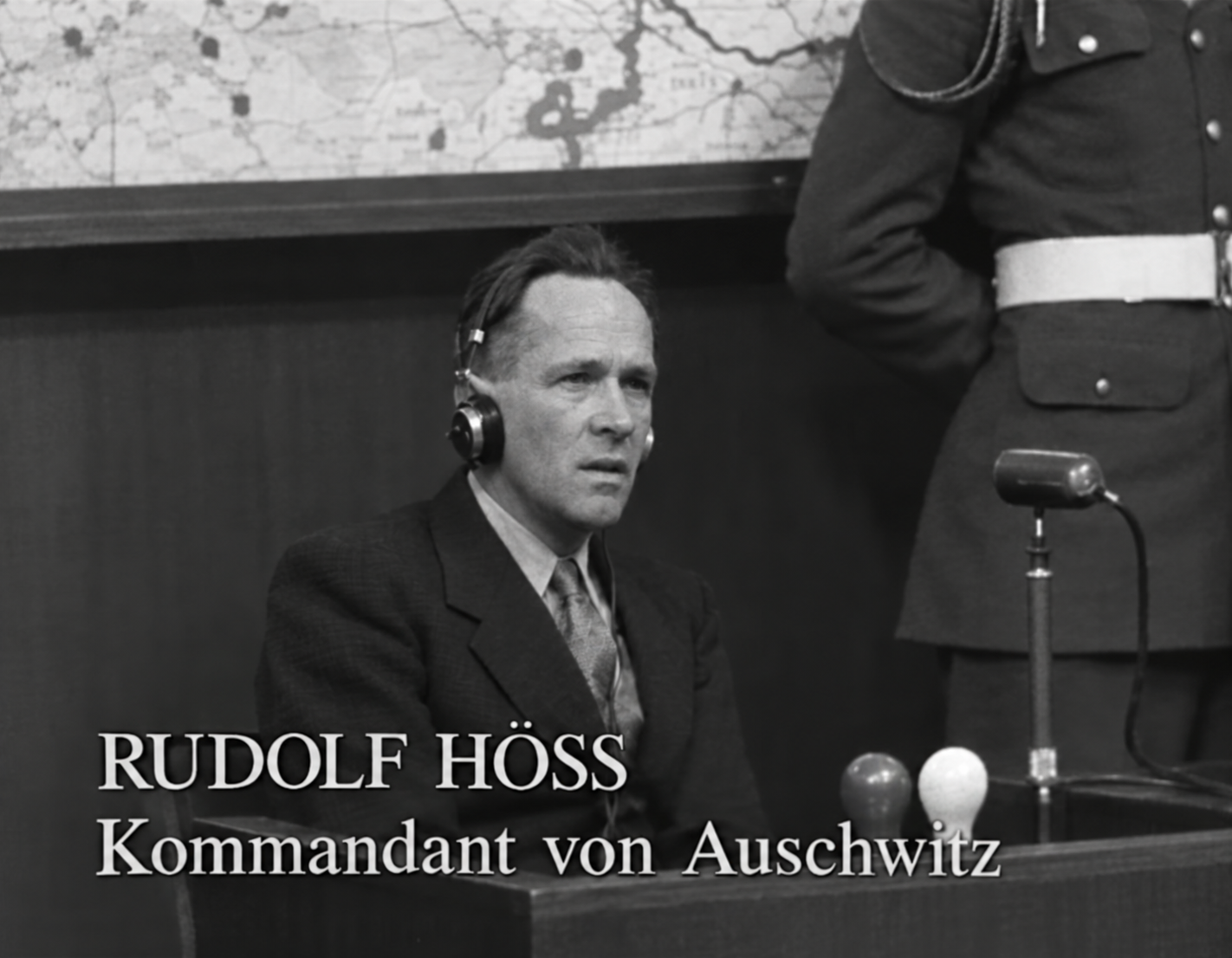
Rudolf Höss, the commandant at Auschwitz death camp, was called to testify at Nuremberg on 15 April 1946 as a defence witness for Ernst Kaltenbrunner, the successor to Reinhard Heydrich as head of the Reich Security Main Office (RSHA), the key institution of Heinrich Himmler’s SS-police complex, which was the most individually powerful element of the Nazi regime after 1941.
Höss’s testimony contains many notable things. From the perspective of the present time, when Holocaust denial is on the rise again, it is important that Höss tells the court he saw for himself the construction of the Auschwitz-Birkenau “extermination camp” and the effect of gas on Jews put “in the chambers”. Höss also wrote an affidavit, which was read into evidence. It said, inter alia:
I commanded Auschwitz until 1 December 1943, and estimate that at least 2,500,000 victims were executed and exterminated there by gassing and burning … Mass executions by gassing commenced during the summer of 1941 and continued until fall 1944. I personally supervised executions at Auschwitz …
I was ordered to establish extermination facilities at Auschwitz in June 1941. … I visited Treblinka to find out how they carried out their exterminations. … [The commandant there] used monoxide gas, and I did not think that his methods were very efficient. So when I set up the extermination building at Auschwitz, I used Zyklon B … Another improvement we made over Treblinka was that we built our gas chamber to accommodate 2,000 people at one time whereas at Treblinka their ten gas chambers only accommodated 200 people each. …
Children of tender years were invariably exterminated since by reason of their youth they were unable to work. … [T]he foul and nauseating stench from the continuous burning of bodies permeated the entire area and all of the people living in the surrounding communities knew that exterminations were going on at Auschwitz.
Asked, “Is that all true and correct, Witness?”, Höss said: “Yes.”
Höss gives testimony of his personal knowledge of the medical experiments conducted at his camp on Jewish inmates by SS doctors Carl Clauberg, Horst Schumann, and Josef Mengele, as well as knowing about what Dr. Sigmund Rascher did at Dachau.
Perhaps most importantly from a historical perspective, Höss describes the role of various actors in the Nazi hierarchy in giving and conveying orders. Höss mentions in particular two men he dealt with frequently: Adolf Eichmann, the primary logistical coordinator of the Holocaust at the RSHA and a regular visitor to Auschwitz, and Heinrich Müller, the Gestapo Chief. Crucially, Höss says of Himmler and Adolf Hitler:
This is relevant to the historiographical debate over when and how the Holocaust Order was issued.
In the summer of 1941, I was summoned to Berlin to [meet with] Reichsführer SS Himmler to receive personal orders. He told me something to the effect—I do not remember the exact words—that the Führer had given the order for a Final Solution of the Jewish Question. We, the SS, must carry out that order. If it is not carried out now then the Jews will later on destroy the German people. He had chosen Auschwitz on account of its easy access by rail and also because the extensive site offered space for measures ensuring isolation.
The exact date of Höss’s meeting with Himmler, where he was told that Hitler had issued the order for the Final Solution, has never been conclusively pinned down, but Richard David Breitman makes a very persuasive case in his 1991 book, The Architect of Genocide: Himmler and the Final Solution (pp. 189, 294), that it was between 13 and 15 July 1941.
“Himmler was not in Berlin very often during the summer of 1941”, Breitman notes, making the process of elimination relatively straightforward: “It is most unlikely that Himmler set the Final Solution in motion before 22 June”, the day the Germans invaded the Soviet Union, and dates after September are too late. “Himmler left the capital for East Prussia on 25 June and did not return until 13 July”, Breitman writes. “On 15 July he went back to East Prussia.”
It is possible Himmler returned to “Berlin for one brief visit during August [1941]”, Breitman goes on. Himmler’s personal administrative officer, Rudolf Brandt, was in Berlin from 3-4 August: Himmler might have been with him, but there is no positive evidence he was.
There are an additional “several days late that month”—the 21st, 22nd, and 24th—where “Himmler did not appear for his customary sessions with Brandt at his field headquarters”, the Feldkommandostelle Hochwald (or Schwarzschanze) in former Poland. But, as Breitman documents, there is no evidence suggesting Himmler had changed his location on those days; it seems more likely he was ill.

