By Kyle Orton (@KyleWOrton) on 30 October 2026
A United Nations report published in 2012 under the authority of the U.N. Secretary-General explains the role the U.N. played in ordering and organising the evacuation of civilians from Srebrenica after the town was captured by the Bosnian Serb Army of the Republika Srpska (VRS) around 14:00 on 11 July 1995.
The U.N. report documents that in the evening of 11 July 1995, French General Bernard Janvier, the overall commander of the U.N. peacekeeping forces (UNPROFOR) in the whole of former Jugoslavija, received a delegation at his headquarters in Zagreb from the Government of the Netherlands, specifically senior officials representing the Dutch Defence Minister Joris Voorhoeve: the Dutch Chief of the Defence Staff, Henk van den Breemen and Deputy Commander of the Royal Netherlands Army Ad van Baal. The purpose was to plan the U.N. response to the VRS overrunning Srebrenica. “The persons who took part in that meeting agreed that both DutchBat and the refugees needed to be evacuated, whereby first of all the UNHCR [U.N. High Commission for refugees] would be responsible for the evacuation of the refugees”, the report notes.
“DutchBat” refers to the UNPROFOR contingent in the Srebrenica “safe area”, whose members, including the commander, Colonel Thom Karremans, were mostly Dutch, hence the name. Karremans had independently received instructions from the Dutch government to get the civilians and his own troops out of Srebrenica. Karremans had also been in contact with General Cornelis “Kees” Nicolai, the chief of staff for the UNPROFOR mission in Bosnia. UNPROFOR’s command structure had Janvier at the top, with a theatre command in each of the Jugoslav republics. UNPROFOR in Bosnia was led by Rupert Smith (British), who was away at this time. Smith’s deputy, Hervé Gobilliard (French), was acting head of “BH Command” during the fall of Srebrenica.
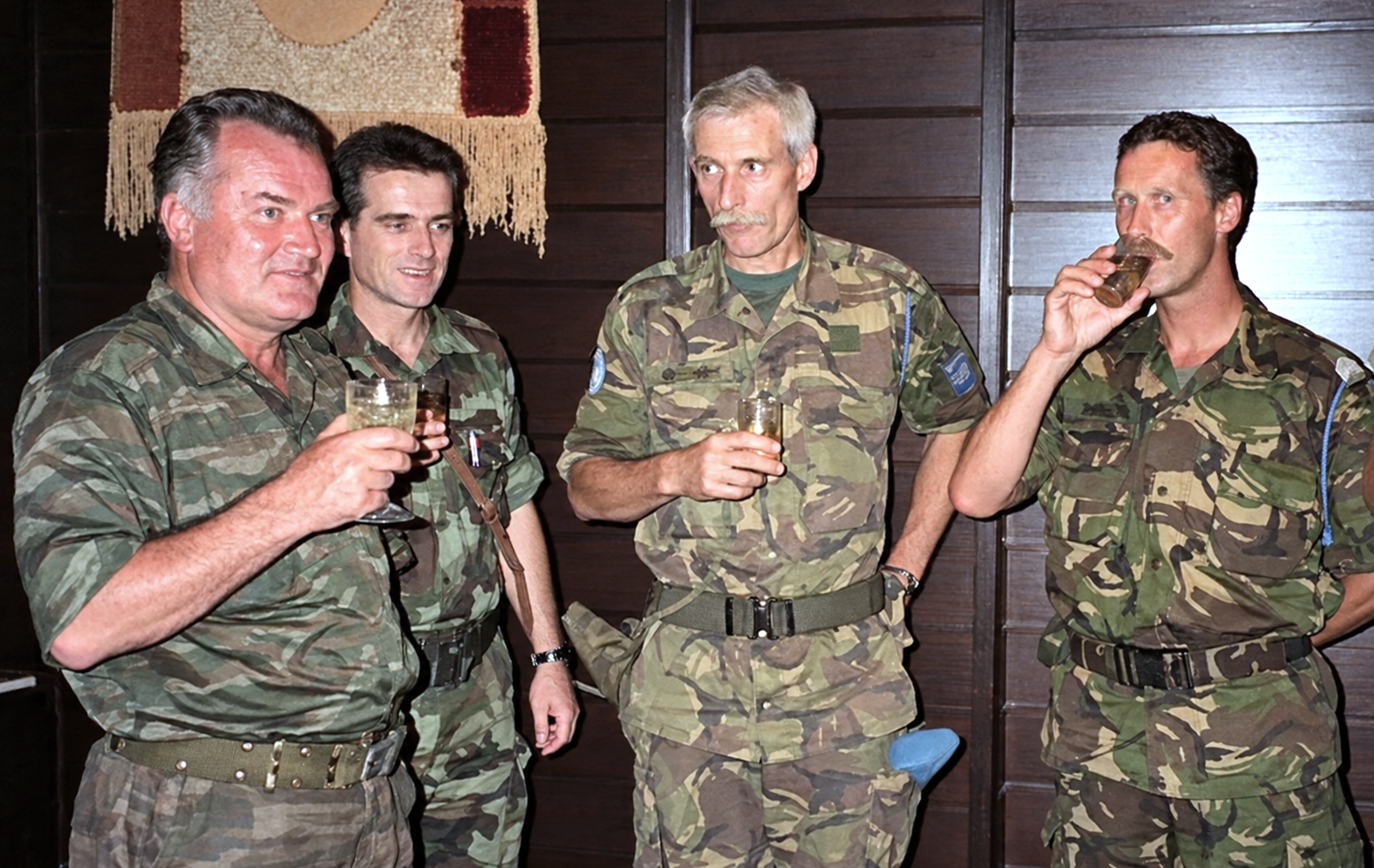
As the U.N. report notes, Colonel Karremans can be seen explaining these facts to General Ratko Mladić, the VRS supreme commander, in the video tape of their first meeting at Hotel Fontana around 20:00 on 11 July. Karremans says:
I had a talk with General Nicolai two hours ago, and also with the national authorities [i.e., Dutch government], about the request on behalf of the population. … I’ve been ordered by BH Command to take care of all the refugees … within the [U.N.] compound of Potočari. … [T]he request of the BH Command is to, let’s say, to negotiate or ask for the withdrawal of the Battalion [i.e., DutchBat] and withdrawal of those refugees and if there are possibilities to assist that withdrawal.
The U.N. report quotes Karremans reiterating to Mladić that he is speaking to relay what he has been “asked by General Nicolai and more by General Janvier … and also by the national authorities”.
This is all correct, according to the full official transcript of the meeting prepared by the International Criminal Tribunal for the former Yugoslavia (ICTY) using the recordings. And Karremans goes on to be even more direct: “I’ve been asked by General Nicolai to ask release for the civilian population. … I’ve been … asked by General Nicolai to say that while we leave here, I prefer to leave … with the population, those people who would like to leave the enclave.”
Karremans says he regards it as his primary task to “assist the population as much as possible [to] get out of the enclave”. And Karremans is insistent that leaving is the desire of the Muslims in Srebrenica. “A lot of people”, Karremans says, specifically referring to the women gathered at Potočari, some of whom speak English, have said to him: “We are waiting for the buses and can we leave the enclave?” The U.N. report bluntly says: “the refugees … wanted to leave”. Even the ICTY case that ruled Srebrenica was a genocide and rather strangely that the civilian evacuation was “ethnic cleansing”—formally, forcible transfer as a crime against humanity—acknowledged “the Srebrenica refugees in Potočari were clamouring to get out of the enclave”.
During this first meeting on 11 July, “Mladić said that the Muslim civilian population was not the target of his action, but actually that he wanted to offer them help”, the U.N. report notes. This is also an accurate rendering of the transcript, where Mladić is shown saying: “UNPROFOR forces are not the objective of my operations. … Neither is the Muslim population the objective of my operations. I want to help you. … I also want to help that civilian Muslim population because they are not responsible for what has happened.”
At the end of this first meeting, Mladić, per the transcript, asked Karremans to find a representative of the Muslim civilian population with whom he could “work out an arrangement” so they can “all leave” or “all stay” as they prefer. When Karremans and Mladić met at Hotel Fontana a second time, around 23:00 on 11 July, Karremans brought along Nesib Mandžić, a schoolteacher from Srebrenica, who was distinctly unimpressed to have been cast in the role of community representative. Nonetheless, Mandžić agreed to play the part and the logistics of evacuating the Muslim civilians from Srebrenica was discussed.
Mladić had asked Karremans to try to find representatives of the Muslim armed forces, the 28th Division of the Army of Bosnia and Hercegovina (ABiH), whose presence the “safe zone” and use of it to shield their offensive operations had been the proximate cause of the VRS takeover. Mladić wanted the 28th to negotiate their surrender, but the division commander, Naser Orić, had fled before Srebrenica fell, and most of the remainder of the force had staged a breakout from the enclave, leading a column towards Tuzla that was engaged in combat by the VRS. Still, from the transcript we know Mladić told Mandžić to let it be known among the Muslims that their fighters who laid down their arms would be “treat[ed] in accordance with international conventions and we guarantee that everybody will live, even those who committed crimes against our people”.
The Zagreb headquarters where General Janvier was stationed was run by Yasushi Akashi, the U.N. Secretary-General’s personal Special Representative for former Jugoslavija. Akashi was involved at every stage in the plans to evacuate the civilians and DutchBat from Srebrenica, and constantly liaised with the U.N. leadership in New York. Kofi Annan, then-Undersecretary-General for U.N. Peacekeeping Operations, cabled Akashi in the evening of 11 July, full of praise for his “excellent reporting” and the “calm leadership” he had provided to UNPROFOR. (Annan’s praise for the “competence and courage” of UNPROFOR seemed to be to soften the blow when he complained about their intelligence failure in not foreseeing the fall of Srebrenica.) Annan concluded the cable, speaking on behalf of U.N. institutionally under Secretary-General Boutros Boutros-Ghali, by saying Akashi and UNPROFOR had “our full support” in the decisions taken and the decisions to come.
In the “early morning” of 12 July, according to the U.N. report, Karremans spoke to Dutch Defence Minister Voorhoeve, who told Karremans: “save as much as possible”, meaning get as many of the Dutch troops and Muslim civilians out of Srebrenica as he could. When Karremans relayed this message to Mladić in their third meeting at Hotel Fontana shortly afterwards, around 10:00 on 12 July, Mladić was receptive, and instead of waiting to process a request through General Nicolai in Sarajevo for busses to carry out the evacuation, “Mladić said that he could arrange for vehicles himself”, the U.N. report states. Karremans subsequently asked that the U.N.’s locally-employed staff—he prepared a list of about twenty-nine people, according to the U.N. report—be allowed to leave with DutchBat, and “Mladić agreed to that”.
The evacuation of the civilians and DutchBat from Srebrenica began around 14:00 on 12 July 1995. Military-age Muslim men were prevented from leaving because the VRS said it wanted to screen them for war crimes. By the time the evacuation was complete in the evening of 13 July, Mladić had already left Srebrenica—indeed, had left Bosnia. Mladic went to Serbia that afternoon. Part of what Mladić was doing in Belgrade was meeting the Red Cross to arrange their access to the Srebrenica detainees and facilitate an “all for all” prisoner-of-war swap with Sarajevo. Except as everybody knows, this would never happen. In Mladić’s absence, the Muslim men detained at Potočari, and the POWs taken from the breakout column, were murdered in a series of massacres, beginning in the evening of 13 July and ending in the afternoon of 16 July, before Mladić returned to Bosnia the next day.
* * * * *
SOURCES:
United Nations (2012), ‘Chapter VIII: Decisions of National Tribunals’, in: United Nations Juridical Yearbook 2011, pp. 575-576. Available here.
Kofi Annan, ‘Situation in Srebrenica’, cable to Yasushi Akashi, 11 July 1995. Available here.
The full ICT transcript of the Hotel Fontana meetings is available here (esp. pp. 17-19, 22-23, 26, 41-42).
Prosecutor v. Radislav Krstić, Trial Judgment, ICTY, 2 August 2001, para. 146. Available here.

