By Kyle Orton (@KyleWOrton) on 7 April 2026
In the early phase of the Soviet Union instrumentalising the Armenian desire for the 1915-16 massacres in the Ottoman Empire to be recognised as genocide, in the 1950s and early 1960s, Moscow allowed histories to be written about 1915, mostly by Armenians. The villains in these books were the Young Turks and the Armenian Dashnak revolutionaries, since both were nationalists, and the former was supposedly supported by British “imperialists”. This was troublesome at a popular level in Soviet Armenia.
This was merely one indication of the tensions inherent to using the Armenian national tragedy for Communist active measures. The whole point was to raise the salience of 1915 in Armenian memory, identity, and political organisation had to be raised: that was how Turkey would be pressured and Ankara’s relations with other NATO States strained. But in creating the space for this, the Soviets were running the risk the Armenians would develop ideas of their own.
The Armenian Communist Party took on an interesting role as a quasi-democratic representative in this period, mediating for Armenians with the Central Committee. A demand upon which the Armenians increasingly focused was for the construction of a genocide memorial, a proposal first made in a July 1963 open letter by John Kirakosyan, who would combine his roles as professional historian and Party propagandist to write one of the early Soviet histories, The First World War and Western Armenians, 1914-1916 (1965).
The famous protest of tens of thousands in Yerevan on 24 April 1965—the fiftieth anniversary of the arrest of the Armenian leadership in Constantinople, which Armenian nationalists mark the beginning of the genocide—had its origins partly in Moscow’s foot-dragging about the memorial. The Yerevan protest was an unprecedented display of popular defiance in the Soviet Union, all the more alarming since the emphasis was not actually so much on 1915. The protesters’ main slogan was, “Return Our Land”, referred to the Karabakh as well as eastern Turkey. It the final analysis, however, the protest was not the signal of an irreparable rupture, but the trigger for the opposite.
Understanding how badly they had misjudged Armenian popular sentiment, the Soviets quickly and successfully course corrected. On the one hand, there was an overt crackdown. The Armenian Communist Party and the State apparatus it oversaw were thoroughly purged. While there were no criminal prosecutions, remarkably, the Armenian ruling elite was convicted of either being sympathisers with nationalist heresy or too incompetent to uphold political correctness, and they had to go.
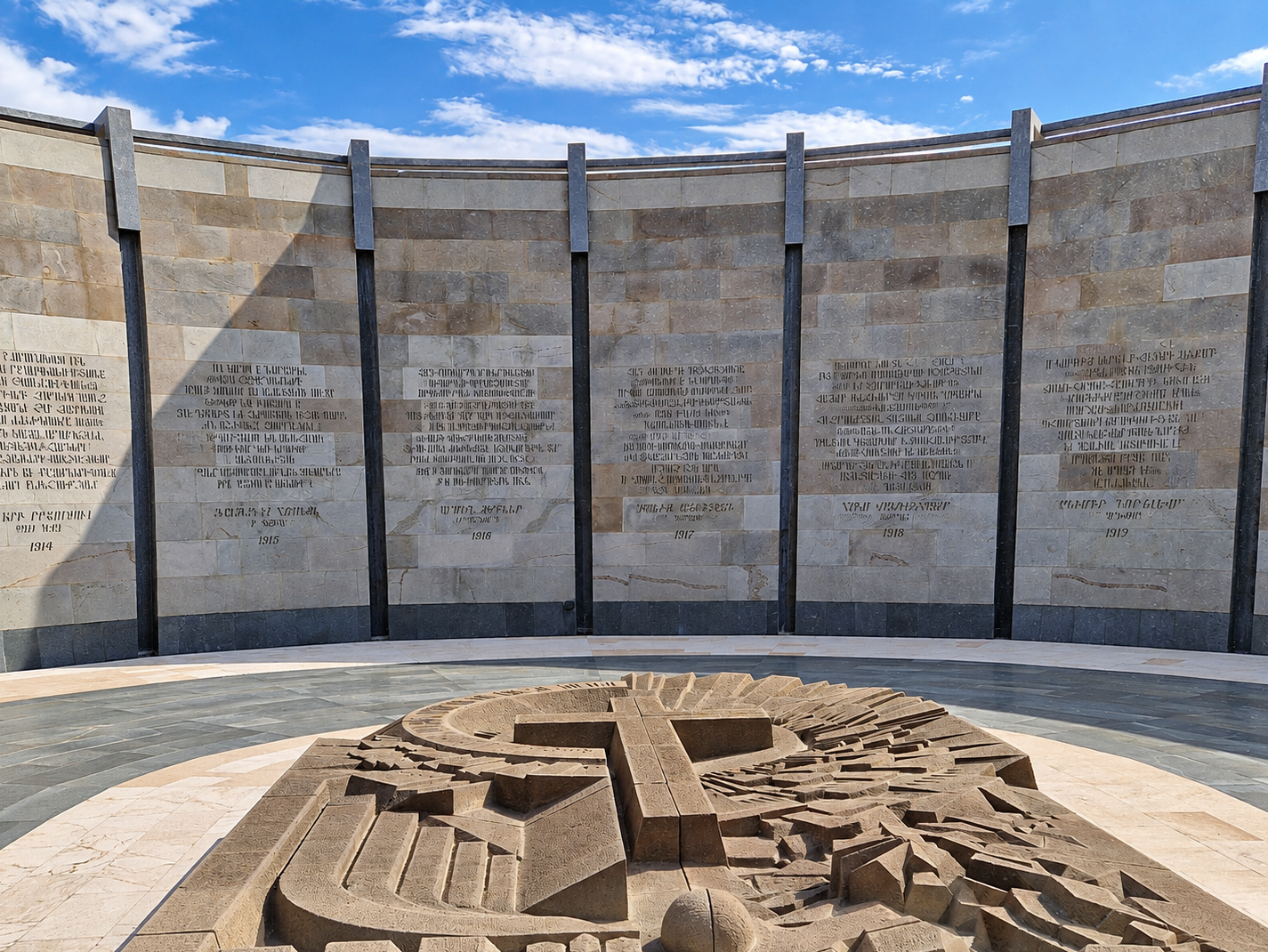
On the other hand, there were ostensible concessions that cleverly served as mechanisms to channel Armenian sentiment to Soviet ends. The Soviets muffled the ideological warfare against the Dashnaks, who soon moved into alliance with Moscow, and the main Armenian demand, for a Armenian Genocide Memorial Complex, was granted. The Memorial opened in November 1967 and the annual commemorations permitted there from April 1968 reinforced a memory paradigm that rather cleverly squared the ideological circle between Soviet Communism and Armenian nationalism.
The idea was promoted anew that the Armenians had already achieved their objective of a national homeland—in the Soviet Union, which, of course, was premised on the dissolution of nations. Moreover, 1915 was integrated into the official Soviet doctrine of genocide as a product of anti-Soviet forces, notably imperialism and capitalism, which manifested in their final form in Nazi Germany. By this time, the false story of the Soviets alone taking a consistent anti-Nazi stance and defeating the Third Reich by sacrificing 27 million lives had become central to the regime’s legitimacy, and the logic was extended to label all enemies “fascists”.
As such, the Armenians were cast as victims of a living tradition of anti-Sovietism—with its ongoing “genocides” by the United States in Vietnam, the National Party government in South Africa (apartheid and genocide were routinely conflated), and Portugal in its African colonies—and the Armenian nation was portrayed as having been rescued from genocide by incorporation into the Soviet Union, showing the path to salvation for all of humanity. This framework was reflected in the language of the Tsitsernakaberd Memorial being shorn of all nationalist particularism, just as none of the Second World War monuments to the Soviet dead mentioned Jews.
SOURCE: Anton Weiss-Wendt (2018), A Rhetorical Crime: Genocide in the Geopolitical Discourse of the Cold War, pp. 121-124.

