By Kyle Orton (@KyleWOrton) on 3 May 2025
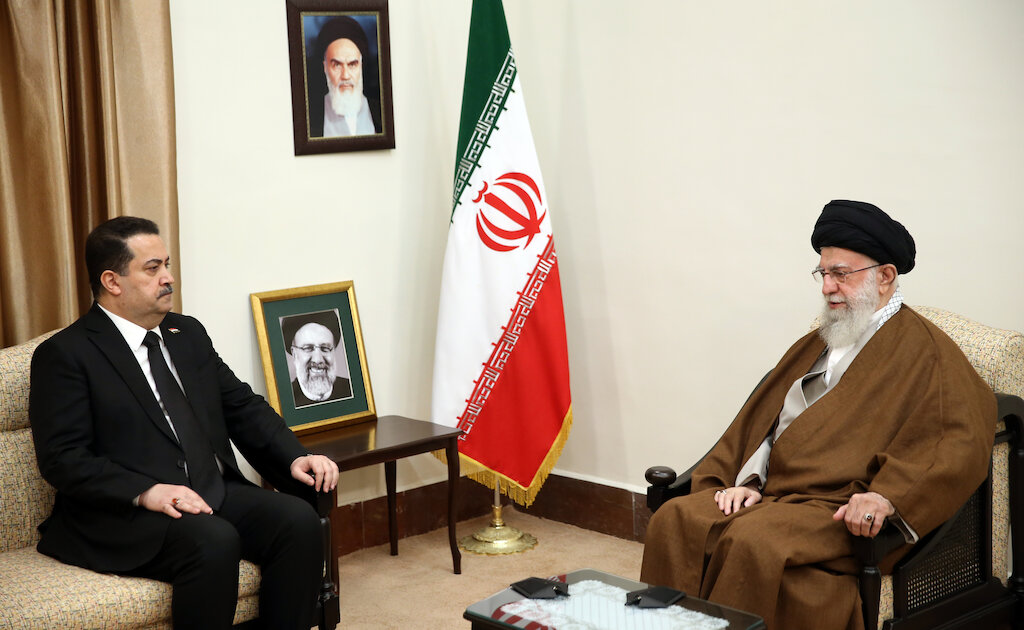
Muhammad al-Sudani has been Iraq’s Prime Minister since October 2022. He was installed at Iran’s behest after a year-long political logjam following the 2021 Iraqi elections. The political fronts for Iran’s terrorist-militias lost those elections, but Tehran picked the Prime Minister anyway.
Al-Sudani’s political rise was engineered by one of these Islamic Revolutionary Guards Corps (IRGC) militias, Asaib Ahl al-Haq (AAH), which is headed publicly by Qais al-Khazali. Iran’s Shia militias, which killed over 600 American soldiers in Iraq from 2003 to 2011, were combined into al-Hashd al-Shabi in 2014, formalised as a parallel State entity (exactly like the IRGC) in 2016, and have been represented in the Iraqi parliament as the Fatah Alliance since 2018.
AAH was notorious even by the murderous standards of the IRGC Network in Iraq because it was the front the IRGC used for possibly the most sophisticated terrorist operation of the Iraq war, the January 2007 raid on the Coalition Joint Security Station (JSS) inside the police headquarters in Karbala. Triggered by the U.S. very belatedly trying to curb the IRGC’s activities in Iraq the previous month, AAH/IRGC infiltrated the JSS, killed one American soldier during the raid, and abducted four more soldiers, who were found soon afterwards handcuffed and murdered. Qais and his brother, Laith al-Khazali, were arrested and imprisoned in March 2007. However, AAH took five British hostages in May 2007, and after it had murdered all-but one of them, cut a deal to free the sole survivor, computer consultant Peter Moore. In exchange, Laith was let out of prison in June 2009 and Qais that December.
The Iranian support system for AAH was run by Hamid al-Utabi (Abu Mustafa al-Sheibani), an Iraqi-born IRGC operative since the 1980s when he joined the Badr Corps, the first of Iran’s “Iraqi” militias, formed out of defectors during the war with Saddam Husayn. It is from Badr that most of the other militias were spun off after 2003, though AAH itself emerges from Muqtada al-Sadr’s Jaysh al-Mahdi. This is standard operating procedure for Iran when it exports the Islamic Revolution, the model first applied in Lebanon, to create a mirage of clones from existing institutions, which are often lazily described as “splits”, but the process is much more like cell replication—some division of roles, contributing to the overall growth of an organically integrated whole.
A case in point: In April 2013, Al-Utabi became the founding leader of another IRGC militia, Kataib Sayyid al-Shuhada (KSS), before formally handing over the leadership so he could take up a role at the Iraqi Interior Ministry. Again, what can be seen in Al-Utabi’s history is the reality of Iran’s Shi’a militias: a single fluid network, sharing the same resources and ideology and leadership, which reaches right into the heart of the Iraqi State.
The architect of the Karbala operation was Abdul Reza Shahla’i, a senior Quds Force official directing the IRGC militia network in Iraq during the American regency, responsible for the deaths of many Coalition soldiers and thousands of Iraqi civilians. Shahla’i was later implicated in the murky plot to blow up the Saudi ambassador in Washington, D.C., in 2011, and now oversees the IRGC unit in Yemen, Ansar Allah or “the Houthis”. An unsuccessful attempt was made by the U.S. to kill Shahla’i on 3 January 2020, the same night Qassem Sulaymani and his Iraqi deputy, Jamal al-Ibrahimi (Abu Mahdi al-Muhandis), were done away with.
This is the company Al-Sudani has been keeping, and it is hardly surprising. Al-Sudani’s family were deeply involved the Islamic Da’wa Party, founded in Iraq but always transnational in nature and under the control of Ayatollah Ruhollah Khomeini—an exile in Iraq from 1965—long before the 1979 Revolution in Iran. AAH was (finally) added to the State Department’s list of Foreign Terrorist Organisations on the day Sulaymani was killed, and Qais and Laith were named as Specially Designated Global Terrorists (SDGT). Al-Sudani made himself the figurehead for AAH’s bid for power after these designations.
 Kyle Orton's Blog
Here in the United States, it’s likely that very few remember the term Shi’a Crescent, and fewer will understand what it still means. Today’s (“MAGA”) Republicans certainly don’t, and the McGovern Democrats never wanted to.
LikeLiked by 1 person