By Kyle Orton (@KyleWOrton) on 1 June 2025
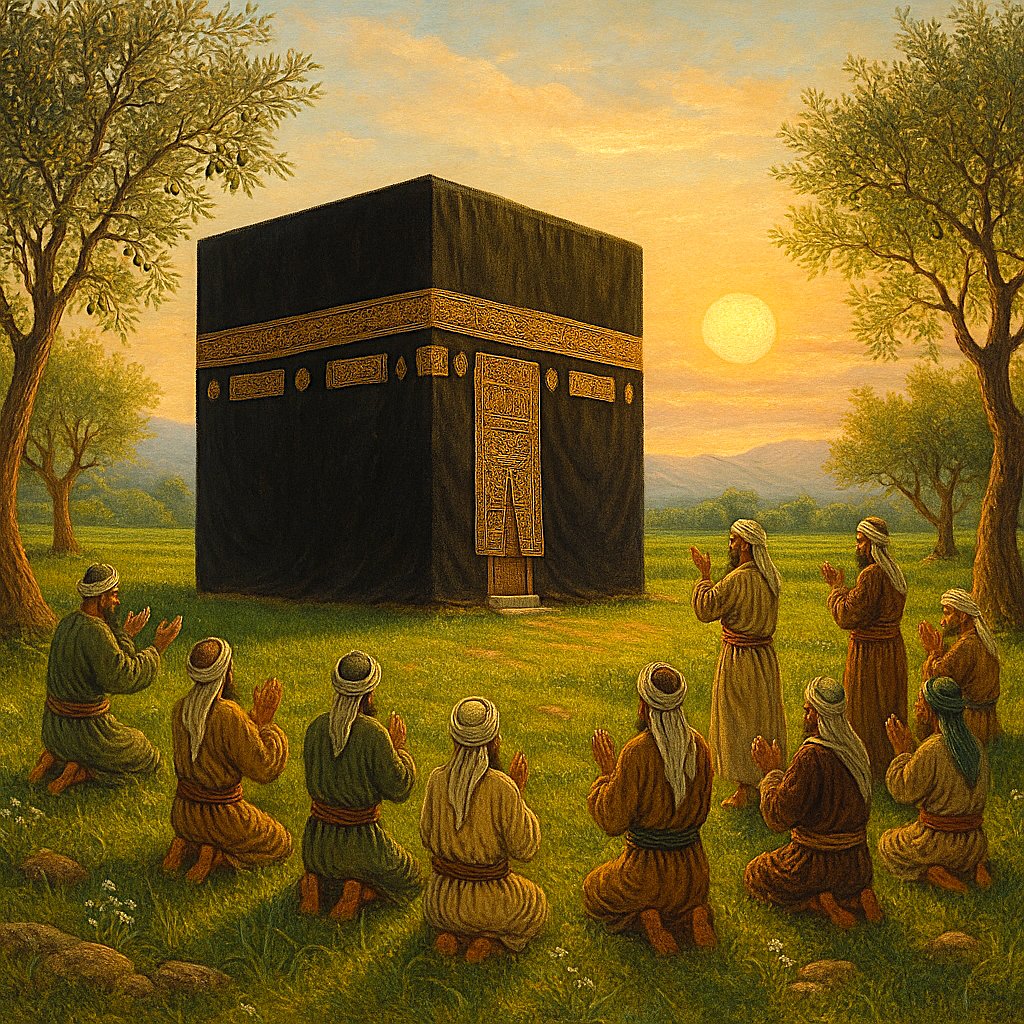
Below is a reproduction of an academic book chapter by G.R. Hawting, “The Origins of the Sanctuary at Mecca”, in G.H.A. Juynboll [ed.] (1982), Studies on the First Century of Islamic Society, pp. 23-47.
__________________________
This paper is concerned with the question of how the pre-Islamic sanctuary at Mecca became the Muslim sanctuary.[1] I intend to put forward some of the evidence which has led me to think that the way in which the question is usually answered, both in the traditional Muslim literature and in works of modern scholarship, produces an inadequate account of the origins and development of the Muslim sanctuary, and I wish to propose the outlines of an alternative way of envisaging the islamization of the Meccan sanctuary.[2]
The traditional view emphasizes continuity of development and places the adoption of the Meccan sanctuary by Islam in the context of the career of the Prophet Muḥammad in the Ḥijāz. It seems that Muḥammad adopted the Meccan sanctuary, after an initial attraction towards Jerusalem, because it was the religious centre of the society in which he had grown up. The process of islamization is not seen to involve any radical changes in the organization of the sanctuary, nor in the ceremonies associated with it. The one important concomitant of Muḥammad’s takeover of the Meccan sanctuary, the destruction of its idols, is seen as a reimposition of the monotheism for which it had been founded by Abraham, a purification of the sanctuary from the abuses which had been introduced in the Jāhiliyya. Generally, the features of the Muslim sanctuary at Mecca and the ceremonies which are performed there are explained as a continuation of those which had existed in pagan times but which had originated in the time of Abraham.[3] In spite of some extensive modifications to this traditional account proposed by modern scholars, what seem to be its essential features have not been disputed. Scholars such as Wellhausen and Lammens have suggested that the islamization of the Meccan sanctuary involved changes in its organization and rituals which were rather more significant than one would gather from the traditional Muslim literature,[4] and Western scholars in general, of course, have been unable to accept that the islamization of the sanctuary was merely the restoration of its original monotheism. Nevertheless, the Muslim sanctuary at Mecca continues to be seen as basically a continuation of the sanctuary of pagan times in the same place, and the islamization of that sanctuary continues to be associated with the prophetic career of Muḥammad.
Now, in so far as the theme of this colloquium is concerned, this stress on continuity of development in the Muslim sanctuary implies, conversely, that the Muslim sanctuary is an element of discontinuity for the Middle East as a whole in the transition from Late Antiquity to the Islamic period. According to the generally accepted account just summarized, the Muslim sanctuary at Mecca is to be seen as a legacy of the origins of Islam in the pre-Islamic Ḥijāz, not connected with the pre-Islamic history of the wider Middle East outside Arabia. In this respect Islam is to be seen as something brought out of Arabia by the Arab conquests and accepted by the conquered peoples at the hands of their new rulers. The traditional account of the origins of the Muslim sanctuary, then, supports the view that the coming of Islam marks an almost complete break in the history of the Middle East.
The evidence which I wish to concentrate upon in this paper, and which I think is difficult to reconcile with the generally accepted version of the islamization of the Meccan sanctuary, is provided by the use in the Muslim literature of certain terms or names which are connected with the sanctuary at Mecca. There are certain names and terms which, with reference to the Muslim sanctuary at Mecca, have fixed and precise meanings but which sometimes occur in the traditions, in the Qur’ān and in the poetry in a way which conflicts with their usual meanings, or at least suggests that they are being used with a different sense. It seems likely that these cases date from a time before the Muslim sanctuary became established at Mecca in its classical form, the form in which we know it, since I can see no way in which the sort of material which I will discuss could have originated once the Muslim sanctuary had taken its final shape. These names or terms, it must be emphasized, are now applied to some of the most important features of the Muslim sanctuary at Mecca, but the evidence seems to show that they originated independently of that sanctuary and only later came to be used to designate features of it. Furthermore, in some cases it is possible to indicate the likely source of the name or term in question or to suggest its probable original associations, and when we can do this it is to Judaism that we have to look. It appears that certain Muslim sanctuary ideas and certain names which Islam applies to its sanctuary at Mecca originated in a Jewish milieu, in the context of Jewish sanctuary ideas, and that they were then taken up by Islam and applied to the Meccan sanctuary.
This evidence, as already said, is very difficult to reconcile with the usual version of how the Meccan sanctuary was adopted by Islam. When scholars have recognized that certain features of Islam parallel those of Judaism or are to be explained as having their origins in Judaism, they have generally had recourse to two distinct theories in order to explain the phenomenon. The usual explanation is that the Prophet or the Muslims “borrowed” beliefs, rituals or institutions from Judaism and elsewhere as Islam came into contact with other religions. Such “borrowing” would have been possible, according to the traditional accounts of the origins of Islam, either in Medina in the time of the Prophet where there existed a significant Jewish community, or after the conquests outside Arabia when the Muslims came into contact with the Jews and others in ‘Irāq and elsewhere. The other theory which has been used is that parallels between Judaism and Islam are to be explained by the fact that both are descendants of one hypothetical “Semitic Religion”, the religion of the Semitic people before it became dispersed into the various groups which are known in historical times. In other words, there is a mentality or stock of religious ideas which is common to the various Semitic peoples and which explains why so many Muslim ideas and institutions seem to be related to those of the Old Testament and of Judaism.
Regarding the sanctuary at Mecca, both theories have been used by scholars to explain obvious points of contact between it and sanctuary ideas found in the Old Testament, in Judaism and sometimes in other “Semitic” religions like Syriac Christianity.[5] But it seems that neither theory can be used to explain the sort of material to be discussed here. On the one hand, the sort of contacts between Muslim and Jewish sanctuary ideas with which we are concerned are more than simply parallels of a general kind. They indicate a close historical contact between the two religious traditions, the Muslim sanctuary ideas growing directly out of those of Judaism, and thus the theory of an underlying “Semitic Religion” cannot provide an adequate explanation of them. On the other hand, the traditional version of the origins of Islam does not really allow for the “borrowing” of ideas from Judaism in the period before the Meccan sanctuary became the Muslim sanctuary, which is what must have happened in the cases to be discussed in this paper. According to the traditional accounts, Muḥammad made the Meccan sanctuary the Muslim sanctuary early in the Medinan period of his career, and there is nothing in the traditional accounts which would explain how he could have “borrowed” ideas from Judaism in the period before the Hijra. In the case of the material to be discussed here, therefore, if one wanted to maintain the theory of “borrowing” in the way in which it is usually used, one would have to postulate some way in which Muḥammad could have become conversant with and adopted Jewish sanctuary ideas while still at Mecca, for which there is no supporting evidence in the sources.
Only one scholar has attempted to argue in detail that this happened: the Dutch scholar R. Dozy in his work Die Israeliten zu Mekka (1864). Impressed by the points of contact and parallels between the Muslim sanctuary at Mecca and its rituals and the sanctuary ideas of the Old Testament and Judaism, Dozy thought that the Muslim sanctuary had to be seen as a development of those ideas. But at the same time Dozy accepted the traditional Muslim version of the origins of Islam in the Ḥijāz at the beginning of the seventh century A.D. In order to reconcile his conviction with the traditional information, therefore, Dozy put forward his hypothesis that there had been a number of migrations of Jews to Mecca, beginning even before Jerusalem had become established as the Israelite sanctuary, and that the sanctuary of Mecca had been founded originally by these Jewish immigrants to Mecca. In the course of time many of the original practices and beliefs had become deformed and it was in this form that they were taken over by Muḥammad as he grew up in Mecca. In particular, Dozy argued that the tradition that the Meccan sanctuary had been founded by Abraham was current in Mecca in the lifetime of Muḥammad and had been accepted by him even before his Hijra.
C. Snouck Hurgronje’s Het Mekkaansche Feest (1880) was intended largely as a refutation of Dozy’s work and was so successful that since its publication scholars have generally rejected Dozy’s ideas or have ignored them. Snouck Hurgronje’s argument, which has become one of the most widely accepted ideas of modern scholarship on the beginnings of Islam, was that the adoption of the Meccan sanctuary by Muḥammad has to be seen as a reaction to the rejection of him by the Jews of Medina. Only in the face of this rejection, according to Snouck Hurgronje, did Muḥammad move towards the arabization of his religion, a move in which the adoption of the Meccan sanctuary was an important step. And only at this time did Muḥammad begin to formulate the doctrine that the Meccan sanctuary had been founded by Abraham, an idea which grew out of his contact with the Jews of Medina.[6] This thesis, therefore, rules out direct borrowing from Judaism in the period before the Hijra and restricts the influence of Judaism on Islam to a period after the adoption of the Meccan sanctuary by Islam. In cases where it is not possible to use this explanation, it seems one has to fall back on the theory of the underlying common “Semitic Religion”. Accepting the traditional version of the islamization of the Meccan sanctuary as it is expressed in the thesis of Snouck Hurgronje, therefore, scholars who have discussed the parallels and points of contact between the Muslim sanctuary and Jewish and Old Testament sanctuary ideas have used now one, now the other explanation, according to the material under discussion.
If, then, neither of the theories offers an adequate explanation of the sort of material to be discussed here, how can we explain it without introducing a hypothesis that would seem as improbable as that put forward by Dozy? It seems that it is possible to propose an alternative scheme for the islamization of the Meccan sanctuary which would allow for Muslim “borrowing” of Jewish sanctuary ideas before the Meccan sanctuary became established as the Muslim sanctuary, a scheme which has been suggested in part by the evidence to be discussed in this paper. There is other evidence too which seems to support the scheme I wish to propose, but it is not possible to discuss it all here. The scheme can, of course, only be envisaged in its broad outlines, and precise details, in particular the question of chronology, remain unclear, but it does seem that the general scheme which will now be outlined makes sense of and is in accordance with the evidence to be discussed.
It seems that the Muslim sanctuary at Mecca is the result of a sort of compromise between a preexisting pagan sanctuary and sanctuary ideas which had developed first in a Jewish milieu. I envisage that Muslim sanctuary ideas originated first in a Jewish matrix, as did Islam itself. At a certain stage in the development of the new religion the need arose to assert its independence, and one of the most obvious ways in which this could be done was by establishing a specifically Muslim sanctuary. The choice of sanctuary would have been governed by already existing sanctuary ideas and when a suitable sanctuary was fixed upon these sanctuary ideas would themselves have been modified to take account of the facts of the sanctuary which had been chosen. It seems likely that the Meccan sanctuary was chosen only after the elimination of other possibilities—that in the early Islamic period a number of possible sanctuary sites gained adherents until finally Mecca became established as the Muslim sanctuary. And it also seems likely that one reason for the adoption of the Meccan sanctuary was that it did approximate to the sanctuary ideas which had already been formed—although they had to be reformulated, the physical facts of the Meccan sanctuary did not mean that already existing notions and terminology had to be abandoned. The precise details of this process, as I have said, are still unclear, especially with regards to chronology. It does seem likely, however, that it took longer than is allowed for by Muslim tradition and that it was only concluded at a relatively late date in the Islamic period, not at its beginning as has been generally accepted. If this theory, which can be supported by evidence other than that which is to be discussed here, is accepted, then the Muslim sanctuary at Mecca should no longer be regarded as simply a remnant of Arab paganism. In part at least, it is a continuation of ideas which had developed in non-Arab circles before the conquests.
One of the most striking characteristics of the traditional Muslim material on the sanctuary is the surprising degree of change and movement within the Meccan sanctuary which it allows for. I have already indicated that the traditional version of the islamization of the Meccan sanctuary suggests an essential continuity between the sanctuary of the Jāhiliyya and that of Islam, but, in spite of this, one would gather from the Muslim traditions that the sanctuary or features of it were continually subject to rebuilding and changes of position. The Ka’ba itself is frequently said to have been demolished and rebuilt.[7] The Black Stone is on a number of occasions removed from the Ka’ba and then restored to its place.[8] The stone called Maqām Ibrāhīm is moved around by floods and by human actions.[9] The well of Zamzam is “discovered” on two separate occasions.[10] Al-Masjid al-Ḥarām, explained as the mosque containing the Ka’ba at Mecca, is several times rebuilt and enlarged.[11] It is true that in the way in which they are presented these details do not conflict with the essential continuity between the Jāhiliyya and Muslim sanctuaries: the reports about changes in the organization or form of the sanctuary, or aspects of it, refer to specific occasions in the Jāhiliyya and early Islam and to features of the Meccan sanctuary as it is known in its Muslim form, so that they do not necessarily indicate that the traditional version has to be revised in the way I am suggesting. Nevertheless, the preservation of so much detail, much of which is self-contradictory, does seem to be noteworthy and possibly to indicate that even Muslim tradition recognized that the history of the sanctuary and its incorporation by Islam could not be presented as a simple, straightforward development.
Furthermore, the traditional material on the history of the sanctuary is hardly of a sort to inspire confidence in it as a record of historical events. Sometimes we find the same basic material being made to refer to two allegedly separate events: compare, for example, the accounts of the demolition and rebuilding of the Ka’ba by Ibn al-Zubayr with those of its earlier demolition and rebuilding by al-Walīd b. Mughīra,[12] or the traditions about the fire which is said to have damaged the Ka’ba in the Jāhiliyya with those about the fire which destroyed the Abyssinian church of al-Qullīs at Ṣan’ā’.[13] Elsewhere we find a sort of overlapping of material—two allegedly distinct features of the sanctuary having the same or related traditions attached to them. The overlapping of the material on the Black Stone and the Maqām Ibrāhīm will be discussed later, and a similar phenomenon occurs in the material on the well of Zamzam and the hollow (bi’r or jubb) which is said to have existed inside the Ka’ba.[14]
Even if we could discount the information which is obviously legendary or unhistorical in character, then, the contradictions, overlapping and duplications which occur in the traditions about the history of the Meccan sanctuary would make it a hazardous, in my view, impossible, undertaking to write a straightforward narrative history of the sanctuary and its islamization. If there is a historical basis to the traditions, it seems likely that it is to be sought in their general presentation rather than in the specific details which they present. On this level the details about change and movement within the sanctuary seem to be suggestive. They seem to prepare the way for a hypothesis which envisages even more radical developments in the process which led to the adoption of the Meccan sanctuary by Islam. If we now look more closely at the use of a number of important names or terms in the traditions, it appears that on some occasions it is only with difficulty that they can be understood in the sense in which they are now used with reference to the Muslim sanctuary at Mecca. It seems that they have been redefined at some stage so that they have come to be used in a sense which is not their original one.
a. Maqām Ibrāhīm. In the Muslim sanctuary at Mecca the name Maqām Ibrāhīm is given to a stone which is situated a little distance from the north-east wall of the Ka’ba. The stone has a place in the pilgrimage rituals, two rak’as being made there at the end of the ṭawāf. Muslim tradition preserves a number of different explanations for the sanctity of the stone and the reason for the application to it of the name Maqām Ibrāhīm. The traditional material on the stone has been summarized most fully in a recent article by Professor Kister.[15] With the Maqām Ibrāhīm, as with most other aspects of the sanctuary and its rituals, the main concern of modern scholarship has been to explain its significance for the religion of the Jāhiliyya, to detach it from the Muslim traditions which associate it with Abraham and to explain it as a relic of paganism. Wellhausen suggested that it was a pagan sacrificial stone, a suggestion which Gaudefroy-Demombynes supported by reference to the indentation or hollow which it contains; Lammens preferred to see it as a bethel.[16] The most obvious reference which seems at odds with the idea that the Maqām Ibrāhīm is the sacred stone bearing that name at the Muslim Sanctuary is the Qur’ānic verse 2:125: “Take for yourselves a place of prayer from the Maqām Ibrāhīm” (“wa-ttakhidhū min Maqāmi Ibrāhīma muṣallā”). In connection with this verse the exegetes give a number of different explanations of what is meant by Maqām Ibrāhīm. In addition to the view that the name here refers to the stone which is now so called, it is also said to indicate the whole of the ḥaram or various extended areas within the ḥaram.[17] The context seems to require explanations such as these since it is necessary to explain away the preposition min as a redundant particle if it is desired to see the Qur’ānic reference as to the stone which is now called Maqām Ibrāhīm.[18] On the whole, therefore, the verse seems inconsistent with the usually accepted signification of the name Maqām Ibrāhīm.
Furthermore, in some traditions and verses of poetry the name Maqām Ibrāhīm, or more frequently simply al-Maqām, occurs in contexts which suggest that we are dealing with something other than the stone which now bears the name. In one tradition there is reference to Quraysh sitting in the “groups” (scil. “in the Maqām”).[19] In a verse of Hudhayfa b. Ghānim included in Ibn Hishām’s Sīra, ‘Abd Manāf is said to have “laid bare (?) Zamzam by the Maqām” (“ṭawā Zamzam ‘inda al-Maqām”).[20] This latter reference is typical of several in that it seems to give the Maqām undue prominence if it is envisaged that the name refers to the sacred stone which is now called Maqām Ibrāhīm. On evidence of this sort, Lammens argued that al-Maqām was a synonym for al-Ka’ba,[21] and he also cited in support of this view a verse of ‘Umar b. Abī Rabī’a which refers to the pilgrims making the takbīr at the Maqām: “lā wa’lladhī ba’atha al-nabiyya Muḥammadan bi’l-nūri wa’l-Islām … wa-bimā ahalla bihi al-ḥujjāj wa’l-’ummār ‘inda al-Maqām wa-rukni bayti al-ḥarām …”[22] Although the verse does not support Lammens’s contention fully, it is easy to see how he formed the opinion that al-Maqām here means the Ka’ba: this is another example of the use of the word al-Maqām where, if we have the Muslim sanctuary at Mecca in mind, we might expect from the context some expression broadly synonymous with “the sanctuary,” such as al-Ka’ba or al-bayt. Possibly another example of the same sort would be Azraqī’s statement that the Prophet used the Maqām as a qibla while he was in Mecca (“fa-kāna yuṣallī ilā’l-Maqām mā kāna bi-Makka”).[23]
At this stage I am concerned only to indicate the difficulty in attaching the references to the Muslim sanctuary at Mecca as we know it. As yet it is not possible to say what the names al-Maqām and Maqām Ibrāhīm do refer to in the sort of examples cited above, but one thing that should be borne in mind, and which discussion so far has ignored, is the possibility that references to al-Maqām are not always to Maqām Ibrāhīm, whatever the latter indicates. Sometimes it seems that a gloss has been inserted into a text in order to make it clear that al-Maqām does mean Maqām Ibrāhīm, and it may be wondered why such glosses, which affect the continuity of the text, were considered necessary. For example, Azraqī reports that when al-Mahdī came to Mecca to make the ḥajj, ‘Ubayd Allāh b. ‘Uthmān came to him where he was staying in the Dār al-Nadwa bringing with him al-Maqām Maqām Ibrāhīm.[24] In the section dealing with Quraysh’s rebuilding of the Ka’ba, Azraqī has two versions of a tradition describing in almost identical terms the fear of Quraysh in face of the serpent which God had caused to dwell in the bayt. According to one version, Quraysh withdrew ‘inda al-Maqām, according to the other ‘inda Maqām Ibrāhīm.[25] The possibility is obvious that the latter is a standardizing gloss.
Leaving this question on one side, however, it seems clear that, whether the references are to al-Maqām or Maqām Ibrāhīm, there is frequently some difficulty in reconciling the references with the Meccan sanctuary as we know it, or some suggestion that they are not to the stone which now bears the name Maqām Ibrāhīm. Since it seems impossible that such references could have originated after the Muslim sanctuary had become established at Mecca in the form in which we know it, it seems to follow that they must date from an earlier period when the name Maqām Ibrāhīm meant something else. The name has then been reinterpreted and applied to the stone which is now so called.
Such material, I agree, is frequently somewhat ambiguous, and it is often not possible to say with certainty that al-Maqām or Maqām Ibrāhīm does not refer to the sacred stone of the Muslim sanctuary at Mecca. The attempt to reconcile the Qur’ānic reference with the facts of the Meccan sanctuary, however, seems obviously forced, and when the evidence is taken as a whole it does seem to indicate a development of the sort suggested. In general, it seems likely that the literary sources we have for early Islam represent the outcome of a long process of editorial amendment and revision made necessary by the gradual development of the new religion. If this is accepted, then it seems probable that the remnants of the earliest traditions which would survive would be those which have escaped the editorial process precisely because of their ambiguity: it was not impossible to reconcile them with later ideas and so it was not necessary to remove or alter them. The survival of references like those above which indicate that the Maqām Ibrāhīm was not originally a sacred stone at Mecca, I suggest, can often be attributed to their ambiguity. In the case of the Qur’ānic reference, where the contradiction between its conception of Maqām Ibrāhīm and that of later Islam is more clear, amendment of the text would not have been so easy for obvious reasons. In this case the necessary reconciliation was attempted in the tafsir literature rather than by alteration of the text itself.
b. Al-Ḥijr. A similar development, I think, has occurred in the case of this term. At the Muslim sanctuary at Mecca the name al-Ḥijr designates the semi-circular area adjacent to the north-west wall of the Ka’ba. The area is regarded as of special sanctity, and the pilgrims perform the ritual circumambulations (ṭawāf) around the whole of the area covered by the Ka’ba and al-Ḥijr, not just around the Ka’ba.[26] The special status of the Ḥijr is explained in Muslim tradition in a number of ways: at various times it is said to have been included in the Ka’ba, but ultimately its sanctity derives from its association with Hagar and Ishmael. Most frequently the Ḥijr is explained as the place where Ishmael and his mother are buried.[27] Modern scholarship has again concentrated on the question of the significance of the Ḥijr in the religion of the Jāhiliyya, rejecting the association with Ishmael and Hagar. Lammens argued that it was originally an independent pagan sanctuary which Islam subordinated to the Ka’ba, others have given it some place in the performance of sacrifices in or near the Ka’ba.[28]
Again, however, there are references to al-Ḥijr which suggest that it has changed in meaning. For example, there is mention of Quraysh meeting in al-Ḥijr in the Jāhiliyya and in the lifetime of the Prophet,[29] something which would hardly have been possible in the rather small area which now bears the name. This is reminiscent of the tradition about Quraysh in their “groups” in the Maqām, and just as the name al-Maqām sometimes occurred where we might expect a term indicating “the sanctuary,” so too al-Ḥijr is sometimes used apparently interchangeably with al-bayt or al-Ka’ba. Ibn al-Zubayr, having taken refuge from the Umayyad Caliph Yazīd I, it is said, in Mecca, is usually reported to have taken the title ‘ā’idh bi’l-bayt because he was claiming sanctuary at the Ka’ba.[30] In Ibn ‘Asākir’s version, however, Ibn al-Zubayr is described as “clinging to al-Ḥijr (lazima bi’l-Ḥijr),”[31] and the title ‘ā’idh bi’l-Ḥijr can be found in ḥadīth as a variant of ‘ā’idh bi’l-bayt.[32] ‘Ā’isha too is said to have taken refuge in al-Ḥijr when, after the murder of ‘Uthmān, ‘Alī was recognized as amīr al-mu’minīn: “nazalat ‘alā bāb al-masjid fa-qaṣadat li’l-Ḥijr fa-suttirat fīhi.”[33] Al-Ḥijr is also named in some traditions as the place where Muḥammad was sleeping when he was miraculously taken on his Night Journey,[34] and too as the place where his grandfather, ‘Abd al-Muṭṭalib, was sleeping when he experienced his dream in which the place of the hidden Zamzam well was revealed to him.[35] In these cases it would not be impossible to see al-Ḥijr as the area adjacent to the Ka’ba but the material suggests that we are dealing with a different concept. Lammens suggested, on the evidence of these traditions, that the religious practice of incubation was performed in the independent sanctuary called al-Ḥijr in the Jāhiliyya.[36]
There are some indications of a dispute about the status of al-Ḥijr. The inclusion of al-Ḥijr inside the bayt is the most striking feature of the sanctuary constructed by Ibn al-Zubayr and, similarly, the exclusion of al-Ḥijr appears to be the chief alteration made by al-Ḥajjāj when he destroyed and rebuilt the sanctuary after his defeat of Ibn al-Zubayr.[37] Ibn al-Zubayr’s decision is said to have been justified by reference to a ḥadīth transmitted by ‘Ā’isha, according to which Muḥammad said that, if it had not been for the fact that Quraysh (?ahluki) had only recently given up polytheism or unbelief (shirk or kufr), he would have demolished the Ka’ba and rebuilt it to include al-Ḥijr.[38] In a related tradition ‘Ā’isha is said to have been encouraged by the Prophet to pray in al-Ḥijr because it was a part of the sanctuary (al-Ḥijr min al-bayt).[39] Against this, however, Muḥibb al-Dīn al-Ṭabarī reports that ‘Umar b. al-Khaṭṭāb “invoked God against a woman who prayed in al-Ḥijr” (“a’zimū bi’llāh ‘alā ‘mra’atin ṣallat fī’l-Ḥijr”),[40] and in spite of Ṭabarī’s denial, this seems to be a clear reference to ‘Ā’isha. A tradition given by Azraqī, apparently citing non-Qur’ānic divine revelation, says that al-Ḥijr is a gate of Paradise,[41] but Maqdisī cites a prohibition of the use of al-Ḥijr as a qibla.[42]
From material of this sort, then, it seems that al-Ḥijr sometimes designates an entity rather different from that which is so called at the Muslim sanctuary at Mecca, and again it is difficult to see how such material could have originated after the term had become established in its application to the sanctuary at Mecca. The possible earlier associations of some of the material in which the name al-Ḥijr occurs will be discussed shortly.
c. Al-Ḥaṭīm. Unlike the two previous terms, there does not seem to be any generally accepted definition of what is meant by the name al-Ḥaṭīm at the Muslim sanctuary at Mecca. Apparently most frequently it is taken to refer to the semi-circular wall which marks the boundary of the area adjacent to the Ka’ba called al-Ḥijr, but the name is also explained as a synonym for al-Ḥijr, as referring to the wall of the Ka’ba beneath the water-spout (mizāb), and sometimes as designating that part of al-Ḥijr beneath the water-spout. Other, fuller definitions say that al-Ḥaṭīm is the area “between al-Rukn, al-Maqām, Zamzam and al-Ḥijr,” or “between the door and the corner (rukn, to be discussed shortly) in which is the stone.” There does not seem to be any satisfactory explanation of the meaning of the word, most attempts at an etymology connecting it with the root Ḥ-Ṭ-M with the sense “to break, to smash.”[43] Lammens, of course, suggested that al-Ḥaṭīm was a bethel, “un nouveau rokn, non encore catalogué.”[44]
Again we find that there are references to al-Ḥaṭīm in the traditions which suggest that none of these conflicting definitions is adequate.
Ibn al-’Abbās is reported to have attempted to forbid the mentioning of al-Ḥaṭīm “because in the Jāhiliyya men swore oaths and threw down their whips, shoes or bows (there).”[45] In particular the Khārijite Ibn Muljam is said to have taken aṭy by or near (‘inda) al-Ḥaṭīm his oath to kill ‘Alī.[46] One isolated tradition calls into question the conception of al-Ḥaṭīm as a place or area and explains it as the name of a destroyed idol.[47] It was this last tradition which was decisive in forming Lammens’s view that al-Ḥaṭīm was a pre-Islamic bethel which had been abolished by Islam.[48]
This lack of consensus regarding the meaning of the name distinguishes the case of al-Ḥaṭīm from those of Maqām Ibrāhīm and al-Ḥijr. The last two are well known as the names of features of the Muslim sanctuary at Mecca, but traces of what we have suggested are earlier, superseded meanings for them are occasionally to be found in the literary material. With al-Ḥaṭīm, however, the name really seems superfluous with regard to the Meccan sanctuary,[49] and I suggest that here we are dealing with a remnant of early Muslim sanctuary ideas which it has not proved possible to attach definitively to any feature of the sanctuary when it was islamized.
There must remain some doubt about the earlier meaning of al-Ḥaṭīm or its source, but the view that it was an idol or sacred stone of some sort is not convincing. The majority of the traditions seek to explain it as the name of an area and it is difficult to see why they should do so if it was an object of limited size. Presumably Lammens would have seen the various definitions of al-Ḥaṭīm which have been given above as called forth by embarrassment on the part of Muslims at the memory of this remnant of the pagan past of the Meccan sanctuary. This view, which underlies most of Lammens’s efforts to explain the inconsistencies which he had noted in the Muslim traditions, seems wrong. There is no reason why the Muslims should seek to hide the pagan past of the sanctuary, and indeed it is a prominent feature of the Muslim sanctuary traditions. The pagan deities and ceremonies are explained as aberrations which had been introduced in the period after Abraham had founded the sanctuary.[50] It seems that it is necessary, in order to provide a satisfactory explanation of the material which has been noted here, and much of which was adduced by Lammens, to go beyond the traditional version of how the Meccan sanctuary was incorporated into Islam, a version which Lammens’s explanations accept, and to envisage instead an attempt to apply sanctuary ideas to a sanctuary to which they did not originally refer.
d. Al-Masjid al-Ḥarām. In the Islamic period al-Masjid al-Ḥarām designates the mosque at Mecca with the Ka’ba at its centre. Since Muslim tradition attributes the origin of this mosque to the caliphate of ‘Umar, and since there are a number of references to al-Masjid al-Ḥarām in the Jāhiliyya and the lifetime of the Prophet, however, it is necessary for Muslim tradition to allow for the existence of al-Masjid al-Ḥarām before the existence of the building which now bears that name. In traditions referring to the earlier period, then, the name is taken to indicate the empty space around the Ka’ba even though this was not yet enclosed by a wall, covered with a roof, or dignified architecturally or decoratively. The walls of this pre-Islamic al-Masjid al-Ḥarām, it is said, were no more than the walls of the houses which enclosed the empty space, and its gates (abwāb), which are frequently named, were merely the main streets between the houses giving on to the empty space. In the early Islamic period, beginning with ‘Umar, the empty space is said to have been several times enlarged, enclosed with walls, and covered with a roof to form the mosque which now bears the name.[51]
It may seem that the data already require a surprising amount of accompanying explanation which is not entirely satisfying. In addition to this, however, it is possible to find in the Qur’ān and traditions a number of examples where the name al-Masjid al-Ḥarām occurs and does not seem to coincide with either of the definitions already given.
Sometimes it is necessary for Muslim tradition to see al-Masjid al-Haram as a synonym for the Ka’ba. This interpretation appears most often in connection with Qur’ān 2:139, 144 and 145, the qibla verses: “Turn your face towards al-Masjid al-Haram.” These verses are said to have been revealed when Jerusalem was superseded as the Muslim qibla, and since it is the Ka’ba, or even more specifically a particular part of the Ka’ba, which is the Muslim qibla, it is necessary to see al-Masjid al-Haram here as a reference to the Ka’ba rather than to the space around it.[52] The same interpretation sometimes occurs in commentaries on Qur’ān 3:96–7: “the first bayt established for the people was that at Bakka.” The bayt at Bakka is seen as a reference to the Ka’ba at Mecca and sometimes in this connection a ḥadīth is cited in which it is said that al-Masjid al-Haram was founded a certain amount of time before al-Masjid al-Aqṣā (understood here as the Jerusalem Temple).[53] Again, therefore, we have the equation of al-Masjid al-Haram with the Ka’ba.
Sometimes, however, we find a very different interpretation: al-Masjid al-Haram means the whole of the ḥaram, an area bigger than that of Mecca itself. This appears most frequently concerning Qur’ān 17:1, the isrā’ verse: “Praised be He who transported His servant by night from al-Masjid al-Haram to al-Masjid al-Aqṣā …” Several of the traditions about Muḥammad’s miraculous Night Journey, to which the Qur’ānic verse is seen as an allusion, contain information about its starting point which would conflict with the Qur’ān if al-Masjid al-Haram in 17:1 were seen as a reference to the empty space around the Ka’ba. Of these traditions, perhaps the most common is that which says that Muḥammad was sleeping in the house (dār) of Umm Hānī’ when Gabriel came to take him.[54] Whatever the house of Umm Hānī’ might be, it was clearly not possible to locate it in al-Masjid al-Haram if that is understood as a designation of the empty space around the Ka’ba (or of the Ka’ba itself). In commentaries on the isrā’ verse, therefore, it is frequently stated that al-Masjid al-Haram means the whole of the ḥaram, such an interpretation allowing the house of Umm Hānī’ to fall within it.[55] This extended interpretation of the expression also occurs, for example, in commentaries on Qur’ān 9:28 which prohibits the mushrikīn from entering al-Masjid al-Haram. Several traditions make it clear that it is the whole of the ḥaram, not just the mosque or the Ka’ba, which is forbidden to the mushrikīn.[56]
I do not wish here to enter on a discussion of what al-Masjid al-Ḥarām might have meant originally, merely to make the point that, if we accept the traditional version of the history of the Meccan sanctuary, there seems no satisfactory reason for the fluctuation in the meaning of the name in the ways illustrated. If al-Masjid al-Ḥarām always meant what it now means at the Muslim sanctuary at Mecca, why would it be used in the Qur’ān and the traditions in ways which can only be made to coincide with that meaning with some difficulty? It seems more satisfactory to try to dissociate the name from the Muslim sanctuary at Mecca in cases like those mentioned, to try to make sense of the material without using the concepts of later Islam to interpret it. It seems, for example, that the need to equate al-Masjid al-Ḥarām with the Ka’ba in connection with the qibla verses only arises if we accept the traditional Muslim exegesis of these verses and the traditional accounts of the institution of the qibla. If, as seems more likely, it is considered that the practice of facing the Ka’ba at Mecca in prayer developed independently of these Qur’ānic verses and that the scriptural support for the practice was only provided later, then it is possible to try to reach some understanding of what al-Masjid al-Ḥarām means in the Qur’ān without prejudging the outcome. Again, therefore, I suggest that we have a term which has been adapted in order to provide it with some application to the Meccan sanctuary but which probably originated in a different context.
e. Al-Rukn. This term is explained in two senses: it can mean either the Black Stone which is fixed in the south-east corner of the Ka’ba, or the corner itself which contains the Stone. Sometimes al-Rukn al-Aswad occurs, also with this possible dual meaning. Sometimes the name al-Ḥajar al-Aswad is used, but only with reference to the Stone, not the corner containing it. The plural form, al-Arkān, is also found in connection with the sanctuary, and is explained as referring to the four corners of the Ka’ba.[57] We have, then, one name (al-Rukn) which can refer to two different things, and two names (al-Rukn and al-Ḥajar) which are used to refer to one thing, the Black Stone.
Lammens noted that the Arkān are sometimes mentioned in contexts where it seems inappropriate to envisage them merely as the four corners of the Ka’ba, and he suggested, again, that they were bethels, not necessarily four in number, which at some time in the Jāhiliyya were fixed in the walls of the Ka’ba; the Rukn he saw as the most important of these bethels, the Black Stone. Again he explains the application of the name al-Arkān to the four corners of the sanctuary by reference to Muslim embarrassment and concern to obscure the pagan significance of the Ka’ba and its attachments.[58]
There is some evidence, however, that, as with the other terms which have been mentioned above, the name al-Rukn has been subjected to a redefinition aimed at bringing it into line with later Muslim sanctuary concepts, a redefinition of a sort rather different to that proposed by Lammens.
In some cases it seems that al-Rukn cannot be either the Black Stone or the corner containing it. For example, in the accounts of Ibn al-Zubayr’s rebuilding of the sanctuary it is reported that he placed the Black Stone (variously al-Ḥajar al-Aswad or al-Rukn) in an ark (tābūt) while the bayt was demolished and then ceremoniously replaced it in the south-east corner of the new building.[59] Other traditions relating to this rebuilding, however, mention that Ibn al-Zubayr dug in al-Ḥijr and found there a stone.[60] In some of the traditions this stone appears as a foundation stone, for its uncovering causes all of Mecca to tremble, and one of the traditions refers to it as rukn min arkān al-bayt.[61] A further series of traditions concerns a text which was found, either during the demolition of the Ka’ba by Ibn al-Zubayr or that by Quraysh in the Jāhiliyya, containing a divine promise of sustenance for the people of the sanctuary.[62] These traditions are adduced à propos of Abraham’s request to God as given in Qur’ān 14:40/37: “Oh my Lord, I have settled some of my offspring in an unfruitful valley by your sacred House … Provide them with fruits that they may be grateful.” The traditions, which give the text with only relatively minor variants so that it is clear they are referring to the same phenomenon, variously report that the discovery was made “in al-Maqām,” “in a stone of the foundations (ḥajar min al-asās) of Abraham,” “in a stone (ḥajar) of al-Ḥijr,” “fī ba’ḍi al-zabīr,”[63] “in the well (bi’r) of the Ka’ba,” and finally, “in al-Rukn.” In these traditions, then, the Rukn seems to be something buried or hidden, and it seems likely that there is a degree of overlap between the traditions about the stone discovered by Ibn al-Zubayr, the foundation stone, and those about the stone with the text—we seem to be talking about the same stone in both cases, and the word rukn is used in connection with each.
Such a connection might help to explain a report of Mas’ūdī which perplexed Gaudefroy-Demombynes.[64] According to this report, Ishmael was buried in al-Masjid al-Ḥarām in the place where the Black Stone (al-Ḥajar al-Aswad) was. As we have mentioned, Ishmael is most frequently said to have been buried in al-Ḥijr, while the Black Stone is usually said to have been found in the hill called Abū Qubays. It may be that al-Mas’ūdī or his source had in mind the stone found in al-Ḥijr, which one tradition says marked the grave of Ishmael and another calls al-Rukn, and that the later generally accepted identification of the term al-Rukn with the Black Stone of the Ka’ba led to the substitution in the report of al-Ḥajar al-Aswad for al-Rukn. There are other cases where it can be shown that this has happened.[65]
One of the traditions regarding the burial of certain sanctuary objects in the Zamzam well by the last Jurhumī chief of Mecca before the tribe was expelled says that the Ḥajar al-Rukn was among the articles which were buried.[66] As Caetani has noted, it seems unlikely that this is a reference to the Black Stone: there is no mention that the Black Stone was missing from the Ka’ba in the period following the expulsion of Jurhum, and it would be difficult to account for the persistence of the cult without it.[67]
A tradition of Ibn Sa’d mentions that Ishmael was buried “between al-Rukn and al-bayt.”[68] This makes no sense if the bayt is identified as the Ka’ba and the Rukn as the Black Stone in its corner.
It is hoped to show that it is possible to go further in discussing the significance of the term al-Rukn before it came to be used to designate the Black Stone of the Meccan sanctuary. The way in which the term was redefined and developed seems a sort of paradigm for the development of the Muslim sanctuary at Mecca. If we look beyond the evidence provided by the Muslim literature, in some cases it is possible to relate names and ideas, which are now attached to the Muslim sanctuary at Mecca, to certain Old Testament passages and Jewish traditions associated with them. While we cannot be as precise as we would like, it looks from the evidence as though at least some of the sanctuary ideas and terminology of early Islam had developed first in a Jewish milieu and that they were then, as already said, adapted and redefined so that they could be attached to features of the Meccan sanctuary. I have already indicated why the usual theories of “borrowing” by Islam from Judaism or of the common underlying “Semitic Religion” cannot be used to account for the relationship between Muslim and Jewish ideas and traditions in this case. I wish to illustrate the relationship, as far as possible, with regard to the Maqām Ibrāhīm, al-Ḥijr and al-Rukn.
Sidersky suggested, on general grounds, that there may be a link between the name Maqām Ibrāhīm in Qur’ān 2:125/119: “And take for yourselves a place of prayer from the Maqām Ibrāhīm,” and a passage in the Babylonian Talmud, Berakhot 6b.[69] In that passage the Talmud recommends that each believer should have a fixed place (maqām) for his prayer, and in support reference is made to Abraham’s practice of keeping a fixed place for his prayer. As evidence of Abraham’s practice, there is cited Genesis 19:27: “And Abraham got up early in the morning to the place (maqām) where he had stood.” This maqām was the place where Abraham had previously stood asking for God’s mercy on Sodom, and the Talmud makes it clear that by “stood” is meant “prayed.”[70] From the wording and ideas of the Talmudic passage, therefore, it does not seem far to the Qur’ānic passage mentioning the maqām of Abraham.
Nevertheless, the Qur’ānic passage is clearly not just a variant of the Talmudic—where the latter is simply recommending a fixed place for prayer, the former uses the expression Maqām Ibrāhīm, apparently, as a proper name, possibly as the name for the sanctuary or a part of it.[71] It seems possible, therefore, that the Qur’ānic Maqām Ibrāhīm is not derived from the Talmudic passage as such but rather from the Genesis passage to which it refers. In Genesis 18:22 ff. Abraham stands before the Lord in the maqām which is referred to in 19:27, and this indication that the maqām had been visited by God may have been strengthened by the later use of the word maqām to refer to God, a usage which seems to fit some of the occurrences of the word maqām in the Qur’ān.[72] It may be, therefore, that the association of the place with the divinity suggested the designation Maqām Ibrāhīm for the sanctuary and maybe it was considered that the place where Abraham prayed was the site of the sanctuary he had founded. Some support for this may be found in the Muslim traditions which describe Abraham’s journey to found the bayt in the company of three heavenly beings, one of which is named as the sakīna, a word used by the Rabbis for the Divine Presence.[73] This is reminiscent of Abraham’s three visitors in the Genesis story, one of whom could be identified with the Lord before whom Abraham ministered in the maqōm.[74]
The associations here are rather imprecise and one cannot point to the occurrence of the expression Maqām Ibrāhīm in pre-Islamic Jewish sources. Nevertheless, there does seem to be enough to suggest that the name Maqām Ibrāhīm arose first in the context of elaborations on the Genesis passages, and I can see no obvious alternative explanation for the use of the term in the way in which it occurs in the Qur’ān and some of the other material cited above. I envisage, therefore, that the name first arose as a designation for the sanctuary because it was there that Abraham had stood in the presence of God; when the Meccan sanctuary was taken over, for reasons which are not clear, Maqām Ibrāhīm could no longer be used as a name for the sanctuary as a whole and so it became attached to the stone which now bears the name, a literal interpretation of the root from which maqām is derived giving rise to the story which is most commonly used to explain why the stone is called Maqām Ibrāhīm: it is a stone on which Abraham had stood while building the bayt. I would agree that this proposed scheme goes beyond the evidence provided by the sources, but it does make sense of the evidence in a way which the traditional accounts do not.
In the case of al-Ḥijr, it is possible to establish in rather more detail a link between some of the Muslim material and the account of Jacob’s dream in Genesis chapter 28 as it was elaborated in Jewish traditions. I have not, however, been able to find any connection between the name al-Ḥijr itself and the traditions concerning Jacob’s dream.
As we have seen, al-Ḥijr often occurs in the Muslim traditions where we might expect a term indicating the sanctuary—in classical Islam al-bayt or al-ka’ba. Indeed al-Ḥijr sometimes appears as a variant for al-bayt or al-ka’ba. Now, in Jewish traditions the place where Jacob experienced his dream of the heavenly ladder is regarded as the site of the sanctuary: it is the very same place where Abraham prepared to sacrifice Isaac and later the Temple was to be built there.[75] The possibility that the Muslim traditions about Muḥammad’s Night Journey have been in part influenced by or derived from the story of Jacob’s dream of the heavenly ladder has sometimes been suggested,[76] but in this connection the significance of the names given for the starting point of the Night Journey seems to have been overlooked: one of the most common versions says that he was sleeping in al-Ḥijr at the time.[77] The possibility that the Night Journey was a dream is allowed for by Muslim tradition.[78]
In Genesis 28:17, Jacob awakes from his dream and exclaims “There is none other than the house of God, and this is the gate of heaven.” Reference has already been made to Azraqī’s tradition according to which God revealed to Ishmael that he would open for him a gate of heaven in al-Ḥijr, and in the traditions about the Night Journey al-Ḥijr functions as a gate of heaven—from there Muḥammad goes up through the seven heavens. The idea, of course, is part of the Navel of the Earth circle of ideas,[79] but the important point is that in Muslim tradition it is associated particularly with al-Ḥijr rather than with the sanctuary in general, and, if we accept the traditional explanation of the meaning of al-Ḥijr, there seems no reason for this.
The phrase “the land whereon thou liest” in Genesis 28:13 could be taken to mean that Jacob was buried in the place where he had experienced his dream, the site of the sanctuary. God’s promise that He would give “the land whereon thou liest” to the descendants of Jacob is taken to be a divine promise of the whole of Palestine for Israel since at that time Palestine was reduced in size to the spot where Jacob was sleeping.[80] As mentioned before, the sanctity of al-Ḥijr in Muslim tradition derives in part from the fact that Ishmael is buried there, and the descendants of Ishmael possess the Muslim sanctuary.[81]
It seems, then, that some of the Muslim traditions about al-Ḥijr developed out of Jewish traditions which had grown up around the narrative of Jacob’s dream and that they originated independently of the Meccan sanctuary. I cannot see any way in which the name al-Ḥijr itself may have originated in the traditions about Jacob’s dream, but, if we now come to discuss the possible meanings of the term al-Rukn before it became fixed as the Black Stone or the corner containing it, the link between Muslim sanctuary ideas and the traditions associated with Jacob’s dream becomes even stronger.
In the story in Genesis, Jacob erects a stone in the place where he had slept: this is the stone which had served for his pillow, and Jacob calls it “God’s house.” The stone is, naturally, made much of in the elaborations on the story: it is identified with the Eben Shetiya, the corner stone of the Temple and the pivot on which the whole world is balanced; after Jacob had set it up, God cast it down into the abyss where it serves as the corner stone for the whole world.[82] It seems that al-Rukn was originally, before it became the Black Stone, the name for this Eben Shetiya or a development of it.
In at least one of the traditions about the stone which Ibn al-Zubayr turned up in al-Ḥijr, and the uncovering of which caused all of Mecca to tremble, this stone is referred to as a rukn. Evidently in this guise it is a foundation stone. A similar stone is said to have been unearthed when Quraysh demolished the Ka’ba in the Jāhiliyya: when they attempted to move it, all of Mecca shook and the stone gave out a blinding light.[83] Although the term rukn does not appear in this latter version, it is obvious that we are dealing with the same phenomenon as in the tradition about Ibn al-Zubayr—the two traditions are variants.[84]
The blinding light which the stone gives out in the tradition about Quraysh’s discovery is a further indication that we are dealing with the Rukn and a further link with the Eben Shetiya. One of the most common traditions about the Black Stone or al-Rukn is that it was originally dazzlingly bright and that, if God had not effaced it, it would have illuminated everything between east and west.[85] Muslim tradition describes the blackness of the stone sometimes to pollution by sin, sometimes to the action of the several fires which have engulfed the Ka’ba.[86] In Jewish tradition the first ray of light which illuminated the whole world issued from the Eben Shetiya,[87] and the Eben Shetiya also parallels the Rukn in that it is said to have come down to earth from heaven and is one of the few things of heavenly origin in this world.[88]
The idea that the Rukn was buried, like the Eben Shetiya, seems well established. In addition to the stone which Ibn al-Zubayr and Quraysh found in al-Ḥijr, we have al-Mas’ūdī’s reference to the Black Stone buried in the same place as Ishmael,[89] and the tradition of the burial of the Ḥajar al-Rukn by the last Jurhumī chief of Mecca.[90] Even the traditions about the bringing down of the Black Stone from Abū Qubays by Ishmael and Abraham sometimes say that they had to dig it up.[91] This feature seems too persistent to be insignificant, and again it appears to link the three apparently separate objects—the Eben Shetiya, the stone in al-Ḥijr and the Black Stone.
In Jewish tradition the Eben Shetiya is stamped with the name of God;[92] the inscription which, according to Muslim tradition, was found on the stone discovered in al-Ḥijr or elsewhere begins: “I am Allah, the Lord of Bakka …” (“innanī Allāh Dhū Bakka”).[93]
If we simply had to explain parallels between the Black Stone and the Eben Shetiya, it might be possible to do so by reference to a borrowing by Islam of Jewish material and the application of it to Muslim institutions in the period when Islam came into contact with “foreign” religions—the usual form of the “borrowing” theory in fact. But any explanation of this sort seems to be belied by the fact that, as I have argued, in Muslim traditions the name al-Rukn may refer to two stones which are in theory quite distinct, that the material on the Eben Shetiya which was “borrowed” is applied to the stone buried beneath the sanctuary as much as to the Black Stone embedded in the wall of the Ka’ba. If the traditions about the Eben Shetiya were “borrowed” in the way which is usually envisaged, there would not seem to be any way in which the stone beneath the sanctuary, overlapping with both the Black Stone and the Eben Shetiya, could be explained. Again the most satisfactory explanation is to see the Rukn as a remnant in Muslim tradition of the Jewish sanctuary ideas out of which the earliest Muslim ones arose. The Rukn was originally the corner stone of heavenly origin buried beneath the sanctuary. When the Meccan sanctuary was taken over by Islam, the name and some of the ideas associated with it came to be applied to the stone of that sanctuary, the Black Stone. But, since the name al-Rukn (pillar, support, foundation) means something more than merely “stone,” the name was also applied to the corner containing the stone. This development, I suggest, typifies that whereby the earliest Muslim sanctuary ideas were modified and adapted to take account of the facts of the Meccan sanctuary when it was taken up as the Muslim sanctuary.
But it is not only the Black Stone and the stone buried beneath the sanctuary which seem to share some of the same traditional material. Overlapping occurs too between the material on the Rukn (in both senses) and that on the stone now called Maqām Ibrāhīm, and this suggests that the redefinition of terms which accompanied the islamization of the Meccan sanctuary took some time to achieve.
Some sources report that on the stone called Maqām Ibrāhīm there is an inscription in “foreign” characters.[94] The historian al-Fākihī reports that he saw this inscription when the stone was being restored in 256/870, and he reproduces the foreign letters as far as he could read them. It seems that this inscription, as it is given in Arabic in the sources, is basically a variant of that found by Ibn al-Zubayr and Quraysh when they demolished the Ka’ba, the text promising sustenance to “its people.” Introducing his discussion of the text on the Maqām Ibrāhīm, al-Fākihī specifically says that it was found by Quraysh in the Jāhiliyya.[95] It will be remembered that the traditions about the discovery of that text give several different versions of where it was found, including “in a stone in al-Ḥijr,” “in al-Rukn,” and “in al-Maqām.”[96] One of the traditions about Quraysh’s discovery, one which names al-Rukn as the place where the text was found, says that it was a kitāb written in Syriac which Quraysh got a Jew to read for them.[97] Al-Fākihī says that the inscription was in Hebrew or Himyaritic, although one of his informants offered a translation on the basis of his many years’ study of al-Barābī.[98]
Finally, al-Fākihī cites a tradition from Ibn al-’Abbās mentioning that there is an inscription (kitāb) in the Maqām Ibrāhīm which could be read if it were washed. Notwithstanding, Ibn al-’Abbās gives the text of the kitāb, and it is another variant on the other texts promising sustenance to “its people.”[99] It seems, then, that Muslim tradition applied the story of the inscription to the stone now called Maqām Ibrāhīm as well as to the Rukn.
Several other traditions give broadly similar information about the stone called Maqām Ibrāhīm and the Black Stone. Both are said to have come down to earth from heaven and both were originally dazzlingly bright.[100] Both were brought down from Abū Qubays when Abraham was building the Ka’ba.[101] The two stones are also linked in eschatology: on the Last Day they will both appear as big as Abū Qubays, both will have eyes and lips, and both will testify in favour of those who visited them.[102]
The information about the inscription which is applied both to the Maqām Ibrāhīm and the Rukn suggests that there is more to this than merely a desire to link two important features of the sanctuary. Provisionally, I suggest that this overlapping of material is evidence that the redefinition of terms involved in the adoption of the Meccan sanctuary by Islam took some time to carry through. It seems possible that, before the Rukn finally came to be identified with the Black Stone and then with its corner, there was a tendency to attach some of the ideas about the Rukn, and perhaps the name too, to the stone which eventually came to be called Maqām Ibrāhīm. Possibly the fact that the stone now called Maqām Ibrāhīm did bear an inscription led to application of traditions about the Rukn to it.[103]
I have, of course, left many questions about the terms and institutions discussed in this paper unanswered, but should like to conclude by saying again that I think the evidence put forward is difficult to make sense of if the usual version of the adoption of the Meccan sanctuary by Islam is accepted, and that the alternative scheme suggested here seems to me necessary to account for the evidence I have presented.
___________________________________
FOOTNOTES
[1] This formulation, of course, implies that there was a sanctuary at Mecca before the Muslim sanctuary was established there. Theoretically, any discussion of the origins of the Muslim sanctuary would need to begin by allowing for the possibility that the Meccan sanctuary owes its origins completely to Islam. I have not overlooked this possibility, but think that the evidence which will be presented in this paper justifies expressing the question in these terms.
[2] I wish to thank Prof. P.M. Holt and M.A. Cook for reading versions of this paper and suggesting improvements.
[3] See e.g. al-Azraqī, apud Die Chroniken der Stadt Mekka, ed. F. Wüstenfeld (Leipzig: 1858–61), Vol. 1 passim; Ibn al-Kalbī, Kitāb al-Aṣnām, ed. W. Atallah (Paris: 1969), pp. 3 ff.
[4] J. Wellhausen, Reste arabischen Heidenthums (3rd edition, Berlin: 1927), especially pp. 68 ff.; H. Lammens, “Les sanctuaires préislamiques …” MUSJ 11: 41–73; idem, “Le culte des bétyles,” L’Arabie occidentale avant l’hegire (Beirut: 1928).
[5] See e.g. A.J. Wensinck, “The navel of the earth,” Verhandelingen der Koninklijke Akademie van Wetenschappen te Amsterdam, Afdeeling Letterkunde, Nieuwe Reeks, 17, No. 1: 13, discussing the association between the sanctuary and the idea of “high places” in Islam and elsewhere.
[6] Substantial parts of Snouck Hurgronje’s work are available in a French translation by G.-H. Bousquet: “Le pèlerinage à la Mecque,” Selected works of C. Snouck Hurgronje, ed. and trans. G.-H. Bousquet and J. Schacht (Leiden: 1957), pp. 171–213; “La légende qoranique d’Abraham …” Revue Africaine 95 (1951): 273–288; see too “Ibrāhīm,” EI, 2 (R. Paret).
[7] For general summaries, see: C. Snouck Hurgronje, Mekka (The Hague: 1889–90), I: 2 ff.; M. Gaudefroy-Demombynes, Le pèlerinage à la Mekke (Paris: 1923), pp. 27–41; “Ka’ba,” EI, 1 (A.J. Wensinck).
[8] Azraqī, passim.
[9] Ibid., pp. 271 ff.
[10] See “Zamzam,” EI, 1 (B. Carra de Vaux).
[11] Ibid., “Al-Masjid al-Ḥarām” (A.J. Wensinck).
[12] Azraqī, pp. 105–9, 140–5.
[13] Cf. especially the accounts of the fire which damaged the Ka’ba in Azraqī, pp. 105–6, with the fire which destroyed al-Qalīs as reported in the Persian epic of Ṭabarī, ed. H. Zotenberg, I: 298; note the role of the wind in each case.
[14] On the bi’r (or jubb) al-Ka’ba, see Azraqī, pp. 169 ff.
[15] M.J. Kister, “Maqām Ibrāhīm, a stone with an inscription,” Le Muséon 84 (1971): 477–91.
[16] Wellhausen, p. 76; Gaudefroy-Demombynes, p. 103; Lammens, “Sanctuaires préislamiques,” p. 56.
[17] For a summary, see Kister, p. 479, notes 8, 9.
[18] Kister, p. 480; however, Kister also cites here al-Rāzī, Tafsir al-ghayb (Cairo: 1327), I: 473, on the phrase “ittakhadhtum min fulānin ṣanāman” as being an analogy to the Qur’ānic phrase. Rāzī’s mention of others of a similar sort which he gives, is hardly convincing evidence that the use of min in those phrases is as normal as the Maqām Ibrāhīm indicates the sacred stone at Mecca (in the same way that the passage is in I:719). Cf. Qur’ān 2:63: “a-tattakhidhūnī huzu’an” (“do you make us an object of derision?”).
[19] Ibn Hishām, Sīra (Cairo: 1955), I: 1.314 (= Ṭabarī, Ta’rīkh [Leiden: 1879 ff.] I: 1188): “‘Abd Allāh b. Mas’ūd ran … to the Maqām … and Quraysh were in their ‘groups’ (?andiya) … and he stood by ‘inda the Maqām and said …”; Gaudefroy-Demombynes, p. 103; Lammens, “Sanctuaires préislamites,” p. 105, n. 1. Because of the nature of the reference, it is not possible to say for sure what preposition would be used for “in.”
[20] Ibn Hishām, 1: 1757, 1519; Lammens, “Sanctuaires préislamites,” p. 105, n. 1.
[21] Ibid.
[22] Dīwān, ed. P. Schwartz (Leipzig: 1909).
[23] Azraqī, p. 273.
[24] Ibid., p. 278.
[25] Cf. ibid., p. 105 with p. 108.
[26] Maqdisī, “Descriptio imperii moslemici,” BGA 3, no. 2 (1906): 72; Wellhausen, p. 74; “Ka’ba,” EI, I.
[27] E.g. Ibn Hishām, 1:5 (= Azraqī, p. 220); Ibn Sa’d, Kitāb al-Ṭabaqāt, ed. E. Sachau et al., 1, part 1: 25. Yāqūt, Mu’jam al-Buldān, ed. F. Wüstenfeld, 2:208, mentions only the tomb of Hagar in al-Ḥijr, not that of Ishmael, and various other locations are sometimes given for Ishmael’s tomb (e.g. al-Ḥarawī, p. 8613: between Zamzam and al-Rukn). Other traditions associate al-Ḥijr with Hagar and Ishmael in other ways: it was a cattle pen for Ishmael’s animals (Azraqī, p. 3113–14); it was the place where Abraham left his concubine and son when he settled them in the wilderness (Ṭabarī, Tafsīr, new Cairo ed., 3:62).
[28] Lammens, “Sanctuaires préislamites,” p. 44, n. 2; Gaudefroy-Demombynes, pp. 37, 328.
[29] Ibn Hishām, 1:661.
[30] E.g. Ṭabarī, Ta’rīkh, 2:222, 233 (“wa-Ibn al-Zubayr bi-hā qad lazima al-Ka’ba”); Balādhurī, Ansāb al-Ashrāf (Jerusalem: 1938), 4b:1320 (“lazima janiba al-Ka’ba”).
[31] Ibn ‘Asākir, Ta’rīkh Dimashq (Damascus: 1951ff.), 7:410.
[32] Ibn Ḥanbal, Musnad (Cairo: 1313), 6:290.
[33] Ṭabarī, Ta’rīkh, 1:2995, 3112.
[34] E.g. Ṭabarī, Tafsīr, Būlāq ed.; Ibn Hishām, 1:397.
[35] Ibn Hishām, 1:110, 142 (= Azraqī, p. 284); Ya’qūbī, Ta’rīkh (Beirut: 1970), 1:246.
[36] “Bétyles,” p. 147, n. 7. But cf. idem, “Sanctuaires préislamites,” p. 107, where he argues that Muḥammad was not practising incubation when he was taken on the Night Journey—an argument made necessary by Lammens’s desire here to prove that al-Masjid al-Ḥarām generally refers to all of the ḥaram.
[37] Azraqī, pp. 145 ff.; Ṭabarī, Ta’rīkh, 2:854.
[38] Azraqī, pp. 142, 218–19, 222; Ṭabarī, Ta’rīkh, 2:537; Balādhurī, Ansāb, 4B: 55–6; Ibn Sa’d, 1, part 1: 94–5.
[39] Azraqī, p. 219; according to another tradition, ibid., ‘Ā’isha said that she did not mind whether she prayed in the Ka’ba or in al-Ḥijr (mā ubālī ṣallaytu fī al-Ḥijr aw fī al-Ka’ba). The association, in the traditions, of ‘Ā’isha with al-Ḥijr (she takes refuge there, she prays there, she is the supposed source of the ḥadīth justifying its inclusion in the bayt) is striking.
[40] Muḥibb al-Dīn Ṭabarī, al-Qirā (Cairo: 1948), p. 465.
[41] Azraqī, pp. 219–20: fa-awḥā Allāh (ilā Ismā’īl) innanī aftaḥu laka bāban min al-janna fī al-Ḥijr.
[42] Maqdisī, p. 72.
[43] Azraqī, p. 267; Yāqūt, 2:290; Lane, Lexicon, s.v.; R. Burton, Personal Narrative of a Pilgrimage … (memorial ed., London: 1893), p. 305; Wellhausen, p. 74; “Ka’ba,” EI, I.
[44] “Bétyles,” p. 149.
[45] Wellhausen, p. 74, n. 1; Bukhārī, Manāqib al-Anṣār, Chapter 27 (ed. Krehl, 3:20).
[46] Ṭabarī, Ta’rīkh, 1:3464; Wellhausen, p. 74.
[47] Wellhausen, p. 74.
[48] Lammens, “Bétyles,” p. 148, n. 1.
[49] See e.g. Azraqī, p. 22511, where Sa’īd b. Jubayr is said to have put his sandals “on the wall of al-Ḥijr” (‘alā jadr al-Ḥijr). If al-Ḥaṭīm was commonly used as a designation of this wall, as some sources say, it might be wondered why Azraqī’s tradition does not use it here.
[50] See e.g. Ibn al-Kalbī, pp. 3 ff., where this is clearly and succinctly stated.
[51] Azraqī, pp. 306–19; Balādhurī, Futūḥ, ed. M. de Goeje, p. 46; Muḥibb al-Dīn Ṭabarī, p. 607; Lammens, “La Mecque à la veille de l’hégire,” MUSJ, 8 (1922), passim; “al-Masjid al-Ḥarām,” EI, I.
[52] The formula usually used in the historical works says that Muḥammad changed the qibla from Bayt al-Maqdis to the Ka’ba (e.g. Balādhurī, Ansāb [Cairo: 1959], I:271; Ṭabarī, Ta’rīkh, 1:1279; Ya’qūbī, 2:12). Ṭabarī’s Tafsīr on the qibla verses (new Cairo ed., 3:177 ff.) consists largely of traditions which debate the question of which part of the Ka’ba is the exact qibla. For Ṭabari, it would seem, the question why the Qur’an uses al-Masjid al-Haram instead of al-Ka’ba does not arise. Cf., however, the Tafsir of al-Baydawi, ad loc., which goes to some trouble to explain, not very convincingly, the Qur’anic usage here. It is probable that the formula “al-Ka’ba qiblat ahl al-masjid wa’l-masjid qiblat ahl al-ḥaram wa’l-ḥaram qiblat ahl al-arḍ” (Azraqī, pp. 264–5) is also a response to this question.
[53] Azraqī, pp. 39–40, 301; Ṭabarī, Tafsīr, new Cairo ed., 7:21; Bukhārī, Anbiyā’, Chapters 10, 40; Muḥibb al-Dīn Ṭabarī, p. 606.
[54] Ibn Hishām, 1:402 (= Ṭabarī, Tafsīr, Būlāq, 15:3).
[55] Azraqī, p. 301; Muḥibb al-Dīn Ṭabarī, p. 607; Ṭabarī, Tafsīr, Būlāq, 15:3 (all of the ḥaram is a masjid).
[56] Ṭabarī, Tafsīr, new Cairo ed., 14:190f. (all of the ḥaram is a masjid and a qibla).
[57] For a good example of the possible variants, cf. Balādhurī, Ansāb, 4B:56 (“wa-ja’ala Ibn al-Zubayr al-ḥajar al-aswad fī tābūt … thumma sattara al-rukn bi-thawb wa-radda al-ḥajar”), Azraqī, p. 143 (“ja’ala al-rukn fī tābūt”), and Ṭabarī, Ta’rīkh, 2:537 (“ja’ala al-rukn al-aswad fī tābūt”). “Ka’ba,” EI, I says that the arkān are the four corners of the Ka’ba and that the Black Stone is called al-ḥajar al-aswad. Wellhausen, p. 74: “Der schwarze Stein heisst schlechthin die Ecke (al-Rukn) als gäbe es kein andere heilige Ecke.”
[58] Lammens, “Sanctuaires préislamites,” pp. 51–2, 80; “Bétyles,” pp. 145–7. For the wiping (anointing? mash) of the arkān see Azraqī, p. 49; Fāsī, Shifā’, p. 192. Cf. the lapis pertusus of the Jerusalem sanctuary which, says the Bordeaux Pilgrim (PPTS 1:21–2), the Jews anointed with oil.
[59] See note 57 above.
[60] Azraqī, pp. 143, 220.
[61] Azraqī, p. 143.
[62] Ibid., pp. 42–3; Ibn Hishām, 1:195–6; Ṭabarī, Tafsīr, new Cairo ed., 3:61.
[63] Al-zabūr is usually, of course, translated by “the Psalms,” and it could be that the tradition is saying that the text was found in “one of the Psalms.” The context, however, seems to require something else, and M.A. Cook pointed out to me that the dictionaries have the expression zabara al-bi’r (he lined the well with stone) and the noun zabr (stone, casing of a well; see Lane, Lexicon, s.v.). Given the mention of stones and wells in other traditions, it could be that al-zabūr here means something like “the well lining.”
[64] Pèlerinage, p. 32, n. 4, citing Mas’ūdī, Murūj, ed. A.J.-B. Pavet de Courteille and A.C. Barbier de Meynard, 1: 120.
[65] Cf. al-Ḥalabī’s account of the burial of the sanctuary objects by the last Jurhumī chief of Mecca (Sīra [Būlāq: 1280], 1:43) with that of Ibn Isḥāq (Sīra, 1:114): where Ibn Hishām’s Sīra says that the ḥajar al-rukn was among the things which were buried, Ḥalabī’s Sīra refers to al-ḥajar al-aswad.
[66] Ibn Hishām 1:114 (= Ṭabarī, Ta’rīkh, 1:1132–4). Azraqī’s version (p. 52) does not refer to the ḥajar al-rukn. Note that Fāsī, pp. 191–2, has two variants of the tradition as it is found in Ibn Hishām which may be significant. One mentions the burial of al-ḥajar in a place other than in Zamzam, the other attributes the burial of al-rukn to B. Iyāḍ ibn Nizār, also in a place other than Zamzam.
[67] Caetani, Annali, 1:62; cf. Gaudefroy-Demombynes, p. 48.
[68] Ibn Sa’d, 1, part 1, 2522–27.
[69] D. Sidersky, Les origines des légendes musulmanes … (Paris: 1933), pp. 53–4, no. 15.
[70] Genesis, 18:22 ff.; the Targums, both on this verse and on 19:27, gloss “standing” as “praying” (English trans. W. Etheridge [London: 1862], 1, Genesis and Exodus).
[71] See above, pp. 30–1.
[72] E. Landau, Die dem Raume entnommenen Synonyma für Gott in der Neuhebräischen Literatur (Zürich: 1888), pp. 30 ff.; S. Schechter, Rabbinic Theology (London: 1909), p. 27, n. 1; L. Ginzberg, The Legends of the Jews (Philadelphia: 1911 ff.), 1:349, n. 130, for bibliography. Lammens, “Sanctuaires préislamites,” p. 104, n. 4, suggests that in the Qur’ān maqām means sometimes “quelque chose comme l’essence divine.”
[73] On the sakīna in Islam: A. Geiger, Was hat Mohammed aus dem Judenthume aufgenommen? (2nd edition, Leipzig: 1902), pp. 53–55, English trans. Judaism and Islam (Madras: 1898), pp. 39–40; I. Goldziher, “La notion de la sakīna chez les mohamétans,” RHR 28 (1893), reprinted in Gesammelte Schriften, 3:296–308.
[74] On the difficulties caused to the exegetes by the apparent variation in the number of Abraham’s visitors in the Genesis account, see J. Bowker, The Targums and Rabbinic Literature (Cambridge: 1969), p. 210.
[75] E.g. the Targum of Ps. Jonathan, ad loc.; Ginzberg, 1:349.
[76] B. Schrieke, “Die Himmelsreise Muhammads,” Isl. 6 (1916): 12.
[77] See above, p. 34.
[78] Ibn Hishām, 1:399–400.
[79] Wensinck, pp. 24–5.
[80] Ginzberg, 1:351.
[81] Ishmael, Muḥammad and ‘Abd al-Muṭṭalib seem to take, in the Muslim traditions, the place assigned to Jacob in the Jewish. M. A. Cook has suggested that the designation al-ḥujar for the burial place of Muḥammad in Muslim tradition (explained as the ‘rooms’ of the Prophet’s wife) may be related to the designation al-Ḥijr for Ishmael’s burial place.
[82] Ginzberg, 1:349 and note 141.
[83] Azraqī, p. 143.
[84] The traditions about the two supposedly different events frequently use the same or similar words and phrases.
[85] Azraqī, p. 232; Fāsī, 1:168.
[86] Azraqī, p. 32, cf. pp. 227 ff. Ibn Sa’d, 1, part 1:12, “The Black Stone (al-ḥajar al-aswad) shone like the moon for the people of Mecca until the pollution of impure people caused it to go black.” For a discussion of various questions which arise in connection with the tradition that the Stone’s blackness is to be ascribed to sin, see Muḥibb al-Dīn Ṭabarī, p. 261.
[87] Ginzberg, 1:12–13.
[88] Ibid.; Fāsī, 1:168.
[89] See above, pp. 39–40.
[90] See above, p. 40.
[91] See e.g. al-Ḥarbī, Kitāb manāsik al-ḥajj (Riyāḍ: 1969), p. 483.
[92] Ginzberg, 1:349 and note 141.
[93] E.g. Azraqī, pp. 42–3; Ṭabarī, Tafsīr, new Cairo ed., 3:61; Ibn Hishām, 1:196. According to the expert whose opinion on the inscription on the Maqām Ibrāhīm is reported by Fākihī, the first line of the inscription, translated into Arabic, reads “‘innānī anā Allāh lā ilāh illā anā” (Kister, p. 485; see too the 3 texts found, according to the tradition given by ‘Abd al-Razzāq, in the Maqām Ibrāhīm, each of which begins: “‘innānī Allāh Dhū Bakkah”; ibid., p. 486, note 48).
[94] Fākihī, Muntaqā (MS Leiden Or. 463, fol. 335a ff.); text and translation in Kister, pp. 485 ff. For a reproduction of the foreign inscription given by Fākihī, see Dozy, Israeliten, appendix. The maqām is mentioned by name as the place of the inscription also in Ibn Hishām, 1:196 (Arabic text given, no mention of it being in a foreign script), and in Azraqī, p. 4212 (also gives Arabic text with no mention of a foreign script). Maqām Ibrāhīm is named as the place of 3 ṣufūḥ in ‘Abd al-Razzāq (Jami’, MS Feyzullah Ef. 541, fol. 134a), given by Kister, p. 486 note 48.
[95] Kister, p. 489.
[96] See above, pp. 39–40.
[97] Azraqī, p. 4316 = Ibn Hishām, 1:196.
[98] Kister, p. 486. Fākihī explains al-Barābī as “ancient Egyptian writing on stones” (“Kitāb fī al-ḥijāra bi-miṣr min kitāb al-awwalīn”), apparently, therefore, hieroglyphics. M. A. Cook has pointed out, however, that barābī is the plural form of barbā, from Coptic p’erpe, the word for an ancient Egyptian temple; see Dozy, Supplément, s.v.
[99] Kister, p. 491.
[100] Ibid., pp. 481–2; note 22 for sources.
[101] E.g. Azraqī, pp. 25 ff. The parallels here are very striking. In some traditions Abraham builds until he comes to the place of the rukn, and he then sends Ishmael off to find a suitable stone. In others Abraham builds until the walls become too high, and he then sends Ishmael off to find a stone for him to stand on.
[102] Kister, p. 482, n. 23 for sources.
[103] My first thought was that the whole tradition of the inscription on the stone called Maqām Ibrāhīm was to be explained as a development from the tradition about the inscription found on the stone beneath the sanctuary. But as M. A. Cook argued with me, Fākihī’s account is circumstantial and seems to be based on fact. I now think it likely, therefore, that Fākihī did see an inscription on the Maqām Ibrāhīm, but that the interpretation which he and others give is derived from the tradition about the stone beneath the sanctuary.
 Kyle Orton's Blog
THANK YOU !!!!!
This is going to take time to work through, but I strongly suspect it will tend to support research which amateur I have done over the past two decades.
One should keep in mind that the official Quran (today’s) was published by scribes hired by Uthman, decades after the revelation of the last of the Sura. The scribes shifted verses between the Mecca and Medina Sura, rearranged the chapters by length, and as later scholars have noted, the linguistic style changes radically with the shift of location to Medina. It’s also said that Umar and Uthman forbade the inclusion of any material possessed by Ali. When Uthman’s Quran was published, all earlier Qurans were ordered destroyed. (Then there was the radical re-interpretation of the Night Journey by Caliph el-Malik, and then his son, during the Second Fitna. Et cetera, etc ….)
LikeLike
Welcome! I think once you get through this, it might lead to some questions even about the Uthmanic codex. As with so much in this area, the contest there is from multiple directions and across numerous axes.
LikeLike
The “Uthmanic codex” is what I referred to at first. I shall bite my tongue regarding further (cough) “questions” involving its manner of composition, its final content, and the likely purpose of such. That codex was published during Uthman’s reign, but its creation was ordered by Umar.
I shall merely suggest that [1] rather than Uthman, Abu Bakr or the Prophet himself, one should take a long and comprehensive, very-cold-eyed look at the 2nd Rashidun Caliph, Umar; [2] consider the psycho-medical effect of Khadijah’s death on Mohammed (how it might have affected him over the next decade); [3] take about 10 paces off to one side and look at the various sources of the Hadith (including alleged “wife” Aisha.)
The first 13 years of Mohammed’s ministry was sincere and authentic development and preaching of Faith. Something began happening among the Companions after Khadijah’s passing, and that “something” had to do with Umar.
When today’s Muslims ask questions and come to opinions about it – as Mahmoud Mohammed Taha did – they are killed for doing that.
LikeLiked by 1 person
(comment #2)
Research the use of “abrogation” in the Uthman Quran. Verses in the Medina chapters (the chronological last third of the book) modify, reverse and obliterate verses in the Mecca chapters. Ancient commentary (not to mention contemporary) indicates the use was VERY deliberate.
See Baqarah 2:106 (the second Sura/chapter in the Uthman Quran, verse 106.)
Find a paper by Dr. Gerhard Lichtenthaeler, titled “Mahmud Muhammad Taha: Sudanese Martyr, Mystic and Muslim Reformer”. (Sorry, I don’t have a link, just the copied text.) See the fourth paragraph in the paper – the second paragraph in the lead section which is titled “Taha’s Second Message of Islam”. The paragraph begins “Taha bases his main thesis on Sura 2:106 of the Quran….”
The Eighties Sudanese government – then closely-linked to al Qaida – butchered Taha because of things he wrote. His body was flown into the desert and buried in an unmarked grave.
The Umar/Uthman “official” Quran was a deliberate corruption of the original religion, in order to support Umar’s establishment of Empire.
Be VERY careful.
LikeLike
(COMMENT # 3)
Link to the Gerhard Lichtenthaeler paper
https://sudaneseonline.com/board/470/msg/1417436915.html
LikeLike