By Kyle Orton (@KyleWOrton) on 4 June 2025
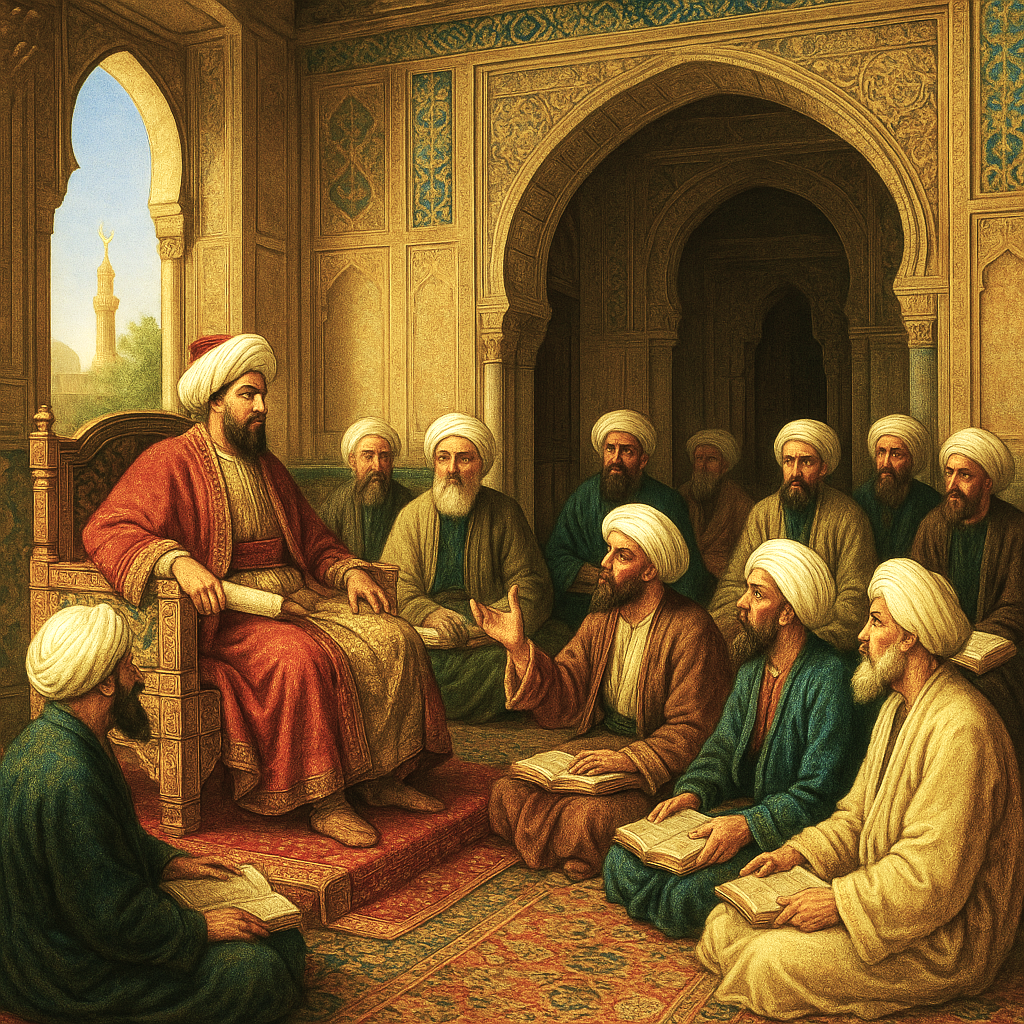
Muslim belief is that the Qur’an is “uncreated” (ghayr makhluq). While the Qur’an was revealed to Muhammad over twenty-three years (610-32 AD), the “speech of God” (kalam Allah) in these revelations had existed co-eternally with God. This was once a point of serious dispute in Islamic theology, and the outcome of that debate was an important waymarker in the development of Islam.
THE MU’TAZILITES
A theological school known as the Mu’tazilites, often described as “rationalist”, operating in Abbasid Iraq in the early ninth century, argued that the Qur’an was created and must have been created, since God necessarily existed before any speech He made. This view prevailed for a time: Mu’tazilism was declared official doctrine by the Abbasid Caliph in 827 AD, and in 833 a State-wide persecution of non-Mu’tazilites was inaugurated, remembered as Al-Mihna (lit. “ordeal”; in Christendom, we might say “inquisition”). The most famous victim of this crackdown was Ahmad ibn Hanbal, a Baghdad-born jurist.
Hanbal and his supporters were known as “the people of Hadith” (ahl al-hadith), and their method of argument was affirmations of belief, followed by quotes from the Qur’an and the Hadith, the compilations of sayings, views, and activities of the Prophet Muhammad and the “pious ancestors” (salaf al-salih), roughly the first three generations of Muslims. The Mu’tazilite approach was more inquisitive. For example, the Mu’tazilites rejected anthropomorphising God: episodes in the Qur’an or Tradition where God is described as having hands or sitting on a throne were reinterpreted metaphorically (a practice known as ta’wil). Hanbal was having none of this and said it was divesting God of His attributes (sifat).[1] For the better part of fifteen years, Hanbal was in prison or in exile, but he ultimately prevailed.
One of the first things the Abbasid Caliph Al-Mutawakkil (r. 847-61) did upon taking the throne was call off the Mihna, and invite Hanbal back to Baghdad. The Mu’tazilites declined in influence thereafter, hastened by the closing of the gates of ijtihad (independent reasoning) in the tenth century and a period of severe persecution under Al-Qadir (r. 991-1031). By contrast, Hanbali become one of the four schools (madhabs) accepted as orthodox by Sunni Islam, albeit its influence has retreated from the Fertile Crescent. Hanbalism is now concentrated in Saudi Arabia, where it underlies the official creed of Wahhabism.[2]
The fall of the Mu’tazilites was the signal of a profound change in Islam.
THE CALIPHS
The word “Caliph” (Khilafa) was first used by the Umayyad ruler Abd al-Malik (r. 685-705) back in the 690s, adopted as he sought to restore the authority of the dynasty in the aftermath of a civil war and as part of his larger project of reorienting the Arab Empire from its more open and indistinct Biblical monotheism to a more exclusivist creed based on the Qur’an,[3] where the word appears twice.[4] The previous, vaguer title of “Commander of the Believers” (Emir al-Mu’mineen) was maintained, but took second place. By a fortunate ambiguity, “Khalifa” could be used to mean “Deputy (of God)”, the one to define the proper beliefs and practices of believers, and “Successor (of the Prophet)”. Muhammad was forgotten for more than half-a-century after his death, but Abd al-Malik’s opponent in the civil war, Ibn al-Zubayr, had discovered the power of claiming legitimacy by association with the Prophet. The cult of Muhammad would become a feature of the Qur’anic umma (community) ever-afterwards, a key marker separating emergent Islam from the predecessor monotheisms that gave it birth, since neither Jews nor Christians could accept the claim that Muhammad was a Prophet.[5]
The great process of compilation and exegesis that began in the middle of the eighth century produced a salvation history for the Arab Empire that began to stabilise in the early ninth century, giving us Islam as we recognise it.[6] The process involved writing biographies of the Prophet (the first one we know of was written c. 760) and the collecting the sayings (i.e., theological views) and activities (examples) of the Prophet in the Hadith. These biographies and Hadith would become a source of guidance for Muslims (the Sunna) on par with the Qur’an, and they would be used—alongside the literary histories of the early military campaigns, theological arguments, and other apologia produced in the same period—to interpret the Qur’an, both in themselves and as the basis for formal exegesis (tafsir). This corpus would also be used to formulate the Holy Law (shari’a) that codified the guidance for Muslim conduct, making the Law’s progenitors and guardians, the ulema, an increasingly important class in the Empire.
The Sunna and shari’a was, from the start, a threat to the power of the Caliphs, and often intentionally so: it had been formulated by the ulema, alongside assertions that the Caliph had no role in creating the Law yet was bound by it, in no small part as a reaction against the absolutist claims of the Deputy of God.[7] The Umayyads had ruled unaffected by this, as did the first two Caliphs of the Abbasid dynasty that displaced the Umayyads in a revolution in 750 AD. By the time of the third Abbasid Caliph, Al-Mahdi (r. 775-85), the impact of the ulema was being felt in public life.[8] For thirty years or so, there was something of a tug-of-war. The situation was fluid enough that the Caliph sometimes won a round by, say, getting a friendly alim to “find” a Hadith validating his position. But the direction of travel was remorseless, eliminating the Caliphs as sources of Law or even arbiters among the contending factions of ulema. Consensus (ijma) among the ulema themselves was the decider. By the end of the reign of Harun al-Rashid (r. 786-809), the ulema had gone from being legal experts outside the State to not only holding State positions: their views now “took precedence over the God-inspired State itself”.[9]
The official endorsement of the Mu’tazilites by Al-Ma’mun (r. 813-33) and the Mihna was the last attempt to claw back for the Caliphs the status of parity with the Prophet, whose legacy the Caliphs were to uphold, and the role of defining and patrolling the frontiers of orthodoxy. It ended in failure. The conception of the faith as the ulema had refashioned it—a legalistic creed with rules for everything from taxation to personal dress, binding even the Caliph, who was merely chief enforcer of a Law decided on by the community—had spread too far. Al-Mutawakkil’s termination of the Mihna was a formality.[10] The ulema had won, divesting the Caliphal office of its creedal functions.[11]
Inevitably, in an Arab Empire where “religious” and “political” were never separate categories, the sapping of the Caliphs’ divine authority by the ulema bled their temporal authority. After Al-Mutawakkil’s assassination in 861, the Abbasid Caliphs became prisoners of the ghilman Turkish slave soldiers who had been their Praetorians, and the Empire devolved into chaos and fragmentation. The “Islamic Golden Age” that began with the founding of Baghdad in 754 was drawing to a close. Nonetheless, there was an irony at work, visible at this point in the decision of the ghilman to rule from behind the Caliph, rather than carrying out an overt military coup: the ulema had devastated the “political” authority of the Abbasid Caliphs and they would never recover it, but “the desanctification of the [Caliphal] institution was never complete”.[12]
In 946, Baghdad was occupied by the Buyids, an Iranian Shi’a dynasty, only for the dreams of the Shi’is—dashed already by the Abbasids who had utilised them to get to power—to be dashed again. The Buyids quickly saw that rule was impossible without the blessing, however involuntary, of the Abbasid Caliphs. The counter-Caliphal claims of the Fatimid Ismailis faded. Iranian overlordship of Baghdad was displaced by new foreign masters, the Seljuk Turks, in 1055, yet still the Abbasid Caliphs were maintained as props. Even after the Abbasid State was gone, reduced to rubble by the Mongols in 1258, the Abbasid Caliphs remained, now the prisoners of the Mamlukes, another cadre of Turkish slave soldiers, in Cairo. Muslims, it seemed, could not do without a Caliph.[13]
_________________________
FOOTNOTES
[1] Cole Bunzel (2023), Wahhabism: The History of a Militant Islamic Movement, pp. 98-99.
[2] To the extent the term “Wahhabism” is known in the West, it is generally associated with extremism and terrorism. This is not wholly unreasonable: since the 1980s, the jihadi-Salafist movement has drawn on the Wahhabi tradition, for concepts and the prestige and legitimacy that comes with antiquity, among other things. The Islamic State (IS) in the last decade has gone further. IS has always had a particular fixation on Saudi Arabia as a rival for the leadership of Sunnidom and has taken to claiming the monarchy has betrayed its heritage. In IS’s telling, it is the true inheritor of the first Saudi State (1744-1818) formed by the revivalist preacher Muhammad ibn Abd al-Wahhab. As the Saudi Kingdom has been de-emphasising its Wahhabi foundations and setting a more nationalist path in the same period, there is a potential audience inside the Kingdom for IS’s message. It was, after all, the claim to be restoring authentic Wahhabism, in a period of much milder reforms, that motivated Juhayman al-Utaybi, at least before the apocalyptic turn that ended in disaster at the Grand Mosque in 1979. A lot may depend on how powerful IS is within the Kingdom, a question that even the Saudi government may not know the answer to. See: Bunzel, Wahhabism, pp. 336-41.
[3] Fred Donner (2010), Muhammad and the Believers: At the Origins of Islam, p. 211.
[4] Quran 2:30 and 38:26. The second reference is in relation to King David, or the Prophet Dawud as he is to Muslims, and Abd al-Malik seems to have been particularly keen on that parallel as he set himself up implicitly as a figure to rank alongside the prophets in general, not just Muhammad. As the builder of the Dome of the Rock in Jerusalem, David’s city, Abd al-Malik also had another connection to play on. See: Muhammad and the Believers, p. 211.
[5] Muhammad and the Believers, pp. 205-09. Before Abd al-Malik, some Jews and it seems some Christians had been counted among the believers’ by the Qur’anic Arabs (see: pp. 69-71, 114, 227-32).
[6] John Wansbrough (1977), Quranic Studies: Sources and Methods of Scriptural Interpretation, pp. 44, 66.
[7] Patricia Crone and Martin Hinds (1986), God’s Caliph: Religious Authority in the First Centuries of Islam, pp. 91-92.
[8] God’s Caliph, p. 87.
[9] God’s Caliph, pp. 88-91.
[10] God’s Caliph, pp. 93-97.
[11] God’s Caliph, pp. 109-10.
[12] God’s Caliph, p. 97.
[13] The Abbasids were finally deprived of the Caliphal title in 1517 when the Ottoman Turks conquered Egypt and took it to Constantinople as part of the war booty. True, the Ottomans did not quite know what to do with the title initially, but by the end of the eighteenth century had found their way. The reverberations of the abolition of Caliphate in 1924 are with us still.


Good one! Few know of the Mu’tazila. Fewer know of what happened to them, and why.
LikeLiked by 1 person
The rationalist, Greek-influenced Mu’tazila came to be opposed by the Ash’arites, who said that, theologically, nothing happens but that Allah has already willed it to happen. That men cannot discover or build anything except Allah has already given them the knowledge or the power/skill to do so. That everything which is … is because the Divine has made it so.
Certain corrupt Umayyad Caliphs latched onto that bit of inanity, using it as a way of escaping blame for things they’d done, the crimes they’d committed.
Then in the midst of the theological debate, one of those Umayyads ordered that Mu’tazilism was to be the official Islamic doctrine (which played right into the hands of the Ash’arites, who announced that he was thereby proven to be defying Allah.)
And you thought the European religious wars were off-the-wall ….
LikeLike