Category Archives: IS Relations With Al-Qaeda

The Islamic State is Taking Advantage of the Mess in Northern Syria

By Kyle Orton (@KyleWOrton) on 22 July 2022

The United States announced on 12 July that it had killed the Islamic State’s (ISIS) governor of Syria in a drone strike in the village of Galtan in the Jinderes district of the north-western Syrian province of Efrin on the border with Turkey. The U.S. Central Command (CENTCOM) statement identified the slain man as “Maher al-Agal”, though a more precise transliteration is Maher al-Aqal (ماهر العقال). Riding on the motorcycle alongside Al-Aqal when he was killed was a “senior ISIS official” with whom he was “closely associated”. This ISIS official was “seriously injured during the strike”, CENTCOM notes, adding that the Jinderes strike caused no civilian casualties. Continue reading

Al-Qaeda Letter on Relations with the Islamic State and Iran

By Kyle Orton (@KyleWOrton) on 5 February 2018

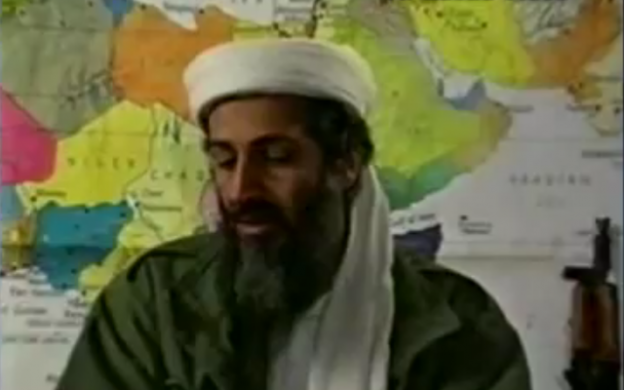
Usama bin Ladin in an al-Qaeda video (image source: CNN)

A letter released by the Office of the Director of National Intelligence (ODNI) on 20 May 2015, the “Letter to Abu Abdallah al-Hajj”, was written by an al-Qaeda leader on 17 December 2007. The letter, reproduced below with some editions in transliteration and some important sections highlighted bold, is interesting for several reasons. Continue reading

Al-Qaeda Instructs the Islamic State’s Predecessor Not to Attack Iran

By Kyle Orton (@KyleWOrton) on 21 November 2017

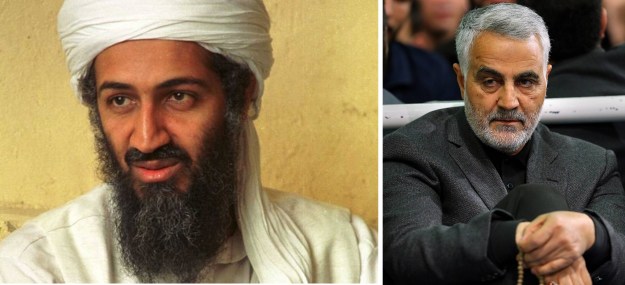
Usama bin Ladin, Qassem Sulaymani

Among the documents recovered from Usama bin Ladin’s compound in Abbottabad was the “Letter to Karim”, dated 18 October 2007. The letter was released in 2015 by the Office of the Director of National Intelligence (ODNI). “Karim” likely refers to Abdul Munim al-Badawi (Abu Hamza al-Muhajir), the leader of al-Qaeda in Mesopotamia (AQM), the predecessor organization to the Islamic State, after the group’s founder, Ahmad al-Khalayleh (Abu Musab al-Zarqawi), was killed in June 2006. The letter is reproduced below with some interesting details highlighted in bold. Continue reading

Why The Islamic State Endures

By Kyle Orton (@KyleWOrton) on March 15, 2017

Brian Fishman’s The Master Plan provides a comprehensive history of the Islamic State’s (IS) strategic evolution, covering the personalities and events that shaped one of the most feared terrorist-insurgent groups that has ever existed. Eminently readable, in places even amusing—no small feat in a book about IS—Fishman flips with ease between the overview and the granular to demonstrate his points, using new sources that will allow as much supplementary research as a reader could wish for, and ties it together in a narrative that will be of use to both specialists and generalists. Continue reading

When the Islamic State’s Founder Clashed with an Al-Qaeda Cleric

By Kyle Orton (@KyleWOrton) on February 12, 2017

Abu Musab al-Zarqawi [left] and Abu Muhammad al-Maqdisi [right]

Al-Qaeda’s expulsion of the Islamic State (IS) from its ranks three years ago did not come from nowhere. IS had always been problematic and the dispute in the months leading up to the decisive break was far from the first time that Al-Qaeda “central” had clashed with the Iraq-based group. Continue reading

The Islamic State’s Official Biography of the Caliph’s Deputy

By Kyle Orton (@KyleWOrton) on December 18, 2016

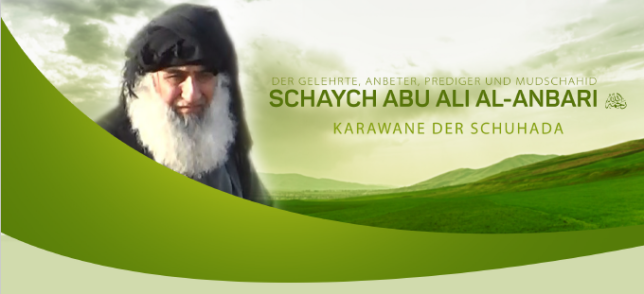
Obituary for Abdurrahman al-Qaduli in the German version of Rumiya, 11 November 2016

Obituary for Abdurrahman al-Qaduli in the German version of Rumiya, 11 November 2016

The forty-first edition of the Islamic State’s newsletter, al-Naba, released within the territory of the caliphate on 30 July 2016 and released online on 2 August, and the forty-third edition (released 13 and 16 August), contained a two-part obituary for Abd al-Rahman al-Qaduli (Abu Ali al-Anbari), the caliph’s deputy when he was killed on 24 March. The obituaries, entitled, “The Devout Scholar and Mujahid Preacher: Shaykh Abu Ali al-Anbari”,[1] make clear that al-Qaduli was one of the most consequential jihadists in the history of the Islamic State movement. Below is a translation, with some interesting and/or important sections highlighted in bold. The biography resolves some long-standing mysteries, and some of the claims are dubious in light of other evidence we have: these issues, and other points of context and explanation, are in the footnotes. The subheadings are mine, added to signpost the narrative and break it up into more manageable chunks.
Continue reading

Al-Qaeda Explains its Split with the Islamic State

By Kyle Orton (@KyleWOrton) on December 6, 2016

1

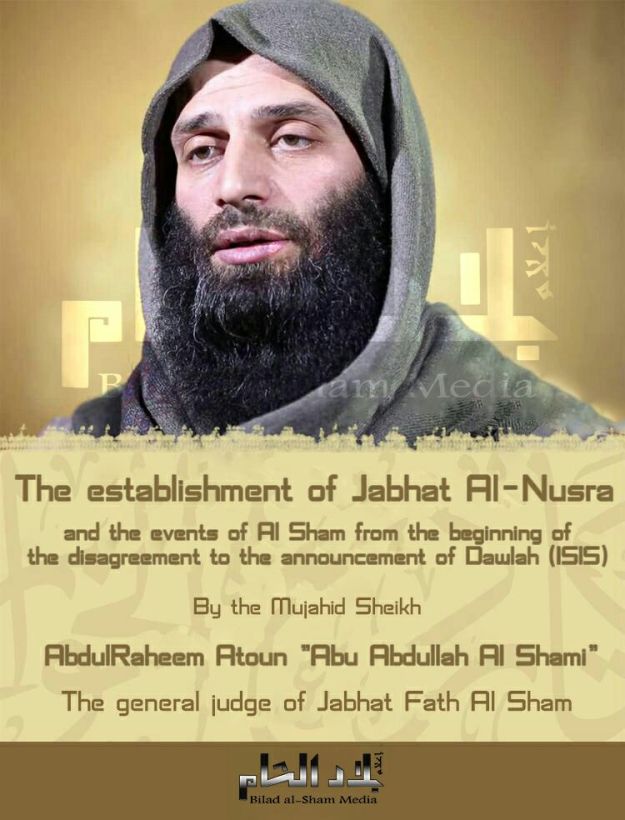
On 20 November 2016, Jabhat Fatah al-Sham (JFS), al-Qaeda’s rebranded presence in Syria, published its first official account of how JFS, previously known as Jabhat al-Nusra, split from its parent organization, the group we now know as the Islamic State (IS). The statement was composed by Abd al-Rahim Atun (Abu Abdullah al-Shami), identified as the General Judge of JFS. It is apparently drawn from the book, “Under the Shade of the Tree of Jihad” (p. 177-194), and the post was entitled, “The Establishment of Jabhat al-Nusra and the Events of al-Sham [Syria] from the Beginning of the Disagreement to the Announcement of al-Dawla [the State]”. On 27 November, Bilad al-Sham Media released an English language version of this statement, which is reproduced below with some editions for spelling, grammar, and so on, and some especially notable sections bolded. Continue reading

The Islamic State’s Relationship With Al-Qaeda

By Kyle Orton (@KyleWOrton) on August 30, 2016

1

Since al-Qaeda broke ties with the Islamic State (IS), then the Islamic State of Iraq and Syria (ISIS), in 2014 there has been an ongoing war of narratives about what happened. Below is an attempt to work through this murky situation. Continue reading

The Riddle of Haji Bakr

By Kyle Orton (@KyleWOrton) on November 10, 2015

Samir al-Khlifawi (Haji Bakr): in Saddam's army, in American prison, as a commander of the Islamic State

Samir al-Khlifawi (Haji Bakr): in Saddam’s intelligence service, in American prison, as a commander of the Islamic State

In the last few months I’ve increasingly focussed on the former (Saddam) regime elements (FREs) within the Islamic State (IS). There’s now an entire section on this blog about it, and Aaron Zelin over at Jihadology recently gave me time to elaborate in a podcast.

In studying this topic there is one inescapable name: Samir Abd Muhammad al-Khlifawi, better-known by his pseudonym Haji Bakr, and sometimes by his kunya, Abu Bakr al-Iraqi. Al-Khlifawi is a former colonel in an elite intelligence unit of the Saddam Hussein regime—focussed on air defence at Habbaniya airbase, though what exactly that entails is murky. Al-Khlifawi was also apparently involved in weapons development.

Al-Khlifawi came to international attention in April when Christoph Reuter published an article in Der Spiegel naming al-Khlifawi as the “architect” of IS’s expansion into Syria, and the man who had been “pulling the strings at IS for years.” Continue reading

ISIS’s Spokesman Denounces Al-Qaeda’s Leader, Claims ISIS Is The Victim

By Kyle Orton (@KyleWOrton) on May 13, 2014

The spokesman of the Islamic State of Iraq and Syria (ISIS), Abu Muhammad al-Adnani, gave a speech via audio message on 11 May 2014, entitled “‘Adhr’a emir al-Qaeda” (Apologies, emir of al-Qaeda). Al-Qaeda’s leader, Ayman al-Zawahiri, disowned ISIS, al-Qaeda’s prior Iraqi branch, in February, and then gave an extended statement a few days ago that placed blame for the schism squarely on ISIS. Al-Adnani’s speech was a response to al-Zawahiri, and it was among ISIS’s most stern attacks on al-Qaeda so far. Al-Adnani denounced al-Zawahiri for allegedly deviating from the outlook of Usama bin Ladin. Al-Adnani called on al-Zawahiri to reverse his ruling that accepted Jabhat al-Nusra’s split from ISIS. Al-Nusra has rebelliously broken its pledge of allegiance to ISIS, al-Adnani says, and al-Zawahiri’s duty was to side with ISIS against this renegade—not to join in a campaign of sedition and conspiracy against ISIS. Most intriguingly, al-Adnani denied that ISIS had ever been, in a formal sense, subordinate to al-Qaeda. Rather, says al-Adnani, ISIS had placed itself in a position of voluntarily labelling themselves as al-Qaeda and accepting the advice of the “elders of jihad” in order to unite the ranks of the jihadists. But, says al-Adnani, this was not a command relationship for ISIS’s internal affairs: witness, al-Adnani says, ISIS’s refusal to listen to al-Qaeda’s order to cease attacking Shi’i civilians. Though, says al-Adnani, ISIS did obey al-Qaeda in external matters, specifically not targeting Iran, where al-Qaeda has an important facilitation network that serves as its supply line from Afghanistan-Pakistan to the Arab world. Al-Adnani’s speech was translated today by Musa Cerantonio, an Australian convert to Islam who is one of ISIS’s most important international propagandist-recruiters. Al-Adnani’s speech is reprinted below. Continue reading