Franco and Hitler: A Meeting and its Consequences

By Kyle Orton (@KyleWOrton) on 17 June 2021

By the autumn of 1940, the entirety of Western Europe except Spain and Portugal lay under Nazi control, as did much of the Centre and parts of the East: Austria, Czechoslovakia, Poland, Denmark, Norway, the Netherlands, Belgium, Luxembourg, and France had all fallen without serious resistance, and Britain’s refusal to take the German offer of leaving the Continent to the Nazis and the Nazis would leave the British with India had incurred the wrath of the Luftwaffe with night after night of air-raids.

It was in this context that a meeting was held, on 23 October 1940, between Adolf Hitler and Spain’s ruler, Francisco Franco. The meeting, taking place at the railway station in Hendaye, within conquered France, on the western-most point of the Franco-Spanish border, was also attended by the foreign ministers, Ramón Serrano Súñer (Spain) and Joachim von Ribbentrop (Germany). The Germans arranged the meeting to try to get Spain into the war, and General Franco attended the meeting intent on refusing—politely. Continue reading

When Did the “Roman” Empire Become the “Byzantine” Empire?

By Kyle Orton (@KyleWOrton) on 12 June 2021

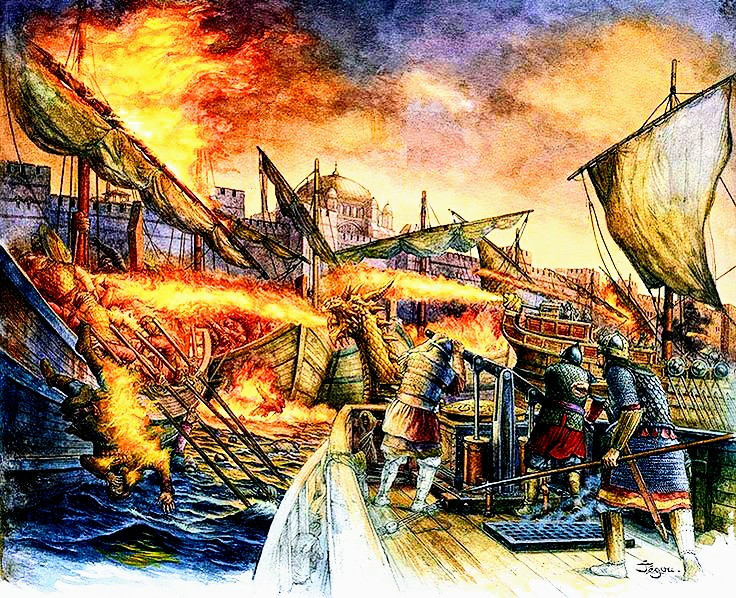
A painting representing the Byzantines use of “Greek fire” to repel the Arab siege of Constantinople, 674-78

The use of the word “Byzantium” for the Eastern Roman Empire is inescapable, though it is best thought of as a term of convenience rather than definition. For one thing, the inhabitants never called themselves “Byzantines”: they always thought of themselves as “Romans”, though using the Greek work “Romaioi”. The easiest way to see the problem is to ask: When did the Byzantine Empire begin? Continue reading

How Many Christians Were There in the Roman Empire?

By Kyle Orton (@KyleWOrton) on 11 June 2021

The numbers on the growth of Christianity in the Roman Empire are very uncertain, but there are enough data points to hazard a reasonable estimate. Continue reading

Just What Is Iran Capable Of?

By Kyle Orton (@KyleWOrton) on 8 June 2021

Massive explosion at Khojir in eastern Tehran lights up the night sky, 25 June 2021 [image source]

The clerical regime in Iran, born in terrorism and dedicated to its export, has carried out atrocities across the world since 1979. The Islamic Republic has made Israel and Jews a special target of its murderous Revolution, and this has naturally incurred what one might call “resistance” from the Israeli government. What is notable in recent times is how the global ledger is shaping up, albeit while the strategic regional situation is quite different. The Israelis have delivered blow after blow to Iran, many of them within Iran, including removing senior officials, and the Iranian theocracy has proven unable to reply because its terrorist infrastructure is so badly infiltrated and just sheerly incompetent. Continue reading

The History of “Central Europe”

By Kyle Orton (@KyleWOrton) on 7 June 2021

The Idea of Central Europe: Geopolitics, Culture and Regional Identity (2018), by Otilia Dhand, is an engaging and rather ambitious book, a work of intellectual history. Dhand’s core argument is that from the introduction of the term “Central Europe” in the nineteenth century, it did not describe a set geographical zone and the definition was always contested since the term was an attempt to construct local identities, a self separate from some other, as an instrument in the pursuit of geopolitical interests, always revisionist: these were attempts to will something into existence by influencing political behaviour. Continue reading

Islamic State Advertises its Afghan Escalation and Holding Territory in Africa

By Kyle Orton (@KyleWOrton) on 29 May 2021

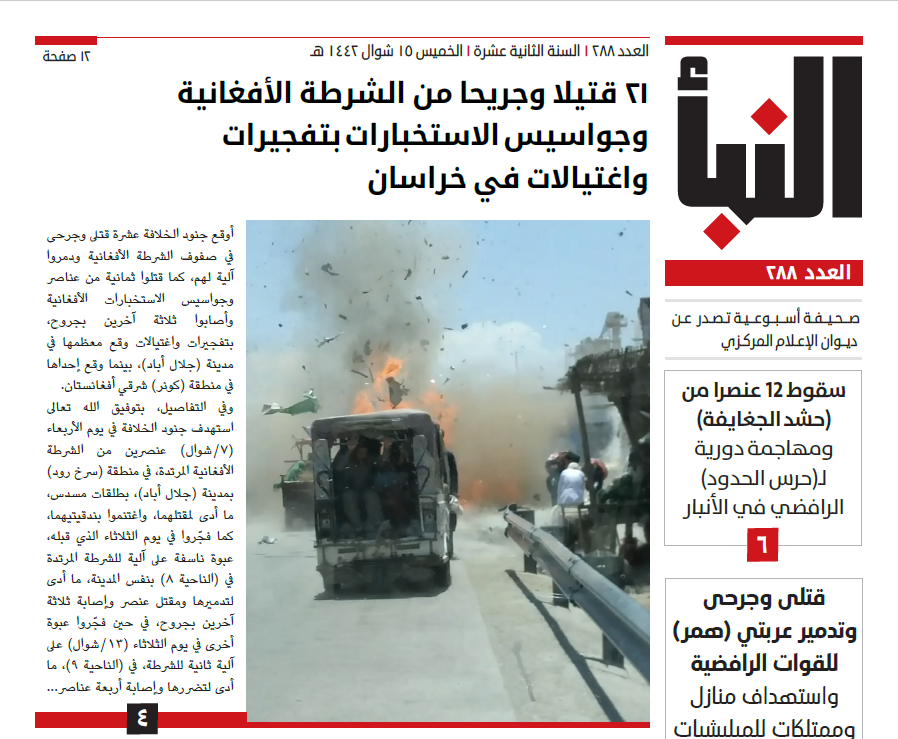
Al-Naba 288, front page

The Islamic State (IS) released the 288th edition of Al-Naba yesterday, and amid the commonplace items—insurgent reports from Iraq and Syria, Egypt and Africa, its main editorial and the ideological essay(s)—the two items on its front page were most interesting. The top item was a series of reports from Afghanistan about the ongoing progress of IS as NATO draws down. The second item down was from Nigeria, about the imposition of zakat, the tax for the needy, which had some suggestive details about IS’s procurement of territory in Africa. Continue reading

Gaza is Just One Front in Iran’s Regional War

By Kyle Orton (@KyleWOrton) on 27 May 2021

Israel’s Iron Dome missile defence system [left] activates over southern Israel against incoming HAMAS rockets [right], 14 May 2021

Naim Qassem, the deputy secretary-general of Hizballah, the Lebanese division of Iran’s Islamic Revolutionary Guards Corps (IRGC), gave an interesting interview to Hizballah’s Al-Nour radio station on 22 May, explaining IRGC/Hizballah’s vision for what it had achieved with the recent war in Gaza. Qassem added to a large body of evidence about Iran’s extensive role in the war, a lot of it supplied directly by the combatant parties themselves. Not only did the clerical regime in Iran supply the material basis for the Islamists’ war against Israel this month; they provided much of the ideological framework, too. Continue reading

The Spokesman’s Response When the Islamic State Went to War With the Syrian Rebellion

By Kyle Orton (@KyleWOrton) on 24 May 2021

Taha Falaha (Abu Muhammad al-Adnani) is probably most famous for the September 2014 speech he made as the official spokesman for the Islamic State (IS) calling for international terrorist attacks, which initiated a wave of atrocities in Europe and beyond lasting about three years. But Falaha had been in office by that time, formally, since the summer of 2011, and in total he would make two-dozen speeches before he was killed at the end of August 2016. The twelfth speech, entitled, “The Scout Doesn’t Lie to His People”, and reproduced below,[1] was made on 7 January 2014, four days after the onset of a massive assault on IS by the Syrian rebellion that inter alia killed senior jihadist commanders like Samir al-Khlifawi (Haji Bakr or Abu Bakr al-Iraqi). What is interesting about this speech, as revealed in the recent Al-Naba profile of Falaha’s great friend and collaborator, the media emir Wael al-Ta’i (Abu Muhammad al-Furqan), is that Falaha composed this speech while he was besieged by the rebels in Aleppo. Al-Ta’i had evacuated the IS media department and their families, then slipped back into the area surrounded by the rebels to help Falaha compose IS’s first political counter-measure to this unexpected development in Syria, which was followed nearly a fortnight afterwards by a speech from the caliph himself, Ibrahim al-Badri (Abu Bakr al-Baghdadi). Continue reading

Islamic State Comments on the Gaza War and Escalates in Afghanistan

By Kyle Orton (@KyleWOrton) on 22 May 2021

Al-Naba 287, page three

The last two issues of Al-Naba, the weekly newsletter of the Islamic State (IS), had a number of interesting items, most obviously finally breaking its silence on the latest flare-up between Israel and HAMAS. Continue reading

Islamic State Profiles the Godfather of its Media Department

By Kyle Orton (@KyleWOrton) on 8 May 2021

Wael al-Ta’i (Abu Muhammad al-Furqan), Al-Naba 285, p. 3

The 285th edition of Al-Naba, the weekly newsletter of the Islamic State (IS), released on 6 May, had a biography of Abu Muhammad al-Furqan, one of the most important IS leaders, the head of its Central Media Department and its operational ruler when he was killed in September 2016. Continue reading