By Kyle Orton (@KyleWOrton) on 19 November 2019

President Barack Obama meeting President-elect Donald Trump, 10 November 2016 [image source]
By Kyle Orton (@KyleWOrton) on 19 November 2019
President Barack Obama meeting President-elect Donald Trump, 10 November 2016 [image source]
By Kyle Orton (@KyleWOrton) on 18 November 2019
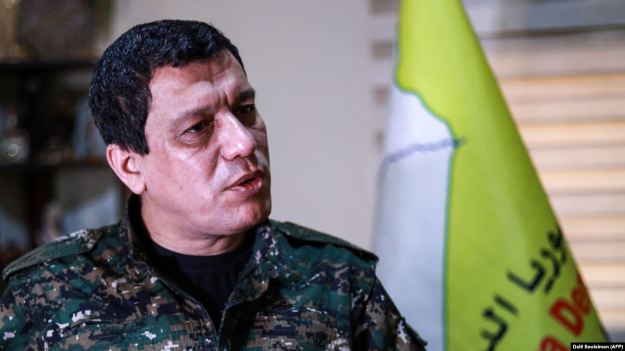
“SDF commander “General Mazlum Kobani” (the PKK executive official Ferhat Abdi Shahin) being interviewed by AFP in Hasaka city, 24 January 2019 [image source]
By Oved Lobel on 18 November 2019

PKK at a terrorist training camp in the Asad regime-held Bekaa Valley of Lebanon, 1991 [source]
The broad outline of the PKK’s relationship with the Soviet Union—and then the Russian Federation—is fairly clear. After the PKK was founded in Turkey in the late 1970s by Ocalan, it was evicted from the country during the 1980 military coup. The PKK moved to Syria, where Ocalan was already based, having fled Turkey in June 1979. From there, the PKK moved into the Bekaa area of Lebanon, at that time controlled by the Syrian regime of Hafez al-Asad, and the Soviets acted through Asad, as they so often did in dealing with terrorist groups, to build the PKK into a fighting force that was then unleashed in 1984 on Turkey, a frontline NATO state in the Cold War. Continue reading
By Kyle Orton (@KyleWOrton) on 12 November 2019

Ahmad al-Hashlum, Hasan Qassab, Hamza al-Malla, Mazen al-Harami
There has been a renewed crackdown on dissent in the areas of Syria run by the Kurdistan Workers’ Party (PKK). While on Syrian soil, the PKK uses the name Democratic Union Party (PYD), and its armed wing is called the People’s Protection Units (YPG). The YPG/PKK is the dominant force in the “Syrian Democratic Forces” (SDF), the U.S.-led international Coalition’s ground partner in Syria against the Islamic State (ISIS). Continue reading
By Kyle Orton (@KyleWOrton) on 10 November 2019
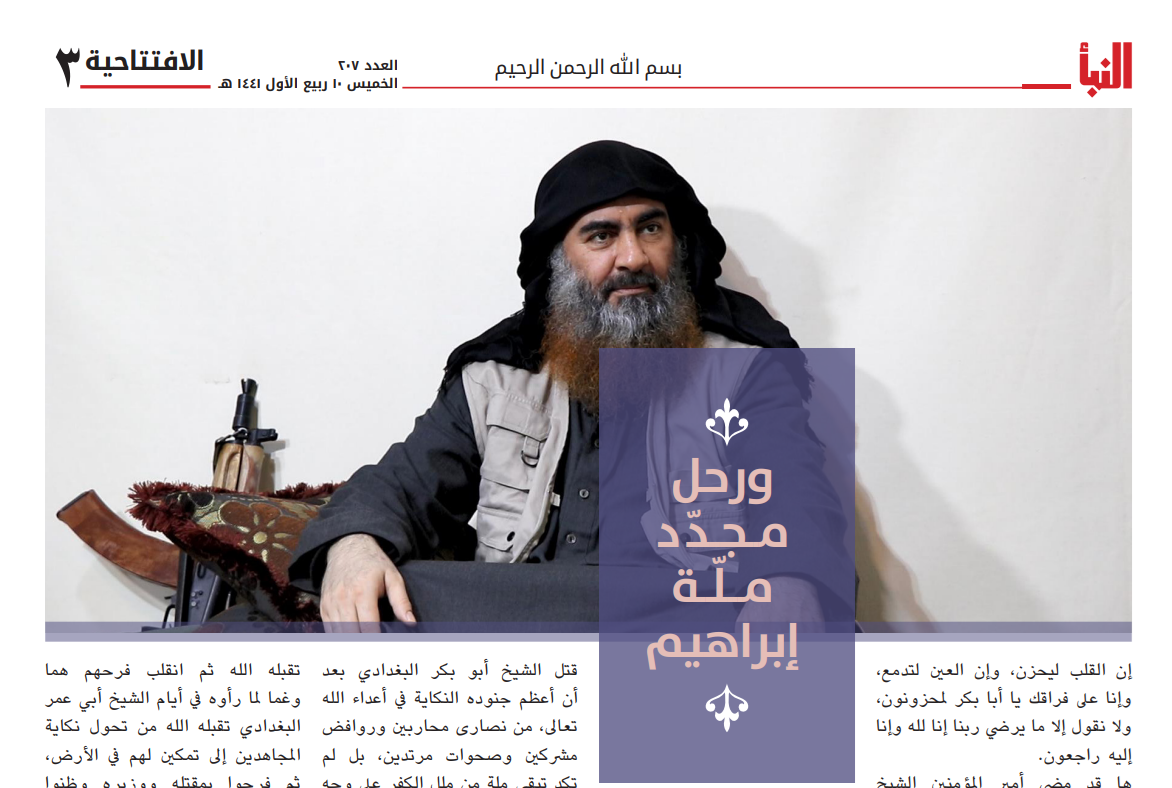
The 207th edition of Al-Naba, the weekly newsletter of the Islamic State (IS), published on 7 November 2019, devotes its main editorial to Ibrahim al-Badri (Abu Bakr al-Baghdadi), the first “Caliph” when the “Caliphate” was declared in June 2014, who was killed on 27 October 2019.
By Kyle Orton (@KyleWOrton) on 8 November 2019
This article was originally published at European Eye on Radicalization under the headline, “Who is the New Leader of the Islamic State?”
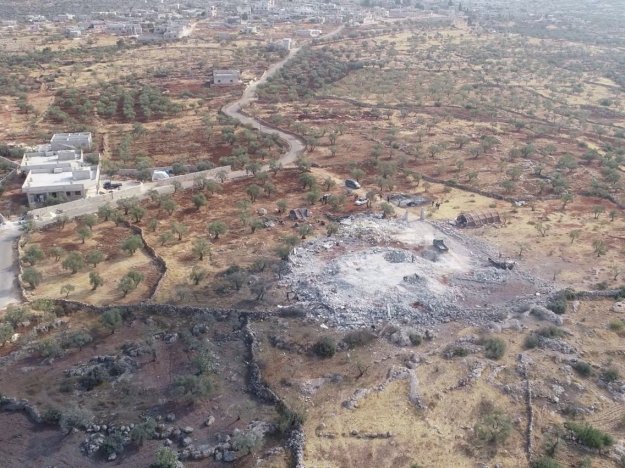
The destroyed compound where Abu Bakr al-Baghdadi was found in Syria // Drone footage taken by Turkey’s state-run Anadolu Agency
The so-called caliph of the Islamic State (ISIS), Ibrahim al-Badri (Abu Bakr al-Baghdadi), was killed in an American raid in Syria on 27 October, and the spokesman, Abu Hassan al-Muhajir, was killed the next day in an airstrike. ISIS acknowledged the losses and appointed new leaders on Halloween.
Abu Hamza al-Qurayshi introduced himself in a nearly-eight-minute audio statement as the new spokesman and named Abu Ibrahim al-Hashemi al-Qurayshi as Al-Baghdadi’s replacement. Little information was given about either man.
The U.S. government has said it knows “almost nothing” about the new caliph, Abu Ibrahim, leaving us no closer, for now, to knowing his identity. But some options present themselves. Continue reading
By Kyle Orton (@KyleWOrton) on 7 November 2019

Taha Falaha (Abu Muhammad al-Adnani) [right] appearing in an Islamic State video alongside Tarkhan Batirashvili (Abu Umar al-Shishani, 3 June 2017, displaying a scene from 2014 when IS demolished the borders between Iraq and Syria. Falaha was killed in August 2016. It is common for IS to hold back pictures and footage of its leaders for time-spans that can reach over a decade.
By Kyle Orton (@KyleWOrton) on 31 October 2019
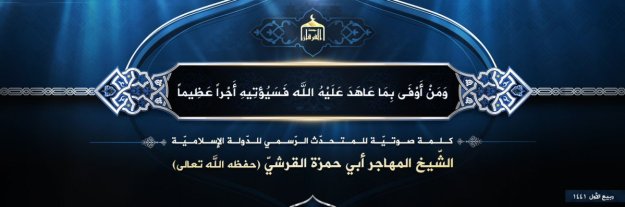
Earlier today, the Islamic State (IS) released a speech through Al-Furqan Media by its new spokesman, Abu Hamza al-Qurayshi. The statement was brief, just under eight minutes, and entitled, “Whosoever Fulfils That Which He Has Promised God, On Him Will He Bestow A Great Reward” (drawn from Qur’anic verse, 48:10). Abu Hamza confirmed that IS’s caliph, Ibrahim al-Badri (Abu Bakr al-Baghdadi), was dead, killed in the American raid in Idlib in the early hours of the morning [Syria time] on 27 October, and that his predecessor, Abu Hassan al-Muhajir, was also deceased, killed in an airstrike the day after Al-Baghdadi’s demise. The new IS leader was announced as Abu Ibrahim al-Hashemi al-Qurayshi. IS released a transcript of the speech, which is reproduced below with some editions for transliteration and interesting sections highlighted in bold. Continue reading
A version of this article was published at The Arab Weekly.
By Kyle Orton (@KyleWOrton) on 12 October 2019
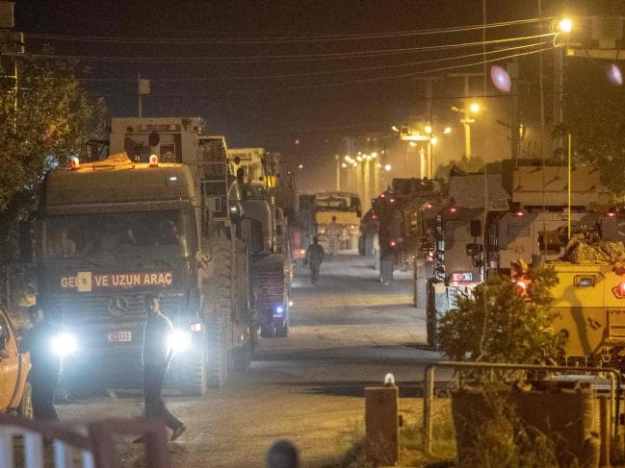
Turkish Armed Forces heading towards the border with Syria, 8 October 2019 // BULENT KILIC / AFP
The beginning of Turkey’s third incursion into Syria on Wednesday, this time dubbed Operation PEACE SPRING and aimed at the areas east of the Euphrates River, is the culmination of an American policy started under Barack Obama that has been continued by Donald Trump. That it is inevitable makes it no less tragic for the innocents caught up in this mess. It does mean that the emotive posturing on social media, and attempts by Obama era officials to cast the blame for the Syria catastrophe onto Trump, are more-than-usually grotesque. Continue reading
By Kyle Orton (@KyleWOrton) on 9 October 2019
Interview with De Re Militari Journal. Continue reading
 Kyle Orton's Blog