The West’s Partners in Syria and the Risks to Turkey

Originally published at The Henry Jackson Society

By Kyle Orton (@KyleWOrton) on 8 June 2017

Aftermath of a TAK bombing in central Istanbul, Turkey, 7 June 2016

The Kurdistan Freedom Falcons (TAK) issued a threat against Turkey on Tuesday, at the very moment the U.S.-led Coalition was announcing the commencement of the operation to evict the Islamic State (IS) from its Syrian capital, Raqqa, in alliance with the TAK’s mother organization, the Kurdistan Workers’ Party (PKK). This underlines some of the challenges confronting the Coalition as a result of a half-decade of short-sighted counter-terrorism policy in Syria and a regional posture that tilted away from traditional allies. Continue reading

Islamic State’s Attack in Iran Was a Bid For the Mantle of ‘Protector of the Sunnis’

Published at The Telegraph

By Kyle Orton (@KyleWOrton) on 7 June 2017

Armed terrorists stormed the Iranian parliament complex in Tehran (CREDIT: OMID VAHABZADEH/AFP/GETTY IMAGES)

In its choice of target and timing, ISIL has shown, once again, its skill in exploiting the rivalries of its enemies—setting them against one another to buy itself greater room for manoeuvre. Continue reading

Al-Qaeda-Linked Jihadi in Syria Comments on the Gulf Crisis

By Kyle Orton (@KyleWOrton) on 6 June 2017

Abdallah al-Muhaysini

A major diplomatic crisis has erupted between the Gulf states, pitting Saudi Arabia, Bahrain, and the United Arab Emirates against Qatar because of what these states claim is Qatar’s destabilizing behaviour.[1] On 5 June, Abdallah al-Muhaysini, identified last year by the U.S. government as a senior member of al-Qaeda in Syria, put out a message on Telegram effectively taking Qatar’s side, arguing that the campaign against Qatar was an American-orchestrated conspiracy against a government that had supported Muslims, i.e. Islamists.[2] The message is republished below with some syntactical and spelling edits. Continue reading

The West’s Plan for Defeating the Islamic State in Syria is Fatally Flawed

By Kyle Orton (@KyleWOrton) on 6 June 2017

A member of the YPG/PKK militia, Delil Souleiman/Agence France-Presse — Getty Images

The United States recently committed itself to arming the Kurdish People’s Protection Units, known as the Y.P.G., to help evict the Islamic State from its Syrian stronghold, Raqqa. This decision is likely to prove deeply troublesome, risking the regional stability necessary for the lasting defeat of the Islamic State.

The Y.P.G. denies that it is, in effect, a wing of the Kurdistan Workers’ Party, or P.K.K., but the evidence is clear. The P.K.K., a Marxist-leaning Kurdish nationalist organization, was founded in Turkey in 1978, and took up arms against the Turkish state in 1984. The group’s leader, Abdullah Ocalan, was expelled from Syria in 1998, when his old patron, the regime of Hafez al-Assad (Bashar’s father), came under military threat from Turkey. Mr. Ocalan was soon arrested by the Turks, and the tide of war turned against the P.K.K. Continue reading

Jihadi Ally Calls for Official Opposition Government to Take Over Idlib

By Kyle Orton (@KyleWOrton) on 1 June 2017

Hussam al-Atrash was the most senior religious official of Harakat Nooradeen al-Zengi and is now Deputy General Security Official of Hay’at Tahrir al-Sham (HTS), a jihadi-salafist insurgent group in north-western Syria whose relationship with al-Qaeda is much-contested. On 31 May, al-Atrash issued a statement arguing for a change of course for the insurgency in the “Greater Idlib” area.
Continue reading

Raqqa Doesn’t Want to Be Liberated By the West’s Partners

By Kyle Orton (@KyleWOrton) on 30 May 2017

Map of the tribes around Raqqa city (source: WINEP report)

We are now on the eve of the operation to evict the Islamic State (IS) from its Syrian capital, Raqqa, and, as expected, the United States will partner with the Syrian Democratic Forces (SDF), the front-group for the Democratic Union Party (PYD) and its armed wing, the People’s Protection Units (YPG), which President Donald Trump’s administration has committed to directly arming.

Many of the doubts voiced about this course relate to Turkey, since the PYD/YPG is—despite continued efforts to obfuscate the fact—the Syrian department of the Kurdistan Workers’ Party (PKK), the premier internal security threat to Turkey for many decades. The discussion then tends to fall into one of two grooves. Continue reading

American YPG Fighter Complains About Group’s Lack of Medical Care

By Kyle Orton (@KyleWOrton) on 26 May 2017

Patrick Ryan Kasprik

Patrick Ryan Kasprik was arrested in Lee County, Florida, in September 2015 for battery of a police officer and resisting arrest. By the time of Kasprik’s scheduled court appearance in February 2016, he was in Syria, having joined the People’s Protection Units (YPG)—without any training—as a combat medic. The YPG is the military wing of the Democratic Union Party (PYD), the name under which the terrorist-designated Kurdistan Workers’ Party (PKK) operates while on Syrian soil. There has been a flow of Westerners joining the YPG/PKK for several years. Kasprik left Rojava in November 2016. On 24 May 2017, Kasprik wrote a public Facebook status that spoke of YPG/PKK commanders having an alarming racial disdain for Arabs and buttressed prior reports by American YPG volunteers that the YPG was providing insufficient care to its wounded. Indeed, Kasprik suggested that the YPG was content for fatalities because it made for good propaganda. Kasprik’s full post is reproduced below with some explanatory notes added in square brackets.
Continue reading

Islamic State Newsletter Says Manchester Bomber Was a “Soldier of the Caliphate”

By Kyle Orton (@KyleWOrton) on 25 May 2017

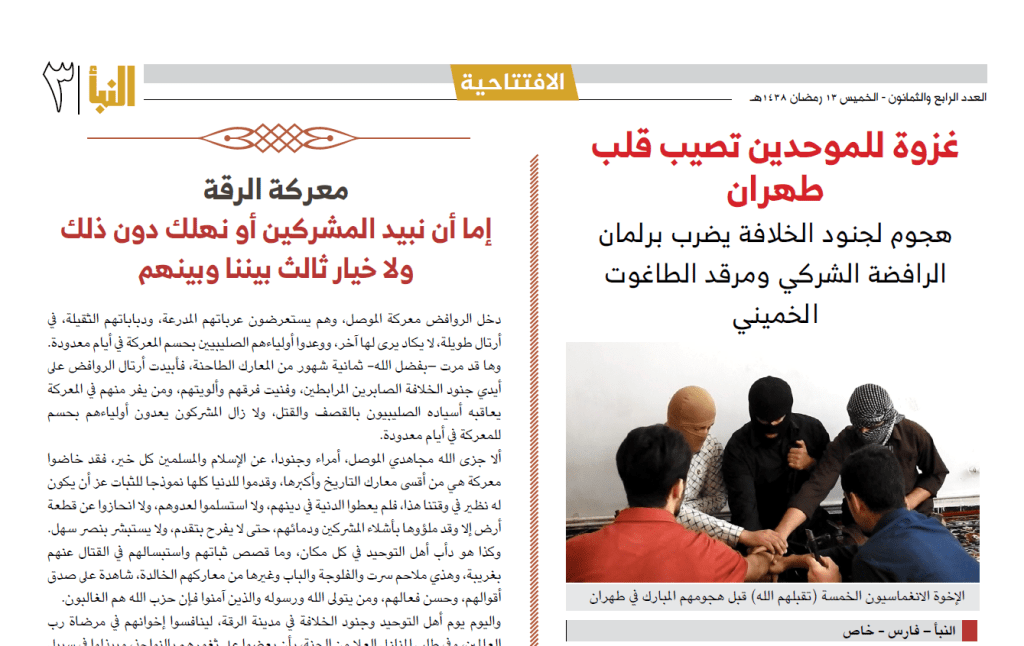
Article about Manchester Arena suicide-killer Salman Abedi, page 2 of Al-Naba 82

The Islamic State (IS) released the eighty-second edition of its newsletter, Al-Naba, on 25 May 2017. The first article in Al-Naba 82 was about the suicide attack on the Manchester Arena on 22 May, which IS claimed the next day. The article in Al-Naba provided very few details about the murderer, Salman Abedi, or IS’s role in the attack, mostly gloating over the allegedly panicky reaction of the British state. Continue reading

The Islamic State Expands Its Definition of Heresy

By Kyle Orton (@KyleWOrton) on 20 May 2017

A ruling in the name of the Islamic State’s Delegated Committee, prepared it seems by one of its senior members, Abu Zayd al-Iraqi, was issued on 17 May, expanding the scope of who, within the Muslim community, IS considers a heretic. The memo was addressed to “All Wilayat, Dawawin, and Committees,” and entitled, “That Those Who Perish Would Perish Upon Proof and Those Who Live Would Live Upon Proof”. The wide use of takfir (excommunication) has been one of IS’s most defining and controversial features—even within the jihadist world. This judgment, which comes in the context of a broader centralization of authority—on 14 May a decree banned individual IS fighters from using social media—takes IS into territory akin to the Armed Islamic Group (GIA), which hereticized whole sections of Algeria’s population and began slaughtering them. The text of the ruling was released in English and is reproduced below. Continue reading

Coalition on the Verge of Repeating the Mistakes of the Past Against the Islamic State

This article was published at BICOM

By Kyle Orton (@KyleWOrton) on 16 May 2017

Within the next month, the Islamic State (IS) will likely lose its grip on its Iraqi capital, Mosul, and the operation to drive it from its Syrian capital, Raqqa, will begin. The destruction of IS’s caliphate, however, is not even close to the end of the road for the movement, not least because of the manner in which it is being accomplished.

At its core the IS movement is waging a revolutionary war, and as Craig Whiteside, a fellow with The International Centre for Counter-Terrorism has explained, this means that the focus is on legitimacy. Military victories come and go but if IS is, over the long-term, gaining acceptance—whether from support, resignation, or fear—among the population it hopes to govern (the Sunni Arabs), then it is winning. It is for this reason that IS tries to embed political victories within its military defeats. Continue reading