Tag Archives: Abu Muhammad al-Jolani

Rumiyah Profiles Ahmad Abousamra, A Senior American in the Islamic State

By Kyle Orton (@KyleWOrton) on 8 April 2017

The eighth edition of the Islamic State’s magazine, Rumiyah (Rome), was released on 5 April 2017, and contained an obituary for one of the architects of the magazine itself. Named by his kunyas, Abu Sulayman al-Shami, Abu Sulayman al-Halabi, and Ahmad Abdul-Badi Abu Samrah, the jihadist referred to is Ahmad Abousamra, a U.S.-Syrian dual citizen. Abousamra is quite possibly the most senior American ever to have been in IS’s ranks, and the Rumiyah article gives a very interesting glimpse more generally of IS’s hierarchy, particularly the importance of its media and the late emir of that department, Abu Muhammad al-Furqan. The Rumiyah article is reproduced below with some editions in transliteration, occasional explanatory notes, and interesting or important aspects highlighted. Continue reading

Jihadi Cleric Calls for Al-Qaeda’s Leader in Syria To Be Put on Trial

By Kyle Orton (@KyleWOrton) on March 3, 2017

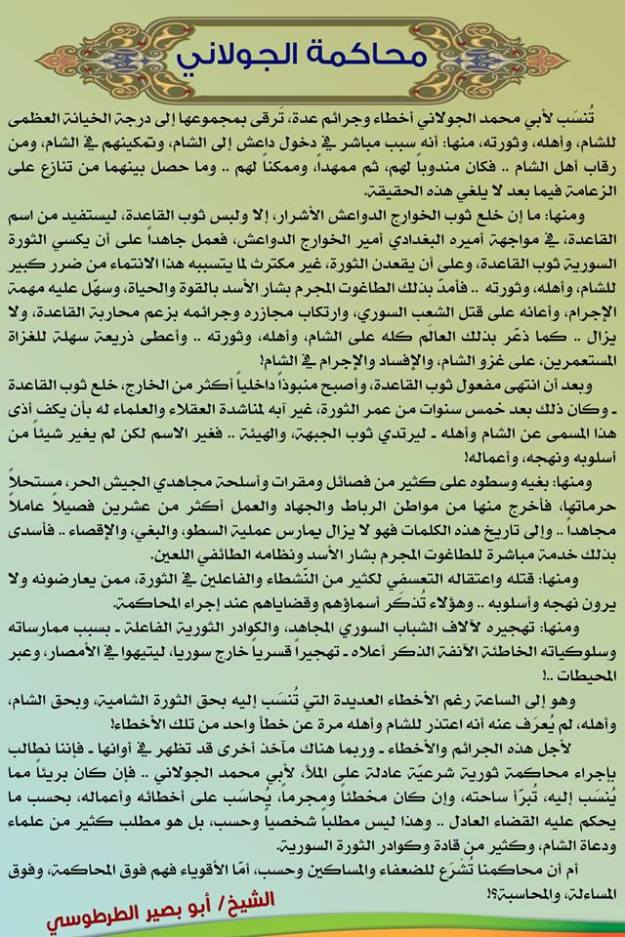
Abdul Munim Halima (Abu Basir al-Tartusi), a Syrian previously based in London, is an important jihadi-salafist scholar, who has diverged from some aspects of jihadism since the 7 July 2005 massacre on the London subway system by al-Qaeda. As the Syrian rebellion has progressed, Halima has departed even further from key jihadi ideologues that continue to take al-Qaeda’s line and support its branch in the country, Jabhat al-Nusra, which formed as a splinter from the Islamic State and has now rebranded itself as Hay’at Tahrir al-Sham. Halima has long expressed the view that al-Nusra and its leader, Ahmad al-Shara (Abu Muhammad al-Jolani), were insufficiently focused on Syrian needs. Halima tended to favour Ahrar al-Sham, an insurgent group with deep links to al-Qaeda, but which has presented its jihadism within a more nationalistic framework. Halima retains sway over Islamist opinion, especially in Syria, so his fatwa today calling for al-Shara to be put on trial for crimes against the Syrian revolution is noteworthy. Halima was especially exercised that the recent attempts by al-Shara to separate his organization from al-Qaeda came so long—and so unconvincingly—after so many had begged him for so long to carry out this policy. Instead, says Halima, al-Shara bullied and dominated the Syrian insurgency in the north under the flag of al-Qaeda, providing the regime of Bashar al-Assad with an alibi for his barbaric conduct in suppressing the insurrection. This is one of several “crimes” Halima says al-Shara should face a court for. The fatwa is reproduced below with some editions to transliteration and syntax.
Continue reading

U.S. Treasury Targets Al-Qaeda in Syria

By Kyle Orton (@KyleWOrton) on February 24, 2017

The U.S. Treasury on Thursday imposed sanctions on two senior operatives associated with al-Qaeda in Syria (AQS). This is undoubtedly part of the escalating campaign against AQS. The two men are interesting on their own account, however, and give a glimpse at some of the things that have shaped jihadism across the Fertile Crescent. In the one case, that of Iyad Nazmi Salih Khalil, better-known as Iyad al-Tubaysi or Abu Julaybib, this history begins with the earliest days of the Islamic State (IS), from which AQS splintered, in Iraq before Saddam Husayn was deposed. The other case, that of Bassam al-Hasri (Abu Umar al-Filistini), highlights the events at the outset of the Syrian uprising, when the regime of Bashar al-Assad set in motion its strategic plan to militarize and radicalize the nascent insurgency in order to present the population and the world a binary choice—the dictator or a terrorist takeover. Continue reading

Al-Qaeda Reshapes the Insurgency in Northern Syria

By Kyle Orton (@KyleWOrton) on February 7, 2017

Hay’at Tahrir al-Sham logo

A series of clashes broke out on 19 January between al-Qaeda’s rebranded Syrian branch, Jabhat Fatah al-Sham (JFS), and its heretofore close ally and portal into the Syrian rebellion, Ahrar al-Sham. By 23 January, JFS had expanded its targets, engaging in hostilities with mainstream rebel groups in the “Greater Idlib” area, and specifically trying—and succeeding—in dismantling the positions of Jaysh al-Mujahideen, a moderate group, west of Aleppo. The crisis continued to escalate, forcing many groups to merge with Ahrar al-Sham for protection, until 28 January, when a JFS-led merger was announced under the banner of Hay’at Tahrir al-Sham (HTS), or the Syrian Liberation Committee. HTS announced a ceasefire, and since then individuals and groups—including a significant number from Ahrar—have given allegiance to HTS. This radical reshaping of revolutionary dynamics in northern Syria has undoubtedly created antibodies going forward against al-Qaeda that could be capitalized on by the international community, but the present situation is highly favourable to al-Qaeda. Continue reading

Al-Qaeda Says Attacking Syrian Rebel Groups Was Self-Defence Against A ‘Conspiracy’

By Kyle Orton (@KyleWOrton) on January 26, 2017

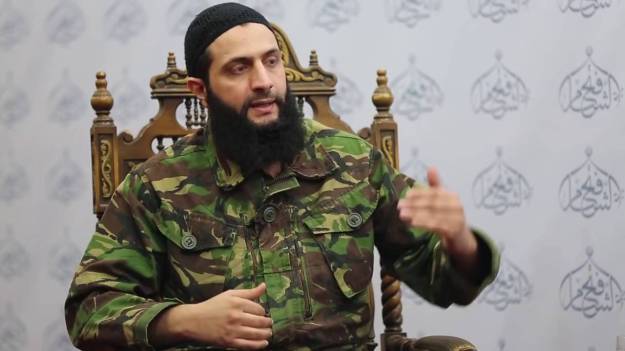
Ahmad al-Shara (Abu Muhammad al-Jolani)

Ahmad al-Shara (Abu Muhammad al-Jolani)

Violence erupted between Jabhat Fatah al-Sham, the rebranded al-Qaeda branch in Syria, and Ahrar al-Sham, its long-time ally and its bridge into the Syrian rebellion, beginning on 19 January. These clashes expanded to encompass the mainstream armed opposition on 23 January. Today, al-Maqalaat, a pro-JFS outlet, published a long statement explaining the fighting from JFS’s point-of-view. The salient points of the argument and other interesting elements are highlighted in bold. Continue reading

Jihadist Profile of Abu Bakr al-Baghdadi

By Kyle Orton (@KyleWOrton) on January 23, 2017

A short biography of the “Caliph” of the Islamic State (IS), Ibrahim al-Badri (Abu Bakr al-Baghdadi), was leaked online by the group in July 2013. A rough translation is reproduced below.

Continue reading

Al-Qaeda Operative Explains Failure To Merge With Syrian Rebels

By Kyle Orton (@KyleWOrton) on January 8, 2017

1

On 5 January 2016, Abdallah al-Muhaysini appeared on episode sixty of Sham Weekly, an interview series, to lament the failure of the Syrian insurrectionists to merge with Jabhat Fatah al-Sham (JFS), al-Qaeda’s rebranded presence in Syria. Al-Muhaysini places the blame for the failure to merge squarely on Ahrar al-Sham. Continue reading

The Assad Regime Admits to Manipulating the Islamic State

By Kyle Orton (@KyleWOrton) on January 6, 2017

Khaled Abboud

From the beginning of the uprising in Syria in 2011, there have been accusations that Bashar al-Assad’s regime was in a de facto partnership with the Islamic State (IS) against the mainstream opposition. These accusations have a considerable basis in fact: during the entirety of the Anglo-American occupation of Iraq, Assad collaborated with IS jihadists in the destabilization of Iraq, killing thousands of Iraqi civilians and hundreds of American and British troops. Once the Syrian uprising was underway, the regime undertook various measures to bolster extremists in the insurgency. Assad and IS worked in tandem to leave Syria as a binary choice between themselves: Assad was sure this would rehabilitate him in the eyes of the world and transform his criminal regime into a partner of the international community in suppressing a terrorist insurgency, and IS wanted to rally Sunnis to its banner. The Secretary of the Syrian Parliament has now come forward to underline this. Continue reading

The Islamic State’s Official Biography of the Caliph’s Deputy

By Kyle Orton (@KyleWOrton) on December 18, 2016

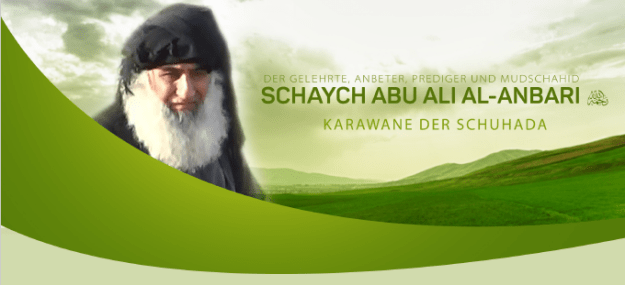
Obituary for Abdurrahman al-Qaduli in the German version of Rumiya, 11 November 2016

Obituary for Abdurrahman al-Qaduli in the German version of Rumiya, 11 November 2016

The forty-first edition of the Islamic State’s newsletter, al-Naba, released within the territory of the caliphate on 30 July 2016 and released online on 2 August, and the forty-third edition (released 13 and 16 August), contained a two-part obituary for Abd al-Rahman al-Qaduli (Abu Ali al-Anbari), the caliph’s deputy when he was killed on 24 March. The obituaries, entitled, “The Devout Scholar and Mujahid Preacher: Shaykh Abu Ali al-Anbari”,[1] make clear that al-Qaduli was one of the most consequential jihadists in the history of the Islamic State movement. Below is a translation, with some interesting and/or important sections highlighted in bold. The biography resolves some long-standing mysteries, and some of the claims are dubious in light of other evidence we have: these issues, and other points of context and explanation, are in the footnotes. The subheadings are mine, added to signpost the narrative and break it up into more manageable chunks.
Continue reading

Al-Qaeda Explains its Split with the Islamic State

By Kyle Orton (@KyleWOrton) on December 6, 2016

1

On 20 November 2016, Jabhat Fatah al-Sham (JFS), al-Qaeda’s rebranded presence in Syria, published its first official account of how JFS, previously known as Jabhat al-Nusra, split from its parent organization, the group we now know as the Islamic State (IS). The statement was composed by Abd al-Rahim Atun (Abu Abdullah al-Shami), identified as the General Judge of JFS. It is apparently drawn from the book, “Under the Shade of the Tree of Jihad” (p. 177-194), and the post was entitled, “The Establishment of Jabhat al-Nusra and the Events of al-Sham [Syria] from the Beginning of the Disagreement to the Announcement of al-Dawla [the State]”. On 27 November, Bilad al-Sham Media released an English language version of this statement, which is reproduced below with some editions for spelling, grammar, and so on, and some especially notable sections bolded. Continue reading