Tag Archives: al-Naba

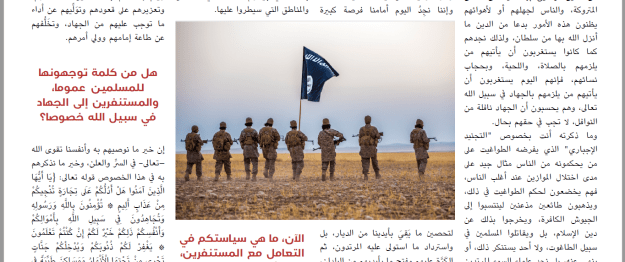
Islamic State Tells Its Forces To Fight To The Last Man in Raqqa

By Kyle Orton (@KyleWOrton) on 24 June 2017

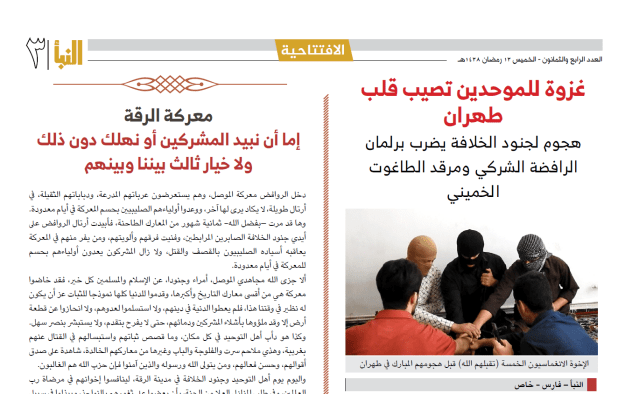
Al-Naba 84, page 3

The Islamic State (IS) has a standard strategy of withdrawing from urban areas and conserving its forces when faced with an overwhelming enemy. This strategy has been publicly spelled out by IS, more recently and a decade ago when “the State” was new. The notable exceptions to this rule, Fallujah (2004) and Kobani (2014), were driven by political considerations, and it appears that such considerations apply to Raqqa, IS’s Syrian “capital”, which came under attack from the U.S.-led Coalition’s “partner force”, the PKK front-group that calls itself the Syrian Democratic Forces (SDF), on 6 June. In the 84th edition of IS’s weekly newsletter, Al-Naba, released on 8 June, the main editorial was about the Raqqa battle and encouraged IS’s jihadists to fight to the very last, ostensibly to inflict such heavy casualties over such a protracted period that the SDF/PKK would not be able to sustain itself. Continue reading

Senior Islamic State Cleric Turki al-Binali Killed in an Airstrike

By Kyle Orton (@KyleWOrton) on 11 June 2017

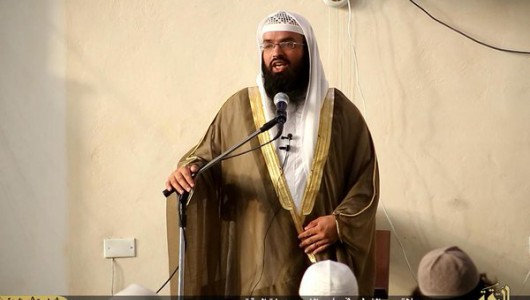
Turki al-Binali at prayers in Raqqa, July 2015

It was reported on jihadist websites and by local activists that Turki al-Binali (Abu Hammam al-Athari), a senior cleric of the Islamic State (IS) and perhaps the most important public proponent of the caliphate’s formation, had been killed in Syria by an airstrike from the U.S.-led Coalition on 29 May. IS has been silent on this despite releasing their newsletter al-Naba and the tenth edition of their English-language propaganda magazine Rumiyah since then. On Tuesday, the intelligence services of the Kurdistan Regional Government (KRG) in northern Iraq confirmed that al-Binali had been killed. Continue reading

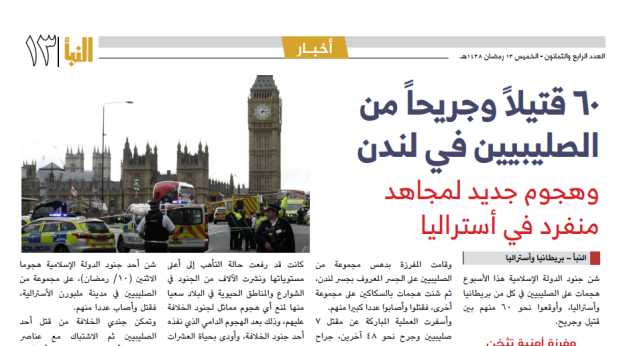
The Islamic State’s Newsletter on the London Bridge Attack and Melbourne Siege

By Kyle Orton (@KyleWOrton) on 8 June 2017

Al-Naba 84

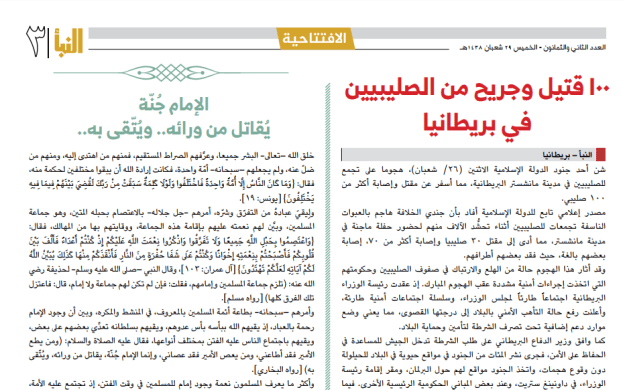
The eighty-forth edition of Al-Naba (The News), released by the Islamic State on 8 June 2017, included a section on the terrorist attacks in Britain, on London Bridge, on 3 June, and in Australia, the siege of the apartment block in Melbourne, on 5 June. Continue reading

Islamic State Newsletter Says Manchester Bomber Was a “Soldier of the Caliphate”

By Kyle Orton (@KyleWOrton) on 25 May 2017

Article about Manchester Arena suicide-killer Salman Abedi, page 2 of Al-Naba 82

The Islamic State (IS) released the eighty-second edition of its newsletter, Al-Naba, on 25 May 2017. The first article in Al-Naba 82 was about the suicide attack on the Manchester Arena on 22 May, which IS claimed the next day. The article in Al-Naba provided very few details about the murderer, Salman Abedi, or IS’s role in the attack, mostly gloating over the allegedly panicky reaction of the British state. Continue reading

Islamic State Newsletter Claims Algerian Suicide Bombing

By Kyle Orton (@KyleWOrton) on 9 April 2017

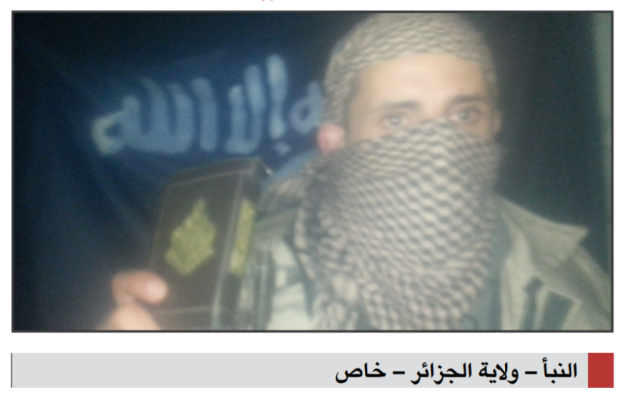
Picture published in Al-Naba 71 of Izzadeen Balqamri, the Islamic State suicide bomber in Constantine, Algeria, on 26 February 2017.

In the seventy-first edition of Al-Naba, the Islamic State’s English-language newsletter, published on 9 March 2017, the organisation claimed responsibility for the suicide bombing outside the police station in Constantine, Algeria, on 26 February. Al-Naba published a picture of the attacker and named him as Izzadeen Balqamri. Continue reading

Islamic State Claims the Westminster Attack

By Kyle Orton (@KyleWOrton) on 31 March 2017

Al-Naba 74, page 12, 30 March 2017

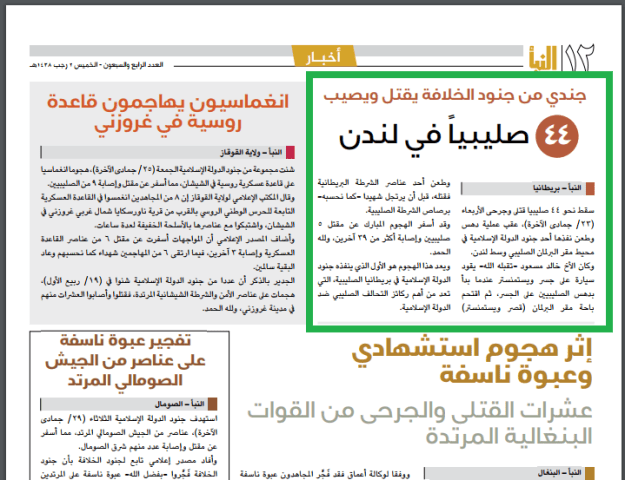
The seventy-fourth edition of al-Naba, the Islamic State’s newsletter, released online on 30 March 2017, reiterated the terrorist group’s 23 March claim via Amaq of the 22 March Westminster attack by Khalid Masood (born: Adrian Russell Ajao). The brief article is reproduced below.
Continue reading

Al-Naba’s Obituary for Abu Muhammad al-Adnani

By Kyle Orton (@KyleWOrton) on August 31, 2016

The United States reported yesterday that it had killed one of the most important officials in the Islamic State (IS), Taha Subhi Falaha, better known as Abu Muhammad al-Adnani. As the Pentagon statement noted, Falaha “served as principal architect of [IS’s] external operations and as [IS’s] chief spokesman.”

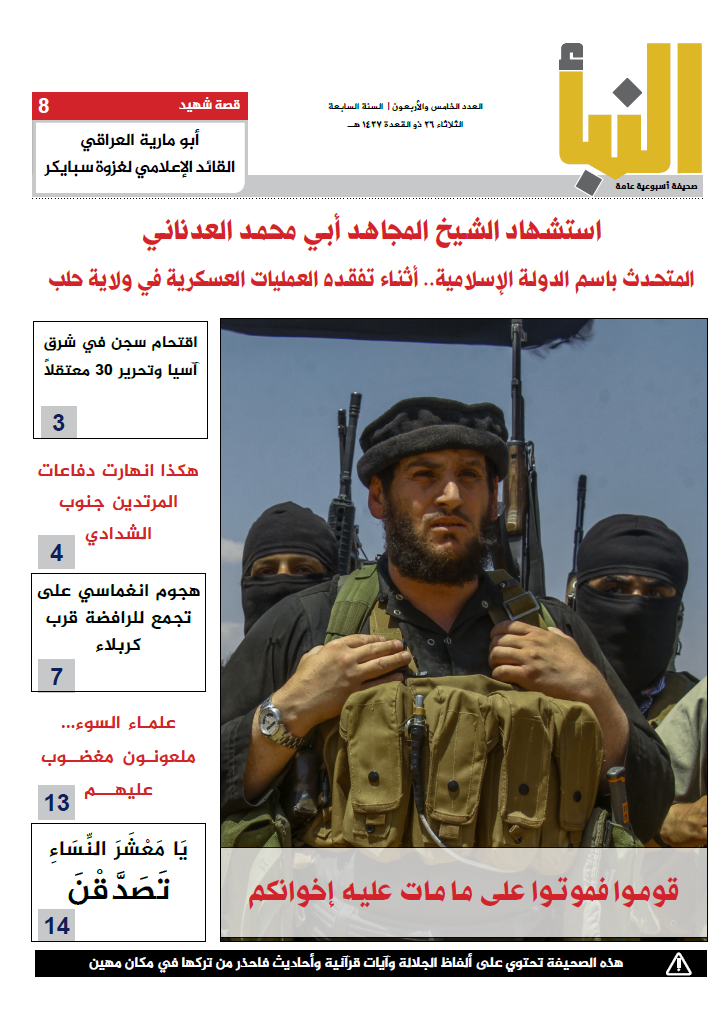
Within hours, IS issued the forty-fifth edition of its newsletter, Al-Naba. The cover of Al-Naba 45 (above) featured a photograph of Falaha, only the second one of him officially released by IS. The second page contained the only other official picture we have of Falaha—published in the second edition of Dabiq magazine on 27 July 2014—and a brief obituary. And the main editorial on page three was framed around Falaha.

Continue reading

Looking At the Islamic State’s Past, Seeing its Future

By Kyle Orton (@KyleWOrton) on August 27, 2016
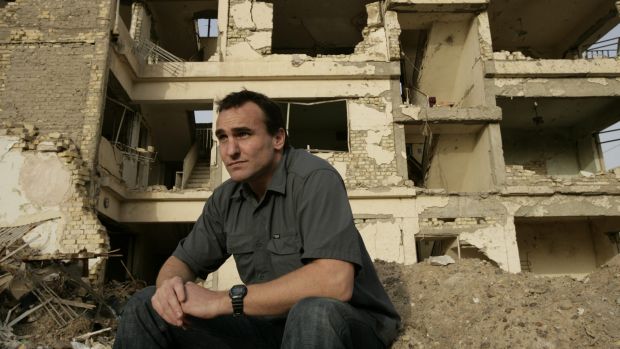
Michael Ware

Michael Ware

Only the Dead documents the experience of Michael Ware, an Australian journalist who arrived in Iraq in early 2003 and spent eleven months-per-year there for seven years. Ware made contact soon after the fall of Saddam Hussein with those resisting the new order, at a time when the Americans were struggling to map such forces.

Ware established communication with the more nationalist-Islamist forces. Once in that milieu, the globalist jihadists, who were working in the shadows, a small, foreign-dominated force towards which even many insurgents were guarded, found him. The leader of the jihadists, Ahmad al-Khalayleh, became something of an obsession for Ware as he stepped onto the world stage with his gruesome tactics as Abu Musab al-Zarqawi. Zarqawi, the “Shaykh of the Slaughters,” would found an organization that became a movement and then burst Iraq’s frontiers, known to us now as the Islamic State (IS).

In tracking Zarqawi and his men, Ware presents some incredible footage and gives some snapshots from the fascinating days, whose effects we are all still feeling, when the Iraqi insurgency was taking root. Continue reading

Ahrar al-Sham and Al-Qaeda

By Kyle Orton (@KyleWOrton) on August 12, 2016

The Islamic State’s (IS) weekly newsletter, al-Naba, interviewed a high-ranking al-Qaeda defector, Abu Ubayda al-Lubnani, across two issues in February and March 2016. Abu Ubayda announced his defection from al-Qaeda to IS in April 2014 via al-Battar and Abu Ubayda’s name appeared on a list of prominent clerics supporting IS’s caliphate declaration that was circulated not long after the declaration. Abu Ubayda is described by al-Naba—as best as can be told accurately—as having been a member of al-Qaeda’s Shura or Consultation Council, a training officer in its Military Committee, and a counter-intelligence officer. Abu Ubayda is advertised as speaking about many secret aspects of al-Qaeda.

Among the topics Abu Ubayda covers is the alleged infiltration and manipulation of al-Qaeda by foreign intelligence services, specifically Pakistan’s Inter-Services Intelligence (ISI), which is not only a violation of jihadist doctrine by collaborating with an “infidel” and illegitimate state but led to the deaths of a number of senior al-Qaeda leaders.

Perhaps the most intriguing aspect of what Abu Ubayda has to say relates to al-Qaeda’s attempt to take advantage of the Syrian revolution. This persistent campaign has followed a pattern of disguising al-Qaeda’s presence and attempting to influence and eventually co-opt the rebellion against Bashar al-Assad’s regime. One lever al-Qaeda relied upon, according to Abu Ubayda, was Ahrar al-Sham, an organization that disclaims all connections to al-Qaeda and dissimulates about its ideology. Whatever Ahrar’s dominant ideology, it is simply a fact that it has served as the bridge between the foreign-led jihadists and Syrian Islamists, and its connections to al-Qaeda are evident enough. Abu Ubayda suggests Ahrar’s connections to al-Qaeda are even deeper than they appear. Continue reading

Long-Term Islamic State Operative Carries Out Suicide Bombing in Ansbach

By Kyle Orton (@KyleWOrton) on July 27, 2016

The German police secure the area surrounding the crime scene after the suicide attack in Ansbach

The German police secure the area surrounding the crime scene after the suicide attack in Ansbach

In Ansbach in Bavaria State, southern Germany, a suicide bomber blew himself up at a wine bar not far from the Ansbach Open music festival during the final concert around 22:10 on the evening of 24 July 2016. Fifteen people were injured, three gravely. The suicide-killer, who had wandered around the entranceway with a backpack, was soon identified as a twenty-seven-year-old Syrian refugee, Mohammad Daleel, who came to Germany in 2014. Daleel “lived in an old hotel that was converted into a refugee shelter”. Daleel had been rejected as an asylum seeker in Germany, where he was known to the authorities for petty criminality. Daleel was scheduled to be deported to Bulgaria within thirty days, though the deportation had been temporarily suspended while Daleel underwent a medical evaluation, and had been placed in a psychiatric clinic. Daleel had allegedly tried to commit suicide twice before the bombing. Continue reading