Tag Archives: al-Qaeda

The Idlib Offensive: Delayed, Not Cancelled

By Kyle Orton (@KyleWOrton) on 20 September 2018

For about two months, it has seemed that an offensive by Bashar al-Assad’s regime, Iran, and Russia into Idlib was imminent, with disastrous humanitarian and strategic consequences. On Monday, an agreement was reached between Turkey and Russia that put a halt to this prospect, at least for now. There is good reason to think the pro-Assad forces are delaying, rather than cancelling, their plans to reconquer Idlib, but the extra time gives space to Turkey to alter the terms politically. Continue reading

Al-Qaeda Leader Says America is the Main Enemy

By Kyle Orton (@KyleWOrton) on 11 September 2018

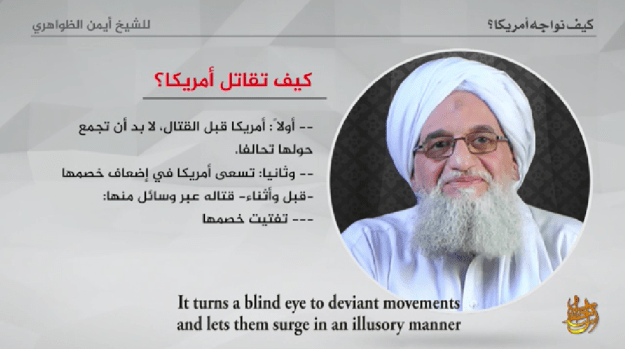
Al-Qaeda’s emir, Ayman al-Zawahiri, released a half-hour video speech today, entitled, “How to Confront America”. Al-Zawahiri’s speech mentions in passing the move of the U.S. Embassy in Israel from Tel Aviv to Jerusalem, but this—and the increasing relations of the Gulf states with the Jewish state—are held to be mere examples of the rot spread by America. Despite the lessening of Christian belief in the West, says Al-Zawahiri, the inhabitants of what was once called Christendom remain “Crusaders” at heart, with a fierce hatred for Islam and Muslims. Perhaps worse than any physical attack on the jihadists, however, is the ideological challenge of America’s secularism, Al-Zawahiri adds. An English transcript of the speech was released by As-Sahab Media and is reprinted below. Continue reading

The Man Who Made Crime Pay For the Islamic State

By Kyle Orton (@KyleWOrton) on 9 September 2018

The United States has launched at least five raids into Syria to date, all of them against the Islamic State (IS).[1] The second such raid, on 15 May 2015, killed Fathi al-Tunisi (Abu Sayyaf al-Iraqi, Abu Muhammad al-Iraqi, or Abd al-Ghani), who oversaw critical revenue-generating criminal schemes for the group. Al-Tunisi was primarily responsible for the oil industry in eastern Syria, in which capacity he collaborated with Bashar al-Asad’s regime, and he worked as head of the Antiquities Division of IS Diwan al-Rikaz, which translates literally as the “Department of Precious Things That Come Out of the Ground”, usually given as the “Department of Natural Resources”. Al-Tunisi was what is sometimes termed a “middle manager”: the connective tissue between the most senior levels of the leadership and local administrators, ensuring smooth coordination between the two by inter alia keeping the books. In short, the kind of terrorist operative that keeps an organisation going. Continue reading

What Questions Remain About 9/11?

By Kyle Orton (@KyleWOrton) on 5 September 2018

In less than a week, it will be the seventeenth anniversary of al-Qaeda’s “Plane’s Operation”, the assault on the United States. It is a vertiginous enough reflection that many of us have been alive more years since 11 September 2001 than before it, and positively alarming that many of those who will soon move into the government, media, and other leading societal institutions will have been born after an event that still shapes so much of the international scene. As Anthony Summers and Robbyn Swan put it in The Eleventh Day: The Ultimate Account of 9/11 (2011), we are left with “the brief name ‘9/11’,” the context and meaning stripped away all this time later. The book is a useful overview of an event that should always be to some degree fresh in mind, though it is not without its problems in its analytical sections. Continue reading

The State of Play in Syria and Iraq on the Eve of the Idlib Offensive

By Kyle Orton (@KyleWOrton) on 29 August 2018

Two ideas that have become quite prevalent are that the Islamic State is defeated or on its way to defeat and that the Syrian war is winding down. Both are gravely mistaken. Continue reading

The Coalition is Heading for Disaster in Afghanistan

By Kyle Orton (@KyleWOrton) on 16 August 2018

The Taliban released a statement on Tuesday afternoon about its virtual takeover of Ghazni province in southern Afghanistan. Alongside other recent developments, military and political, the outlook for the Coalition mission is increasingly bleak. Continue reading

The Capture of An ISIS Wife

By Kyle Orton (@KyleWOrton) on 21 July 2018

Seda Dudarkaeva (image source)

Turkish police announced on 19 July that they had arrested the wife of Tarkhan Batirashvili (Abu Umar al-Shishani), an Islamic State (IS) commander who was killed two years ago this month in Shirqat, Iraq. The capture brings to the fore a story stretching from senior levels of the Chechen Republic to the Levant. Continue reading

Turkey’s Upcoming Foreign Policy Challenges

By Kyle Orton (@KyleWOrton) on 12 July 2018

American troops look out toward the border with Turkey from a small outpost near the town of Minbij, 7 Feb. 2018 (AP Photo/Susannah George)

As Turkey moves past last month’s election, the foreign policy challenges remain acute, particularly in Syria, and there is a looming confrontation with the United States over sanctions on Iran that might undo the recent progress toward the normalisation of U.S.-Turkish relations. Continue reading

Al-Qaeda Statement on the Loss of Forces Fighting the Syrian Regime

By Kyle Orton (@KyleWOrton) on 9 July 2018


After the schism between al-Qaeda and its former Syrian branch, Jabhat al-Nusra (now Hay’at Tahrir al-Sham), the remaining al-Qaeda loyalists in the country gathered under the banner of Tandheem Hurras al-Deen (The Religious Guardians’ Organization). Hurras al-Deen has been among those targeted in the wave of assassinations in the “Greater Idlib” area, and has been publicly hereticized by the Islamic State, whose cells are among those conducting the assassinations. Hurras al-Deen in recent days has gained some popularity and legitimacy in Idlib by being the only force to initiate offensive operations against the pro-Asad coalition as the latter conquers Deraa. Today, Hurras al-Deen released a statement through its Sham al-Ribat Media on the loss of ten of its jihadists yesterday after they stepped on a mine near Sarja in southern Idlib. The statement is reproduced below. Continue reading

Egypt: Between Dictatorship and Islamism

By Kyle Orton (@KyleWOrton) on 4 July 2018

Egyptian soldiers in the Sinai (image source)

Five years on from the military coup d’etat in Egypt that brought to power Abdel Fattah el Sisi, the problems of the country—political, economic, demographic, security—remain as intractable as ever. Indeed, in many cases, the problems are worse than before. Among the problems that are noticeably worse now than in 2013 is security, specifically the Islamic State (Daesh) insurgency in the Sinai. Continue reading