Tag Archives: al-Qaeda

Former Al-Qaeda in Syria Branch Arrests Members of Al-Qaeda in Syria

By Kyle Orton (@KyleWOrton) on 28 November 2017

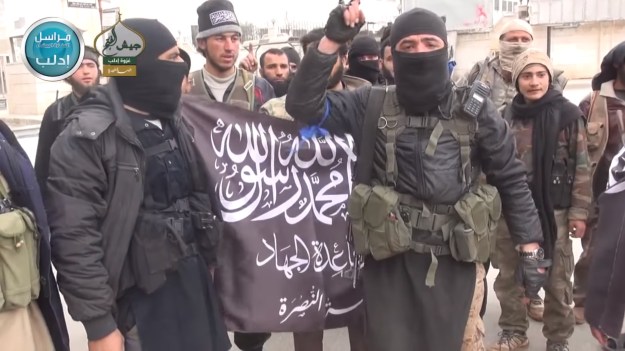
Iyad al-Tubaysi (Abu Julaybib), Sami al-Uraydi (Abu Mahmud al-Shami)

Hay’at Tahrir al-Sham (HTS), a powerful jihadi group in northern Syria, formally broke from al-Qaeda’s command over the last year. In the morning of 27 November, HTS arrested the leaders of a splinter group from HTS that remained loyal to al-Qaeda. The arrests were first reported by pro-al-Qaeda media, and HTS has since released a statement explaining that, having found this al-Qaeda group unwilling to even engage in reconciliation talks, it placed “the heads of turmoil” before a “just shari’a court” to answer for spreading demoralizing lies about HTS. Continue reading

Hay’at Tahrir al-Sham Statement on Arresting Al-Qaeda Loyalists in Syria

By Kyle Orton (@KyleWOrton) on 28 November 2017

Hay’at Tahrir al-Sham (HTS), the jihadist group in Syria that has broken away from al-Qaeda’s formal command, appears to have arrested the leaders of its splinter group that retained allegiance to al-Qaeda on 27 November. The arrests were first reported by pro-Qaeda media and later by HTS itself. HTS released a statement on the matter yesterday evening, “For the judicial authorities will be the decisive word,” which was translated by Al-Maqalaat and is reproduced below with some syntactical edits. Continue reading

America Reveals How Iran Funds Instability in Yemen

By Kyle Orton (@KyleWOrton) on 23 November 2017

The Office of Foreign Assets Control (OFAC) in the U.S. Department of Treasury, on 20 November, sanctioned “a network of individuals and entities involved in a large-scale scheme to help Iran’s Islamic Revolutionary Guard Corps-Quds Force (IRGC-QF) counterfeit currency to support its destabilizing activities” in Yemen. Continue reading

Al-Qaeda Instructs the Islamic State’s Predecessor Not to Attack Iran

By Kyle Orton (@KyleWOrton) on 21 November 2017

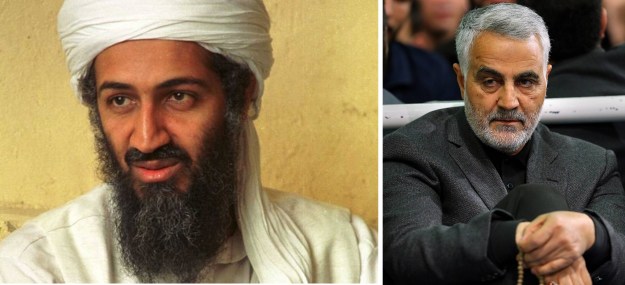
Usama bin Ladin, Qassem Sulaymani

Among the documents recovered from Usama bin Ladin’s compound in Abbottabad was the “Letter to Karim”, dated 18 October 2007. The letter was released in 2015 by the Office of the Director of National Intelligence (ODNI). “Karim” likely refers to Abdul Munim al-Badawi (Abu Hamza al-Muhajir), the leader of al-Qaeda in Mesopotamia (AQM), the predecessor organization to the Islamic State, after the group’s founder, Ahmad al-Khalayleh (Abu Musab al-Zarqawi), was killed in June 2006. The letter is reproduced below with some interesting details highlighted in bold. Continue reading

A Defection and the Dictatorship in Syrian Kurdistan

By Kyle Orton (@KyleWOrton) on 17 November 2017

Talal Silo

It was announced on 15 November that Talal Ali Silo, the official spokesman of the Syrian Democratic Forces (SDF), had fled to the EUPHRATES SHIELD zone in northern Aleppo, run by rebels operating under the Free Syrian Army (FSA) brand that are dependent on Turkey. The SDF is the partner force in Syria for the U.S.-led Coalition against the Islamic State (IS). Though the SDF presents itself as a multi-ethnic coalition of Kurds and Arabs, it was initiated as a front for the Kurdistan Workers’ Party (PKK). By attaching non-Kurdish units to a PKK core and using the SDF banner, it circumvented various legal and political obstacles for Coalition states. But all real power has remained in the hands of the PKK, which has systematically purged all genuinely independent power centres within the SDF. Silo, a Turkoman, helped further the narrative of the SDF’s ethnic inclusivity, and his defection underlines the reality of the organization’s political exclusivity. Continue reading

The Controversial End of the Islamic State in Raqqa

By Kyle Orton (@KyleWOrton) on 14 November 2017

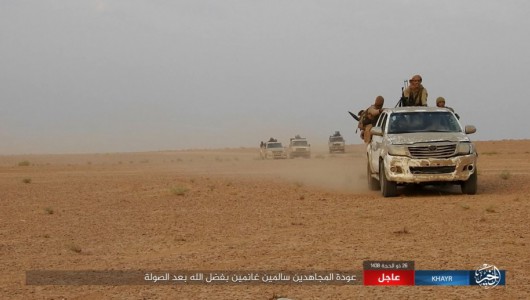
IS jihadists arriving south of Deir Ezzor city, September 2017

A deal was made between the “Syrian Democratic Forces,” the U.S.-led Coalition’s “partner force” in Syria that is wholly dominated by the Kurdistan Workers’ Party (PKK), and the Islamic State (IS), which ostensibly evacuated the remnants of the IS jihadists—said to be between 300 and 500 militants, plus 400 “hostages” (i.e. women and children)—from Raqqa by 15 October. The U.S.-led Coalition said at the time, “do not condone” the deal, but the Coalition acknowledged that its PKK partner had to make these tactical calls, and there was a lot of local pressure from local tribal leaders to reach this deal given the devastation visited on the city. It now transpires, however, that this deal was the worst of all worlds: the Coalition ruined the city in its efforts to overcome IS’s tactical adaptations to the air campaign, and then allowed a scandalous number of IS jihadists to escape. Continue reading

Hamza bin Ladin Presents Al-Qaeda As the Guardian of Revolution

By Kyle Orton (@KyleWOrton) on 9 November 2017

Hamza bin Ladin on his wedding day in Tehran, under the protection of the Quds Force, the expeditionary unit of the Islamic Revolutionary Guard Corps that attempts to spread the Iranian revolution through subversion and terrorism

Hamza bin Ladin, whose profile is being deliberately raised within al-Qaeda, released a speech on 7 November 2017, “The Fighter Against Invaders And The Inciter of Rebellion Against Tyrants”, an English transcript of which was produced by As-Sahab Media, and is reproduced below. Continue reading

Clerics Put Forward an Initiative to Unite Jihadists in Syria

By Kyle Orton (@KyleWOrton) on 27 October 2017

It was announced on 25 October that a unity proposal had been formulated to resolve the dispute in Syria between Hay’at Tahrir al-Sham (HTS), its former command organization, al-Qaeda, and the jihadi splinter faction from Ahrar al-Sham, Jaysh al-Ahrar, which has broken between the two. The initiative was backed by major jihadi-salafist clerics, Issam al-Barqawi (Abu Muhammad al-Maqdisi) and Umar Othman (Abu Qatada al-Filistini), and invited the support of all jihadi “scholars”. The text of the proposal, translated by Al-Maqalaat, is reproduced below, with some editions to transliteration and syntax. Continue reading

Al-Maqdisi Weighs in on Turkey’s Intervention in Idlib and Hay’at Tahrir al-Sham

By Kyle Orton (@KyleWOrton) on 14 October 2017

Issam al-Barqawi (Abu Muhammad al-Maqdisi), the Jordan-based jihadi-salafist cleric, put out a message on 12 October 2017 in reaction to the Turkish government moving forces into the Idlib Province in north-western Syria on 7 October. Initially it had seemed that Turkey was to confront Hay’at Tahrir al-Sham (HTS), the former al-Qaeda branch in Syria, but it soon became apparent that the operation was a redrawing of terms that was largely coordinated between Ankara and HTS. Given how critical al-Barqawi has been of HTS, this was interesting. Al-Barqawi’s statement was translated by Trunk News Translations and is republished below. Continue reading

The Islamic State Planned For Sectarian War in Iraq From the Beginning

By Kyle Orton (@KyleWOrton) on 13 October 2017

The Iraqi Kurdish authorities arrested Mustafa Haji Muhammad Khan (Hassan Ghul) on 23 January 2004. Khan had been dispatched to Iraq by Nashwan Abd al-Baqi (Abd al-Hadi al-Iraqi), one of the key military officials of al-Qaeda “central” (AQC), to function as AQC’s intermediary with Ahmad al-Khalayleh (Abu Musab al-Zarqawi), the founder of the Islamic State movement. Khan replaced Abdallah al-Kurdi, the first envoy sent by Abd al-Baqi. Al-Kurdi had failed to establish any footing to do his job effectively, but Khan, a battle-hardened jihadist from Baluchistan, earned a measure of respect from al-Khalayleh and facilitated a productive conversation between AQC and al-Khalayleh. Al-Khalayleh, possessed of a pathological anti-Shi’ism, wrote a seventeen-page memo to Usama bin Laden explaining his strategy to defeat the Americans by starting a total war between the sects in Iraq. That memo, in digital form, was given to Khan, and Khan had it in his possession when he was captured. A translation of the letter is given below with some interesting sections highlighted in bold.[1] Continue reading