Tag Archives: al-Qaeda

The Islamic State’s Obituary for Abu Ayman al-Iraqi

By Kyle Orton (@KyleWOrton) on 12 September 2017

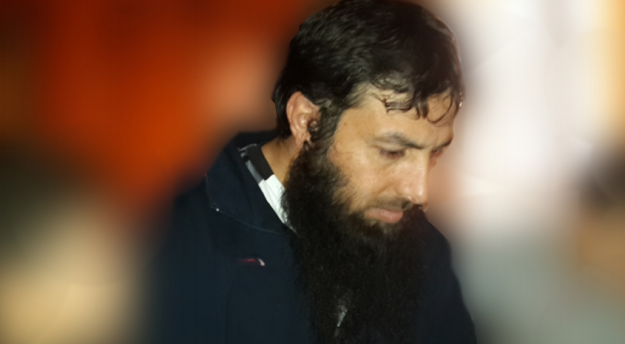
Ali al-Aswad (Abu Ayman al-Iraqi), al-Naba, 20 July 2017

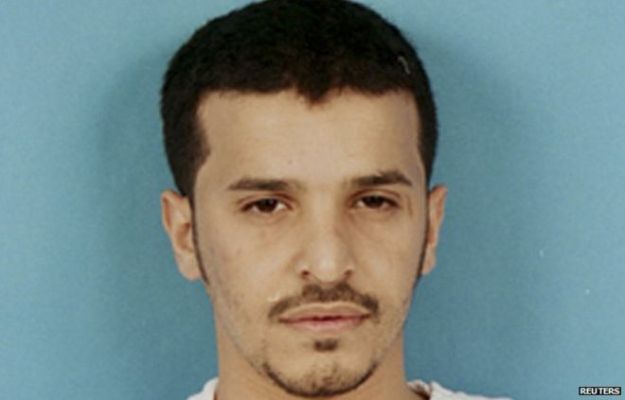
In the ninetieth edition of its newsletter, al-Naba, released on 20 July 2017, the Islamic State (IS) published an obituary for one of its most senior operatives, Ali Aswad al-Jiburi, much better known as Abu Ayman al-Iraqi, who had been serving as the caliph’s “security advisor” when he was killed on 18 May 2016. Continue reading

The Campaign to Weaken An Al-Qaeda-Affiliated Group in Syria

By Kyle Orton (@KyleWOrton) on 12 September 2017

Abdallah al-Muhaysini and Muslah al-Alyani, two senior clerics in Hay’at Tahrir al-Sham (HTS), the former al-Qaeda branch in Syria, resigned on 11 September 2017 after leaked recordings showed HTS commanders musing about assassinating al-Muhaysini. There is clearly a well-orchestrated campaign underway to weaken HTS by discrediting and dividing it, and the sophistication of the campaign gives every indication of being the work of a state intelligence service, almost certainly Turkey’s. Continue reading

Syria’s Regime Conducted the Khan Shaykhun Chemical Attack, United Nations Concludes

By Kyle Orton (@KyleWOrton) on 9 September 2017

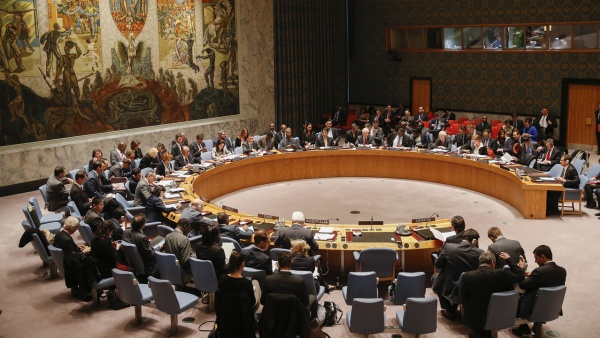
United Nations Security Council (Shannon Stapleton/Reuters)

After the use of chemical weapons of mass destruction (CWMD) in the Syrian town of Khan Shaykhun in April, American and French intelligence publicly assessed that the perpetrator was the regime of Bashar al-Asad, and President Donald Trump acted swiftly to punish the atrocity. The United Nations Independent International Commission of Inquiry on the Syrian Arab Republic released a report on 6 September that ratifies these findings, concluding that Asad attacked the population of Khan Shaykhun with chemical weapons. Continue reading

One More Time on Saddam and the Islamic State

Originally published at The Henry Jackson Society

By Kyle Orton (@KyleWOrton) on 2 September 2017

The most recent issue of Perspectives on Terrorism had a paper by Ronen Zeidel entitled, ‘The Dawa’ish: A Collective Profile of IS Commanders’, which was “the first attempt to provide a comprehensive collective profile of commanders and leaders of the Islamic State (IS)”. Based on “an inventory of over 600 names”, the paper assessed the nationality, ethnicity, and tribal origins not just of the very senior IS commanders, but those lower down, a novel and much-needed line of investigation. Zeidel found that these commanders of the IS movement are or were overwhelmingly Iraqi and Sunni Arab, with an important Turkoman contingent.

Zeidel’s findings are important for drawing attention again to the local-revolutionary character of an organisation that gets a great deal of attention for its foreign fighters and external attacks, especially in the West, but which only a recently acquired global reach—and, indeed, only recently needed to: until 2011, the West was easily reachable since it had troops on the ground in Iraq, so the incentive to invest resources in creating a foreign terrorist apparatus was minimal.

One small part of Zeidel’s work has created something of a storm, however. Zeidel gives the occupation held by these commanders and, for those where this was known, 72% of them were former regime elements (FREs) from the dictatorship of Saddam Husayn. This reignited the argument over how important the FREs have been to IS. Continue reading

Islamic State Imposes Conscription

By Kyle Orton (@KyleWOrton) on 18 August 2017

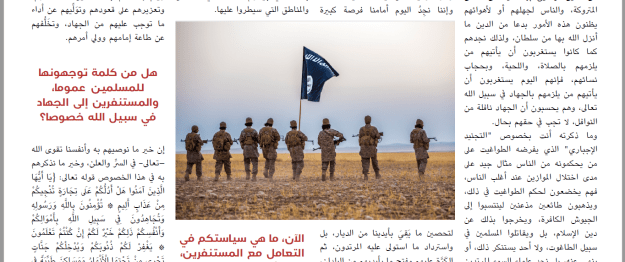
Al-Naba 93, page 9

The Islamic State (IS) is clearly struggling to hold its ground in eastern Syria and has now, for the first time in its history, compelled men into its ranks to try to stem this tide. Continue reading

The Forgotten Foreign Fighters: The PKK in Syria

By Kyle Orton (@KyleWOrton) on 17 August 2017

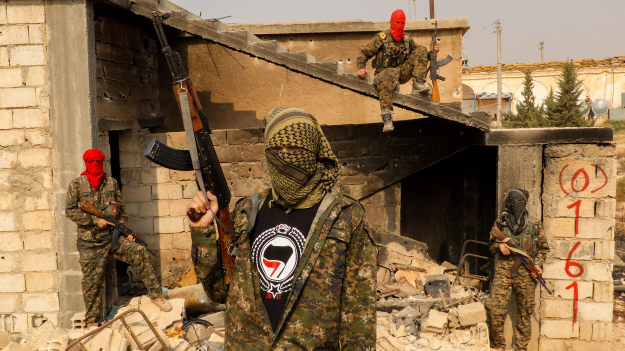
I released a report today, published by the Henry Jackson Society, The Forgotten Foreign Fighters: The PKK in Syria. Continue reading

The Role of Turkey in Syria

By Kyle Orton (@KyleWOrton) on 16 August 2017

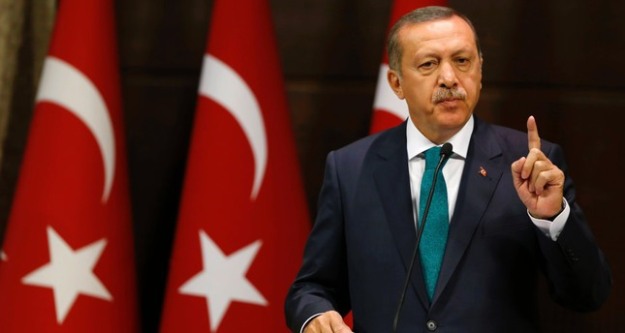
Recep Tayyip Erdogan (image source)

The Turkish government has gotten more and more deeply involved in Syria since the uprising began in 2011. But Turkey now finds its original aim, namely the overthrow of Bashar al-Assad’s regime, unattainable, creating tensions with the Syrian armed opposition, its primary lever inside Syria, and there are considerable problems stabilizing the zone of Syria that came under Turkish occupation after Ankara’s direct intervention in 2016. The defeat of Turkey’s primary objective has been accompanied by the rise of further problems, notably the exacerbation of its longest-standing internal security threat, that posed by the Kurdistan Workers’ Party (Partiya Karkerên Kurdistan – PKK), and the generation of new internal threats, from the Islamic State (IS) and potentially from al-Qaeda-linked groups. The options for solving these problems are constrained and unpalatable. Continue reading

Whither Al-Qaeda in Syria?

By Kyle Orton (@KyleWOrton) on 15 August 2017

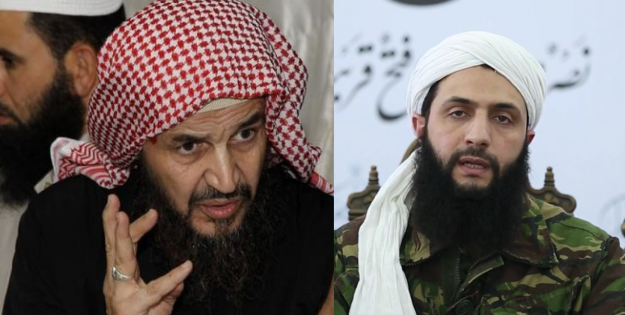
A statement from Issam al-Barqawi, far better known as Abu Muhammad al-Maqdisi, the Jordan-based Palestinian jihadi-salafist cleric, was released in English on Telegram on 15 August 2017. The statement dealt with his view of Hay’at Tahrir al-Sham (HTS), highlighting again the questions around this Syrian-based jihadi group and its relations with al-Qaeda. Continue reading

The Leadership Structure of the Islamic State

By Kyle Orton (@KyleWOrton) on 6 August 2017

A year ago, I wrote a report documenting the biographies of Islamic State (IS) leaders and something of the structure of the organisation. Since then, the intricacies of the structure have been further revealed, even as it has somewhat crumbled in practice. The caliphate—the statelet built by IS—has been significantly degraded: the Iraqi “capital”, Mosul, has fallen, and operation to clear the Syrian “capital”, Raqqa, is underway. More significantly, upwards of 40% of those profiled have been killed, so it seemed an opportune moment for an update on who currently leads the world’s most infamous terrorist movement.
Continue reading

Iran and Russia Are Using the Taliban Against the West

By Kyle Orton (@KyleWOrton) on 5 August 2017

Taliban jihadists (image source)

The New York Times reported on the growing closeness of relations between the governments in Iran and Russia, and the Taliban movement in Afghanistan, something that became especially salient earlier this year and which has been visible for at least two years. Continue reading