Tag Archives: Ayman al-Zawahiri

Fifteen Years After 9/11

By Kyle Orton (@KyleWOrton) on September 11, 2016

Originally published at The International Business Times

1

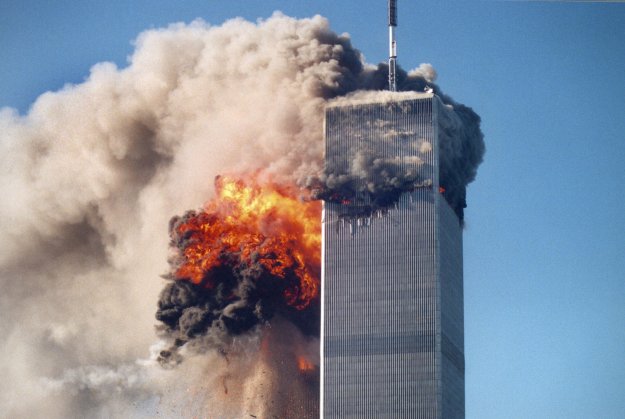
Fifteen years on from the 11 September 2001 terror attacks on the US, al-Qaeda is better-positioned than ever before. Its leadership held, and it has rebuilt a presence in Afghanistan. More importantly, al-Qaeda has built powerful regional branches in India, North Africa, Somalia, Yemen and Syria.

Rebranding itself away from the savagery of Iraq, al-Qaeda has sought to embed itself in local populations by gaining popular legitimacy to shield itself from retribution if, or when, it launches terrorist strikes in the West. This is proceeding apace, above all because of a failure to assist the mainstream opposition in Syria, sections of which were forced into interdependency with al-Qaeda to resist the strategy of massacre and expulsion conducted by the Assad regime. Continue reading

The Fall of the Islamic State’s Terrorism Director

By Kyle Orton (@KyleWOrton) on August 31, 2016

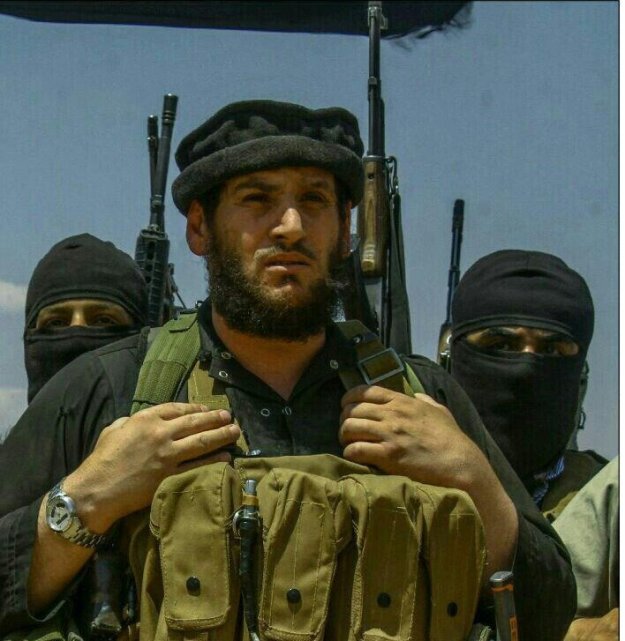
Taha Falaha (Abu Muhammad al-Adnani) in al-Naba

Taha Falaha (Abu Muhammad al-Adnani) in al-Naba

The Islamic State confirmed yesterday, via their “news” agency Amaq, that Taha Subhi Falaha had been killed in Aleppo. Falaha had gained global notoriety under his kunya, Abu Muhammad al-Adnani, after his September 2014 speech calling on Muslims in the West to “kill any disbeliever” in range, and to at least “spit in his face” if one was unable to find a knife or a car or a rock to do murder with.

Falaha was often referred to as the spokesman of IS, and so he was—the voice of the organization since 2011. He was also from the first generation of the organization, recruited before the invasion of Iraq, one of the few within the organization of that stature. But, as I explained recently in a paper for the Henry Jackson Society that compiled what is known of IS’s leadership, Falaha was much more than a figurehead.

Falaha was the governor of IS-held areas in Syria and the man who oversaw the external terrorist attacks. By now he was the caliph’s effective deputy. Heretofore, IS’s impressive bureaucracy has managed to replace individuals with minimal perturbation. IS will experience few perturbations quite like this.
Continue reading

The Dangers of Emptying Guantanamo

By Kyle Orton (@KyleWOrton) on August 17, 2016

It was announced on 15 August that fifteen more inmates from the Guantanamo Bay detention facility have transferred, twelve Yemenis and three Afghans, to the United Arab Emirates, the largest individual release of the Obama administration. The U.A.E. also took in five “lower-level” Yemeni detainees in November. The Emirates had previously taken in just one—Abdullah al-Hamiri, in 2008—but President Obama leveraged this deal with the Gulf states at the May 2015 meeting when the Khaleejis were deeply concerned about the then-impending Iran nuclear deal, and in exchange for security reassurances, Obama extracted further concessions.

One reason why so many jihadists have been released to the U.A.E., other than having a similar language and culture, is because the U.A.E. has a competent security apparatus to monitor these people. Those released last November were kept in “a custodial rehabilitation program“—a version of house-arrest, basically. The conditions this time around are less clear.

What is clear is just how dangerous the operatives who are being let out of the Guantanamo detention facility are. Every single one of them has been assessed as posing a “high” risk to America, her interests, and her allies. Continue reading

The Structure of Al-Qaeda

By Kyle Orton (@KyleWOrton) on August 14, 2016
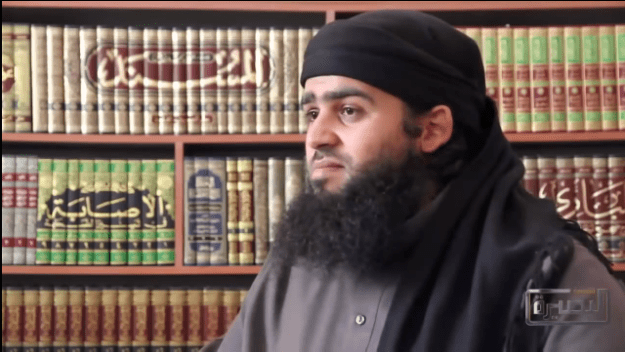
Screenshot of Mostafa Mahamed (Abu Sulayman al-Muhajir) during a video interview, 12 April 2014

Screenshot of Mostafa Mahamed (Abu Sulayman al-Muhajir) during a video interview, 12 April 2014

Mostafa Mahamed (Abu Sulayman al-Muhajir) is an Australian citizen who was born on 14 February 1984 in Port Said, Egypt. Mahamed currently occupies a “senior leadership position” within al-Qaeda in Syria—formerly Jabhat al-Nusra, now Jabhat Fatah al-Sham (JFS)—according to the sanctions levied against him in May by the U.S. Treasury. In an indication of Mahamed’s seniority, he moved from Australia to Syria in late 2012 and within a few months led the mediation efforts between al-Nusra and the then-Islamic State of Iraq and Syria (ISIS), now the Islamic State (IS), that began with a breach in April 2013 and ended with al-Qaeda expelling ISIS from its command structure in February 2014. Mahamed is also one of the public faces of al-Qaeda in Syria, now calling himself the “Director of Foreign Media Relations of JFS”. In this capacity, Mahamed has inter alia recently communicated with CNN to further the narrative that al-Nusra/JFS has “split” with al-Qaeda—something, let it be noted, neither the leader of al-Nusra/JFS nor Mahamed have actually said.

With regard to both the ongoing narrative war between IS and al-Qaeda over what their actual relationship was in the lead-up to the schism and al-Qaeda’s structure—the two things very much interlinked—Mahamed gave a very useful interview on 12 April 2014, about ten weeks before ISIS became IS when it declared its caliphate. Mahamed also touches on other interesting matters, such as those jihadi ideologues al-Nusra/JFS regards as guides, and—small point—al-Qaeda’s continuing claim that IS’s founder, Abu Musab al-Zarqawi would have sided with them. (This is matched on the other side by IS continuing to feature Usama bin Ladin in their propaganda as one of their forebears, while regarding Ayman al-Zawahiri as deviant.)

In watching the video back, I ended up taking notes, which turned into a partial (though fairly substantial) transcript that will perhaps be of use to others as well, so it’s posted below. Continue reading

Ahrar al-Sham and Al-Qaeda

By Kyle Orton (@KyleWOrton) on August 12, 2016

The Islamic State’s (IS) weekly newsletter, al-Naba, interviewed a high-ranking al-Qaeda defector, Abu Ubayda al-Lubnani, across two issues in February and March 2016. Abu Ubayda announced his defection from al-Qaeda to IS in April 2014 via al-Battar and Abu Ubayda’s name appeared on a list of prominent clerics supporting IS’s caliphate declaration that was circulated not long after the declaration. Abu Ubayda is described by al-Naba—as best as can be told accurately—as having been a member of al-Qaeda’s Shura or Consultation Council, a training officer in its Military Committee, and a counter-intelligence officer. Abu Ubayda is advertised as speaking about many secret aspects of al-Qaeda.

Among the topics Abu Ubayda covers is the alleged infiltration and manipulation of al-Qaeda by foreign intelligence services, specifically Pakistan’s Inter-Services Intelligence (ISI), which is not only a violation of jihadist doctrine by collaborating with an “infidel” and illegitimate state but led to the deaths of a number of senior al-Qaeda leaders.

Perhaps the most intriguing aspect of what Abu Ubayda has to say relates to al-Qaeda’s attempt to take advantage of the Syrian revolution. This persistent campaign has followed a pattern of disguising al-Qaeda’s presence and attempting to influence and eventually co-opt the rebellion against Bashar al-Assad’s regime. One lever al-Qaeda relied upon, according to Abu Ubayda, was Ahrar al-Sham, an organization that disclaims all connections to al-Qaeda and dissimulates about its ideology. Whatever Ahrar’s dominant ideology, it is simply a fact that it has served as the bridge between the foreign-led jihadists and Syrian Islamists, and its connections to al-Qaeda are evident enough. Abu Ubayda suggests Ahrar’s connections to al-Qaeda are even deeper than they appear. Continue reading

Al-Qaeda Rebrands, Marches on in Syria

By Kyle Orton (@KyleWOrton) on August 2, 2016

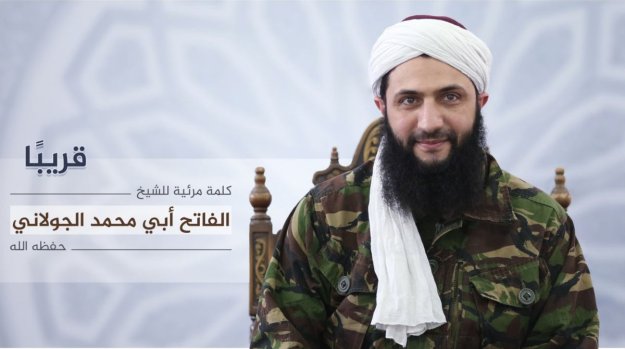
First ever picture of the leader of Jabhat al-Nusra (al-Qaeda in Syria), Ahmad al-Shara (Abu Muhammad al-Jolani), 28 July 2016

First ever picture of the leader of Jabhat al-Nusra (al-Qaeda in Syria), Ahmad al-Shara (Abu Muhammad al-Jolani), 28 July 2016

The leader of Jabhat al-Nusra (al-Qaeda in Syria), Abu Muhammad al-Jolani, whose real name is Ahmad al-Shara, ostensibly broke the link between his organization and al-Qaeda last week. This is another stage in al-Qaeda’s long-term strategy of embedding itself into local societies so that it can more effectively reshape the faith and shield itself from the international community. Continue reading

Jabhat al-Nusra Claims to Dissociate From Al-Qaeda

By Kyle Orton (@KyleWOrton) on July 28, 2016

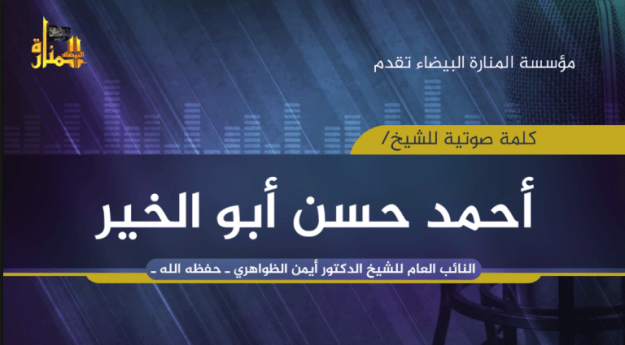
Graphic released with the speech of Ahmad Hassan (Abu Khayr al-Masri) about Jabhat al-Nusra and relations with al-Qaeda

Graphic released with the speech of Ahmad Hassan (Abu Khayr al-Masri) about Jabhat al-Nusra and relations with al-Qaeda

In advance of Jabhat al-Nusra rebranding as Jabhat Fatah al-Sham (JFS) on 28 July 2016, there were carefully coordinated media releases between al-Qaeda “central” (AQC) and al-Nusra. First, al-Manara al-Bayda (The White Minaret), al-Nusra’s media arm, released a six-minute audio speech by Abdullah Muhammad Rajab Abd al-Rahman (Abu Khayr al-Masri),[1] identified as the deputy to al-Qaeda’s leader Ayman al-Zawahiri; then there was the first ever picture of al-Nusra’s leader, Abu Muhammad al-Jolani, whose real name is Ahmad Husayn al-Shara, and shortly thereafter a video of al-Shara ostensibly severing ties with al-Qaeda; and finally the founding document for JFS was published. Continue reading

Donald Trump is Wrong (Again): Saddam Hussein Supported Terrorism

By Kyle Orton (@KyleWOrton) on July 6, 2016

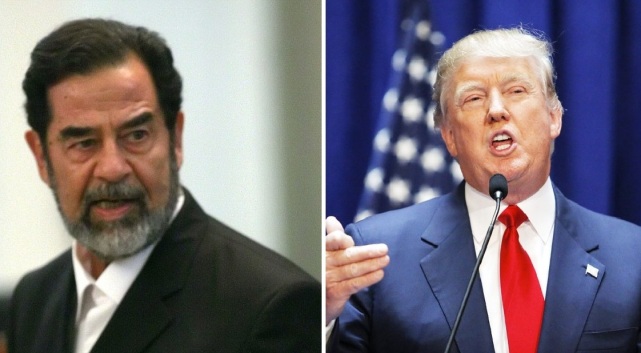
Last night Donald Trump unburdened himself of the view that Saddam Hussein was an efficient anti-terrorist operator. It is a statement Trump has made before, and it is one of such staggering ignorance—yet one which has such wide sympathy—that it seemed worth examining the multiple ways in which it was wrong. Continue reading

Yemen and Al-Qaeda’s Long-Term Strategy

By Kyle Orton (@KyleWOrton) on May 10, 2016

During al-Qaeda's occupation of al-Mukalla, Yemen, April 2015 to April 2016 (source)

During al-Qaeda’s occupation of al-Mukalla, Yemen, April 2015 to April 2016 (source)

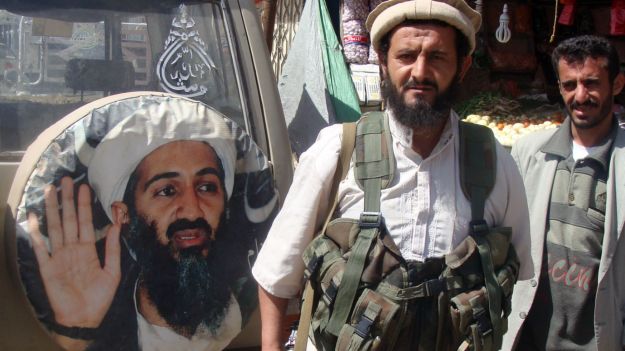
In Yemen, at the end of last month, al-Qaeda in the Arabian Peninsula (AQAP) was cleared from al-Mukalla, their major urban stronghold. This ends a year of occupation and brings to a close what is effectively the third emirate or statelet AQAP has either set up or attempted to set up in Yemen since 2011. These projects offer some insights into al-Qaeda’s methodology in getting to an Islamic state, including its rebranding in opposition to the Islamic State (IS). Continue reading

Al-Qaeda’s Leader Calls for Jihadi Unity in Syria, Building a Caliphate

By Kyle Orton (@KyleWOrton) on May 9, 2016

1

The leader of al-Qaeda, Ayman al-Zawahiri, released an audio statement on 8 May 2016. The speech was entitled, “Hasten to Syria,” “Go Forth to Syria,” or “March Forth to Syria,” depending on translation.[1] An English-language translation has been made available and is reproduced below, with some editions in transliteration and some important sections highlighted in bold. Continue reading