By Kyle Orton (@KyleWOrton) on 18 November 2019
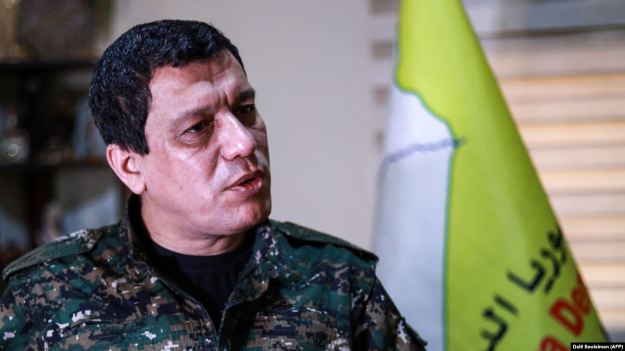
“SDF commander “General Mazlum Kobani” (the PKK executive official Ferhat Abdi Shahin) being interviewed by AFP in Hasaka city, 24 January 2019 [image source]
By Kyle Orton (@KyleWOrton) on 18 November 2019
“SDF commander “General Mazlum Kobani” (the PKK executive official Ferhat Abdi Shahin) being interviewed by AFP in Hasaka city, 24 January 2019 [image source]
By Oved Lobel on 18 November 2019

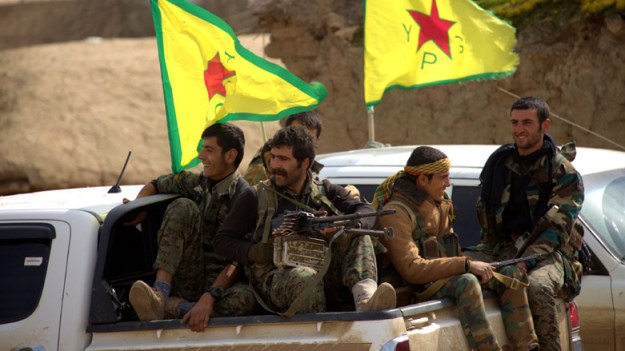
PKK at a terrorist training camp in the Asad regime-held Bekaa Valley of Lebanon, 1991 [source]
The broad outline of the PKK’s relationship with the Soviet Union—and then the Russian Federation—is fairly clear. After the PKK was founded in Turkey in the late 1970s by Ocalan, it was evicted from the country during the 1980 military coup. The PKK moved to Syria, where Ocalan was already based, having fled Turkey in June 1979. From there, the PKK moved into the Bekaa area of Lebanon, at that time controlled by the Syrian regime of Hafez al-Asad, and the Soviets acted through Asad, as they so often did in dealing with terrorist groups, to build the PKK into a fighting force that was then unleashed in 1984 on Turkey, a frontline NATO state in the Cold War. Continue reading
By Kyle Orton (@KyleWOrton) on 22 July 2019

U.S. President Donald Trump and Turkey’s President Recep Tayyip Erdogan meeting during the G20 leaders summit in Osaka, Japan, 29 June 2019 [image source]
By Kyle Orton (@KyleWOrton) on 15 June 2019
The Arab inhabitants of eastern Syria have once again turned out in protest against the Syrian Democratic Forces (SDF), the Western partner force in the campaign against the Islamic State (IS). The rejection of the SDF’s rule in the area has its roots in political dynamics that were entirely foreseeable. Continue readingBy Kyle Orton (@KyleWOrton) on 18 April 2019

Israeli opinion generally regards the country’s efforts to contain Iran, especially in Syria, as having been successful. In fact, the trendline runs the other way: Iran is constraining Israel, entrenching all around the Jewish state. Continue reading
By Kyle Orton (@KyleWOrton) on 15 April 2019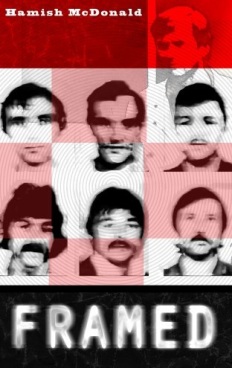
In February 1979, police in south-eastern Australia arrested six people. The suspects were members of the Croatian nationalist scene that agitated against Communist Jugoslavija and they had planned to commit a series of attacks against symbols of Marshal Tito’s regime that could have killed hundreds of Australians. Except they hadn’t, as Hamish McDonald, a journalist with the Sydney Morning Herald, shows in Framed (2012). Despite the “Croatian Six” being convicted for terrorism and spending a decade in prison, the reality of what had happened was nearly the exact opposite—and at least some powerful people in the Australian government knew or suspected as much from the get-go. Continue reading
By Kyle Orton (@KyleWOrton) on 20 March 2019
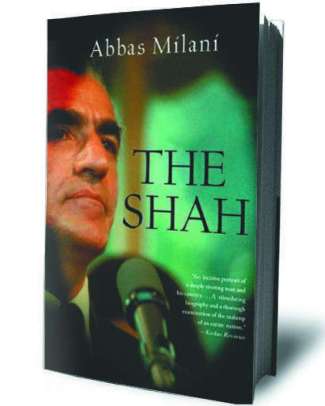
Abbas Milani’s The Shah gives a portrait of Iran’s last monarch, Muhammad Reza Pahlavi, and the impact that his downfall forty years ago continues to have in the Middle East, notably the emboldening of the Islamist movement. Continue reading
By Kyle Orton (@KyleWOrton) on 19 March 2019

When the Democratic Party faced a revolt from its ranks for daring to propose condemning anti-Semitism, the scene gave those of us in Britain deja vu. The American Left is following the same script that led to the rapid radicalization of the Labour Party, led by Jeremy Corbyn. It’s no longer a mere talking point, a form of shorthand for journalists: The Democratic Party’s Corbynization is here, and it tacks so closely to what happened in Britain that it’s important for Americans to understand where we’ve been — and where they’re headed. Continue reading
By Kyle Orton (@KyleWOrton) on 17 January 2019

Forty years ago yesterday, Muhammad Reza Pahlavi, the Shah (King) of Iran, left his country for the last time as a year-long revolution crested. A month later, the remnants of the Imperial Government collapsed and Grand Ayatollah Ruhollah Khomeini was swept to power after his long exile, establishing the first Islamist regime. Andrew Scott Cooper’s 2016 book, The Fall of Heaven: The Pahlavis and the Final Days of Imperial Iran, charts how this happened. Continue reading
By Kyle Orton (@KyleWOrton) on 12 December 2018

© AP Photo / Jim Hollander, Pool
Essay: “Zionism is Making Us Stupid”: The Russian Relationship with Israel from the Soviets to Putin Continue reading