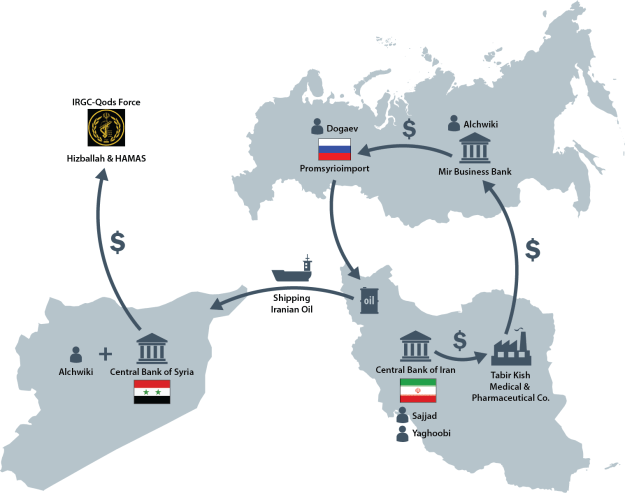
Visual representation of the Alchwiki Network (source: U.S. Treasury)
The United States Treasury Department’s Office of Foreign Assets Control (OFAC) sanctioned ten targets today, targeting an “international network through which the Iranian regime, working with Russian companies, provides millions of barrels of oil to” Bashar al-Assad’s regime in Syria, and “[t]he Assad regime, in turn, facilitates the movement of hundreds of millions of U.S. dollars (USD) to the Islamic Revolutionary Guard Corps-Qods Force (IRGC-QF),” the expeditionary wing of Tehran’s spy-terrorist apparatus, “for onward transfer to HAMAS and Hizballah.” Continue reading →
Al-Qaeda’s leader, Ayman al-Zawahiri, made a speech on 26 January 2018, entitled, “After Seven Years Where Is the Deliverance?” The speech built the case that the “Arab spring” uprisings failed because they tried to make changes within the framework of the nation-state, to be incremental, and to make accommodations with the fallen regimes, rather than radical “purification” by launching coordinated jihadist revolutions that respected no frontier, violently uprooted the old order, and implemented the shari’a. An English transcript of the speech was released by al-Qaeda’s As-Sahab Media station and is reproduced below. Continue reading →
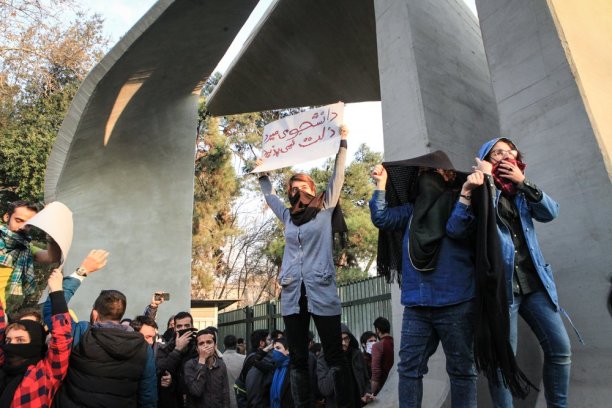
Protests in Tehran, Iran, 30 December 2017. (Photo by Stringer/Anadolu Agency/Getty Images)
Protests broke out against the Iranian government on 27 December, and have achieved a wider geographic spread in the country than even the massive uprising of June 2009, reaching into religiously conservative, working-class towns and districts traditionally regarded as pro-regime. It is likely these demonstrations will be suppressed, but that does not obviate the need for Western policy. To the contrary, the protests exposed several flawed assumptions in recent policy-making, and a course correction is urgently necessary. Continue reading →
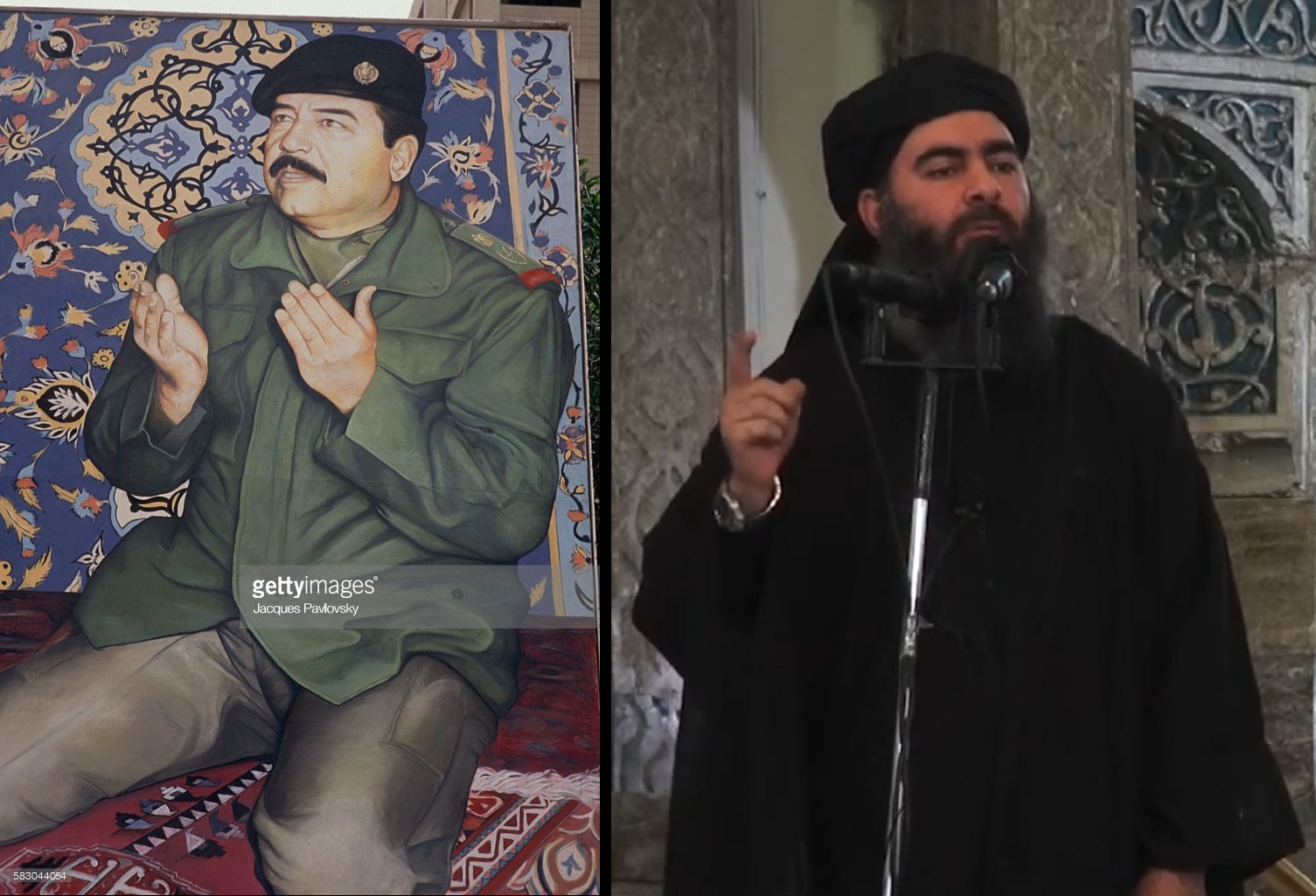
This essay, written to tie together my work on the relationship between the Saddam Hussein regime and the Islamic State, was completed last summer and submitted to an outlet, where it entered a form of development hell. After giving up on that option late last year, the opportunity arose to get a shorter version published in The New York Times in December. But I procrastinated too long over what to do with the full essay and a recent change in my work situation means I no longer have the bandwidth to go through the process of finding it a new home, so here it is.
“Abu-Bakr al Baghdadi is a product of the last decade of Saddam’s reign,” argues Amatzia Baram, a scholar of Iraq. He is correct in at least three ways. First, in its last decade in power, the Iraqi Ba’ath regime transformed into an Islamist government, cultivating a more religious, sectarian population on which the Islamic State (ISIS) could draw. Part of Saddam Hussein’s “Faith Campaign” also involved outreach to Islamist terrorists, including al-Qaeda, which meant that the synthesis of Ba’athism and Salafism that fused into the Iraqi insurgency after the fall of Saddam was already well advanced by the time the Anglo-American forces arrived in Baghdad in 2003. Second, the ISIS leadership and military planning and logistics is substantially reliant on the intellectual capital grown in the military and intelligence services of the Saddam regime. And finally, the smuggling networks on which ISIS relies, among the tribes and across the borders of Iraq’s neighbours, for the movement of men and materiel, are directly inherited from the networks erected by the Saddam regime in its closing decade to evade the sanctions. The advantages of being the successor to the Saddam regime make ISIS a more formidable challenge than previous Salafi-jihadist groups, and one that is likely to be with us for some time.
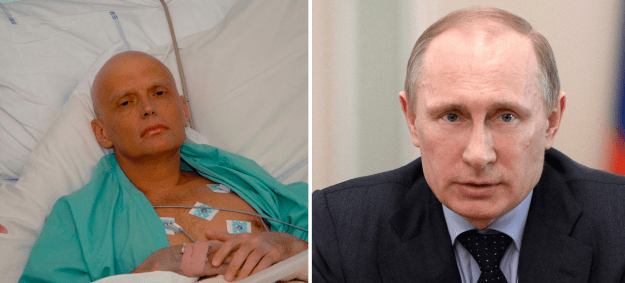
The British inquiry into the death of Alexander Litvinenko concluded on Thursday, making official what everyone already knew: the Russian intelligence services, “probably” at the direct order of Russian President Vladimir Putin, murdered Litvinenko in London in November 2006.
Welcome as it is to have this on the record and to have Litvinenko’s killers named for all the world to see, it now leaves questions, primarily:
Will similar forensic scrutiny be brought to bear on several other odd instances of political and other crime in Russia?
And what does the British government intend to do now that the Kremlin is carrying out assassinations on its territory again? Continue reading →

 Kyle Orton's Blog