By Kyle Orton (@KyleWOrton) on 26 February 2019
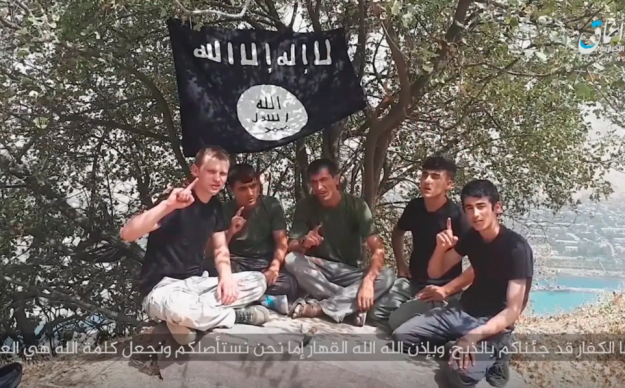
Islamic State terrorists responsible for the Danghara attack in Tajikistan, July 2018 [source]
By Kyle Orton (@KyleWOrton) on 26 February 2019
Islamic State terrorists responsible for the Danghara attack in Tajikistan, July 2018 [source]
By Kyle Orton (@KyleWOrton) on 1 March 2018

Aftermath of a pro-Asad coalition bombing in Hamouria, in besieged Eastern Ghuta, near Damascus, 22 February 2018. (AFP)
In the summer and autumn of 2017, it was claimed Syria’s civil war was winding down, but the nearly seven-year conflict is nowhere near to finished, and recent events suggest it could even escalate. Continue reading
By Kyle Orton (@KyleWOrton) on September 8, 2015
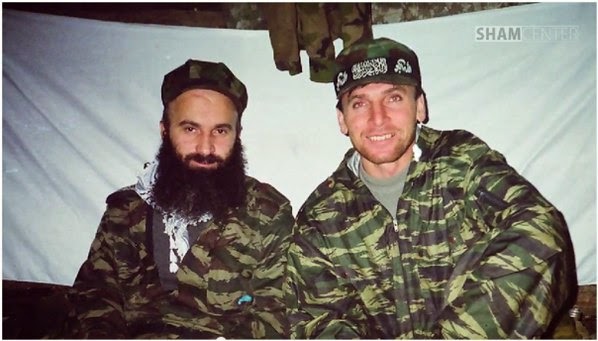
Shamil Basayev and Murad Margoshvili (a.k.a. Muslem a-Shishani)
Last year I wrote about the murky role Russia was playing in the Syrian war, bolstering the Bashar al-Assad tyranny while facilitating the rise of the Islamic State (ISIS) and other Salafi-jihadists as a means of dividing and discrediting the Syrian opposition. This strategy and the associated tactics—infiltrating the insurgency, facilitating the arrival of al-Qaeda and other global jihadists to displace the nationalists, and in general driving the rebellion into the political dead-end of extremism and barbaric atrocities—has worked in other States where the intelligence services were trained by Moscow, and it worked internally to defeat the separatist movement in Chechnya. In Syria, Russia is reinforcing an old client regime, which has staked its life on the proposition that it is the last line of defence against a terrorist takeover and a genocide against the minorities, a policy now largely directed on-the-ground by Iran, to whom Assad surrendered sovereignty some time ago. New evidence has emerged to underline these points. Continue reading
By Kyle Orton (@KyleWOrton) on October 21, 2014
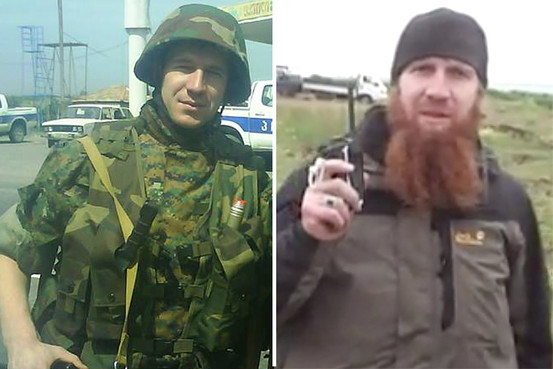
Abu Omar a-Shishani, while in Georgian military, now as I.S. leader in Syria/Iraq
The Syrian rebellion, on Oct. 5, took over areas of Tel al-Hara, near Nawa, a major town twenty miles north of Deraa City, which is a strategic gateway to the road networks that keep the Assad regime alive in Deraa Province. The videos (1/2/3) showed FSA-branded rebels like Liwa al-Furqan and Jabhat Thuwar as-Suriya (the Syrian Revolutionaries’ Front) in control. Jabhat an-Nusra, the Syrian branch of al-Qaeda, had an important presence, but it was not dominant. So this seemed like good news on its own terms.
Two days later the plot thickened when a further video was uploaded to YouTube, showing the rebels touring a captured regime intelligence station in Tel al-Hara: Continue reading
By Kyle Orton (@KyleWOrton) on August 16, 2014
Also cross-posted at the Gerasites blog

Stephen F. Cohen
Since the Ukraine crisis began earlier this year, Stephen Cohen has acquired quite the reputation for apologetics for the Putin dictatorship and its aggression against Ukraine. Cohen, a scholar of Russia, especially the Bolshevik Revolution, has printed most of his pieces in support of Vladimir Putin in The Nation, a magazine edited by his wife Katrina vanden Heuvel. Now he has done so again. Credit where it is due: each salvo has been more hysterical than the last. Continue reading
By Kyle Orton (@KyleWOrton) on April 22, 2014
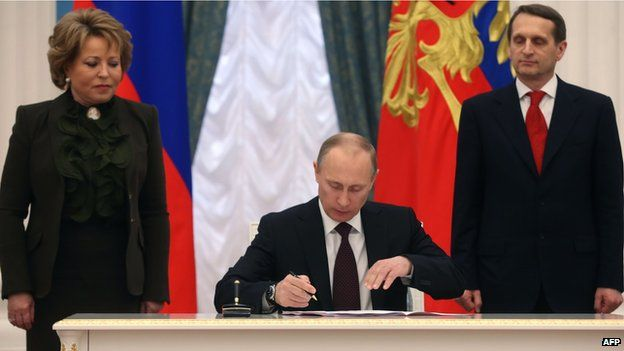
In the wake of Russia’s annexation of Crimea last month, The New York Times has reported on the tactics of subversion and provocation the Kremlin used to destabilise and ultimately conquer parts of Ukraine:

