By Kyle Orton (@KyleWOrton) on 3 May 2025
By Kyle Orton (@KyleWOrton) on 19 June 2024

Israel pre-emptively struck against the Arab armies massing on her borders on 5 June 1967 and routed them by 10 June. The intention of the Arab States in 1967 had been plainly expressed over nearly twenty years. After the pan-Arab invasion had failed to destroy the Jewish State in 1948, Arab leaders—speaking directly and through their State-run media—made clear that they intended to wage another war that would succeed in eliminating Israel. As the Arab armies moved into position in May 1967, the Arab governments openly proclaimed that this was that long-awaited war.
Below is a far-from-exhaustive compilation of Arab statements in the lead-up to the Six-Day War:
By Kyle Orton (@KyleWOrton) on 3 July 2022

An IRA parade in Belfast || Image source
By Kyle Orton (@KyleWOrton) on 28 June 2022
By Kyle Orton (@KyleWOrton) on October 23, 2020
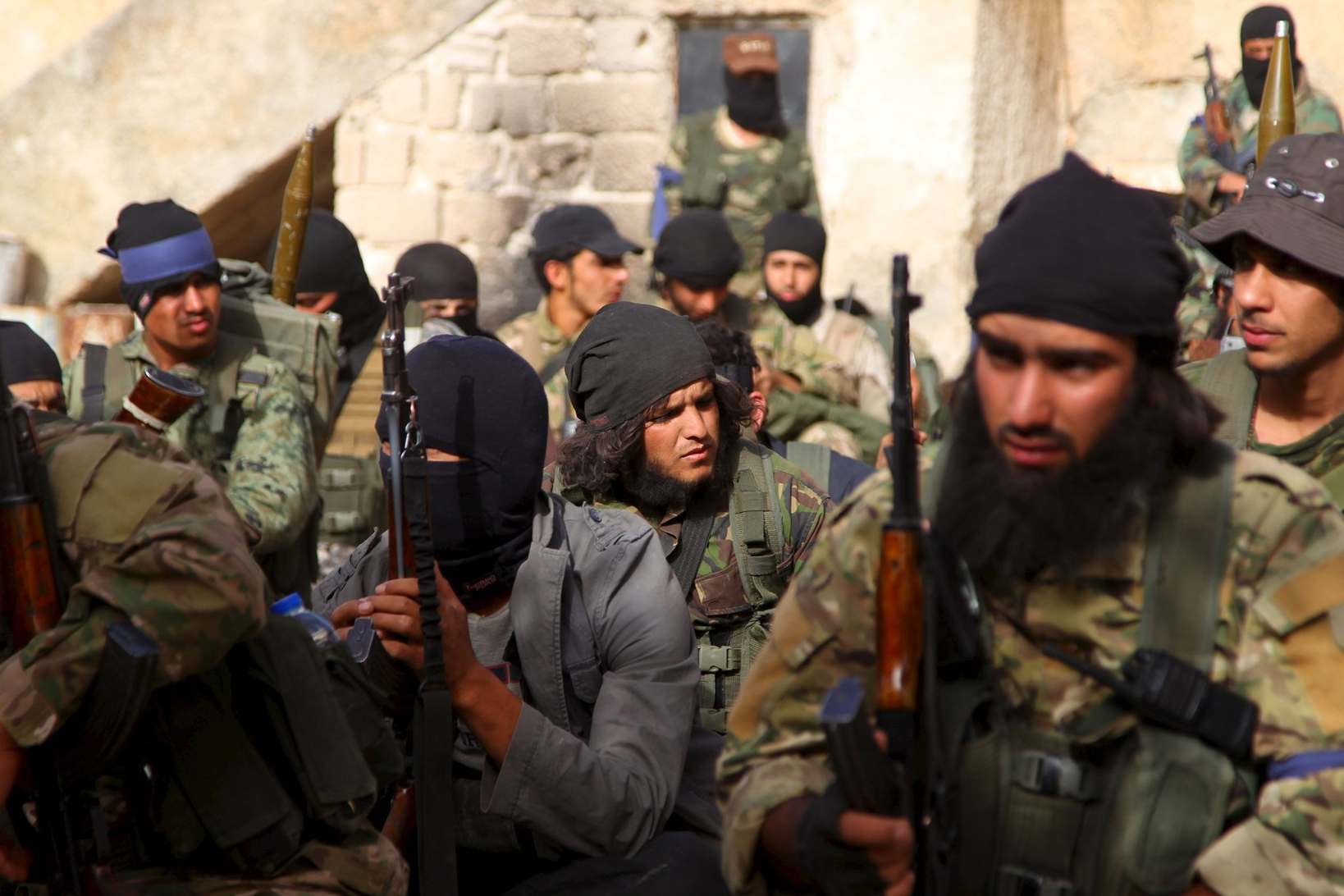
A chapter about Islamism in Syria I wrote for the American Foreign Policy Council’s (AFPC) ‘World Almanac of Islamism’ was published today. Do check it out, and the broader site, which is a great, accessible resource. The format of the website necessitated that the chapter as I submitted it was edited, condensed, and split up to fill out the various categories. In case it is of any interest, the original version of the chapter is reproduced below.
By Kyle Orton (@KyleWOrton) on 12 June 2020

Ismail Nazlikul (Kasim Engin) [image source]
By Kyle Orton (@KyleWOrton) on 19 November 2019

President Barack Obama meeting President-elect Donald Trump, 10 November 2016 [image source]
By Oved Lobel on 18 November 2019

PKK at a terrorist training camp in the Asad regime-held Bekaa Valley of Lebanon, 1991 [source]
The broad outline of the PKK’s relationship with the Soviet Union—and then the Russian Federation—is fairly clear. After the PKK was founded in Turkey in the late 1970s by Ocalan, it was evicted from the country during the 1980 military coup. The PKK moved to Syria, where Ocalan was already based, having fled Turkey in June 1979. From there, the PKK moved into the Bekaa area of Lebanon, at that time controlled by the Syrian regime of Hafez al-Asad, and the Soviets acted through Asad, as they so often did in dealing with terrorist groups, to build the PKK into a fighting force that was then unleashed in 1984 on Turkey, a frontline NATO state in the Cold War. Continue reading


 Kyle Orton's Blog