Tag Archives: insurgency

The Dissolution of Al-Qaeda in Iraq

By Kyle Orton (@KyleWOrton) on 17 January 2021

One of the few pictures in existence of Abd al-Munim al-Badawi (Abu Hamza al-Muhajir)

Abd al-Munim al-Badawi (Abu Hamza al-Muhajir) had become the leader of Al-Qaeda in Mesopotamia (AQM) after its founder, Ahmad al-Khalayleh, much better known as Abu Musab al-Zarqawi, had been killed in June 2006. AQM was the dominant faction within the Islamic State (IS) when it was announced in October 2006 as a merger of jihadist insurgents, and for that reason most analysts at the time considered IS a “front” for AQM. When IS’s emir, Hamid al-Zawi (Abu Umar al-Baghdadi), made his first speech in December 2006 affirming the statehood declaration, most read this as the foreign-led AQM putting an Iraqi face on their enterprise. In fact, as can now be seen, dynamics were essentially as presented by the jihadists.

Crucial was a speech Al-Badawi gave on 10 November 2006, his fifth of what would prove to be fifteen, released by Al-Furqan Media Foundation within IS’s “ministry of information”, entitled, “I’na al-Hukm I’la Allah” (إن الحكم إلا لله), something like “Judgment is Only for God” or “Judgment is God’s Only”, where he gave his bay’a (oath of allegiance) to Al-Zawi, put AQM’s troops under Al-Zawi’s command, and effectively dissolved Al-Qaeda’s presence in Iraq. A transcript of the speech is available here, and a summary of the speech is below. Continue reading

Women and Terrorism: The Case of the May 19th Communist Organization

By Kyle Orton (@KyleWOrton) on 8 January 2021

This article was originally published at European Eye on Radicalization

The world has been captivated this week by the scenes of an insurrectionary mob overrunning the United States Capitol at the behest of President Donald Trump. It is unlikely that many people remember or even know that nearly forty years ago, this building—the meeting place of the U.S. Congress, the place where laws are made—was bombed by a Communist terrorist group, a group remarkable for its all-female membership. A new book, Tonight We Bombed the U.S. Capitol: The Explosive Story of M19, America’s First Female Terrorist Group, by William Rosenau, a senior policy historian at CNA and a fellow in the International Security program at New America, examines this forgotten episode. Continue reading

Losing in Yemen, Winning in Afghanistan, Islamic State Weighs in on Arab-Israeli Peace

By Kyle Orton (@KyleWOrton) on 22 August 2020

Al-Naba 248

The Islamic State (IS) produced the 248th edition of Al-Naba, its newsletter, on 20 August. The front page was devoted to recent events in Yemen, which had not gone well for IS—although one could easily miss that fact when reading a story that a focuses almost entirely on enemy casualties and the failures of others. IS is, of course, not pleased about the Israeli normalisation of relations with the United Arab Emirates, but Al-Naba makes clear that it is more perturbed that Muslims should believe Turkey or Qatar are any better than the U.A.E., despite their different approach to Islamists. Al-Naba 248 documents IS’s continuing advances in Afghanistan—and, indeed, Iraq, Syria, Africa (the Sahel), and Egypt. There is also a report of insurgent activity in the Philippines. Continue reading

Islamic State, Afghanistan, and Replenishment Through Prison Breaks

By Kyle Orton (@KyleWOrton) on 21 August 2020

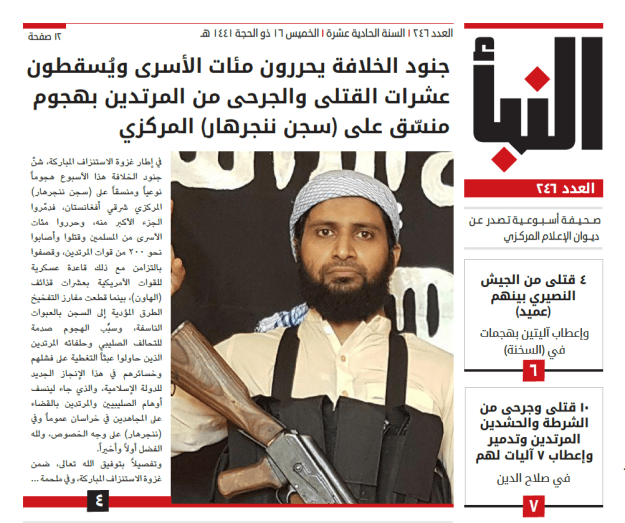
Al-Naba 246, front page, 6 August 2020

The Islamic State (IS) published the 246th edition of its newsletter, Al-Naba, on 6 August, which highlighted the 2-3 August prison break in the Nangarhar province of Afghanistan, a massive IS operation lasting twenty-plus hours, and proclaimed that freeing IS jihadists from prisons will now be a priority for the group. In 2012, shortly after the American withdrawal from Iraq, IS announced Operation BREAKING THE WALLS, which went on for a year, breaking open Iraqi prisons. The narrative of the IS’s “defeat” by the Surge and Awakening of 2007-08 is problematic in some of its fundamentals, but among the reasons it proved to be so fleeting in practice was this prison-break campaign that restored to the battlefield key IS operatives who planned the caliphate project in 2014. It is, therefore, alarming to see the arrival of such a campaign in Afghanistan at the moment the U.S. is headed, heedlessly, for the exit. Continue reading

Islamic State Celebrates the Murderer of Sikhs in Afghanistan

By Kyle Orton (@KyleWOrton) on 20 June 2020

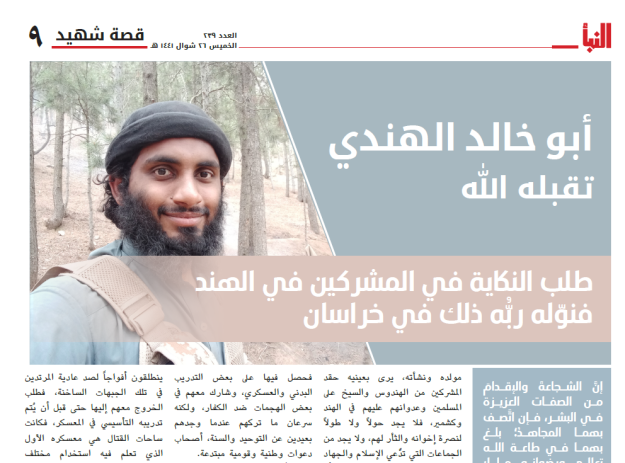
Al-Naba 239, page 9

The Islamic State (IS) released the 239th edition of its newsletter, Al-Naba, on 18 June. Pages 9 and 10 of this twelve-page document were given over to a profile of Abu Khaled al-Hindi, the jihadist elsewhere named as Mohammad Sajid Kuthirummal who massacred twenty-five worshippers at a Sikh gurdwara or temple in Kabul three months ago, on 25 March 2020, during an hours-long siege. The details of Abu Khaled’s life—finding IS after being repelled by “nationalist” jihadist groups, fighting while injured, his obedience to IS’s leaders, and thirst for “martyrdom”—are relatively standard hagiography from IS. What is really worth noting is that such an extensive focus on him, and through him on Afghanistan, underlines the importance IS has placed on its Afghan branch, Wilayat Khorasan. Continue reading

Islamic State is Resurging in Libya

By Kyle Orton (@KyleWOrton) on 13 June 2020

Ghanima (war spoils) captured by Islamic State in Sabha, Libya [Al-Naba 181, 9 May 2019]

After nearly a year of lying low, the Islamic State (IS) has begun reactivating—and advertising its reactivation—in Libya. Continue reading

The CIA and Iraq: Intelligence Failures, Media Successes

By Kyle Orton (@KyleWOrton) on 28 December 2019

In a long article last week, I looked at why the U.S. ran a formal occupation of Iraq for fourteen months after the fall of Saddam Husayn in April 2003, given that there had been an explicit pre-invasion decision not to have an occupation government. The short answer is that the occupation was installed through deception by the State Department, supported by the Central Intelligence Agency (CIA). State and CIA had argued for a protracted occupation in the Situation Room debates in 2002, but President George W. Bush had sided with the Pentagon, which advocated a rapid transfer of power to Iraqis. Having lost in the formal inter-agency process, the State Department succeeded by subversion in getting its way on the ground in Iraq. The disaster this caused in the mismanagement of post-Saddam Iraq was, as the article explained in detail, only the most serious impact of the toxic schism between State/CIA and the Pentagon, a factor whose import is difficult to overstate when examining how the Bush administration functioned. (This feud also at times drew in the Vice President’s Office, which tended to support the Pentagon.)

Continue reading

Islamic State Profiles the Leadership

By Kyle Orton (@KyleWOrton) on 6 April 2019

Islamic State flag in front of the main gate of Saddam Husayn’s palace in Tikrit, 5 April 2015 // AFP PHOTO / MOHAMMED SAWAF

A lengthy document—roughly sixty pages and 12,000 words—was published online on 21 February 2019 containing biographies of twenty-seven senior Islamic State (IS) officials, past and more recent. Those bios that are dated were written between October 2018 and the time of publication, with one exception that was written in the summer of 2018. The author claims to be an IS veteran. While longevity is difficult to prove, the fact that the author provides heretofore unseen images of some of the IS leaders suggests that at a minimum he is an IS operative. Continue reading

Islamic State Newsletter Celebrates Guerrilla Campaign, Attacks Saudi Arabia as ‘Stalinist’

By Kyle Orton (@KyleWOrton) on 16 February 2019

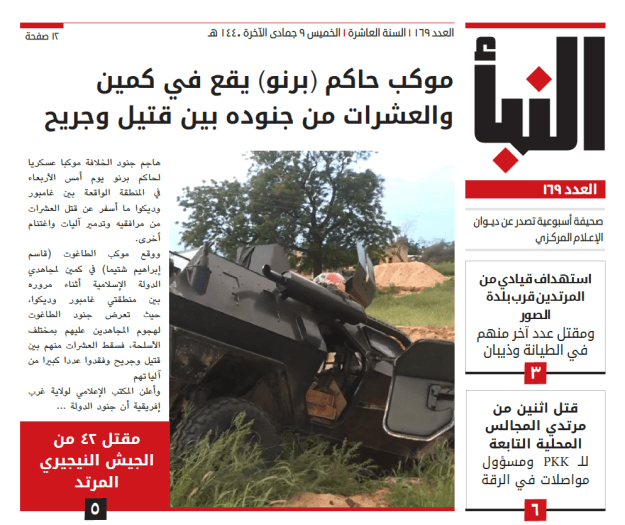
Front page Al-Naba 169

The Islamic State (IS) released the 169th edition of its newsletter, Al-Naba, on 14 February 2019. Al-Naba 169 leads with the attack on the governor of Borno in Nigeria by IS’s branch in that country. In terms of volume, much of the focus remains on the guerrilla campaign in Iraq and Syria, though there is an item on the last stand of the caliphate in Baghuz, the final village in eastern Syria. IS highlights its clashes with al-Qaeda in Yemen. There is a profile of a Russian-speaking atheist-turned-jihadist who was killed in Egypt. And perhaps most notable is an essay on Saudi Arabia, where IS has a terrorist infrastructure that is instructed to be patient. It is a question that likely is unanswerable until it is too late how strong IS is in Saudi Arabia. Continue reading

What Captured ISIS Jihadists Tell Us About the Group

By Kyle Orton (@KyleWOrton) on 2 December 2018

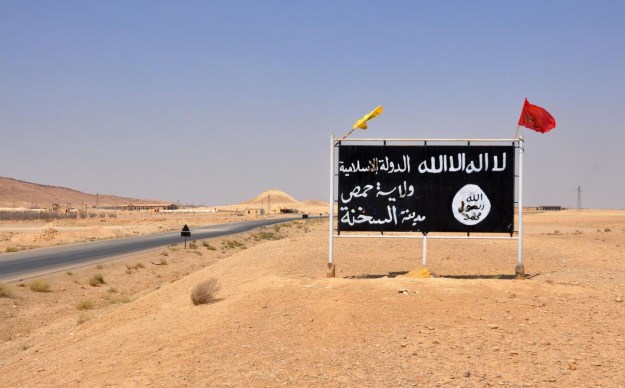
An Islamic State poster near al-Sukhna in the eastern Homs desert, Syria, August 2017 (source)

Over the past week, two members of the Islamic State (IS) have been arrested—a rarity in itself during the Coalition campaign against the group—and both in different ways give a glimpse of archetypes that have made up the organisation, from its inception to its expansion into Syria. Continue reading