Tag Archives: Iran

Art, Identity Politics, and Unmaking the West

By Kyle Orton (@KyleWOrton) on November 2, 2016
1

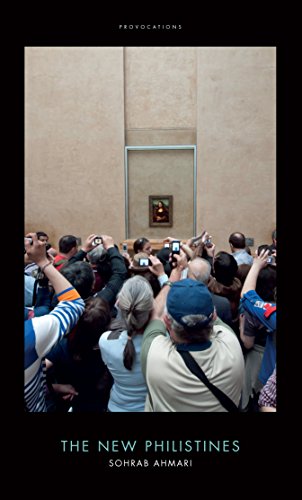
Sohrab Ahmari’s The New Philistines is a crisp and concise polemic. While the book’s focus is “a crisis in the art world,” Ahmari’s dissection of modern art’s failure has implications for the trajectory of the entire liberal Western project.

As Ahmari notes, the complaint that bad art is being considered good is as old as civilization. Ahmari argues persuasively, however, that what is going wrong now is “qualitatively worse than all that came before” because the custodians of our heritage have not redefined the standards of objective beauty and at least a search for truth but have discarded them.

In place of the old standards is a cult of identity politics—a mix of “radical feminism, racial grievance, anti-capitalism, and queer theory”—that has no need for truth-seeking; “truth” is only a means of inflicting upon people an order that is racist, sexist, and homophobic by design, according to the identitarians, which is why their pre-set answers and simply inept art is acceptable, because it advances the cause of challenging this unjust system.

Identity politicization is “one calamity among many” in the art world, yet it has implications far and wide. The identitarians’ own relativistic logic divides the human species into competing tribes whose only interest should be a search for power. With this, the identitarians lay bare their illiberal heart and the danger they pose well beyond the art world.

Ahmari has three chapters. The first covers the reopening of Shakespeare’s Globe and its takeover by the identitarians. The second examines Artforum, the leading contemporary arts magazine in the United States. And in the third Ahmari gives a tour of the London arts scene. Continue reading

Russia Moves in For the Kill in Syria

Originally published at The Henry Jackson Society

By Kyle Orton (@KyleWOrton) on October 21, 2016

Vladimir Putin’s Russia is “deploying all of the Northern fleet and much of the Baltic fleet in the largest surface deployment since the end of the Cold War,” a NATO diplomat told Reuters on Wednesday night. These Naval assets are designed to buttress a final offensive by the remnants of Bashar al-Assad’s regime in Syria, which is effectively controlled on the ground by the Islamic Republic of Iran and an assortment of foreign Shi’a jihadists, against the insurgent-held east of Aleppo city, crushing once and for all the strategic threat posed by the rebellion to the regime, a threat that had already been all-but ended in the first months of Russia’s intervention. Nearly a year ago the U.S. began a political process with the Russians intended to end the war and begin a political transition. Moscow has subverted this process, using force to buttress its political efforts to secure Assad in power. The timing of this attack is seemingly intended as one final humiliation for President Barack Obama. Continue reading

Martyr for the Cause

By Kyle Orton (@KyleWOrton) on October 20, 2016

Mohamedou Ould Salahi

Mohamedou Ould Salahi, a Mauritanian, was released from Guantanamo Bay back to his home country on Monday. This comes as part of Barack Obama’s effort to drive the number of inmates at the detention centre down as far as possible before his Presidency ends. Salahi is the first detainee transferred since the mass-exodus in August, leaving sixty men at Guantanamo, nineteen of them already approved for transfer. Salahi is among the many detainees who claims he is innocent and that he has been maltreated in custody, and he has written a book, Guantánamo Diary, to that effect. The known facts about Salahi’s pre-detainment behaviour suggest caution should be exercised in accepting his version of events. Continue reading

The Demise of Ahmad Mabruk: Al-Qaeda in Syria and American Policy

By Kyle Orton (@KyleWOrton) on October 4, 2016

Ahmad Mabruk in Jabhat al-Nusra's "Heirs of Glory" video, March 2016. (Source: The Long War Journal)

Ahmad Mabruk in Jabhat al-Nusra’s “Heirs of Glory” video, March 2016. (Source: The Long War Journal)

Ahmad Salama Mabruk (Abu Faraj al-Masri) was an al-Qaeda veteran, close to the organization’s leadership. The United States killed Mabruk in Syria on 3 October 2016 in a drone strike near Jisr al-Shughour in northern Syria. This is the second time in a month the U.S. has killed off a senior al-Qaeda jihadist, and sheds some light on the strength of the U.S. policy in Syria. Continue reading

Abandoning Syria to Assad Helps Al-Qaeda

By Kyle Orton (@KyleWOrton) on September 23, 2016

2

The deeply problematic attempted Syrian ceasefire agreement between the United States and Russia last week never really took hold and was finally torn asunder on Monday by Russia and the regime of Bashar al-Assad blitzing an aid convoy and launching massive, indiscriminate aerial attacks on rebel-held areas in Aleppo. Last night, the pro-Assad coalition commenced a renewed assault on Aleppo actually as the parties met to discuss putting the ceasefire back online.

It had been surreal that it was the U.S. insisting that “The ceasefire is not dead”. What it exposed was the lack of Western will to restrain the Assad regime, which al-Qaeda, especially, is exploiting, offering its services in the fight against Assad, and building a sustainable presence in Syria that will threaten the West for many years to come. Continue reading

Syria’s Flawed Ceasefire Comes Crashing Down

By Kyle Orton (@KyleWOrton) on September 21, 2016

A version of this article was published at The New Arab

Humanitarian convoy in Aleppo after the airstrikes by pro-regime coalition, 20 September 2016

The United States and Russia reached an agreement over Syria on 9 September that was supposed to lead to a week of reduced violence—a ceasefire or “cessation of hostilities” (CoH). During this time, there would be free distribution of humanitarian aid—followed by joint operations against the rebranded al-Qaeda branch in the country, Jabhat Fatah al-Sham (JFS), formerly known as Jabhat al-Nusra. This agreement was essentially ignored by Bashar al-Assad’s regime, which Russia had pledged to restrain, and on Monday the agreement was torn up by the regime, returning Syria to all-out war. Continue reading

Fifteen Years After 9/11

By Kyle Orton (@KyleWOrton) on September 11, 2016

Originally published at The International Business Times

1

Fifteen years on from the 11 September 2001 terror attacks on the US, al-Qaeda is better-positioned than ever before. Its leadership held, and it has rebuilt a presence in Afghanistan. More importantly, al-Qaeda has built powerful regional branches in India, North Africa, Somalia, Yemen and Syria.

Rebranding itself away from the savagery of Iraq, al-Qaeda has sought to embed itself in local populations by gaining popular legitimacy to shield itself from retribution if, or when, it launches terrorist strikes in the West. This is proceeding apace, above all because of a failure to assist the mainstream opposition in Syria, sections of which were forced into interdependency with al-Qaeda to resist the strategy of massacre and expulsion conducted by the Assad regime. Continue reading

Moscow Rules in Syria, Again

By Kyle Orton (@KyleWOrton) on September 11, 2016

1

In Geneva on 9 September 2016, the United States and Russia announced an agreement to implement a ceasefire—formally a “cessation of hostilities” (CoH)—in Syria, which is intended to allow humanitarian access and restart the political process to end of the war, and then to begin jointly targeting the Islamic State (IS) and al-Qaeda’s Syrian branch, formerly Jabhat al-Nusra, recently rebranded Jabhat Fatah al-Sham (JFS).

There is reason to wonder if the deal will ever take effect and the lack of an enforcement mechanism against Bashar al-Assad’s regime leaves open the possibility that the pro-regime coalition will, as it did after the February ceasefire, abuse this process to their advantage.

Most dauntingly, if this process worked to the letter it will legitimate the gains of the regime’s aggression, carried out under the cover of the last ceasefire, and has the potential to weaken the insurgency and embolden the regime, strengthening radicalism on all sides, pushing a political settlement further away, and thus protracting the war. Continue reading

Is This the Beginning of the End for the Islamic State?

By Kyle Orton (@KyleWOrton) on September 8, 2016

Screenshot of an Islamic State video displaying captured materials from the New Syrian Army, 27 July 2016

Screenshot of an Islamic State video displaying captured materials from the New Syrian Army, 27 July 2016

City AM asked for contributions on the above question, and I took the “no” side. As can be seen from the below, however, this was very much a matter of interpretation since both sides gave roughly the same answer: the Islamic State’s statelet is coming to an end, but the group will survive, morphing back into a prior stage.  Continue reading

The End of the Islamic State by Christmas?

By Kyle Orton (@KyleWOrton) on September 5, 2016

1

Last week it was reported by The Daily Beast that United States defence and political leaders believe they can at least begin the operation to remove the Islamic State (IS) from its Iraqi capital, Mosul, before President Barack Obama leaves office on 20 January 2017. This seems unlikely. More to the point, if it is true it is highly dangerous, both in the short-term and especially over the long-term. Continue reading