Tag Archives: ISIS

Islamic State Denounces the Pope’s Visit to Iraq as a Conspiracy Against Islam

By Kyle Orton (@KyleWOrton) on 13 March 2021

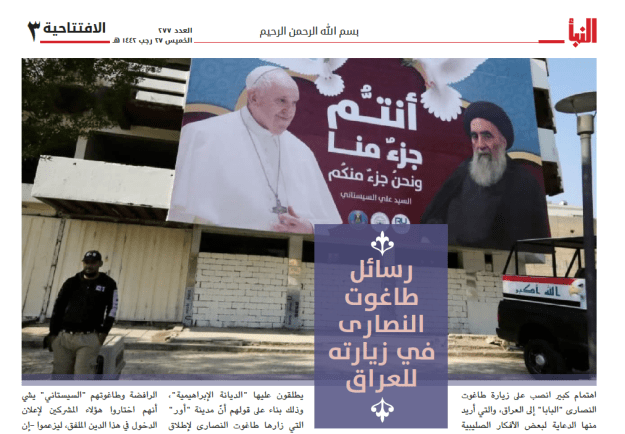
Al-Naba 277, page 3

The Islamic State (IS) released the 277th edition of its weekly newsletter, Al-Naba, on 11 March 2021. The main editorial focused on the Catholic Pope Francis’ 5-8 March apostolic visit to Iraq, where inter alia a Roman Pontiff for the first time visited Ur, believed to be the birthplace of Abraham, and took Mass in the Chaldean rite (at the Cathedral of Saint Joseph in Baghdad). Continue reading

The Second Cabinet of the Islamic State

By Kyle Orton (@KyleWOrton) on 5 March 2021

The Islamic State (IS) movement announced its second “cabinet” on 21 September 2009. The “State” had been announced in October 2006, and the first cabinet had been “appointed” in April 2007.

Continue reading

The First Cabinet of the Islamic State

By Kyle Orton (@KyleWOrton) on 5 March 2021

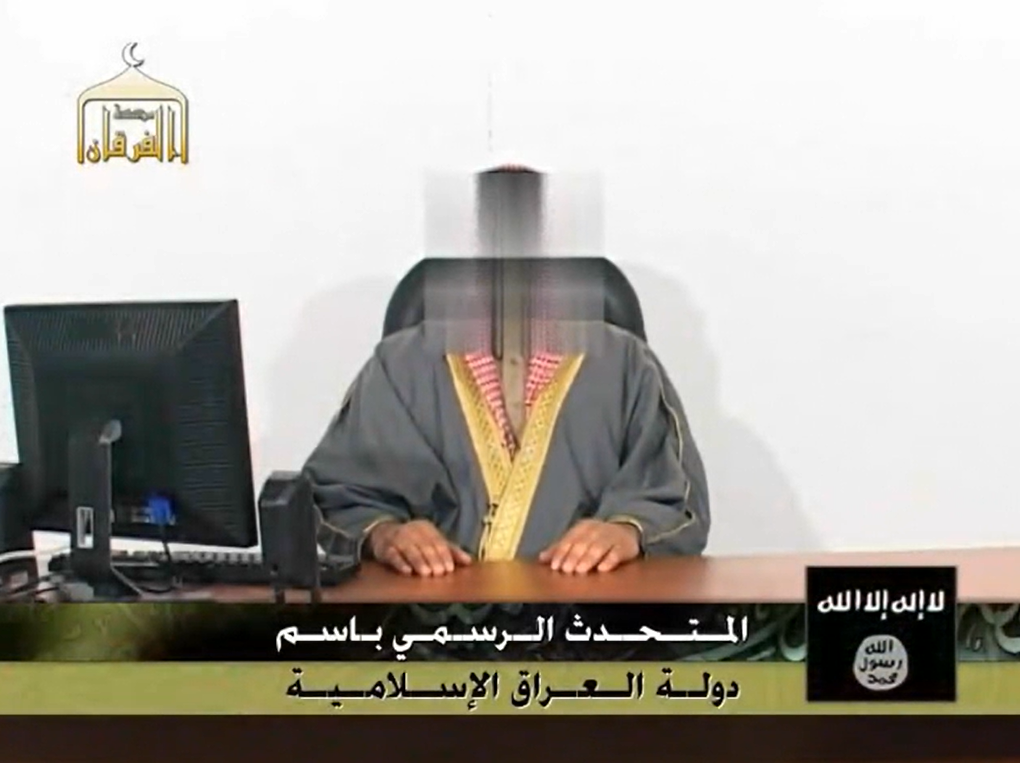
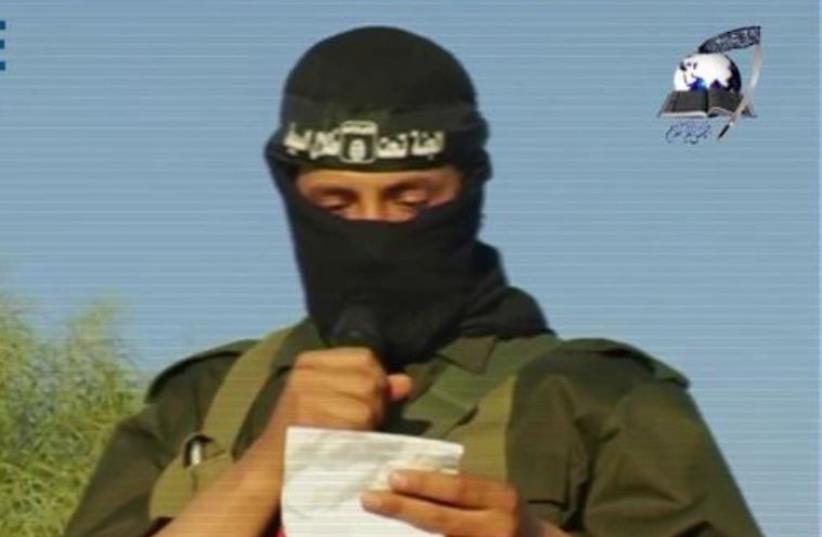
On 19 April 2007, seven months after the Islamic State (IS) movement declared its “State”, the official spokesman, Muharib al-Jaburi, announced the first “cabinet” for this “state”, appointing leaders for various “ministries”. Unusually for IS in this era, the speech was delivered as a video address—albeit (as can be seen) with Muharib’s face blurred out—rather than as an audio address. The reason for this was clearly to push back against the criticism of the IS movement that its leader could not be the “caliph” of all the Muslims, which at this stage IS was not overtly claiming, while being faceless and nameless, known only by his kunya.

Continue reading

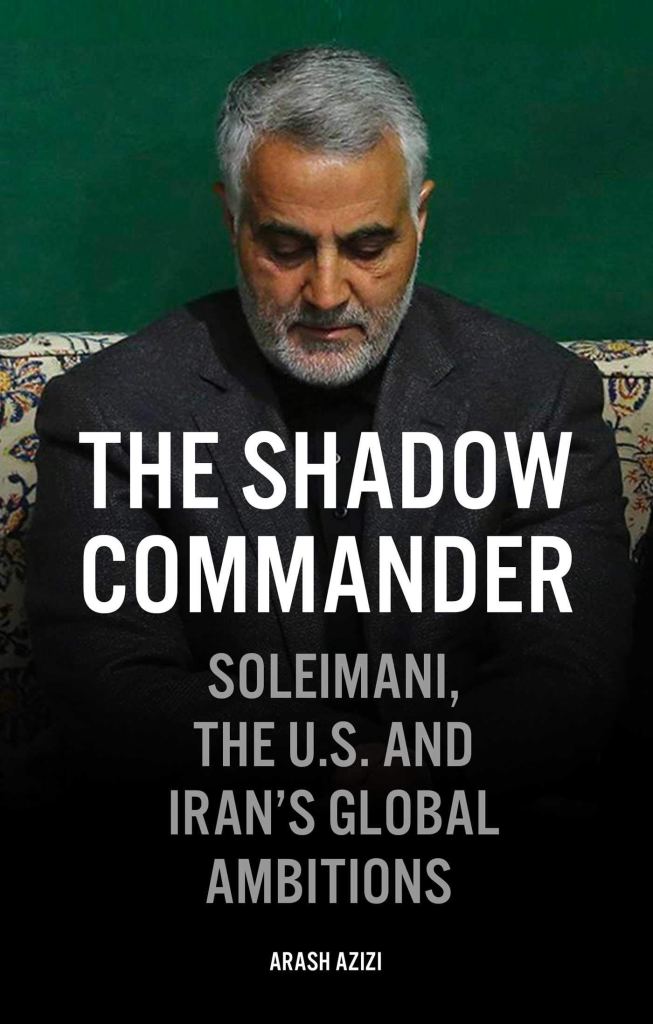
Qassem Sulaymani: Life and Ambition

By Kyle Orton (@KyleWOrton) on 2 March 2021

A year ago, U.S. President Donald Trump gave the order to kill Qassem Soleimani, the de facto deputy leader of Iran. Arash Azizi’s The Shadow Commander: Soleimani, the U.S., and Iran’s Global Ambitions is an effort to explain who Soleimani was, how he rose to controlling the lives of millions of people well outside the borders of Iran, and how in the end he was brought down. Continue reading

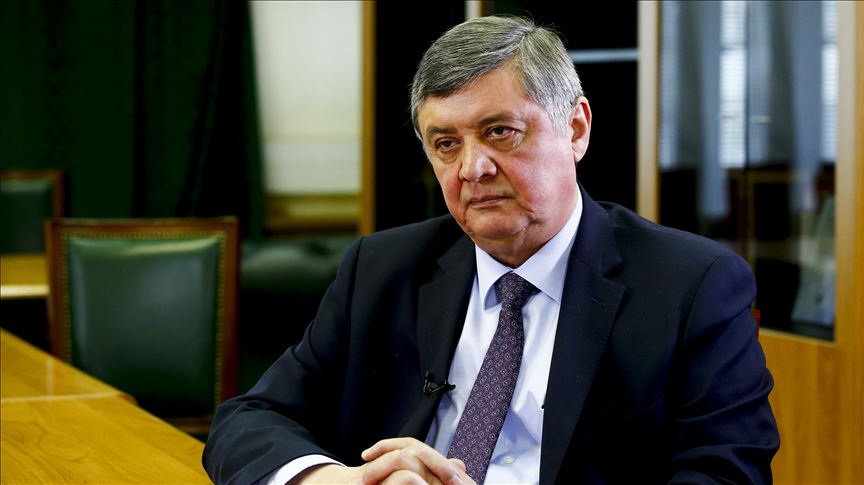
Russia’s View of the Endgame in Afghanistan

By Kyle Orton (@KyleWOrton) on 23 February 2021

Russia’s presidential envoy for Afghanistan Zamir Kabulov

Russian ruler Vladimir Putin’s current special envoy for Afghanistan, Zamir Kabulov, spoke to Sputnik’s Tajik service on 17 February, and a translation of the interview is published below with some interesting sections highlighted in bold. Kabulov was the KGB resident in Kabul in the 1980s and early 1990s, and later in the 1990s, during the Taliban’s reign over Kabul and much of the rest of the country, he was an adviser to the United Nations peace envoy. Continue reading

Islamic State’s Program for ‘Liberating’ Palestine

By Kyle Orton (@KyleWOrton) on 2 February 2021

Jaysh al-Islam in Gaza joins the Islamic State in 2015 (image source)

Hamid al-Zawi (Abu Umar al-Baghdadi), the second leader of the Islamic State movement, known at the time as the Islamic State of Iraq (ISI), made his ninth speech out of what would prove to be twenty-three, entitled “Al-Deen al-Naseeha” or “The Deen is Sincere Advice” (الدين النصيحة), on 14 February 2008. “Deen” is often translated as “religion”, but the implication of referring to the “spiritual” side of life—and not the “secular”—is inadequate to describe the totality contained within the word; something like “creed” or “lifeway” is more accurate. The speech is most notable as something of a rarity in that it focused on Palestine. A transcript of the speech was put out by ISI and is reproduced below with edits for grammar and clarity. Continue reading

Islamic State Claims America, Asad, and Turkey Are Conspiring Against It In Syria

By Kyle Orton (@KyleWOrton) on 27 January 2021

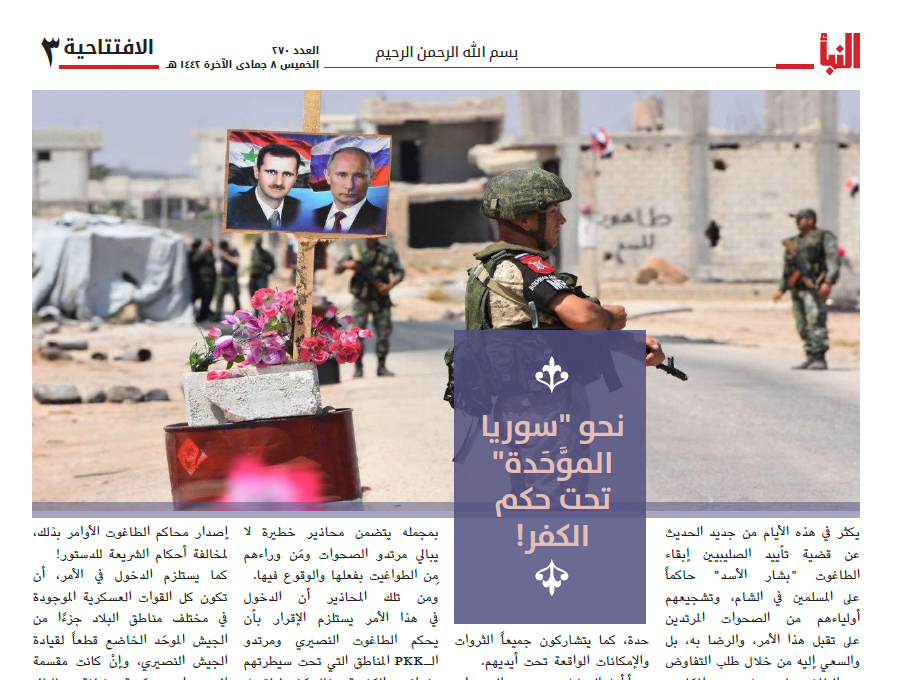
Al-Naba 270, p. 3

In the 270th edition of Al-Naba, the Islamic State’s (IS) weekly newsletter, on 22 January, the main editorial on page three is entitled, “Towards A ‘Unified Syria’ Under the Rule of Unbelief!” The basic premise is that the United States is trying to orchestrate a reunification of Syria that keeps Bashar al-Asad in power, supported by Russia (with, curiously, no mention of Iran, not in the whole article); brings the PKK (“Syrian Democratic Forces”) home to Damascus; and reconciles the “Awakening” (rebel) forces supported by “secular Turkey” to this state system. Continue reading

The Dissolution of Al-Qaeda in Iraq

By Kyle Orton (@KyleWOrton) on 17 January 2021

One of the few pictures in existence of Abd al-Munim al-Badawi (Abu Hamza al-Muhajir)

Abd al-Munim al-Badawi (Abu Hamza al-Muhajir) had become the leader of Al-Qaeda in Mesopotamia (AQM) after its founder, Ahmad al-Khalayleh, much better known as Abu Musab al-Zarqawi, had been killed in June 2006. AQM was the dominant faction within the Islamic State (IS) when it was announced in October 2006 as a merger of jihadist insurgents, and for that reason most analysts at the time considered IS a “front” for AQM. When IS’s emir, Hamid al-Zawi (Abu Umar al-Baghdadi), made his first speech in December 2006 affirming the statehood declaration, most read this as the foreign-led AQM putting an Iraqi face on their enterprise. In fact, as can now be seen, dynamics were essentially as presented by the jihadists.

Crucial was a speech Al-Badawi gave on 10 November 2006, his fifth of what would prove to be fifteen, released by Al-Furqan Media Foundation within IS’s “ministry of information”, entitled, “I’na al-Hukm I’la Allah” (إن الحكم إلا لله), something like “Judgment is Only for God” or “Judgment is God’s Only”, where he gave his bay’a (oath of allegiance) to Al-Zawi, put AQM’s troops under Al-Zawi’s command, and effectively dissolved Al-Qaeda’s presence in Iraq. A transcript of the speech is available here, and a summary of the speech is below. Continue reading

Islamic State Comments on the Storming of the U.S. Capitol

By Kyle Orton (@KyleWOrton) on 8 January 2021

The Islamic State (IS) released the 268th edition of its newsletter, Al-Naba, on the evening of 7 January. The main editorial on page three this week dealt with the Trump-instigated mob storming the U.S. Capitol building on 6 January. Al-Naba took this as the culmination of a trend towards internal crisis for the U.S., but was not convinced that the focus on domestic politics in the next few years will mean an American retreat in the world, though, in the case of the anti-IS war, Al-Naba does detect a collapse in the American position to merely trying to delay IS’s victory. Al-Naba concludes by making clear that no President, of any colour or political persuasion, would affect IS’s stance towards the West since their war against America and its allies is based solely on the fact that these powers are unbelievers. Continue reading

The Death of Al-Qaeda’s Leaders and the Iran Factor

By Kyle Orton (@KyleWOrton) on 16 November 2020

This article was originally published at European Eye on Radicalization

Abdullah Ahmed Abdullah (Abu Muhammad al-Masri) and Ayman al-Zawahiri. // Image sources: FBI, AFP

Credible reports over the last few days indicate that Al-Qaeda’s leader Ayman al-Zawahiri is dead, and there are even clearer reports that two of his most senior deputies have been killed. The terrorist network itself, however, will survive. Al-Qaeda has, in the last ten years, survived the killing of its charismatic founder Usama bin Laden, the upheaval of the “Arab spring”, and the rise of the Islamic State (IS)—all of them greater challenges than whatever short-term turbulence might attend the succession process.

Continue reading