Tag Archives: Islamic State

The Dissolution of Al-Qaeda in Iraq

By Kyle Orton (@KyleWOrton) on 17 January 2021

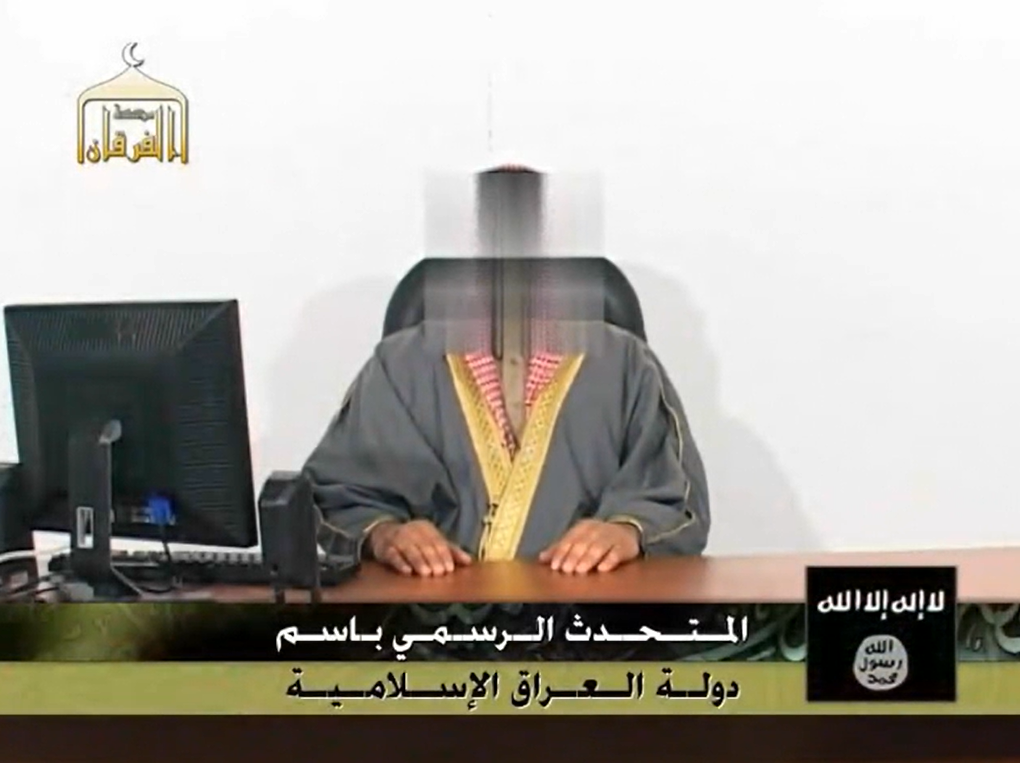
One of the few pictures in existence of Abd al-Munim al-Badawi (Abu Hamza al-Muhajir)

Abd al-Munim al-Badawi (Abu Hamza al-Muhajir) had become the leader of Al-Qaeda in Mesopotamia (AQM) after its founder, Ahmad al-Khalayleh, much better known as Abu Musab al-Zarqawi, had been killed in June 2006. AQM was the dominant faction within the Islamic State (IS) when it was announced in October 2006 as a merger of jihadist insurgents, and for that reason most analysts at the time considered IS a “front” for AQM. When IS’s emir, Hamid al-Zawi (Abu Umar al-Baghdadi), made his first speech in December 2006 affirming the statehood declaration, most read this as the foreign-led AQM putting an Iraqi face on their enterprise. In fact, as can now be seen, dynamics were essentially as presented by the jihadists.

Crucial was a speech Al-Badawi gave on 10 November 2006, his fifth of what would prove to be fifteen, released by Al-Furqan Media Foundation within IS’s “ministry of information”, entitled, “I’na al-Hukm I’la Allah” (إن الحكم إلا لله), something like “Judgment is Only for God” or “Judgment is God’s Only”, where he gave his bay’a (oath of allegiance) to Al-Zawi, put AQM’s troops under Al-Zawi’s command, and effectively dissolved Al-Qaeda’s presence in Iraq. A transcript of the speech is available here, and a summary of the speech is below. Continue reading

Islamic State Comments on the Storming of the U.S. Capitol

By Kyle Orton (@KyleWOrton) on 8 January 2021

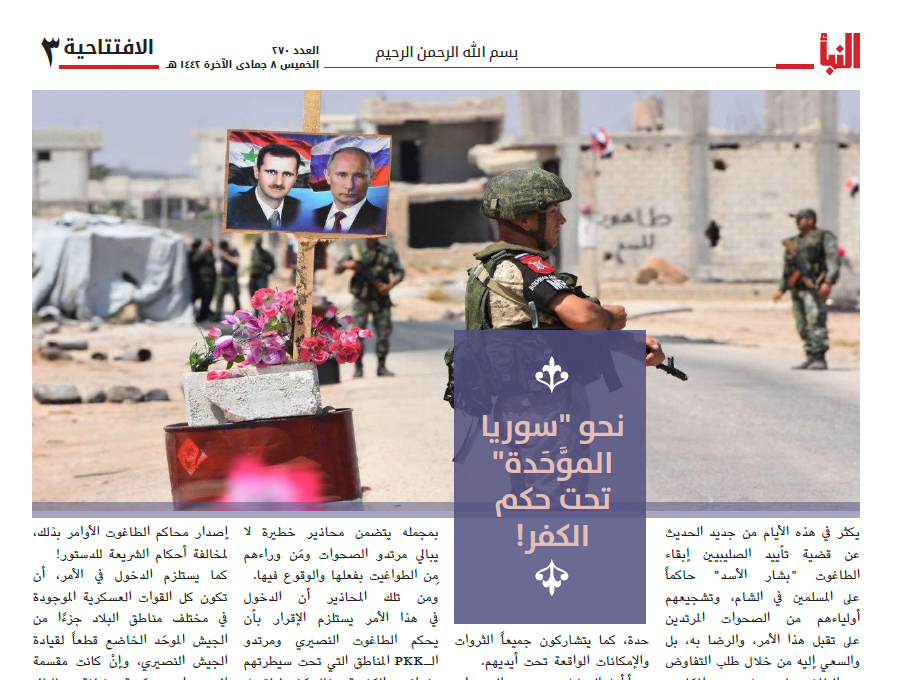
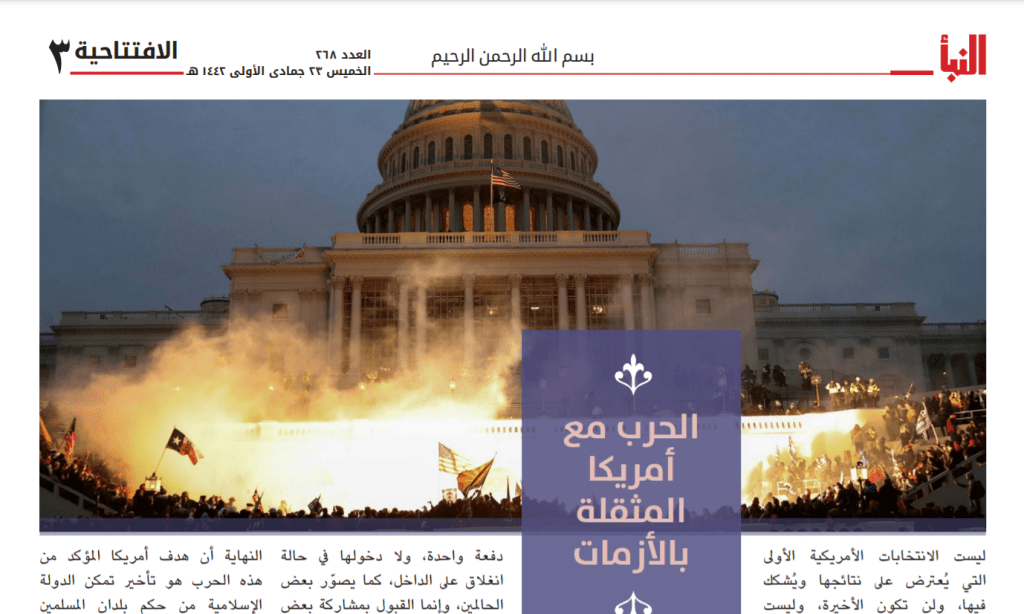
The Islamic State (IS) released the 268th edition of its newsletter, Al-Naba, on the evening of 7 January. The main editorial on page three this week dealt with the Trump-instigated mob storming the U.S. Capitol building on 6 January. Al-Naba took this as the culmination of a trend towards internal crisis for the U.S., but was not convinced that the focus on domestic politics in the next few years will mean an American retreat in the world, though, in the case of the anti-IS war, Al-Naba does detect a collapse in the American position to merely trying to delay IS’s victory. Al-Naba concludes by making clear that no President, of any colour or political persuasion, would affect IS’s stance towards the West since their war against America and its allies is based solely on the fact that these powers are unbelievers. Continue reading

The Death of Al-Qaeda’s Leaders and the Iran Factor

By Kyle Orton (@KyleWOrton) on 16 November 2020

This article was originally published at European Eye on Radicalization

Abdullah Ahmed Abdullah (Abu Muhammad al-Masri) and Ayman al-Zawahiri. // Image sources: FBI, AFP

Credible reports over the last few days indicate that Al-Qaeda’s leader Ayman al-Zawahiri is dead, and there are even clearer reports that two of his most senior deputies have been killed. The terrorist network itself, however, will survive. Al-Qaeda has, in the last ten years, survived the killing of its charismatic founder Usama bin Laden, the upheaval of the “Arab spring”, and the rise of the Islamic State (IS)—all of them greater challenges than whatever short-term turbulence might attend the succession process.

Continue reading

Islamic State Newsletter Highlights War With Al-Qaeda in Africa

By Kyle Orton (@KyleWOrton) on 15 November 2020

Al-Naba 260, page 10

The Islamic State (IS) put out the 260th edition of its newsletter, Al-Naba, on 13 November. Much of the focus was on IS’s war with its jihadi rival, Al-Qaeda, in northern and western Africa. There are reports of guerrilla operations from elsewhere in Africa, from the Centre (in Iraq and Syria), as well as from Egypt and Afghanistan. IS notably feels secure enough in the strength of its networks to draw attention to its responsibility for several attacks in the Turkish-held areas of northern Syria, and there is a rare report of an attack in Indonesia. Al-Naba 260 also has IS’s response to the U.S. Election. Continue reading

Islamic State Calls for Muslims to “Fight and Abuse” Infidels Until They Stop Blaspheming

By Kyle Orton (@KyleWOrton) on 2 November 2020

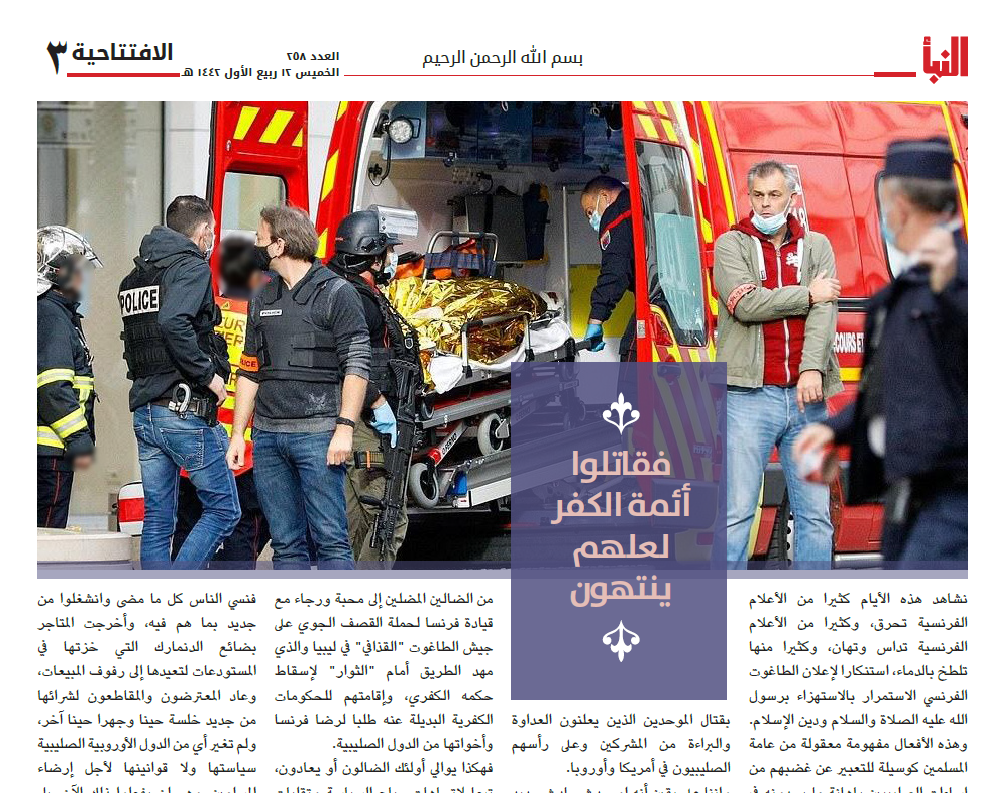
Al-Naba 258, page 3

In the 258th edition of Al-Naba, the Islamic State’s (IS) weekly newsletter, the main editorial on page three is entitled, “Fight the Heads of Disbelief, Perhaps They Will Desist”, and addresses the ongoing and now international dispute after the murder of Samuel Paty, a French schoolteacher, on 16 October. Paty had, after offering those who wanted to leave that opportunity, shown the cartoons from Charlie Hebdo during a class on free speech, and was subsequently beheaded by an Islamist accusing him of blasphemy. In the two weeks since, many Islamist and jihadist groups and individuals, as well as alarming proportions of ordinary Muslims, even in Western countries, have said Paty deserved what he got—albeit at varying levels of openness. A similar message has been transmitted by a number of governments in Muslim-majority countries, notably Turkey and Pakistan, who have effectively blamed France for the atrocity, either citing the French version of secularism (laïcité), racism, or some other grievance. The primary message of IS’s editorial is to declare itself unimpressed with these stances. Continue reading

Saudi Arabia and Prison Breaks: Islamic State’s Spokesman Outlines the Group’s Priorities

By Kyle Orton (@KyleWOrton) on 25 October 2020

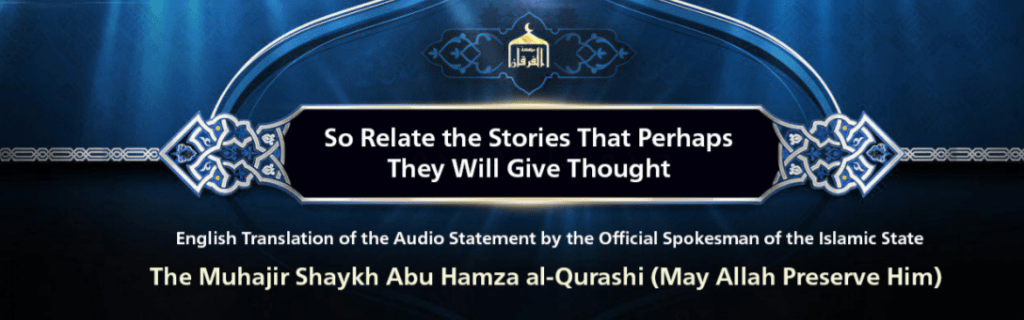
The spokesman of the Islamic State (IS), Abu Hamza al-Qurayshi, released his fourth speech since his appointment a year ago on 18 October 2020, entitled, “So Relate the Stories That Perhaps They Will Give Thought”. Continue reading

Islamic State Celebrates the Murder of French Schoolteacher

By Kyle Orton (@KyleWOrton) on 24 October 2020

Al-Naba 257, page 3

The 257th edition of Al-Naba, the weekly newsletter of the Islamic State (IS), was released on 22 October. Al-Naba 257 contains an article praising the 16 October murder of French schoolteacher Samuel Paty by an Islamist who accused him of blasphemy for showing the Charlie Hebdo cartoons of Islam’s prophet Muhammad during a class on free speech, but the article does not claim that the Chechen refugee who carried out the assassination, Abdoullakh Anzorov, was an IS operative. Among other things, this is a reminder that IS’s claims of responsibility are not indiscriminate, even if it is believed there have been a couple of incidents of high-profile deception. Continue reading

Islamism in Syria

By Kyle Orton (@KyleWOrton) on October 23, 2020

A chapter about Islamism in Syria I wrote for the American Foreign Policy Council’s (AFPC) ‘World Almanac of Islamism’ was published today. Do check it out, and the broader site, which is a great, accessible resource. The format of the website necessitated that the chapter as I submitted it was edited, condensed, and split up to fill out the various categories. In case it is of any interest, the original version of the chapter is reproduced below.

Continue reading

The Current Condition of Al-Qaeda

By Kyle Orton (@KyleWOrton) on October 4, 2020

A chapter about Al-Qaeda I wrote for the American Foreign Policy Council’s (AFPC) ‘World Almanac of Islamism’ was published today. Do check it out, and the broader site, which is a great, accessible resource. The format of the website necessitated that the chapter as I submitted it was edited, condensed, and split up to fill out the various categories. In case it is of any interest, the original version of the chapter is reproduced below.

Continue reading

Islamic State Says America and the Taliban Are Conspiring in Afghanistan, Continues to Focus on Africa

By Kyle Orton (@KyleWOrton) on 20 September 2020

Al-Naba 252, page 3

The 252nd edition of Al-Naba, the weekly newsletter of the Islamic State (IS), was released on 17 September.

Al-Naba 252 contained reports of guerrilla attacks and targeted assassinations at the Centre—against Iraqi security forces and the Iranian proxy militias in the Hashd al-Shabi in Iraq, and against the SDF/PKK in eastern Syria—and the “West African State”, Chad and Niger specifically. IS has been making the Maghreb a primary front since the caliphate collapsed. There was, as ever, the ideological essay on page eleven (of twelve).

The two most notable aspects of Al-Naba 252—expanded on below—were the devotion of the main editorial on page three to an attack on the Taliban for the deal they have made with the Americans over Afghanistan, and IS finally claiming responsibility for the murder of the French aid workers in Niger on 9 August, while continuing its ideological war with Al-Qaeda in Africa. Continue reading