Tag Archives: Islamic State

Syria’s Revolution Has Been Overtaken By Outside Powers

By Kyle Orton (@KyleWOrton) on 16 March 2018

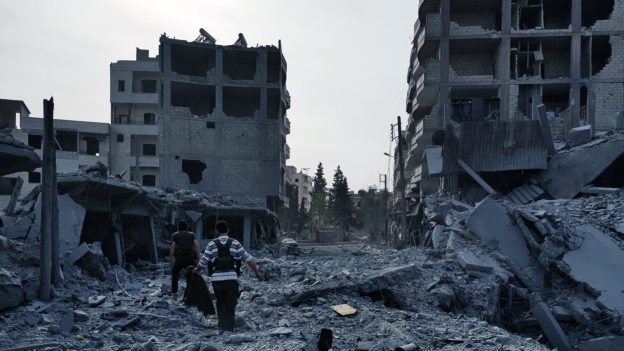
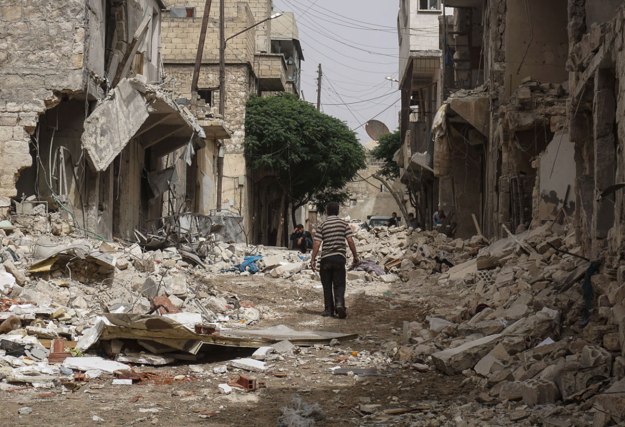
Devastation in Aleppo (image source)

This week marks the seventh anniversary of the Syrian revolution. A movement that began with peaceful street protests calling for reform and—after the government responded with lethal violence—the downfall of the dictator, descended into war that has to this point cost the lives of at least 500,000 people and displaced nearly twelve million others—more than half of Syria’s pre-war population.

In any strategic sense the rebellion has been defeated—it is not able to overthrow Bashar al-Assad by force on its own—and its political cause is increasingly strained as the remnants of the armed opposition are increasingly co-opted by external actors, state and non-state. Continue reading

Islamic State Recommends More Gentleness in Dealing With Sinners

By Kyle Orton (@KyleWOrton) on 10 March 2018

1

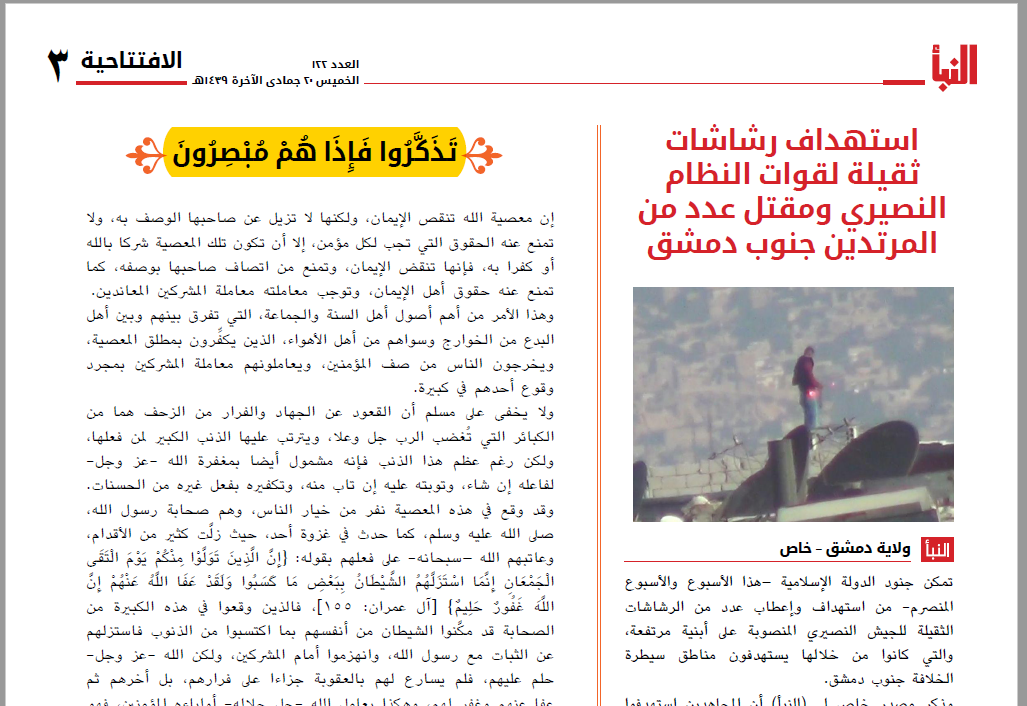
The 122nd edition of Al-Naba, the Islamic State’s weekly newsletter, was released on 9 March 2018 and contained an article, on page 3, suggesting that the use of takfir (excommunication) should be circumscribed. A rough translation is reproduced below. Continue reading

United Nations Documents Human Rights Abuses By the “Syrian Kurds”

By Kyle Orton (@KyleWOrton) on 8 March 2018

Kurdish YPG/PKK fighters (Rodi Said/Reuters)

The Independent International Commission of Inquiry (IICI) on the Syrian Arab Republic was set up in 2011 by the United Nations Human Rights Council to track human rights abuses in Syria.

Naturally, this has meant that most of the Commission’s work is focused on the industrial-scale crimes against humanity committed by Bashar al-Asad’s regime and his enablers in Russia and Iran. Later, as non-state terrorist and extremist groups intruded into Syria, the Commission documented the atrocities by the Islamic State (IS), al-Qaeda, and the Kurdistan Workers’ Party (PKK), which works under the label of the People’s Protection Units (YPG) in Syria and dominates the so-called Syrian Democratic Forces (SDF) that the U.S.-led Coalition works with against IS. The Commission has also recorded abuses by rebel groups.

The Commission’s latest report, released on 6 March 2018, “draws from more than 500 interviews and encapsulates the trends over the past six months in the Syrian Arab Republic, with particular focus on the impact of the offensive against [the Islamic State] and the use of siege warfare on the civilian population.” The report, therefore, has something of a focus on the SDF/PKK human rights violations, though IS’s horrific treatment of religious minorities and so on, plus the pro-Asad coalition’s ongoing campaign of massacre and displacement in areas such as East Ghuta, are given ample attention. Continue reading

Crisis and Opportunity for Turkey and America: The Minbij Dispute

By Kyle Orton (@KyleWOrton) on 4 March 2018

A version of this article was published in The Arab Weekly

The YPG/PKK Minbij Military Council (image source)

The city of Minbij in northern Syria has become a source of severe political tension between the United States and Turkey. It might also be the key to reducing tensions and normalising relations. Continue reading

Human Rights Abuses in Rojava and the Anti-ISIS War

By Kyle Orton (@KyleWOrton) on 3 March 2018

Guerrillas from the Sinjar Resistance Units (YBS), the name the Kurdistan Workers’ Party (PKK) uses in Sinjar, Iraq, together with operatives from the People’s Defence Forces (HPG), the armed units of the PKK inside Turkey, holding a picture of PKK leader Abdullah Ocalan. (image source)

The American-led Coalition’s partner against the Islamic State (IS) in Syria, the so-called Syrian Democratic Forces (SDF), presents itself, ideologically and in terms of the governance structure it controls, in universalistic liberal and democratic terms, emphasizing ecological and feminist themes. The reality is that the SDF is under the politico-military control of the Kurdistan Workers’ Party (PKK), a designated terrorist organization that has run a four-decade-long insurgency against Turkey. The PKK has brought some measure of stability to the areas it controls, but it continues to struggle for legitimacy and without locally-legitimate government IS and other jihadi-Salafists will find political room to operate. The PKK’s continued monopolization of power and abusive governance practices undermine the chances for the “Rojava” system to evolve into a long-term solution to the jihadist terrorists that have used Syrian territory to threaten the region and the wider world. Continue reading

The United Nations Ceasefire for East Ghouta is a Farce

By Kyle Orton (@KyleWOrton) on 2 March 2018

Aftermath of an Assad regime bombardment in Hamouriyah, Eastern Ghouta, 9 January 9, 2018. Samir Tatin/Anadolu Agency/Getty Images

The international community tried to impose a ceasefire in Syria on 24 February, passing resolution 2401 through the United Nations Security Council. The ceasefire never took hold and it is now clear it will not. This was inevitable.

Bashar al Assad’s regime, and the governments that support him in Iran and Russia, have repeatedly made use of ceasefires to sequence their war, taking advantage of the calm on some fronts to concentrate firepower on other areas. The only question is why Western diplomats gambled that this time would be any different. Continue reading

Syria Continues to Unravel as External Powers Dominate

By Kyle Orton (@KyleWOrton) on 1 March 2018

Aftermath of a pro-Asad coalition bombing in Hamouria, in besieged Eastern Ghuta, near Damascus, 22 February 2018. (AFP)

In the summer and autumn of 2017, it was claimed Syria’s civil war was winding down, but the nearly seven-year conflict is nowhere near to finished, and recent events suggest it could even escalate. Continue reading

A New Branch of Al-Qaeda Emerges in Syria

By Kyle Orton (@KyleWOrton) on 1 March 2018

Hurras al-Deen logo

A new jihadi faction announced its formation in Syria on 27 February 2018: Tanzim Hurras al-Deen,[1] which translates as The Organization for the Guardians of the Religion or the Religious Guardians’ Organization. Hurras al-Deen is, unofficially, the re-emergence of a branch of al-Qaeda in Syria after the schism between al-Qaeda “central” and Hay’at Tahrir al-Sham (HTS). The first statement from Hurras al-Deen was released via Telegram and is reproduced below. Continue reading

Al-Qaeda Leader Profiles the Founder of the Islamic State

By Kyle Orton (@KyleWOrton) on 28 February 2018

Ahmad al-Khalayleh (Abu Musab al-Zarqawi) [picture via Getty], Muhammad Zaydan (Sayf al-Adel) [picture via Kronos Advisory LLC]

The military leader of al-Qaeda, Muhammad Saladin Zaydan (Sayf al-Adel), wrote a biography for Ahmad al-Khalayleh (Abu Musab al-Zarqawi), the Jordanian jihadist who founded what is now the Islamic State in Taliban Afghanistan in 1999. Zaydan wrote the biography in 2005 while in Iran, under the protection of the Islamic Republic, where he still is. The biography is reproduced below with some interesting and important sections highlighted in bold. Continue reading

Coping With America’s Syria Policy, Israel Tries To Draw its Own Red Line

Published at TRT World

By Kyle Orton (@KyleWOrton) on 13 February 2018

There was a serious escalation between Israel and Iran in Syria last week. This has been a long-time coming, an inevitable part of the contest for regional order that was obscured, and fuelled, by the narrow focus on the Islamic State (Daesh) and the war against its “caliphate”, particularly over the last year. Continue reading