Tag Archives: Islamic State

Raqqa Doesn’t Want to Be Liberated By the West’s Partners

By Kyle Orton (@KyleWOrton) on 30 May 2017

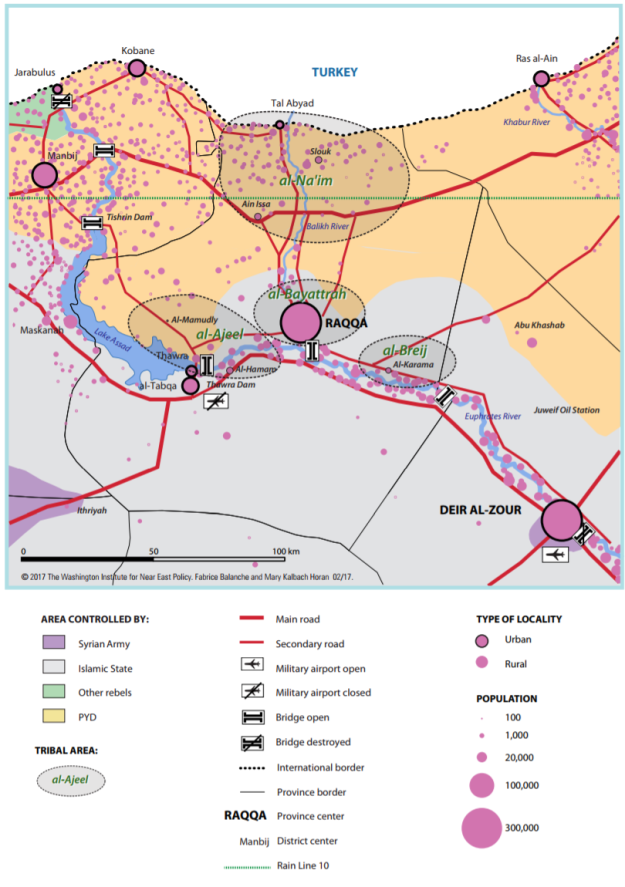
Map of the tribes around Raqqa city (source: WINEP report)

We are now on the eve of the operation to evict the Islamic State (IS) from its Syrian capital, Raqqa, and, as expected, the United States will partner with the Syrian Democratic Forces (SDF), the front-group for the Democratic Union Party (PYD) and its armed wing, the People’s Protection Units (YPG), which President Donald Trump’s administration has committed to directly arming.

Many of the doubts voiced about this course relate to Turkey, since the PYD/YPG is—despite continued efforts to obfuscate the fact—the Syrian department of the Kurdistan Workers’ Party (PKK), the premier internal security threat to Turkey for many decades. The discussion then tends to fall into one of two grooves. Continue reading

Islamic State Newsletter Says Manchester Bomber Was a “Soldier of the Caliphate”

By Kyle Orton (@KyleWOrton) on 25 May 2017

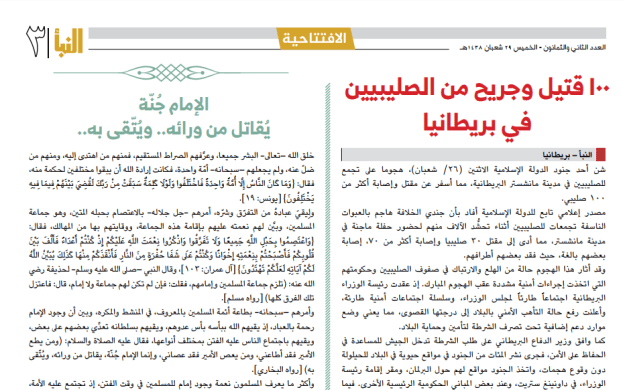
Article about Manchester Arena suicide-killer Salman Abedi, page 2 of Al-Naba 82

The Islamic State (IS) released the eighty-second edition of its newsletter, Al-Naba, on 25 May 2017. The first article in Al-Naba 82 was about the suicide attack on the Manchester Arena on 22 May, which IS claimed the next day. The article in Al-Naba provided very few details about the murderer, Salman Abedi, or IS’s role in the attack, mostly gloating over the allegedly panicky reaction of the British state. Continue reading

The Islamic State Expands Its Definition of Heresy

By Kyle Orton (@KyleWOrton) on 20 May 2017

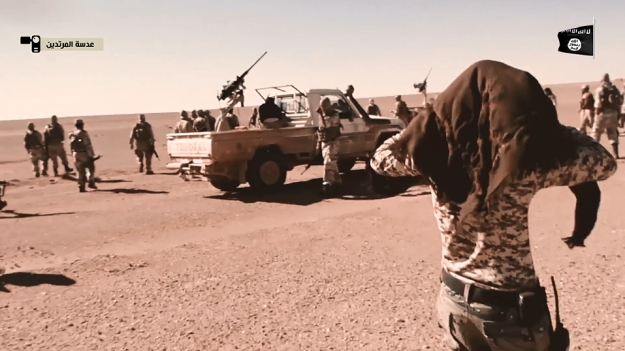
A ruling in the name of the Islamic State’s Delegated Committee, prepared it seems by one of its senior members, Abu Zayd al-Iraqi, was issued on 17 May, expanding the scope of who, within the Muslim community, IS considers a heretic. The memo was addressed to “All Wilayat, Dawawin, and Committees,” and entitled, “That Those Who Perish Would Perish Upon Proof and Those Who Live Would Live Upon Proof”. The wide use of takfir (excommunication) has been one of IS’s most defining and controversial features—even within the jihadist world. This judgment, which comes in the context of a broader centralization of authority—on 14 May a decree banned individual IS fighters from using social media—takes IS into territory akin to the Armed Islamic Group (GIA), which hereticized whole sections of Algeria’s population and began slaughtering them. The text of the ruling was released in English and is reproduced below. Continue reading

Coalition on the Verge of Repeating the Mistakes of the Past Against the Islamic State

This article was published at BICOM

By Kyle Orton (@KyleWOrton) on 16 May 2017

Within the next month, the Islamic State (IS) will likely lose its grip on its Iraqi capital, Mosul, and the operation to drive it from its Syrian capital, Raqqa, will begin. The destruction of IS’s caliphate, however, is not even close to the end of the road for the movement, not least because of the manner in which it is being accomplished.

At its core the IS movement is waging a revolutionary war, and as Craig Whiteside, a fellow with The International Centre for Counter-Terrorism has explained, this means that the focus is on legitimacy. Military victories come and go but if IS is, over the long-term, gaining acceptance—whether from support, resignation, or fear—among the population it hopes to govern (the Sunni Arabs), then it is winning. It is for this reason that IS tries to embed political victories within its military defeats. Continue reading

Media, Democracy, and Terrorism Laws

By Kyle Orton (@KyleWOrton) on 13 May 2017

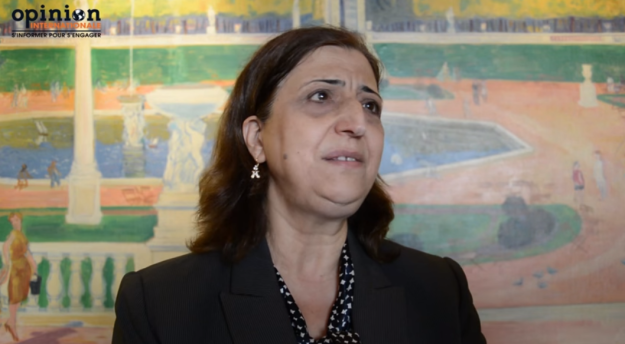
Sinam Mohamad

The New York Times on 11 May carried an op-ed entitled, “Once We Beat ISIS, Don’t Abandon Us,” by Sinam Mohamad, the effective foreign minister of the governance structure in northern Syria administered by the Democratic Union Party (PYD) and its armed wing, the People’s Protection Units (YPG), the Syrian departments of the Kurdistan Workers’ Party (PKK). This comes just over two weeks after another senior PYD/PKK official, Ilham Ahmed, was given space to disseminate the group’s messaging in The Washington Post, and the problems remain the same.
Continue reading

Crackdown Continues in Syrian Kurdish Areas

By Kyle Orton (@KyleWOrton) on 12 May 2017

Fasla Yusef, Syrian Kurdish opposition leader

The Kurdistan Workers’ Party (PKK) controls areas of northern Syria, operating under the name of the Democratic Union Party or PYD (its political wing) and the People’s Protection Units or YPG (its military wing). On Tuesday, President Donald Trump approved plans to arm the YPG directly, abandoning a fiction that the U.S. was only arming the Arab parts of an ostensible coalition, the Syrian Democratic Forces (SDF), which is in fact controlled by the YPG/PKK. This is in preparation for the U.S. backing the “SDF” to liberate Raqqa City, the Syrian capital of the Islamic State’s (IS) caliphate. Leaving aside the geopolitical implications of the U.S. decision for NATO and regional order, and putting aside, too, the likelihood that this decision will defeat its own purposes and give IS a new lease on life, there is a purely humanitarian dimension that deserves more attention. In March the PYD effectively legalized its one-party state in northern Syria and escalated its already-severe persecution of the Kurdish opposition. That crackdown has continued. Continue reading

The Problems With the West’s Partners Against the Islamic State

By Kyle Orton (@KyleWOrton) on 10 May 2017

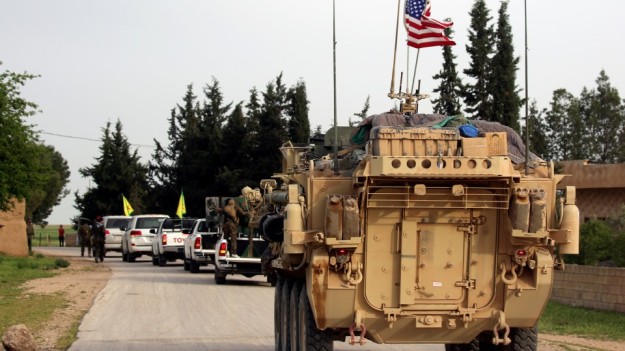
U.S. troops patrolling with the YPG/PKK in the village of Darbasiyah, northern Syria, on the border with Turkey, 28 April 2017

The United States has tried to engage in Syria almost solely in a counter-terrorism capacity, against Daesh (IS) and—in a recently-escalating campaign—against al Qaeda. The narrowness of the focus on jihadist terrorists led to the US disregarding wider political dynamics in the war in Syria—and to a degree in Iraq, too—and partnering with forces that over the long term will undo even this narrow mission.

The announcement yesterday that President Donald Trump will now arm the Kurdish People’s Protection Units (YPG) to expel Daesh from its Syrian capital, Raqqa, is the end-point of this policy, setting up a very dangerous medium- and long-term situation that will redound to the benefit of terrorists. Continue reading

Jihadist Terror Remains a Significant Problem for Britain

By Kyle Orton (@KyleWOrton) on 4 May 2017

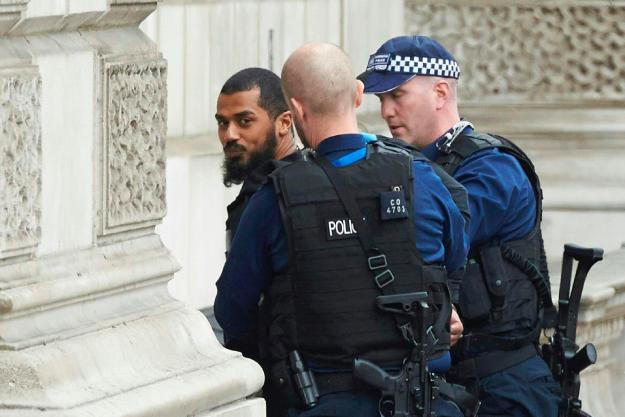
Khalid Mohamed Omar Ali being arrested (image source)

Over the past week, the authorities have disrupted two potential terrorist attacks in London. This follows the Westminster Bridge attack in March, which was claimed by the Islamic State (IS). Britain has been one of the most targeted states by IS’s campaign of global terror, and these latest incidents—whether or not they transpire to be IS-linked—underline the scale of the terrorist threat to Britain. Security forces prevented thirteen attacks in the U.K. between June 2013 and March 2017, and at any one time there are five-hundred live investigations into potential terrorist incidents, with 3,000 Britons believed to be capable of committing an act of domestic terrorism. Continue reading

Al-Qaeda Aligned Jihadist in Syria Condemns Rebel Group Jaysh al-Islam

By Kyle Orton (@KyleWOrton) on 2 May 2017

Maysar al-Jiburi (Abu Mariya al-Qahtani), on Twitter as @alghreeb, is an Iraqi and long-time operative of the Islamic State (IS), who was sent into Syria to set up IS’s secret wing, Jabhat al-Nusra, in 2011. After al-Nusra split with IS and became al-Qaeda’s official branch in Syria, Maysar remained with al-Nusra and was its deputy until the summer of 2014, when the Deir Ezzor branch of al-Nusra that Maysar led was destroyed as IS poured resources captured in Mosul over the border. Since then, Maysar has been—with Saleh al-Hamawi, another member of the advance party that founded al-Nusra—a kind of dissident, formally expelled from al-Nusra, and more recently has set to work spreading his influence in the Turkish-occupied zone of northern Syria, notably through the Ahrar al-Sharqiya group. With the various moves to rebrand and restructure al-Qaeda in Syria under the banner of Hay’at Tahrir al-Sham (HTS), Maysar has been drawn back into the fold to a degree.

Maysar has now released an essay, “Exposing the Backstabbers Within the Ranks,” condemning Jaysh al-Islam for its attacks on HTS in the East Ghouta area of Damascus beginning on 28 April. Intra-insurgent fighting in the besieged enclave a year ago allowed the coalition of states and militias supporting the Bashar al-Assad regime to considerably shrink the enclave and put it on the path to almost certain defeat. Maysar lays particular blame on Samir al-Kaka (Abu Abd al-Rahman al-Kaka; sometimes transliterated al-Kaakeh), a senior cleric of JAI, for issuing rulings licensing this conduct and compares JAI to IS. Maysar also asks, rhetorically, where the condemnations of JAI are from bodies like the Syrian Islamic Council, given how strongly they responded in January when al-Nusra attacked rebel factions as it laid the groundwork for the HTS merger. Masyar’s essay is reproduced below. Continue reading

How Powerful is the Islamic State in Saudi Arabia?

Originally posted at The Henry Jackson Society

By Kyle Orton (@KyleWOrton) on 27 April 2017

The U.S. Department of State designated Mubarak Mohammed Alotaibi, also transliterated as Mubarak Muhammad al-Utaybi, as a Specially Designated Global Terrorist (SDGT), because he has “committed, or pose[s] a significant risk of committing, acts of terrorism that threaten the security of U.S. nationals or the national security, foreign policy, or economy of the United States.” Al-Utaybi is a citizen of Saudi Arabia and is the “Syria-based deputy leader” of the Islamic State’s (IS) branch in the Saudi Kingdom. Continue reading