By Kyle Orton (@KyleWOrton) on 24 January 2019
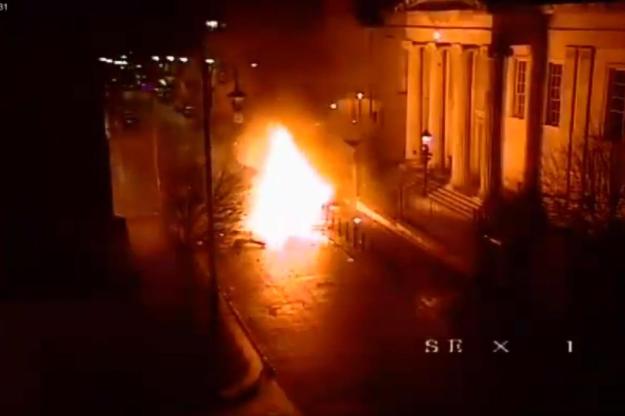
The bombing in Londonderry over the weekend, ostensibly by “dissident” republican elements,[1] and the two further security scares in Northern Ireland since then have brought back memories of the separatist terror-insurgency waged against the United Kingdom by the Provisional Irish Republican Army (PIRA), a war that has largely transitioned into a political phase. One fascinating aspect, looking back on PIRA’s armed campaign, is the foreign support it received, notably from the Soviet Union and its Arab clients.
ORIGINAL IRA
The Original IRA was formed in 1913 and took part in the Easter Rising of April 1916 with help from the Kaiser’s Germany (p. 391), part of Berlin’s political warfare program to destabilise its enemies in the First World War by sponsoring internal radicals, which succeeded spectacularly in Russia. The Easter Rising was defeated, and the execution of fifteen of its leaders (ninety had been sentenced to death) radicalised the Irish independence movement. The IRA would begin one of the first “national liberation” wars of the twentieth century soon after the armistice in the Great War. By mid-1921, the Anglo-Irish war was over, and the island of Ireland had been partitioned. The December 1921 Anglo-Irish Treaty ratified this settlement: the six northern counties would remain with the United Kingdom; the rest would become an independent republic.
By the time the Irish Free State was formally born in December 1922, the head of the Provisional Government, Michael Collins, had been assassinated, and a civil war was underway. The pro-Treaty elements of the IRA became the security structures of the new state. The anti-Treaty IRA declared the Free State a sell-out and continued guerrilla warfare under the IRA banner to try to take the whole island. Through the spring of 1923, the Free State government steadily gained the upper hand, showing no mercy to captured rebels, dozens of whom were executed. A ceasefire was reached in May 1923, though the anti-Treaty IRA dumped and hid (p. 40) its weaponry, rather than surrender it—a constant tactic throughout the various iterations of the IRA.
The IRA’s first effort to gain a foreign sponsor to overturn the partition settlement came in 1925, when a delegation from the anti-Treaty faction, led by P.A. Murray and including Sean Russell and Harry Boland (ostensibly a Sinn Fein politician), went to Moscow via Germany. The delegation had attracted a bit too much attention (pp. 93-4) and Stalin was not impressed with them. Upon arrival, Boland was pulled aside and asked by a Soviet official, “How many bishops did you hang?” When he replied, “None”, his Soviet host informed him: “Ah, you people are not serious at all.”
Despite this inauspicious start, the IRA established relations with the Soviet Union by 1927, according to Tom Mahon, Thomas G. Mahon, and James Gillogly in Decoding the IRA (pp. 276-80). That February, the IRA passed a resolution to mobilise volunteers to go to fight in China alongside Chiang Kai-shek, at that time aligned with the Communists against the British- and Japanese-backed warlords. In December 1927, the IRA even declared public support (pp. 16-17) at its Convention for the Soviet Union in the event of a conflict with Britain. Mahon et al. document a steady stream of intelligence passed from the IRA to the OGPU about America and Britain over the next couple of years, some of it important technical and tactical information that assisted the development of Soviet weaponry in the inter-war years. Moscow, the authors note, chose not to provide significant military assistance to the IRA; had the Soviets done so, war would likely have re-erupted. Relations fizzled just before 1930, though it is not clear they ended at this point. The IRA sent detachments to fight on the Soviet side of the Spanish civil war, for instance. The secrecy of the IRA-Soviet relationship—hidden from the U.S., Britain, and the Irish Free State—mean it is likely there is more to this story.
The IRA’s next foreign sponsor was Nazi Germany. Seán Russell, the chief of staff of the IRA, tasked a subordinate, Seamus O’Donovan, to come up with a bombing campaign against the British in the summer of 1938. O’Donovan’s bombing campaign, “The S-Plan”, began on mainland Britain in August 1939; it attracted the attention of the Nazis and the relationship was born.[2] O’Donovan was soon making trips to Belgium and Germany to meet with Abwehr (German military-intelligence). Russell journeyed to Berlin in mid-1940 to volunteer his services to Hitler. The Fuhrer accepted Russell’s offer and linked him up with Frank Ryan (p. 154), an IRA operative who had fought in Spain and then began collaborating with the Nazis. Operation DOVE was created (p. 211): Russell and Ryan would go back to Ireland, where they would work with other Abwehr assets in sabotage operations and other forms of warfare against the British. The plan collapsed when Russell died of illness aboard the Nazi U-boat taking him to Ireland on 14 August 1940.[3]
The dalliance with the Nazis and the attempt to resume insurgency incurred combined action from the British and the Free State that had shattered the IRA by the end of the Second World War. Virtually dormant for a decade thereafter, there was a flare-up of IRA activity, largely devised by chief of staff Seán Cronin, in the mid-1950s, the so-called “Border Campaign”. Tainted by fascism and unpopular even among republicans, who were trying to work through political channels, the campaign was a dismal failure and was formally declared ended in February 1962.
THE PROVISIONAL IRA
The devolved parliament created at Stormont in 1921, a unique feature among the four nations of the United Kingdom until devolution in the 1990s, was heavily sectarian and discriminatory against Catholics, and this was reinforced all through society, economically and socially. By the 1960s, there was a civil rights movement advocating for equal citizenship in Northern Ireland. Protestant paramilitary organisations—the short-lived Ulster Protestant Volunteers (UPV), associated with Ian Paisley, and the more infamous Ulster Volunteer Force (UVF)—were founded in 1966 to try to block this development, and the Protestant extremists would find much official sympathy, particularly in the police.
The civil rights marchers in Londonderry in October 1968 were met with violence, and in August 1969 an explosion of inter-communal rioting killed seven people (p. 377), wounded about 750, and displaced more than 1,500 Catholic families, five times more than Protestants. Unsurprisingly, those on the Catholic and republican side advocating for militancy sounded more plausible in this environment, if only for self-defence. This was the trigger for Operation BANNER, the British deployment of troops to Northern Ireland, and the beginning of what we euphemistically call “The Troubles”.
THE PROVISIONALS’ FOREIGN RELATIONS
Some of the key early funding to get the IRA’s “armed campaign” going came from the Irish-American community, and will always be associated with the Irish Northern Aid Committee (NORAID). This flow of resources to the IRA from America, notoriously from areas like Boston, with the tacit endorsement of some key politicians, who saw easy votes in this emotive issue, would continue for the rest of the conflict.
The self-defence argument was the one made to the KGB by the IRA in November 1969 when it requested weapons, Vasili Mitrokhin and Christopher Andrew write in The Sword and the Shield (pp. 377-8). The IRA made the request through the secretary-general of the Irish Communist Party, Michael O’Riordan. The IRA had been badly politically damaged by the rioting; it had not acted to protect Catholic communities and some had taken to saying its name stood for, “I Ran Away”. Throughout the 1960s, more Marxist-oriented figures had become influential in the IRA, notably Tomás Mac Giolla and Des O’Hagan, both close to the Soviets and both soon to take the side of the Official IRA (“The Officials”) when the movement split in December 1969. The other faction was the Provisionals or PIRA. Though PIRA became dominant in time, into the early 1970s most of the worst atrocities were carried out by the Officials.
The first direct shipment of weapons from the Soviets to the IRA arrived in August 1972, three years after it was requested, the Mitrokhin Archive records (pp. 384-5), once KGB chief Yuri Andropov was satisfied—since it had not leaked—that the IRA could keep its connection to the Kremlin secret. The operation was codenamed SPLASH, and the weapons, purchased and packaged to disguise their origin, were sent to Ireland aboard a spy vessel, the Reduktor, which was disguised as a fishing trawler for the occasion. Mitrokhin and Andrew note that this was far from the only such shipment, though some of the weapons the Soviets were hoping to be used on the British “imperialists” ended up used on other republicans.
While Andropov somewhat scaled back his ambitions for “special actions” in the West in the late 1960s, this mostly involved a change in tactics, namely “us[ing]—or connive[ing] at the use of—terrorist groups as proxies in the struggle against the United States and its allies”, Mitrokhin and Andrew explain (p. 384). The Soviets build a web of such relationships as part of their war against Israel and Zionism, mostly waged through its Warsaw Pact satellite regimes and Arab clients, particularly Hafiz al-Asad’s Syria and Muammar al-Qaddafi’s Libya.
The Palestinian terrorist asset most firmly controlled by the Soviets was the Popular Front for the Liberation of Palestine (PFLP) because the operations director, Wadi Haddad, was a KGB agent. Haddad’s group was among those used by the Soviets to provide plausible deniability when the KGB wanted to establish contact and/or provide training and weapons to terrorists. The Democratic Front for the Liberation of Palestine (DFLP) were another such a case, as, in turn, were the Sandinistas, whom the DFLP trained. It was through Haddad that the Soviets made contact with PIRA in North Africa, according to Mitrokin and Andrew’s second book, on the KGB’s foreign adventures, The World Was Going Our Way (p. 255). Among those PIRA operatives who graduated from the PFLP camps in Libya was Thomas MacMahon, who murdered Lord Mountbatten (p. 242), the last viceroy of India and the Queen’s husband’s uncle, in August 1979.
PIRA’s connection to the Palestine Liberation Organisation (PLO), the mother ship of the other Palestinian terrorist factions and modern international terrorism, began around 1972 (p. 180). This was, for PIRA, a relationship with another close (if troublesome) Soviet ally. A Washington Post report in 1979 said: “[T]he PLO has provided guns and sabotage devices to its IRA friends”, while “giving special training to IRA members in terrorist schools in” Lebanon. The Soviets used the Syrians throughout the Cold War as a cut-out to deal with terrorists, and as the Communist “urban guerrilla” groups from all over the world, from as far away as Japan and including PIRA, flocked to the PLO’s camps in Syrian-occupied areas of Lebanon, they often (p. 242) landed in Damascus first, where they were vetted (and/or talent spotted) by the Asad regime.
While PIRA’s connection to the PLO was theoretically secret, support for the PLO was widely acknowledged in PIRA literature and by its supporters. In republican areas, posters could, and sometimes still can, be found saying, “IRA-PLO one struggle”. During the Second Intifada, Israel came to believe that this description of “one struggle” was quite literal.[4] Suggestive evidence came to light that PIRA training and equipment was being given to Palestinian terrorists, though the more direct suspicions of IRA snipers involving themselves against the Israelis were proven false. In more recent years, Gerry Adams has been happy to lend support to HAMAS. Some Unionists have reacted by displaying Israeli flags, feeling themselves kindred with the Jews, unpopular with world opinion and surrounded by overwhelmingly more powerful enemies.[5]
The first concrete proof of weapons from Col. Qaddafi to the IRA dates to March 1973, when a ship, Claudia, was intercepted by the Irish Navy as it tried to deliver munitions. Qaddafi saw the “revolutionary” and “anti-colonial” PIRA as brothers-in-arms against the British. The connection gained attention after the April 1986 American raid against Qaddafi, in which the British assisted. In October 1986, a massive shipment of the explosive Semtex and other weapons was delivered to the IRA from Qaddafi’s Libya, which had received the material from Communist Czechoslovakia. This indirect method of dealing with terrorists was, as mentioned above, standard from the Soviets. Qaddafi hosted the PFLP, for example, which helped train both the Communist and Islamist guerrillas involved in the revolution that brought down the Shah of Iran. Another vessel loaded with weapons sent by Qaddafi, the Eksund, was intercepted in October 1987 because of a British spy in PIRA. Libyan Semtex turned up in a number of bombings, including the Remembrance Day atrocity in Enniskillen in November 1987, directed by Martin McGuinness—who showed no shame about having accepted Qaddafi’s support, even as Qaddafi was using fighter jets against a popular revolt.
In 1978, PIRA, already one of the most sophisticated terrorist groups in the world, established relations with the African National Congress (ANC), lending its assistance as the ANC’s armed wing, Umkhonto we Sizwe, sought to escalate its insurgency in South Africa, Stephen Ellis reports in External Mission: The ANC in Exile, 1960-1990 (pp. 137-138). The ANC was tied from its inception to the slavishly pro-Soviet South African Communist Party (SACP). Indeed, many members of the ANC were secret members of the SACP, including its most famous operative, Nelson Mandela. One of Umkhonto’s commanders was Joe Slovo, an SACP member and KGB agent, and he reached out to Gerry Adams by having the ANC representative in Ireland get in contact with the Irish Communist Party, according to Ellis. The “IRA men set up a bomb-making school at a safe house in Luanda [Angola]”, Ellis writes. “The IRA connection was one of the ANC’s most closely guarded secrets”. Ellis adds that in time the ANC would receive training in torture methods and counter-intelligence from the East German Stasi, a frontline Communist secret police force that was, like all the others in the Captive Nations, closely overseen by the KGB.
By the late 1970s, PIRA’s presence in Spain, among the Basque separatist-terrorists of ETA, was detectable. ETA was one of PIRA’s most intimate long-term partners, along with the Revolutionary Armed Forces of Colombia (FARC). PIRA affirmed public “solidarity” with the Baader-Meinhof Gang, and was shown to have a physical infrastructure all over Europe, with operatives arrested in February 1979 smuggling weapons from the Middle East through Greece. Other criminal investigations showed PIRA receiving weapons—even after it had supposedly ended the “armed campaign”—in Slovakia, where Russian mobsters are known to sell their wares, and in Bosnia, where various Islamist groups trade in weapons.
A most intriguing trail was revealed by The Independent on Sunday in 2005: technology used to create bombs triggered by infra-red, which were killing British soldiers in southern Iraq, came from the IRA. The IRA had provided the technology to Palestinian terrorists, the Sunday Independent reported, some of which were sponsored by Saddam Husayn, and it is presumed that forces from this overlap had then provided this capacity to elements of the post-Saddam insurgency.[6] The technology had, as always, been shared with ETA and FARC, too.
It is possible that PIRA’s bomb technology got to the Iraqi insurgents another, more simple way. The militants killing British troops were Shi’a Islamists trained, equipped, and controlled by Iran’s Islamic Revolutionary Guards Corps (IRCG) and its Lebanese branch, Hizballah. The PLO in Lebanon played a crucial role in creating the IRGC, concurrent with PIRA’s presence in those camps (p. 242). It seems likely PIRA established links with IRGC/Hizballah, too. The Iranian regime provided funds to PIRA from no later than 1984, and the Iranian Revolution has celebrated PIRA’s “cause” in its propaganda.
* * * * *
Notes
[1] The “crude” car bomb set off outside the courthouse in Londonderry on 19 January is said to be the work of the New IRA (NIRA), which called itself the Real IRA (RIRA) until a 2012 “merger”. The other main “dissident” factions are Óglaigh na hÉireann (“Irish Volunteers”, ONH), a supposed splinter from NIRA/RIRA, which has itself now divided into two, and the Continuity IRA (CIRA). The relationships among these groups—and between these groups and PIRA (by extension Sinn Fein)—is a matter of some controversy, as I discovered this week when I incautiously reduced this issue down to tweetable form.
PIRA can be analogised to groups like the Palestine Liberation Organisation (PLO) and Kurdistan Workers’ Party (PKK). These groups focus at least as much energy on monopolising influence among their support bases as they do on combating their nominal foes. The PKK, for example, spent years fighting other Kurdish and Leftist groups before it took up arms against Turkey.
Violence and terror are mainstays of enforcing these hegemonic projects, yet both the PLO and PKK have employed subtler means, too, namely permitting nominal “splinters” to exist that claim to be upholding purity, while their progenitors are engaged in compromise. Despite real personal and political animosity, however, and all kinds of complexities in command-and-control, these splinters were operationally indistinct from the parent organisation. The PLO did this with Black September and the PKK does it with the Kurdistan Freedom Falcons (TAK).
Many rank-and-file members, on both sides of these “splits”, were unaware of the reality. Working out who has done what, why, and for whom is a constant problem in terrorism, for practitioners as well as analysts. This is often because of the involvement of state intelligence services—such as the Okhranka under the old regime in Russia or Bashar al-Asad’s regime at present. That said, the dynamics for the PLO and PKK—both of which were subject to extensive state manipulation, by the Soviets and Asad—should not have taken great insight to understand, even before the various archives and defectors weighed in. The existence of formations like Black September and TAK, after so many genuine dissenters had perished, told the story.
A more recent—and contested—case is Hay’at Tahrir al-Sham (HTS), which has come out from under al-Qaeda’s command structure and is now ostensibly competing with an al-Qaeda-loyal entity, Tandheem Hurras al-Deen, in Idlib. The schism is far from complete. Indeed, a recent slip by a HTS official, Abu Layth al-Halabi, disclosed that Hurras al-Deen not only exists in areas wholly controlled by HTS (everyone knew that), but receives food and ammunition on a “daily basis” from HTS, and is part of an operations room “under the supervision of HTS”. The nuances in this relationship are doubtless legion, with much public sniping (dismissed by Abu Layth as “unofficial talk” ignored by the leadership) and the occasional scuffle, but it is far from the all-out antagonism that led al-Qaeda to expel the Islamic State or the Islamic State to make takfir on Hurras al-Deen. If HTS felt threatened by Hurras al-Deen, ideologically or materially, it would put an end to them, as it has so many other insurgent groups.
In a not dissimilar way, PIRA oversees the patronage systems—namely the criminal enterprises—that keep the “dissident” formations alive. PIRA could, therefore, strangle these organisations to death economically if it chose. Moreover, if NIRA or any of the other groups, among whom there are “marginal distinctions”, as Jonathan Evans, the head of the Security Service (MI5), noted in 2012, were acting in a way that PIRA/Sinn Fein found to be objectionable, they would get the treatment meted out to the Irish People’s Liberation Organisation (IPLO). IPLO was allowed to weaken itself in battle with its former overlords, the Irish National Liberation Army (INLA), then had its members tortured and murdered in a single weekend in 1992. PIRA’s action against IPLO was extremely well-coordinated and covered a wide geographic area. When it wants to, PIRA can suppress dissent, and it is not as if PIRA doesn’t know who NIRA etc. are—nobody disputes that these “dissident” factions are led by “former” Provos.
There is a problem in getting to specifics, of course, with clandestine terrorist organisations; they do not exactly put command structure charts into the public realm. Even in classified channels there is an intelligence deficit because of the removal of so much of the British security architecture from Northern Ireland under the terms of the 1998 Belfast Agreement, an unsigned accord that was adopted by a vote in which Sinn Fein abstained. That Dublin ceased to operate spies in PIRA’s ranks after 1998 has also created a terrible blindness. It is quite possible that for the first time in its history, the full membership of PIRA’s “Army Council” is known only to itself. We cannot know the nature of the commands issued, whether they are specific or general, nor how they are transmitted. Yet we are not so blind that there is serious doubt PIRA/Sinn Fein controls the tap that turns “dissident” violence on and off.
[UPDATE: After Sinn Fein’s shockingly strong showing in the 8 February 2020 General Election in Ireland, the Garda Commissioner (head of police) in the republic, Drew Harris, was asked about the relationship between Sinn Fein and PIRA, and said he did not dissent from the Police Service of Northern Ireland (PSNI) report, which noted that “PIRA members believe the army council oversees Sinn Féin with an overarching strategy”.]
[2] When the IRA began its campaign of bombings on the British mainland in March 1973, most Britons interpreted this as a novel escalation, rather than the resumption of an old tactic. The reason for this, in large measure, is that the IRA’s major atrocity in Britain in 1939 was in Coventry, a city devastated the next year by the Nazi Blitz, and the latter eclipsed the former in the cultural memory.
[3] The IRA’s Nazi connection did not quite end in 1940. In 1969, as the IRA was coming back online, it turned to Albert Luykx, a Belgian businessman based in Eire, who had been a member of the Schutzstaffel (SS). Luykx sourced weapons for the IRA, and he had assistance from two members of the Irish Cabinet, Finance Minister Charles Haughey and Agriculture Minister Neil Blaney, in getting the munitions to the Provisionals. The exposure of this conspiracy in the spring of 1970 caused a public scandal and led to the dismissal of the two ministers from the Irish government. It is, however, emblematic of Dublin’s ambivalent role in “The Troubles” that Haughey returned to government in 1979, as Taoiseach, an office he would hold three times, leaving power for the last time in 1992.
[4] UPDATE: Though Irish republicanism is, and has been since no later than the 1960s, firmly in the anti-Israel camp, the Zionist movement at the critical moment of the state’s foundation found common cause with the IRA (and Stalin’s Soviet Union, albeit briefly):
As World War II came to a close, MI5 received a stream of intelligence reports warning that the Irgun and the Stern Gang [a.k.a. Lehi] were not just planning violence in the Mandate of Palestine, but were also plotting to launch attacks inside Britain. In April 1945 an urgent cable from MI5’s outfit in the Middle East, SIME [Security Intelligence Middle East], warned that Victory in Europe (VE-Day) would be a D-Day for Jewish terrorists in the Middle East. Then, in the spring and summer of 1946, coinciding with a sharp escalation of anti-British violence in Palestine, MI5 received apparently reliable reports from SIME that the Irgun and the Stern Gang were planning to send five terrorist “cells” to London, “to work on IRA lines.” To use their own words, the terrorists intended to “beat the dog in his own kennel”. …
As the terrorist threat intensified, MI5 became increasingly worried about the support shown by foreign groups, and even foreign powers, to the Irgun and the Stern Gang. It did not take much detective work for MI5 to discover that the two groups were receiving technical support from the IRA. One Jewish IRA leader, Robert Briscoe, who was also a member of the Irish parliament, a “Revisionist” Zionist and a future mayor of Dublin, was known by MI5 to support the Irgun, and in his memoirs he recalled that he assisted them in every way he could. Briscoe, who in his own words “would do business with Hitler if it was in Ireland’s good,” made several trips to Britain before the war and met Irgun representatives there. He wrote in his memoirs that he elected himself “to a full Professorship with the Chair of Subversive Activities against England,” and helped the Irgun to organize themselves on “IRA lines”.
The former chief rabbi of Ireland, Isaac Herzog, was also an open supporter of both Irish Republican and Zionist terrorism. After his emigration to Palestine in 1936, Herzog rose to arguably the most important position in the Jewish religious world, the chief rabbinate of Palestine. MI5’s DSO in Palestine and the Palestine police both apparently kept a close watch on Rabbi Herzog’s activities. … [O]ne of Herzog’s sons, Chaim, disapproved of his father’s collusion with terrorism. In sharp contrast to his father, Chaim Herzog served in British military intelligence on D-Day, went on to help establish the Israeli intelligence community, and eventually became president of Israel.
[5] The Palestine issue also goes well beyond the fringe in Ireland, both in Ulster and Eire. The Irish government sent its foreign minister, Brian Cowen, to meet with, and show support for, Yasser Arafat, in June 2003, as his forces were waging a terrorist assault against Israel. Arafat is “the symbol of the hope of self-determination of the Palestinian people”, said Cowen, praising the PLO leader for his “outstanding work … tenacity, and persistence”. A bill supporting the boycott, divest, sanctions (BDS) campaign to delegitimise and ultimately destroy Israel has been working its way through the Irish Parliament, despite the evident costs it would impose on the Irish themselves.
[6] The Independent on Sunday gave the intriguing backstory of how the IRA itself acquired this technology. The technology was “given” to PIRA—placed in their path when they went looking for it in New York—by the British as part of a “sting” operation in the early 1990s. The idea was that if the British knew what technology PIRA was using then they could stay a step ahead of the terrorists in developing counter-measures. It was a sound strategy that went wrong fairly quickly: devices constructed with this technology were used to kill a policewoman in Newry and mangle her male colleague in March 1992 before the counter-measures were made effective.