By Kyle Orton (@KyleWOrton) on 19 November 2019

President Barack Obama meeting President-elect Donald Trump, 10 November 2016 [image source]
By Kyle Orton (@KyleWOrton) on 19 November 2019
President Barack Obama meeting President-elect Donald Trump, 10 November 2016 [image source]
By Kyle Orton (@KyleWOrton) on 18 November 2019
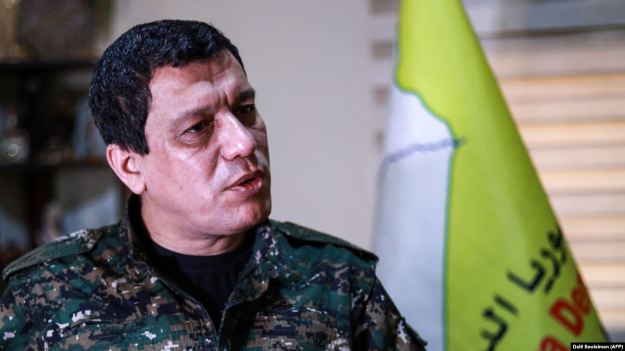
“SDF commander “General Mazlum Kobani” (the PKK executive official Ferhat Abdi Shahin) being interviewed by AFP in Hasaka city, 24 January 2019 [image source]
By Oved Lobel on 18 November 2019

PKK at a terrorist training camp in the Asad regime-held Bekaa Valley of Lebanon, 1991 [source]
The broad outline of the PKK’s relationship with the Soviet Union—and then the Russian Federation—is fairly clear. After the PKK was founded in Turkey in the late 1970s by Ocalan, it was evicted from the country during the 1980 military coup. The PKK moved to Syria, where Ocalan was already based, having fled Turkey in June 1979. From there, the PKK moved into the Bekaa area of Lebanon, at that time controlled by the Syrian regime of Hafez al-Asad, and the Soviets acted through Asad, as they so often did in dealing with terrorist groups, to build the PKK into a fighting force that was then unleashed in 1984 on Turkey, a frontline NATO state in the Cold War. Continue reading
By Kyle Orton (@KyleWOrton) on 12 November 2019

Ahmad al-Hashlum, Hasan Qassab, Hamza al-Malla, Mazen al-Harami
There has been a renewed crackdown on dissent in the areas of Syria run by the Kurdistan Workers’ Party (PKK). While on Syrian soil, the PKK uses the name Democratic Union Party (PYD), and its armed wing is called the People’s Protection Units (YPG). The YPG/PKK is the dominant force in the “Syrian Democratic Forces” (SDF), the U.S.-led international Coalition’s ground partner in Syria against the Islamic State (ISIS). Continue reading
A version of this article was published at The Arab Weekly.
By Kyle Orton (@KyleWOrton) on 12 October 2019
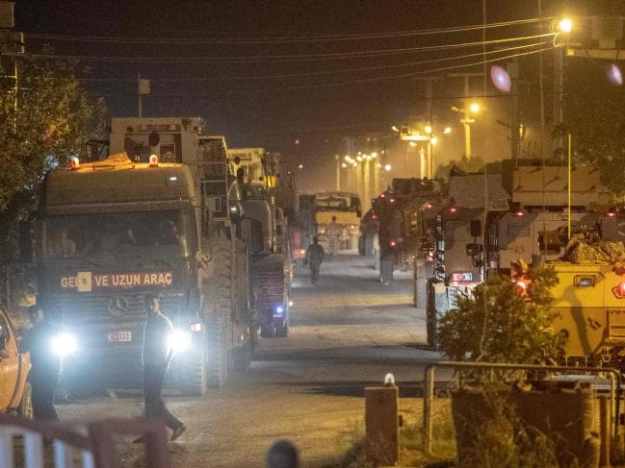
Turkish Armed Forces heading towards the border with Syria, 8 October 2019 // BULENT KILIC / AFP
The beginning of Turkey’s third incursion into Syria on Wednesday, this time dubbed Operation PEACE SPRING and aimed at the areas east of the Euphrates River, is the culmination of an American policy started under Barack Obama that has been continued by Donald Trump. That it is inevitable makes it no less tragic for the innocents caught up in this mess. It does mean that the emotive posturing on social media, and attempts by Obama era officials to cast the blame for the Syria catastrophe onto Trump, are more-than-usually grotesque. Continue reading
By Kyle Orton (@KyleWOrton) on 9 October 2019
Interview with De Re Militari Journal. Continue reading
This article was published at The New Turkey
By Kyle Orton (@KyleWOrton) on 1 October 2019
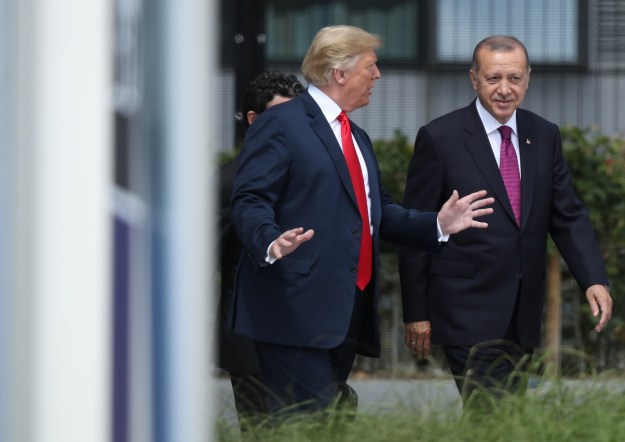
U.S. President Donald Trump and Turkish President Recep Tayyip Erdogan at the opening ceremony of the NATO Summit in Brussels, July 2018 // Getty Images
Turkey’s President Recep Tayyip Erdogan had said earlier in September that he would discuss the problems between Turkey and the United States when he met with the U.S. President Donald Trump on September 25, as part of his trip to New York for the opening of the United Nations General Assembly. But neither side has revealed what was discussed and if anything was resolved. Continue reading
By Kyle Orton (@KyleWOrton) on 22 July 2019

U.S. President Donald Trump and Turkey’s President Recep Tayyip Erdogan meeting during the G20 leaders summit in Osaka, Japan, 29 June 2019 [image source]
By Kyle Orton (@KyleWOrton) on 20 July 2019
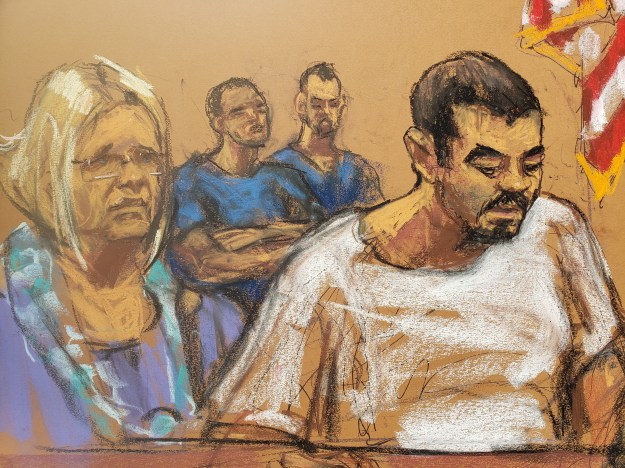
Sketch of Ruslan Asainov // Image credit: Jane Rosenberg/Reuters
In the Eastern District of New York, on 19 July, a criminal complaint was unsealed against Ruslan Maratovich Asainov, described in the press release as a “naturalized U.S. citizen born in Kazakhstan”. According to the release, Asainov is to be charged with providing and attempting to provide “material support, including training, services, and personnel” to a terrorist group, namely the Islamic State (IS), which he joined in 2013 and rose through the ranks to become an emir. Asainov was captured by the “Syrian Democratic Forces” (SDF), the Coalition’s anti-IS Kurdish partner force, and handed over to the FBI, before being returned to America this month. The maximum penalty for these charges is twenty years imprisonment, and it is likely the U.S. government will be seeking additional charges in the indictment. The case raises an interesting question over the gaps in knowledge about IS. Continue reading
By Kyle Orton (@KyleWOrton) on 8 July 2019
This article was originally published at the European Eye on Radicalization

The main issue that Nine Lives has to overcome is the one that has attended Aimen Dean (a pseudonym) since he went public in March 2015 with an interview he gave to the BBC, claiming he had been a British spy within Al-Qaeda between 1998 and 2006. That issue is overcoming the doubts about his story. Nine Lives goes a long way to solving this by bringing in Paul Cruickshank, the editor-in-chief of CTC Sentinel, one of the premier academic resources in the terrorism field, and Tim Lister, a terrorism-focused journalist with CNN, as co-authors. As well as helping structure the book from Dean’s memories, the two co-authors note they had been able to “corroborate key details” that convinced them: “In the years immediately leading up to and following 9/11, Aimen Dean was by far the most important spy the West had inside al-Qaeda”.
Continue reading Kyle Orton's Blog