Tag Archives: Kurds

What is Turkey Doing in Syria?

By Kyle Orton (@KyleWOrton) on 10 March 2019

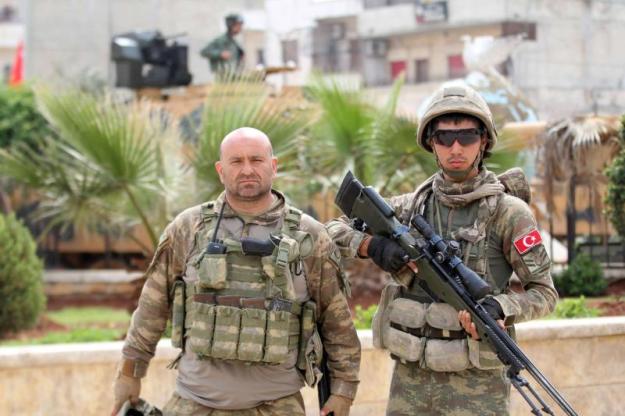
Turkish soldiers in Efrin, Syria, March 2018. (AFP)

Eight years ago, peaceful protests began against Syrian President Bashar Assad. Since then, outside powers — the Iran-Russia axis, the United States and Turkey — have become dominant in Syria.

The Iranians and Russians keeping Assad’s regime alive are clearly going nowhere. The Americans’ indecision on the point is apparently final. So, what of Turkey, which is the custodian of the remnants of the armed opposition? Continue reading

The Consequences of American Withdrawal from Syria

A version of this article was published at CapX

By Kyle Orton (@KyleWOrton) on 21 December 2018

President Trump in a Twitter video saying fallen soldiers agree with his plan to withdraw from Syria, 19 December 2018 [image source]

“We have won against ISIS”, declared President Donald Trump in a Twitter video on Wednesday night. “We’ve taken back the land. And now it’s time for our troops to come back home.” After a day of reporting that the United States has decided on a rapid, total withdrawal from Syria, here was the confirmation. It is a policy course fraught with danger and very likely to lead to outcomes unfavourable to Western interests, whether defined in humanitarian or strategic terms.
Continue reading

The Russian Relationship with Israel: A History

By Kyle Orton (@KyleWOrton) on 12 December 2018

© AP Photo / Jim Hollander, Pool

Essay: “Zionism is Making Us Stupid”: The Russian Relationship with Israel from the Soviets to Putin Continue reading

What Captured ISIS Jihadists Tell Us About the Group

By Kyle Orton (@KyleWOrton) on 2 December 2018

An Islamic State poster near al-Sukhna in the eastern Homs desert, Syria, August 2017 (source)

Over the past week, two members of the Islamic State (IS) have been arrested—a rarity in itself during the Coalition campaign against the group—and both in different ways give a glimpse of archetypes that have made up the organisation, from its inception to its expansion into Syria. Continue reading

Can the Europeans Help Reach Peace in Syria?

This article was published at The New Turkey

By Kyle Orton (@KyleWOrton) on 27 October 2018

Today in Istanbul, four governments—Turkey, Russia, Germany, and France—are meeting for a summit over Syria, attempting to consolidate the Sochi Agreement signed by Russia and Turkey over Idlib, and re-invigorate the international political process. There is little reason to think that these talks can succeed on either front. Continue reading

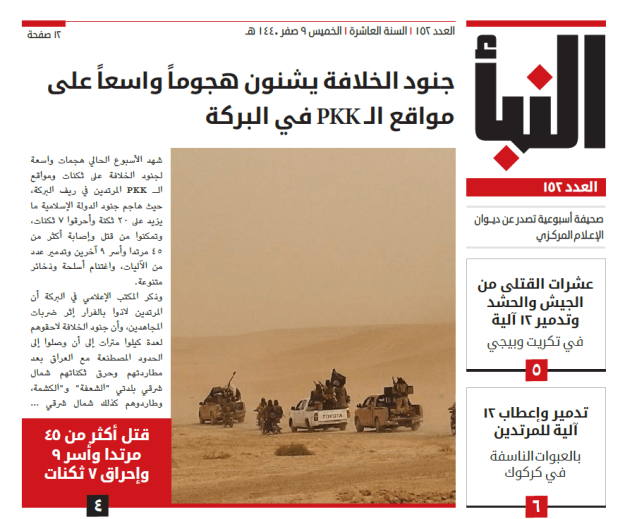
Islamic State Discusses Kurds and Insurgency

By Kyle Orton (@KyleWOrton) on 19 October 2018

The Islamic State (IS) released the 152nd edition of Al-Naba, its weekly newsletter, on 18 October. Continue reading

The State of Play in Syria and Iraq on the Eve of the Idlib Offensive

By Kyle Orton (@KyleWOrton) on 29 August 2018

Two ideas that have become quite prevalent are that the Islamic State is defeated or on its way to defeat and that the Syrian war is winding down. Both are gravely mistaken. Continue reading

Leftists Claim Arson Attack on German Think Tank

By Kyle Orton (@KyleWOrton) on 27 August 2018

The German Council on Foreign Relations (DGAP, Deutsche Gesellschaft für Auswärtige Politik), a semi-official think tank on the model of Chatham House, to which it is affiliated, was subjected to an arson attack on 22 August. The claimants to the attack, the “Autonome Gruppen” (Autonomous Groups), framed it as in part a response to Turkey driving the Kurdistan Workers’ Party (PKK) out of the Efrin province of north-western Syria. Their message was amplified by PKK propaganda channels. A summary of the message and the original are below. Continue reading

Turkey’s War Against the PKK on the Near Abroad

By Kyle Orton (@KyleWOrton) on 21 August 2018

Ismail Özden (image source)

Turkey killed a senior operative of the Kurdistan Workers’ Party (PKK), the internationally-recognised terrorist organisation and narcotics trafficking entity that has been at war with the Turkish state since 1984, in Iraq last week. Turkey launched a wave of airstrikes against PKK targets in Syria and Iraq in April 2017 and for the last several months Ankara has been widening its campaign against the PKK outside Turkey’s borders, particularly in Iraq, where the PKK is not protected by the United States, as it is in eastern Syria. Having feinted in June toward an attack on the historic PKK headquarters in the Qandil Mountains—a somewhat symbolic target at this stage, with the bulk of the PKK’s leadership and resources in Syria—it appears the Turks have opted for a more targeted approach.

This operation underscores the continuance of U.S.-Turkey relations, and the mutual benefits of the relationship, even in its current damaged state, where both sides have a laundry list of legitimate grievances with the other. If a formula for normalisation can be found, the potential to contain and weaken some of the worst, most destabilising elements in the region, saliently the PKK and the Iranian regime, is within reach. Continue reading

Australia’s No-Nonsense Approach to the PKK

By Kyle Orton (@KyleWOrton) on 17 August 2018

Funeral for the victims of the TAK/PKK terrorist attack on the Besiktas football stadium in Istanbul, December 2016. Photograph: Sedat Suna/EPA

The Kurdistan Workers’ Party (PKK), the separatist group in Turkey that is a designated terrorist organisation across much of the West, has always used a vast array of front-groups in the West to raise funds and recruit. After 9/11, with the advent of the War on Terror, the PKK switched tactics in the region to try to conceal its operations and avoid the “terrorism” label. This involved rebranding its operations in Iraq, Syria, and Iran, and setting up a special forces-style urban terrorism wing, the Kurdistan Freedom Falcons (TAK), to deniably carry out its most atrocious activities. The PKK’s rebranding has not been without success. In Australia, however, the government has refused to accept the PKK’s propaganda about TAK and lists it, quite correctly, as simply an alias for the PKK. Continue reading