Tag Archives: Operation EUPHRATES SHIELD

The Islamic State is Taking Advantage of the Mess in Northern Syria

By Kyle Orton (@KyleWOrton) on 22 July 2022

The United States announced on 12 July that it had killed the Islamic State’s (ISIS) governor of Syria in a drone strike in the village of Galtan in the Jinderes district of the north-western Syrian province of Efrin on the border with Turkey. The U.S. Central Command (CENTCOM) statement identified the slain man as “Maher al-Agal”, though a more precise transliteration is Maher al-Aqal (ماهر العقال). Riding on the motorcycle alongside Al-Aqal when he was killed was a “senior ISIS official” with whom he was “closely associated”. This ISIS official was “seriously injured during the strike”, CENTCOM notes, adding that the Jinderes strike caused no civilian casualties. Continue reading
Collision or Collusion for Turkey and America in Syria?

This article was published at The New Turkey

By Kyle Orton (@KyleWOrton) on 1 October 2019

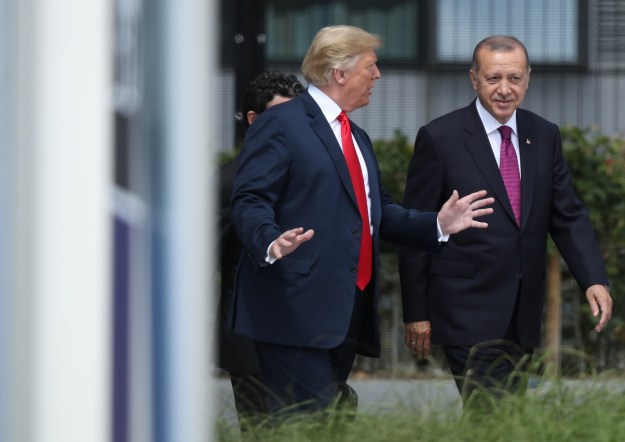
U.S. President Donald Trump and Turkish President Recep Tayyip Erdogan at the opening ceremony of the NATO Summit in Brussels, July 2018 // Getty Images

Turkey’s President Recep Tayyip Erdogan had said earlier in September that he would discuss the problems between Turkey and the United States when he met with the U.S. President Donald Trump on September 25, as part of his trip to New York for the opening of the United Nations General Assembly. But neither side has revealed what was discussed and if anything was resolved. Continue reading

What is Turkey Doing in Syria?

By Kyle Orton (@KyleWOrton) on 10 March 2019

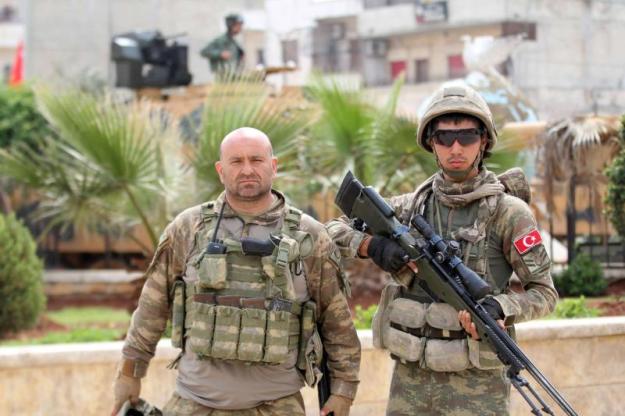
Turkish soldiers in Efrin, Syria, March 2018. (AFP)

Eight years ago, peaceful protests began against Syrian President Bashar Assad. Since then, outside powers — the Iran-Russia axis, the United States and Turkey — have become dominant in Syria.

The Iranians and Russians keeping Assad’s regime alive are clearly going nowhere. The Americans’ indecision on the point is apparently final. So, what of Turkey, which is the custodian of the remnants of the armed opposition? Continue reading

Would Turkey Risk a Clash with America in Syria?

By Kyle Orton (@KyleWOrton) on 18 December 2018

Tel Abyad, Syria [source]

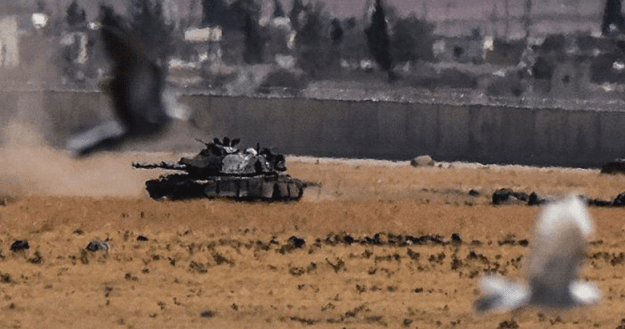
Turkish President Recep Tayyip Erdoğan has threatened a third military operation into Syria, this time in the east. The mobilisation of his proxies and other measures make clear that Erdoğan wants it to be believed he means it. The complication is that the intended target, the Syrian Democratic Forces (SDF), are the chosen partners of the United States-led coalition against Islamic State (ISIS), and U.S. soldiers are present in the area. Continue reading

Why is Turkey Threatening a Third Incursion into Syria?

By Kyle Orton (@KyleWOrton) on 14 December 2018

The United States’ policy in Syria has been, as James Jeffrey, the Special Representative for Syria Engagement, explained recently, focused on “one mission”: the destruction of the Islamic State (Daesh).

The US attempted to pursue this counter-terrorism mission in isolation from the politics of the broader Syrian war. This failed, as it was bound to do, and it has laid the ground for a series of sub-conflicts, another of which might be about to erupt. Continue reading

America’s Search for Stability in Syria is Hostage to the Turkey-PKK War

This article was published at Ahval

By Kyle Orton (@KyleWOrton) on 13 November 2018

Joint patrols begin around Manbij (image source)

The United States has taken steps Syria in recent months that suggest a shift towards reconciliation with Turkey. Even if this is so, however, there is still such a deep divide over strategic outlook that these steps could be easily reversed, opening a new round of uncertainty in northern Syria as 2018 draws to a close. Continue reading

Turkey’s Upcoming Foreign Policy Challenges

By Kyle Orton (@KyleWOrton) on 12 July 2018

American troops look out toward the border with Turkey from a small outpost near the town of Minbij, 7 Feb. 2018 (AP Photo/Susannah George)

As Turkey moves past last month’s election, the foreign policy challenges remain acute, particularly in Syria, and there is a looming confrontation with the United States over sanctions on Iran that might undo the recent progress toward the normalisation of U.S.-Turkish relations. Continue reading

Syria’s Revolution Has Been Overtaken By Outside Powers

By Kyle Orton (@KyleWOrton) on 16 March 2018

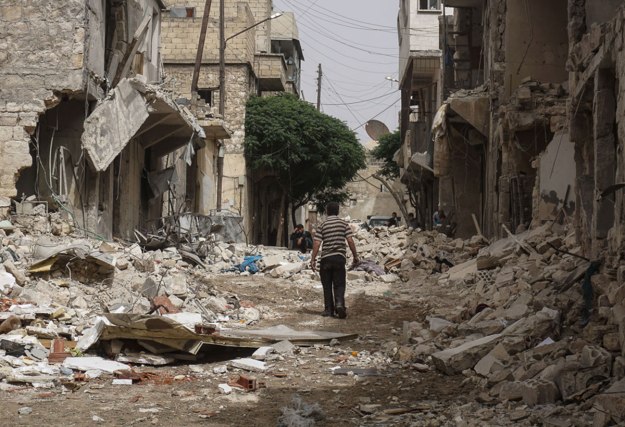
Devastation in Aleppo (image source)

This week marks the seventh anniversary of the Syrian revolution. A movement that began with peaceful street protests calling for reform and—after the government responded with lethal violence—the downfall of the dictator, descended into war that has to this point cost the lives of at least 500,000 people and displaced nearly twelve million others—more than half of Syria’s pre-war population.

In any strategic sense the rebellion has been defeated—it is not able to overthrow Bashar al-Assad by force on its own—and its political cause is increasingly strained as the remnants of the armed opposition are increasingly co-opted by external actors, state and non-state. Continue reading

Crisis and Opportunity for Turkey and America: The Minbij Dispute

By Kyle Orton (@KyleWOrton) on 4 March 2018

A version of this article was published in The Arab Weekly

The YPG/PKK Minbij Military Council (image source)

The city of Minbij in northern Syria has become a source of severe political tension between the United States and Turkey. It might also be the key to reducing tensions and normalising relations. Continue reading

Human Rights Abuses in Rojava and the Anti-ISIS War

By Kyle Orton (@KyleWOrton) on 3 March 2018

Guerrillas from the Sinjar Resistance Units (YBS), the name the Kurdistan Workers’ Party (PKK) uses in Sinjar, Iraq, together with operatives from the People’s Defence Forces (HPG), the armed units of the PKK inside Turkey, holding a picture of PKK leader Abdullah Ocalan. (image source)

The American-led Coalition’s partner against the Islamic State (IS) in Syria, the so-called Syrian Democratic Forces (SDF), presents itself, ideologically and in terms of the governance structure it controls, in universalistic liberal and democratic terms, emphasizing ecological and feminist themes. The reality is that the SDF is under the politico-military control of the Kurdistan Workers’ Party (PKK), a designated terrorist organization that has run a four-decade-long insurgency against Turkey. The PKK has brought some measure of stability to the areas it controls, but it continues to struggle for legitimacy and without locally-legitimate government IS and other jihadi-Salafists will find political room to operate. The PKK’s continued monopolization of power and abusive governance practices undermine the chances for the “Rojava” system to evolve into a long-term solution to the jihadist terrorists that have used Syrian territory to threaten the region and the wider world. Continue reading