By Kyle Orton (@KyleWOrton) on 29 July 2017
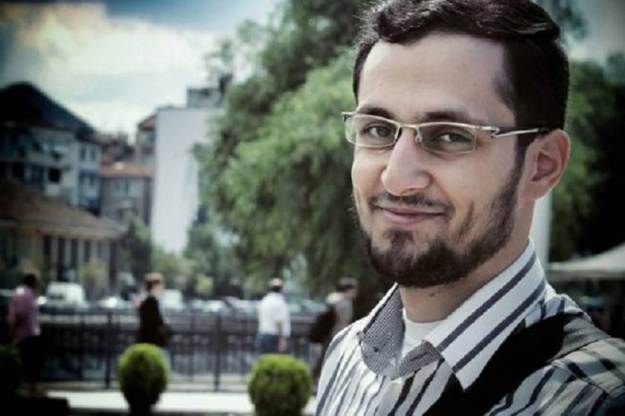
Baraa Kadek (Riyan Meshal) [image source]
By Kyle Orton (@KyleWOrton) on 29 July 2017
Baraa Kadek (Riyan Meshal) [image source]
Published at The Telegraph
By Kyle Orton (@KyleWOrton) on 7 June 2017
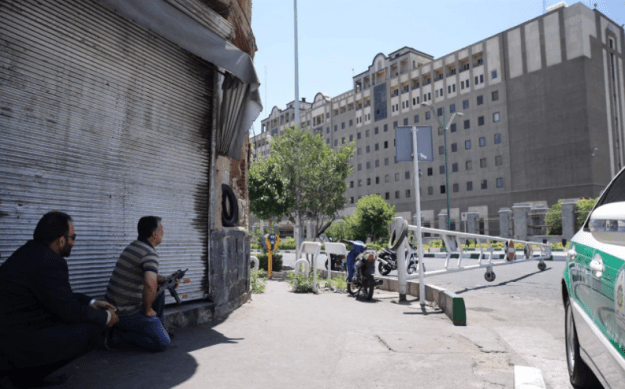
Armed terrorists stormed the Iranian parliament complex in Tehran (CREDIT: OMID VAHABZADEH/AFP/GETTY IMAGES)
In its choice of target and timing, ISIL has shown, once again, its skill in exploiting the rivalries of its enemies—setting them against one another to buy itself greater room for manoeuvre. Continue reading
By Kyle Orton (@KyleWOrton) on 13 May 2017
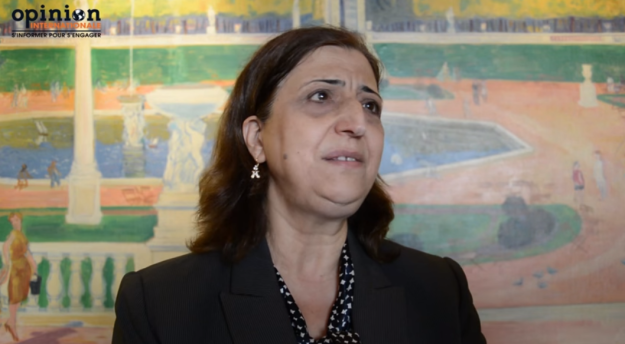
Sinam Mohamad
The New York Times on 11 May carried an op-ed entitled, “Once We Beat ISIS, Don’t Abandon Us,” by Sinam Mohamad, the effective foreign minister of the governance structure in northern Syria administered by the Democratic Union Party (PYD) and its armed wing, the People’s Protection Units (YPG), the Syrian departments of the Kurdistan Workers’ Party (PKK). This comes just over two weeks after another senior PYD/PKK official, Ilham Ahmed, was given space to disseminate the group’s messaging in The Washington Post, and the problems remain the same.
Continue reading
By Kyle Orton (@KyleWOrton) on 29 April 2017

Ilham Ahmed
The West’s Syria policy is beginning to unravel of its own contradictions.
The Turkish government launched airstrikes against the positions of the Kurdistan Workers’ Party (PKK) in north-eastern Syria and the Sinjar area of north-western Iraq in the early hours of 25 April. There were international ramifications to this because the PKK in Syria, which operates politically under the name of the Democratic Union Party (PYD) and militarily as the People’s Defence Units (YPG), is the main partner of the U.S.-led Coalition against the Islamic State (IS). Turkey has protested the U.S. engaging the YPG/PKK so deeply and exclusively as its anti-IS partner, being displeased at the U.S.’s uncritical (public) stance toward the YPG, even after the YPG violated U.S.-brokered agreements on its operational theatres and used Russian airstrikes to attack Turkey- and CIA-backed rebels.
In response to Turkey’s anti-PKK operations this week, The Washington Post has hosted an op-ed by Ilham Ahmed, identified as “a co-president of the Democratic Council of Syria”. Continue reading
Published at The International Business Times
By Kyle Orton (@KyleWOrton) on January 18, 2017

Chelsea Manning (REUTERS/U.S. Army)
It might have been thought that a consistent opposition to treason was not all that difficult. But President Barack Obama’s surprise decision last night to commute the sentence of Bradley, now Chelsea, Manning, showed how deeply political partisanship has penetrated into areas like national security, where ideally country would be put before party or ideology. Continue reading
By Kyle Orton (@KyleWOrton) on January 7, 2017

Abdulkadir Masharipov (source)
It was an hour into 2017 that the Islamic State (IS) carried out its first act of mass-murder: an IS jihadist attacked the Reina nightclub in Istanbul, massacring thirty-nine people. IS has been attacking Turkey with increasing frequency over the last two years and, since Turkey intervened directly in Syria in August, IS’s media output has elevated the Turks into a priority target for terrorism. The public claim of responsibility by IS for the Reina attack suggests that we are moving into a new era in terms of how IS treats Turkey. Turkey’s increasingly warm relations with Russia have angered many Muslims around the world, providing jihadists an incentive and opportunity, and providing al-Qaeda political space it seemed to have lost to co-opt the Syrian rebellion. It is therefore likely that more bloodshed is to come for Turkey. Continue reading
Originally published at The Henry Jackson Society
By Kyle Orton (@KyleWOrton) on December 2, 2016

Islamic State fortifications in Deir Ezzor (from an IS video, 11 July 2016)
The Islamic State (IS) is nominally under attack now in its twin capitals, Mosul in Iraq and Raqqa in Syria. This is necessary task, of course, but, as I’ve written repeatedly over the last few months, clearing IS from its urban centres is not sufficient. IS lost its overt urban holdings once before and nonetheless rebuilt in the deserts between 2008 and 2013, rising again to seize increasingly-large tracts of territory that were eventually declared a caliphate. IS was able to do this because of the success of its long-term method of war-making, and political changes in Baghdad—toward greater sectarianism and authoritarianism—that gave it more space to manoeuvre. The flaws in the strategy and partners the U.S.-led international Coalition have chosen to eliminate IS are creating a situation in which what will be called “victory” is really the resetting of the cycle. More evidence of this has recently come to the fore. Continue reading
By Kyle Orton (@KyleWOrton) on April 2, 2016
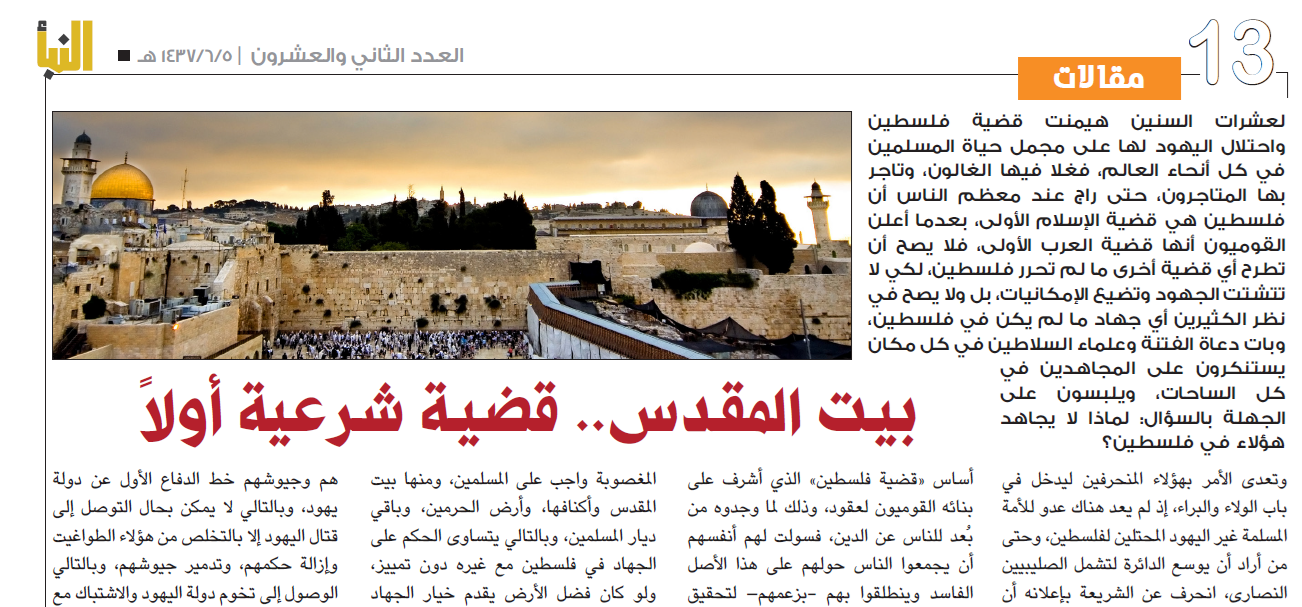
An article in the twenty-second edition of al-Naba, the Islamic State’s (IS) newsletter, released on 15 March 2016, explained why the group has not made fighting Israel a priority.
By Kyle Orton (@KyleWOrton) on February 22, 2016
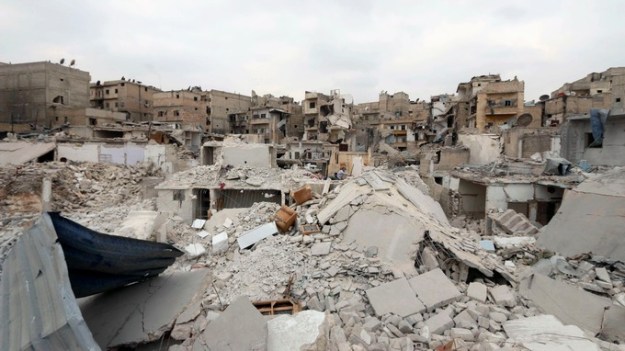
Aleppo City after the destruction of the Asad regime, Iran, and Russia
Introduction
From the beginning of Syria’s war, the regime of Bashar al-Assad, enabled by Iran and Russia, has run a very elaborate media war to portray itself as the victim of an international conspiracy, wherein its only opponents are terrorists from al-Qaeda and its offshoots who are being used by foreigners—namely the Gulf States, Turkey, Israel, and the United States—to overthrow a defiant “resistance” State.
The other part of this strategic messaging is aimed at the West, which Assad otherwise accuses of supporting jihadi-Salafist terrorism against him: Assad is the only alternative to the terrorists, it says, so the West should support him. War criminal he might be, he will protect the minorities—his role in endangering them by starting a sectarian war against the Sunni majority and bolstering the takfiris within the insurgency to cannibalize all legitimate or engageable armed opposition, notwithstanding—and has no immediate plans to fly planes into Western skyscrapers. (That the leading edge of Assad’s ground forces are made up of radically sectarian, foreign Shi’a jihadists under Iran’s control, some of them Iraqis responsible for killing a quarter of the 4,000 U.S. soldiers who fell in Mesopotamia, and are integrated into a State-run terrorist network that has struck Western and Jewish targets the world over, gets left out.)
For Assad and his allies, it helps if this propaganda is not only delivered by regime spokesman but independent analysts, journalists, academics, and politicians. In the last ten days two salient examples have emerged: Stephen Kinzer, a veteran journalist, including for The New York Times, who wrote in The Boston Globe, and Jeffrey Sachs, an academic economist working at Columbia University, who wrote in The Huffington Post. Mixing together conspiracy theories, half-truths, and outright lies—disinformation, to give it an old name—both Kinzer and Sachs told a version of the regime’s narrative. Why they did this is best-known to them. Continue reading
By Kyle Orton (@KyleWOrton) on December 29, 2015
In the last month, the Islamic State (IS) has been waging a concerted campaign to shut down all independent sources of information emanating from its statelet. IS’s focus has been on Raqqa is Being Slaughtered Silently (RBSS), an activist group that began in April 2014 in IS’s de facto capital in northern Syria. RBSS has published information—including pictures and videos, much of it via Twitter—on the crimes of the “caliphate”. IS has now murdered at least five RBSS journalists and activists, two of them on foreign soil in Turkey, plus the father of one of RBSS’s founders. (The sixth case, also in Turkey, is more murky.) The suppression of independent media by IS is necessary to allow the group to maintain social control of the areas it rules and to sustain the narrative that it is building utopia on earth, which attracts in the foreign fighters that help IS maintain and expand its territory.
Continue reading
 Kyle Orton's Blog