Tag Archives: Quds Force

Allowing Iran To Conquer Iraq Will Not Help Defeat The Islamic State

By Kyle Orton (@KyleWOrton) on March 15, 2015

Qassem Suleimani

Qassem Suleimani

Iraq’s Prime Minister Haider al-Abadi announced the beginning of an offensive on March 1 to dislodge the Islamic State (ISIS) from Salah ad-Din Province. Abadi announced that this would be led by the Iraqi army and Hashd al-Shabi, known in English as the Popular Mobilization Units (PMUs), the militias composed overwhelmingly of Shi’ites and directed by Iran.

While the offensive seems to be winding down, it is not over. ISIS is out of ad-Dawr/Dour and al-Awja, south of Tikrit, and Albu Ajeel to the east. Al-Alam to the north seems to still be contested. On March 10, ISIS was driven out of al-Qadissiya, a northern district of Tikrit City. On March 11, the anti-ISIS forces entered Tikrit City, “inched closer to the city center … and took up positions in a military hospital, the police academy and the traffic police headquarters … Forces in southern districts took over three palaces erected by former dictator Saddam Hussein”. Continue reading

Iran and Global Terror: From Argentina to the Fertile Crescent

By Kyle Orton (@KyleWOrton) on February 27, 2015

Khobar Towers, which Iran jointly bombed with al-Qaeda

Khobar Towers, which Iran jointly bombed with al-Qaeda

Argentina’s government yesterday announced it was dissolving the Secretariat of Intelligence (S.I.), an intelligence agency tainted by the “Dirty War” regimes (1974-83), and more recent abuses as President Cristina Kirchner has taken Argentina back toward autocracy, and replacing it with a Federal agency. Just two days before, charges of corruption were levelled against Antonio Stiusso, S.I.’s director until Kirchner fired him in December. At the beginning of this month, Stiusso went missing. It now seems Stiusso has taken shelter in a neighbouring State.

These events are the latest twist in an extraordinary saga that has followed the discovery of the body of Alberto Nisman on Jan. 18 in his apartment in Buenos Aires, shot in the head in an apparent suicide. Nisman was a prosecutor investigating the July 18, 1994, bombing of the Argentine Israelite Mutual Association (AMIA) building in Argentina’s capital. All the evidence that Nisman had gathered pointed to Iran as the perpetrator. Few believe Nisman committed suicide, and—the history of Argentines being “suicided” considered—most fingers are pointing at Iran. Continue reading

America’s Silent Partnership With Iran And The Contest For Middle Eastern Order: Part Four

By Kyle Orton (@KyleWOrton) on February 10, 2015

1

This is the fourth of a four-part series looking at the United States’ increasingly-evident de facto alliance with Iran in the region. The first part looked at the way this policy has developed since President Obama took office and how it has been applied in Iraq; the second part looked at the policy’s application in Syria; the third part looked at its application in Lebanon, Afghanistan, and Yemen; and this part is a conclusion. Continue reading

America’s Silent Partnership With Iran And The Contest For Middle Eastern Order: Part Three

By Kyle Orton (@KyleWOrton) on February 3, 2015

1

This is the third of a four-part series looking at the United States’ increasingly-evident de facto alliance with Iran in the region. This first part looked at the way this policy has developed since President Obama took office and how it has been applied in Iraq. The second part looked at the policy’s application in Syria; this part will look at its application in Lebanon, Afghanistan, and Yemen; and part four will be a conclusion. Continue reading

America’s Silent Partnership With Iran And The Contest For Middle Eastern Order: Part Two

By Kyle Orton (@KyleWOrton) on January 29, 2015

Assad meeting with the boss

Assad meeting with the boss

This is the second of a four-part series looking at the United States’ increasingly-evident de facto alliance with Iran in the region. This first part looked at the way this policy has developed since President Obama took office and how it has been applied in Iraq. This part will look at the policy’s application in Syria; part three will look at its application in Lebanon, Afghanistan, and Yemen; and part four will be a conclusion. Continue reading

America’s Silent Partnership With Iran And The Contest For Middle Eastern Order: Part One

By Kyle Orton (@KyleWOrton) on January 25, 2015

1

This is the first of a four-part series looking at the United States’ increasingly-evident de facto alliance with Iran in the region. This first part looks at the way this policy has developed since President Obama took office and how it has been applied in Iraq. Part two will look at the policy’s application in Syria; part three will look at its application in Lebanon, Afghanistan, and Yemen; and part four will be a conclusion. Continue reading

Iran Tries To Get American Support For Its Takeover Of Lebanon

By Kyle Orton (@KyleWOrton) on December 31, 2014

In early August, the Lebanese Armed Forces (LAF) arrested Abu Ahmad Jumaa, the leader of Liwa Fajr al-Islam (Islamic Dawn Brigade), which had been loyal to al-Qaeda’s Syrian branch, Jabhat an-Nusra but which had then-recently defected to the Islamic State (I.S.). In response, Nusra and I.S. fighters poured across the border into Arsal, Lebanon, where Jumaa was being held, and after five days of clashes the Salafi jihadists withdrew, taking with them thirty Lebanese security personnel. Five of the thirty are now dead: one from his injuries, the other four murdered—at least two of them beheaded. Continue reading

A Freeze In Aleppo Won’t Help Save Syria—But It Might Help Assad

By Kyle Orton (@KyleWOrton) on December 15, 2014

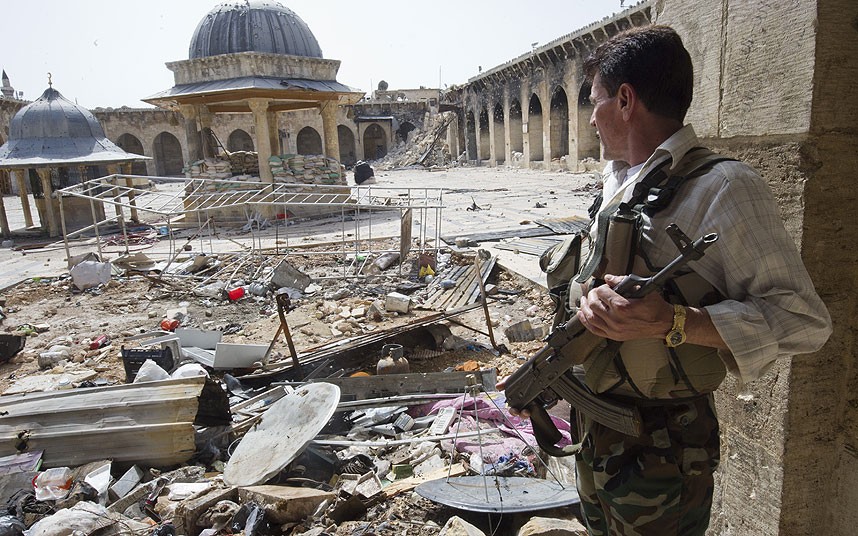
Great Mosque in Aleppo


On October 30, the United Nations peace envoy Staffan de Mistura presented an “action plan” for Syria, which included a plan for a “freeze zone” in Aleppo to give “an opportunity for some type of humanitarian improvement”. De Mistura wanted this to re-focus efforts of fighting units on all sides against the Salafi-jihadists of the Islamic State and Jabhat an-Nusra (al-Qaeda). Small wonder then that Assad’s U.N. envoy, Bashar Jafaari, said the regime was giving the proposal “due consideration”.

This freeze idea had emerged just after the Obama administration had, through surrogates, said it was sympathetic to the idea of trying to use local “ceasefires” Continue reading

Nuclear Negotiations With Iran Go On—And On And On

By Kyle Orton (@KyleWOrton) on December 2, 2014

Fordow, an Iranian nuclear enrichment facility near Qom—easily mistaken for the volcano lair of a Bond villain

Fordow, an Iranian nuclear enrichment facility near Qom—easily mistaken for the volcano lair of a Bond villain

It wasn’t exactly a nail-biting finish in the end was it? In Vienna on Nov. 24, the P5+1 and Iranian negotiators decided to extend for another seven months the “interim” deal, the Joint Plan of Action (JPA), made in November 2013 on Iran’s nuclear weapons program, until June 2015. Conditions always favoured an extension but I was not absolutely sure that this is what would happen until Secretary of State John Kerry said on Nov. 21: “We are not discussing an extension.” Continue reading

Israel’s Airstrikes in Syria

By Kyle Orton (@KyleWOrton) on November 12, 2014

In a post yesterday I listed the operations Israel has so far carried out in Syria. Between 2007 and 2011, Israel eliminated several senior terrorists inside Syria and destroyed a nuclear-weapons facility. Since the war began in 2011, Israel has mostly carried out airstrikes in Syria to prevent Iran and its Islamic Revolutionary Guards Corps (IRGC) transferring advanced weaponry to the IRGC’s Lebanon-based branch, Hizballah. Rather than updating the prior post, which was on a slightly separate matter, this post will be kept as a rolling tally of Israeli operations in Syria, focused only on those since war broke out. Continue reading