Tag Archives: Raqqa

Islamic State Officially Gives Up the Caliphate, Returns to Insurgency

By Kyle Orton (@KyleWOrton) on 15 November 2017
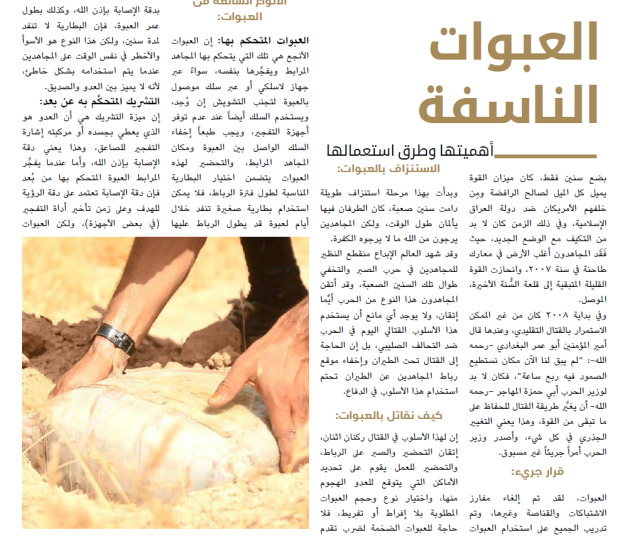
Al-Naba 101, page 8

In the 101st edition of the Islamic State’s weekly newsletter al-Naba (page 8-9), released on 12 October 2017, the organisation gave some fascinating details about how they responded to the “defeat” inflicted on them in 2007-08 by the American surge and the tribal Sahwa (Awakening) forces. The article describes how IS switched wholly to insurgent-terrorist tactics, dismantling its conventional fighting units and even its sniper teams in March 2008, and training in hit-and-run bombings. The leadership at that time, the emir Hamid al-Zawi (Abu Umar al-Baghdadi) and his deputy, the “first minister” and the “war minister” Abdul Munim al-Badawi (Abu Hamza al-Muhajir), encountered some initial scepticism, but the rank-and-file soon came on board when they saw its effectiveness. IS says that it is time to return to this form of warfare. In short, IS marked a switch in al-Naba 101 entirely from the statehood and governance phase of its revolutionary warfare, back into insurgency mode. The article is reproduced below. Continue reading
The Controversial End of the Islamic State in Raqqa

By Kyle Orton (@KyleWOrton) on 14 November 2017

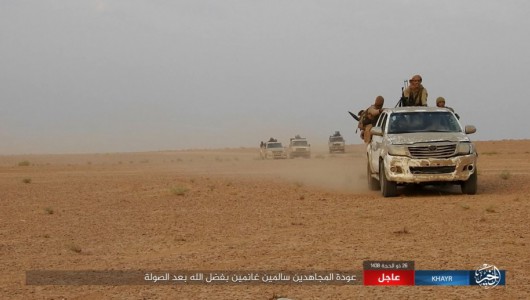
IS jihadists arriving south of Deir Ezzor city, September 2017

A deal was made between the “Syrian Democratic Forces,” the U.S.-led Coalition’s “partner force” in Syria that is wholly dominated by the Kurdistan Workers’ Party (PKK), and the Islamic State (IS), which ostensibly evacuated the remnants of the IS jihadists—said to be between 300 and 500 militants, plus 400 “hostages” (i.e. women and children)—from Raqqa by 15 October. The U.S.-led Coalition said at the time, “do not condone” the deal, but the Coalition acknowledged that its PKK partner had to make these tactical calls, and there was a lot of local pressure from local tribal leaders to reach this deal given the devastation visited on the city. It now transpires, however, that this deal was the worst of all worlds: the Coalition ruined the city in its efforts to overcome IS’s tactical adaptations to the air campaign, and then allowed a scandalous number of IS jihadists to escape. Continue reading

Don’t Celebrate the Fall of Raqqa Just Yet

By Kyle Orton (@KyleWOrton) on 24 October 2017

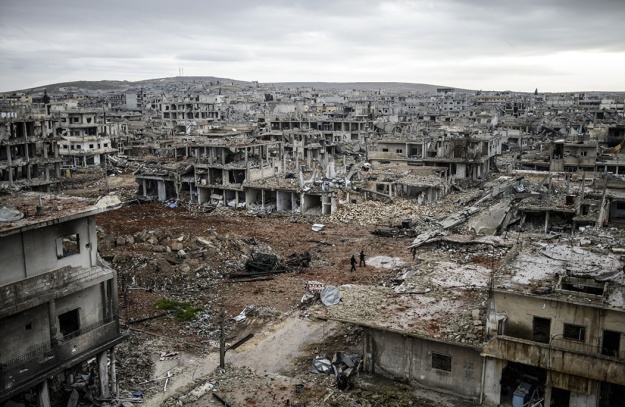
Raqqa city has been destroyed (image source)

The Islamic State (IS) captured Raqqa city, its first provincial capital, in January 2014. Six months later, IS declared its caliphate and Raqqa became its de facto capital. Last Tuesday, the partner force of the US-led anti-IS Coalition, the “Syrian Democratic Forces” (SDF), entered the city centre in Raqqa. A deal had evacuated most of the remaining jihadists over the prior weekend, though a determined core remained and still held about 10 per cent of the city. The caliphate is crumbling and the Coalition says IS has 6,500 fighters left. According to the Coalition, this puts IS “on the verge of a devastating defeat”. Unfortunately, there is no reason to believe this is true. To the contrary, IS is more powerful at this point, in theatre, even after the military reverses inflicted on it by the Coalition, than in the period after the “defeat” of 2008, and the outlook is more favourable now to IS. Moreover, IS now has an international reach, physically and ideologically, it did not previously possess. Continue reading

By Strengthening Iran, the Coalition Has Ensured the Islamic State’s Survival

Published at The Telegraph

By Kyle Orton (@KyleWOrton) on 6 October 2017

The “defeat” of the Islamic State (ISIL), signified by its eviction from Mosul in July, its impending loss of Raqqa, and an apparent resurgence of Bashar al-Assad’s regime in Syria, seemed to augur a new era of stability for the Middle East. The jihadists would be gone and Iranian-backed governments in Syria and Iraq consolidated.

True, Assad murdering those who resisted him with poison gas and concentration camps, and hiding the evidence by installing crematoria, would nag at our conscience. But foreign policy is a cold-blooded business and it has been decreed that ISIL is the greatest—really the only—threat emanating from the region.

It would not be justice, but it would be peace. Or something like that. Continue reading

The Latest Chapter of Syria’s Media War: A ‘Gay Unit’ Fighting the Islamic State

By Kyle Orton (@KyleWOrton) on 31 July 2017

Earlier this month, it was announced that an LGBT military unit had been formed to fight the Islamic State (IS) in its Syrian “capital”, Raqqa city. There does appear to be such a unit in existence, though it is militarily inconsequential and likely has fewer than a dozen members, all of them foreign. The unit’s primary intention was to bolster the ongoing media-political campaign of the Kurdistan Workers’ Party (PKK), which is selling itself to Western audiences as a “progressive” ideological ally in the Middle East. This is the latest chapter in a conflict where the significance of the media war has few precedents. Continue reading

The Coalition’s Partner in Syria: The Syrian Democratic Forces

Originally published at The Henry Jackson Society

By Kyle Orton (@KyleWOrton) on 9 July 2017

Syrian Democratic Forces (SDF) logo

The offensive to expel the Islamic State (IS) from its primary urban stronghold in Syria, Raqqa city, began on 6 November 2016 with shaping operations and commenced in earnest on 6 June 2017. Backed by the U.S.-led Coalition, the operation, known as EUPHRATES WRATH, is being carried out on the ground by the Syrian Democratic Forces (SDF) or Quwwat Suriya al-Dimoqratiyya (QSD). The SDF is formally a coalition of Kurds and Arabs—its announcement of the Raqqa operation named eighteen distinct sub-units. But the predominant force within the SDF is the Kurdistan Workers Party (PKK), and the Arab SDF play a “secondary role of maintaining local security,” which is to say providing an acceptable face for the PKK’s administration in the Arab-majority areas it has captured. Examining the SDF’s composition, and the recent marginalization of Arab SDF groups, underscores the point. Continue reading

Coalition Policy Risks Replacing Islamic State With Other Islamists

By Kyle Orton (@KyleWOrton) on 7 July 2017

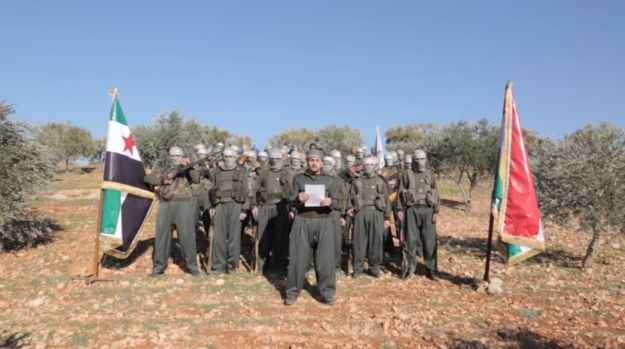
Announcement of the Kurdish Salvation Movement, 12 March 2017

As the operation proceeds to expel the Islamic State (IS) from its last major Syrian urban stronghold, Raqqa city, a statement was published on 5 July by a number of clerics, which points to the danger that the Coalition campaign, by partnering exclusively with Kurdish forces, is preparing conditions that will allow other Islamists to fill the vacuum after IS loses overt control of eastern Syria.
Continue reading

Third Speech of Islamic State Spokesman Abu Hassan al-Muhajir

By Kyle Orton (@KyleWOrton) on 29 June 2017

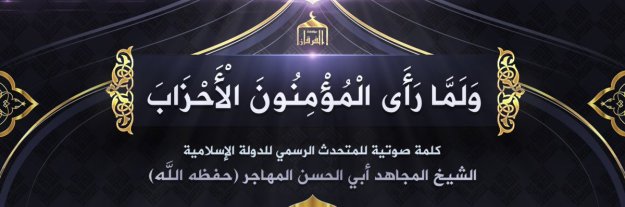
The spokesman of the Islamic State (IS), Abu Hassan al-Muhajir, made his third speech on 12 June 2017, entitled, “And When The Believers Saw The Companies”. Abu Hassan’s first speech was in December 2016 and his second was in April 2017. The primary message of Abu Hassan’s speech was for IS’s troops to resist to the end in what is left of the caliphate’s grip on its Iraqi capital Mosul as that offensive, begun last October, draws to a close, and to hold similarly firm as the operation to evict IS from its Syrian capital Raqqa, launched on 6 June, gets underway. The main editorial of Al-Naba 84 a few days before Abu Hassan spoke laid out IS’s intention, somewhat contrary to its general practice, to resist fiercely in Raqqa. Abu Hassan continues the messaging, consistent since the U.S.-led coalition began its countermeasures against IS, that “patience” will lead to victory. IS has not wavered from this strategy in more than ten years, and it is showing signs of bearing fruit already, a trendline likely to continue unless there is a change of Coalition strategy. In crude, practical terms, Abu Hassan means to say that the terrorism and guerrilla campaign will continue after IS is uprooted from the urban areas.
Continue reading

Viewing the Coalition’s Flawed Anti-Islamic State Strategy From Raqqa’s Frontlines

By Kyle Orton (@KyleWOrton) on 19 June 2017

YPG and U.S military vehicles in Darbasiya, northern Syria, 28 April 2017. REUTERS/Rodi Said/File Photo

At the end of May, Christoph Reuter, a journalist with Der Spiegel, embedded with the Syrian Democratic Forces (SDF) as it made its way, supported by the U.S.-led Coalition, toward Raqqa city, the Syrian “capital” of the Islamic State’s (IS) caliphate. Reuter’s report provides snapshots of a number of important—and worrying—dynamics at play that have made the U.S. decision to back the SDF to liberate Raqqa so worrying over the long-term, even on its own terms as a means of sustainably defeating IS. Continue reading

The West’s Partners in Syria and the Risks to Turkey

Originally published at The Henry Jackson Society

By Kyle Orton (@KyleWOrton) on 8 June 2017

Aftermath of a TAK bombing in central Istanbul, Turkey, 7 June 2016

The Kurdistan Freedom Falcons (TAK) issued a threat against Turkey on Tuesday, at the very moment the U.S.-led Coalition was announcing the commencement of the operation to evict the Islamic State (IS) from its Syrian capital, Raqqa, in alliance with the TAK’s mother organization, the Kurdistan Workers’ Party (PKK). This underlines some of the challenges confronting the Coalition as a result of a half-decade of short-sighted counter-terrorism policy in Syria and a regional posture that tilted away from traditional allies. Continue reading