Tag Archives: religion

Hysteria and the Iranian Revolution

By Kyle Orton (@KyleWOrton) on 12 October 2021

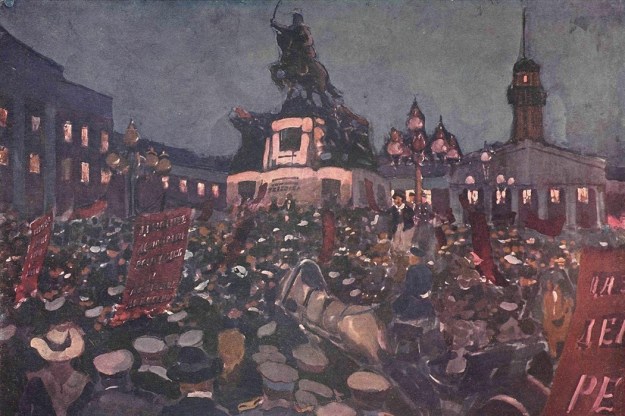
Iranian protesters burn an effigy of the Shah outside the American Embassy, 1979 [source]

There were immense political forces at work in the Iranian Revolution of 1978-79, and they have been covered in some depth on this blog before. In this brief piece, I want to look at the social aspect, specifically the social contagion aspect. People who were in Iran during the Islamic Revolution or who have studied it deeply in retrospect describe the country going “temporarily insane”,[1] and tend to use terms like “febrile” and “hysterical” when describing the atmosphere, especially by the summer of 1978, since, as everyone seems to acknowledge, the revolutionary fervour fed on itself the longer it was allowed to continue. Continue reading

How Many Christians Were There in the Roman Empire?

By Kyle Orton (@KyleWOrton) on 11 June 2021

The numbers on the growth of Christianity in the Roman Empire are very uncertain, but there are enough data points to hazard a reasonable estimate. Continue reading

Islamic State Denounces the Pope’s Visit to Iraq as a Conspiracy Against Islam

By Kyle Orton (@KyleWOrton) on 13 March 2021

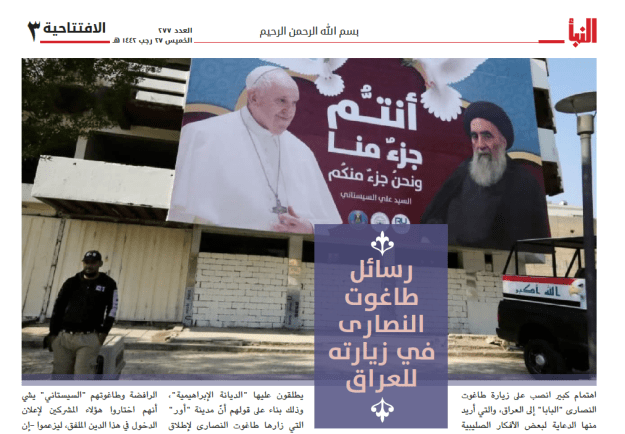
Al-Naba 277, page 3

The Islamic State (IS) released the 277th edition of its weekly newsletter, Al-Naba, on 11 March 2021. The main editorial focused on the Catholic Pope Francis’ 5-8 March apostolic visit to Iraq, where inter alia a Roman Pontiff for the first time visited Ur, believed to be the birthplace of Abraham, and took Mass in the Chaldean rite (at the Cathedral of Saint Joseph in Baghdad). Continue reading

Qassem Sulaymani: Life and Ambition

By Kyle Orton (@KyleWOrton) on 2 March 2021

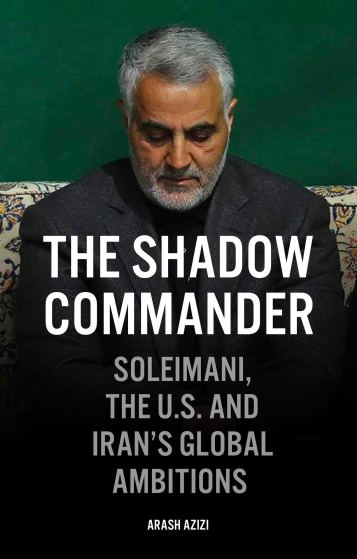
A year ago, U.S. President Donald Trump gave the order to kill Qassem Soleimani, the de facto deputy leader of Iran. Arash Azizi’s The Shadow Commander: Soleimani, the U.S., and Iran’s Global Ambitions is an effort to explain who Soleimani was, how he rose to controlling the lives of millions of people well outside the borders of Iran, and how in the end he was brought down. Continue reading

America, Puritanism, and Hysteria

By Kyle Orton (@KyleWOrton) on 28 July 2020

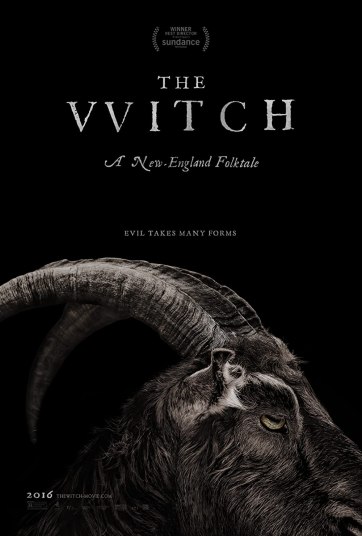
The Witch (2016) is set in the Plymouth Colony, what is now the U.S. state of Massachusetts, in the 1630s. The focus is on Puritanism and the witch craze, subjects that are not entirely irrelevant at the present time. Continue reading

Islamic State Profiles the Leadership

By Kyle Orton (@KyleWOrton) on 6 April 2019

Islamic State flag in front of the main gate of Saddam Husayn’s palace in Tikrit, 5 April 2015 // AFP PHOTO / MOHAMMED SAWAF

A lengthy document—roughly sixty pages and 12,000 words—was published online on 21 February 2019 containing biographies of twenty-seven senior Islamic State (IS) officials, past and more recent. Those bios that are dated were written between October 2018 and the time of publication, with one exception that was written in the summer of 2018. The author claims to be an IS veteran. While longevity is difficult to prove, the fact that the author provides heretofore unseen images of some of the IS leaders suggests that at a minimum he is an IS operative. Continue reading

The Shah, the Cold War, and the Islamists

By Kyle Orton (@KyleWOrton) on 20 March 2019

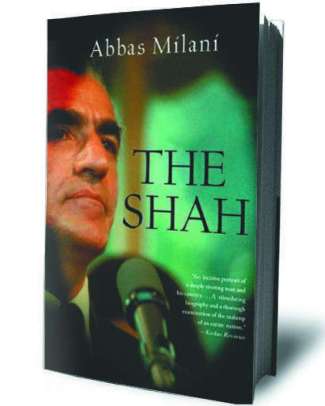
Abbas Milani’s The Shah gives a portrait of Iran’s last monarch, Muhammad Reza Pahlavi, and the impact that his downfall forty years ago continues to have in the Middle East, notably the emboldening of the Islamist movement. Continue reading

Reviewing the Iraqi Surge and Awakening

Book Review: Carter Malkasian, ‘Illusions of Victory’, Oxford University Press, 2017. pp. 280.

By Kyle Orton (@KyleWOrton) on 4 July 2018

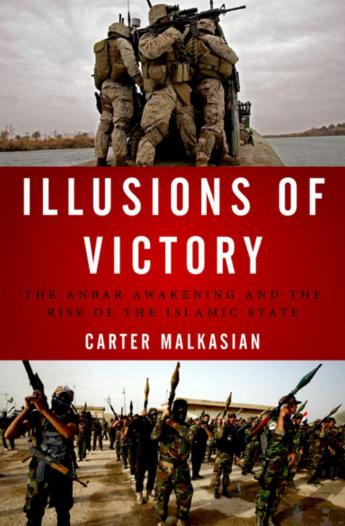
Carter Malkasian sets out in Illusions of Victory: The Anbar Awakening and the Rise of the Islamic State to upend the conventional understanding of the campaign against the Islamic State (IS) movement, known at the time as al-Qaeda in Iraq (AQI), in Anbar province of western Iraq. Continue reading

Islamic State Newsletter Claims the Trèbes Supermarket Siege

By Kyle Orton (@KyleWOrton) on 5 April 2018

Arnaud Beltrame, Radouane Lakdim (image sources: one, two)

In Trebes, a small town of 5,000 people in southern France near Carcassonne, at 11 a.m. on 23 March 2018, a 25-year-old Moroccan-born man, Radouane Lakdim, walked into a “Super U” supermarket and opened fire, killing two people immediately, an attendant and a customer.

An hour earlier, Lakdim had hijacked a car on the outskirts of Carcassonne, killing the passenger by shooting him to death and seriously wounding the driver.

Lakdim then drove five miles to Trebes, appeared to stop outside a military barracks, before stopping outside a riot police centre and shooting at a group of four officers from 200 yards away, seriously injuring one. Continue reading