Tag Archives: Russia

Al-Qaeda Attacks the Saudi Government’s Relationship With America

By Kyle Orton (@KyleWOrton) on 4 December 2018

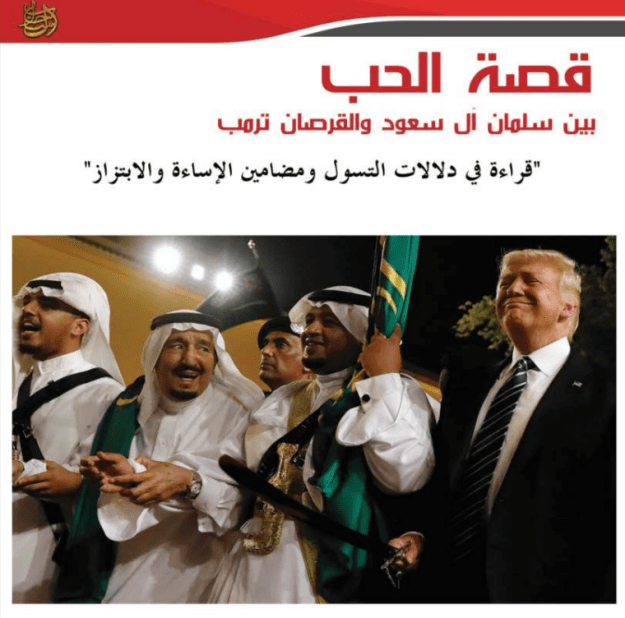
Al-Qaeda released a document on 23 October, “The Love Story Between Salman al-Saud and the Pirate Trump: A Reading of the Symptoms of Begging and the Significance of Wrong and Extortion”,[1] by Shaykh Awab Bin Hasan al-Hasni. Al-Qaeda’s Al-Sahab Foundation released an English translation of Al-Hasani’s essay on 26 November, which is reprinted below with some interesting sections highlighted in bold. Continue reading

America Losing Ground to the Iran-Russia Axis

Published at The Arab Weekly

By Kyle Orton (@KyleWOrton) on 27 November 2018

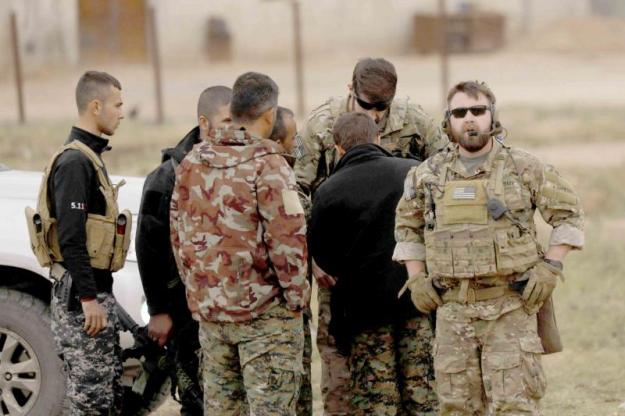
U.S. forces and members of the “Syrian Democratic Forces” (SDF) patrol Al-Darbasiya in northeastern Syria, 4 November 2018. (AFP)

Despite the change of rhetoric between US Presidents Barack Obama and Donald Trump, the United States has continued to lose influence, political and military, in the Middle East to the Iran-Russia axis. Continue reading

America Sanctions the Iran-Russia Axis for Support to Assad and Terrorism

By Kyle Orton (@KyleWOrton) on 20 November 2018

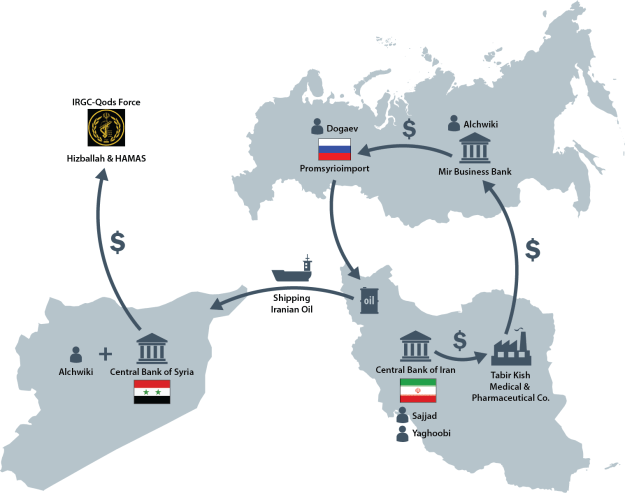
Visual representation of the Alchwiki Network (source: U.S. Treasury)

The United States Treasury Department’s Office of Foreign Assets Control (OFAC) sanctioned ten targets today, targeting an “international network through which the Iranian regime, working with Russian companies, provides millions of barrels of oil to” Bashar al-Assad’s regime in Syria, and “[t]he Assad regime, in turn, facilitates the movement of hundreds of millions of U.S. dollars (USD) to the Islamic Revolutionary Guard Corps-Qods Force (IRGC-QF),” the expeditionary wing of Tehran’s spy-terrorist apparatus, “for onward transfer to HAMAS and Hizballah.” Continue reading

America’s Search for Stability in Syria is Hostage to the Turkey-PKK War

This article was published at Ahval

By Kyle Orton (@KyleWOrton) on 13 November 2018

Joint patrols begin around Manbij (image source)

The United States has taken steps Syria in recent months that suggest a shift towards reconciliation with Turkey. Even if this is so, however, there is still such a deep divide over strategic outlook that these steps could be easily reversed, opening a new round of uncertainty in northern Syria as 2018 draws to a close. Continue reading

Europe Tries to Re-engage in Syria

By Kyle Orton (@KyleWOrton) on 30 October 2018

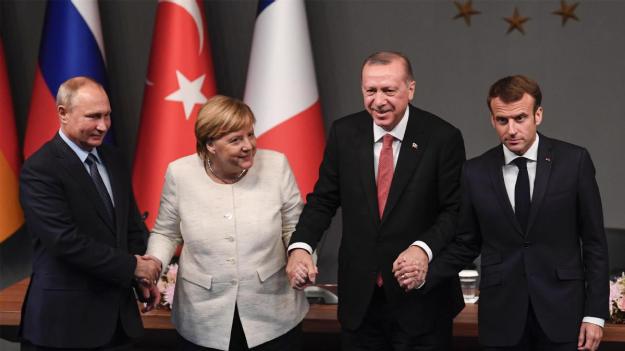
Istanbul summit, 27 October 2018 (image source)

At Saturday’s summit in Istanbul between Turkey, Russia, France and Germany, the focus was on extending the September 17 Turkey-Russia ceasefire agreement reached in Sochi that spared Idlib a full-scale offensive by Bashar al-Assad’s regime and his supporters, and to “progress” on the political track. Continue reading

Can the Europeans Help Reach Peace in Syria?

This article was published at The New Turkey

By Kyle Orton (@KyleWOrton) on 27 October 2018

Today in Istanbul, four governments—Turkey, Russia, Germany, and France—are meeting for a summit over Syria, attempting to consolidate the Sochi Agreement signed by Russia and Turkey over Idlib, and re-invigorate the international political process. There is little reason to think that these talks can succeed on either front. Continue reading

The Idlib Offensive: Delayed, Not Cancelled

By Kyle Orton (@KyleWOrton) on 20 September 2018

For about two months, it has seemed that an offensive by Bashar al-Assad’s regime, Iran, and Russia into Idlib was imminent, with disastrous humanitarian and strategic consequences. On Monday, an agreement was reached between Turkey and Russia that put a halt to this prospect, at least for now. There is good reason to think the pro-Assad forces are delaying, rather than cancelling, their plans to reconquer Idlib, but the extra time gives space to Turkey to alter the terms politically. Continue reading

The Man Who Made Crime Pay For the Islamic State

By Kyle Orton (@KyleWOrton) on 9 September 2018

The United States has launched at least five raids into Syria to date, all of them against the Islamic State (IS).[1] The second such raid, on 15 May 2015, killed Fathi al-Tunisi (Abu Sayyaf al-Iraqi, Abu Muhammad al-Iraqi, or Abd al-Ghani), who oversaw critical revenue-generating criminal schemes for the group. Al-Tunisi was primarily responsible for the oil industry in eastern Syria, in which capacity he collaborated with Bashar al-Asad’s regime, and he worked as head of the Antiquities Division of IS Diwan al-Rikaz, which translates literally as the “Department of Precious Things That Come Out of the Ground”, usually given as the “Department of Natural Resources”. Al-Tunisi was what is sometimes termed a “middle manager”: the connective tissue between the most senior levels of the leadership and local administrators, ensuring smooth coordination between the two by inter alia keeping the books. In short, the kind of terrorist operative that keeps an organisation going. Continue reading

America Sanctions the Syrian Regime for Funding the Islamic State—Again

By Kyle Orton (@KyleWOrton) on 7 September 2018

The U.S. Treasury Department sanctioned four individuals and five entities connected to the Syrian regime of Bashar al-Asad on 6 September 2018. The most interesting was Muhammad al-Katerji, who has been involved in trade with the Islamic State (IS). A relative of his, Hussam al-Katerji, has previously been revealed as funding the jihadists on behalf of the regime, and the U.S. has previously sanctioned another Kremlin-linked Asad regime oligarch, George Haswani, for financing IS. “The United States will continue to target those who facilitate transactions with the murderous Asad regime and support ISIS”, said U.S. Treasury Secretary Steven Mnuchin. Continue reading

What Questions Remain About 9/11?

By Kyle Orton (@KyleWOrton) on 5 September 2018

In less than a week, it will be the seventeenth anniversary of al-Qaeda’s “Plane’s Operation”, the assault on the United States. It is a vertiginous enough reflection that many of us have been alive more years since 11 September 2001 than before it, and positively alarming that many of those who will soon move into the government, media, and other leading societal institutions will have been born after an event that still shapes so much of the international scene. As Anthony Summers and Robbyn Swan put it in The Eleventh Day: The Ultimate Account of 9/11 (2011), we are left with “the brief name ‘9/11’,” the context and meaning stripped away all this time later. The book is a useful overview of an event that should always be to some degree fresh in mind, though it is not without its problems in its analytical sections. Continue reading