By Kyle Orton (@KyleWOrton) on 29 August 2018

Two ideas that have become quite prevalent are that the Islamic State is defeated or on its way to defeat and that the Syrian war is winding down. Both are gravely mistaken. Continue reading
By Kyle Orton (@KyleWOrton) on 29 August 2018

Two ideas that have become quite prevalent are that the Islamic State is defeated or on its way to defeat and that the Syrian war is winding down. Both are gravely mistaken. Continue reading
By Kyle Orton (@KyleWOrton) on 21 August 2018

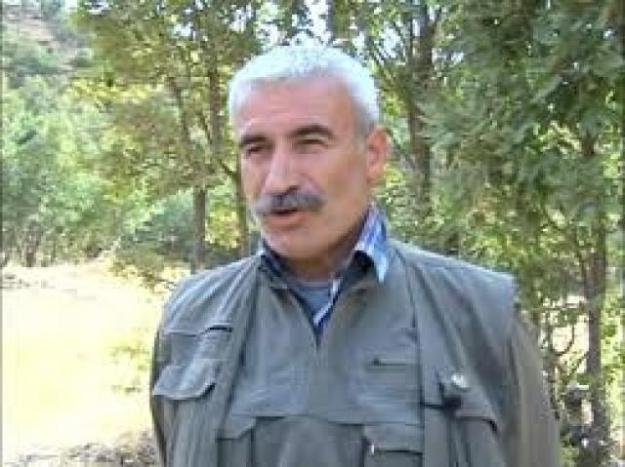
Ismail Özden (image source)
Turkey killed a senior operative of the Kurdistan Workers’ Party (PKK), the internationally-recognised terrorist organisation and narcotics trafficking entity that has been at war with the Turkish state since 1984, in Iraq last week. Turkey launched a wave of airstrikes against PKK targets in Syria and Iraq in April 2017 and for the last several months Ankara has been widening its campaign against the PKK outside Turkey’s borders, particularly in Iraq, where the PKK is not protected by the United States, as it is in eastern Syria. Having feinted in June toward an attack on the historic PKK headquarters in the Qandil Mountains—a somewhat symbolic target at this stage, with the bulk of the PKK’s leadership and resources in Syria—it appears the Turks have opted for a more targeted approach.
This operation underscores the continuance of U.S.-Turkey relations, and the mutual benefits of the relationship, even in its current damaged state, where both sides have a laundry list of legitimate grievances with the other. If a formula for normalisation can be found, the potential to contain and weaken some of the worst, most destabilising elements in the region, saliently the PKK and the Iranian regime, is within reach. Continue reading
This article was published at Ahval under the headline, “Russia to Pick Apart NATO Allies to Reconquer All of Syria”.
By Kyle Orton (@KyleWOrton) on 31 July 2018

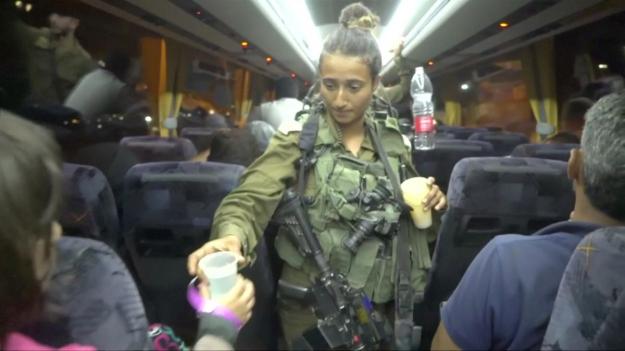
An Israeli solider hands out water on a bus, during the Syria Civil Defence extraction from the Golan Heights // 22 July 2018, provided by Israeli Army to Reuters
The collapse of the opposition in southern Syria is the final destruction of the originally constituted rebellion against President Bashar Assad. It is also a demonstration that the United States under President Donald Trump is no more invested in shaping the outcome in Syria than his predecessor, and marks the potential end of the diplomatic pact that had allowed Turkey to retain some sphere of influence unmolested by the pro-Syrian government coalition. Continue reading
By Kyle Orton (@KyleWOrton) on 21 July 2018

Seda Dudarkaeva (image source)
Turkish police announced on 19 July that they had arrested the wife of Tarkhan Batirashvili (Abu Umar al-Shishani), an Islamic State (IS) commander who was killed two years ago this month in Shirqat, Iraq. The capture brings to the fore a story stretching from senior levels of the Chechen Republic to the Levant. Continue reading
By Kyle Orton (@KyleWOrton) on 12 July 2018

American troops look out toward the border with Turkey from a small outpost near the town of Minbij, 7 Feb. 2018 (AP Photo/Susannah George)
As Turkey moves past last month’s election, the foreign policy challenges remain acute, particularly in Syria, and there is a looming confrontation with the United States over sanctions on Iran that might undo the recent progress toward the normalisation of U.S.-Turkish relations. Continue reading
By Kyle Orton (@KyleWOrton) on 3 July 2018

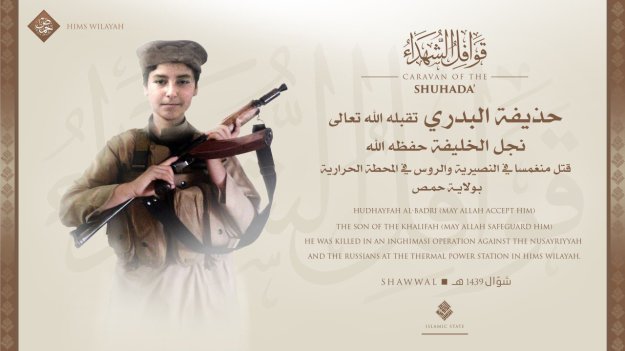
Message on the death of Hudayfa al-Badri, released by the Islamic State, 3 July 2018
At around 21:00 on 3 July 2018, in the middle of England’s World Cup match with Colombia, news broke that a son of Islamic State’s leader, Ibrahim al-Badri (Abu Bakr al-Baghdadi), had been killed in Homs, western Syria. Continue reading
By Kyle Orton (@KyleWOrton) on 7 June 2018

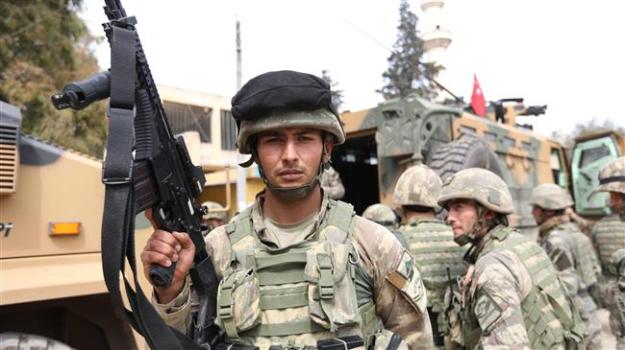
Turkish soldiers and their rebel dependencies in Efrin, 18 March 2018 // AFP
On June 24, for the first time in 15 years, there seems a possibility, however faint, that elections in Turkey will end in defeat for President Recep Tayyip Erdoğan.
It is an uphill battle, not least because of the ongoing state of emergency after the 2016 attempted coup, which has exacerbated the systemic biases against Erdoğan’s political opponents. But the Turkish opposition has managed to overcome its own fractiousness and has a strategic game-plan that makes sense. One card Erdoğan still has to play is foreign policy, and there are signs in Syria and Iraq of advantageous news to come. Continue reading
By Kyle Orton (@KyleWOrton) on 30 May 2018

Russian president Vladimir Putin and Iranian Supreme Leader Ali Khamene’i meeting in Tehran, Iran, 1 Nov. 2017 // Picture via Office of the Iranian Supreme Leader
There have been renewed claims that Russia and Iran, while both supporting Bashar Assad’s regime, have such differences in vision and interest in Syria that there is a schism Western policymakers can take advantage of.
The basic notion is to work with Moscow, which has a less maximalist position, to limit the influence of Iran, a more disruptive power that could draw in worried regional countries to a wider war. This idea is not new and remains illusory. Russia is powerless—even if it were willing—to restrain Iran, the dominant force driving the regime coalition’s war. Continue reading
By Kyle Orton (@KyleWOrton) on 25 May 2018

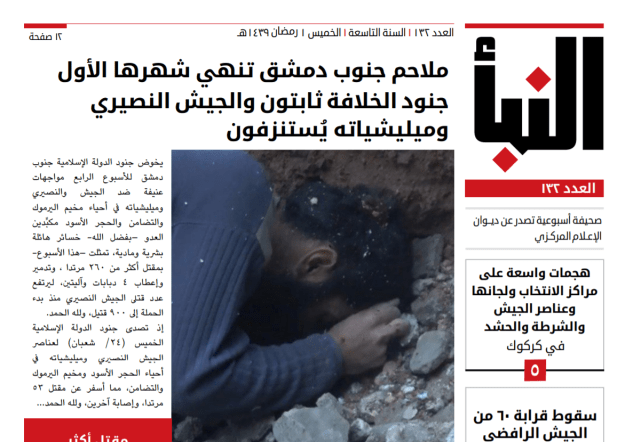
Al-Naba 132
The Islamic State released the 132nd edition of Al-Naba, its newsletter, on 18 May. Continue reading
By Kyle Orton (@KyleWOrton) on 23 May 2018

Said Afandi al-Chirkawi (image source)
The Islamic State (IS) laid claim, in two recent issues of its newsletter, Al-Naba, to three recent attacks in Russia. Continue reading