Tag Archives: Saudi Arabia

The Folly of Trying to Buy Assad’s Loyalty From Iran

By Kyle Orton (@KyleWOrton) on 5 February 2019

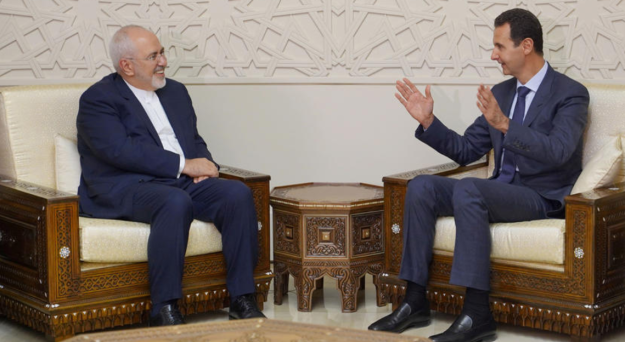
Bashar al-Assad meeting Iranian Foreign Minister Mohammad Javad Zarif, Damascus, Syria, 3 September 2018 // SANA handout to REUTERS

The Syrian regime of Bashar al Assad has nearly collapsed twice under pressure from the armed insurrection, in late 2012 and early 2015. On both occasions, Assad was rescued by outside powers, first Iran and then a joint Iranian-Russian operation. It has been a recurring illusion that there is or will be, a strategic split between Russia and Iran. This prospect has continued to tantalise the US and others, and occasional Moscow-Tehran disagreements are presented as evidence that dynamics are shifting this way. Another round of such speculation is currently underway. Continue reading

Israel Returns to Africa

Published at The Arab Weekly

By Kyle Orton (@KyleWOrton) on 27 January 2019

Israeli Prime Minister Binyamin Netanyahu and Chadian President Idriss Deby meeting in N’Djamena, 20 January 2019 [AFP]

Diplomatic relations between Israel and Chad have been restored after a half century of separation. This was a symbolic breakthrough with a Muslim-majority African country, albeit one in the works for some time. It is an illumination of Israel’s changed geopolitical circumstances, some aspects sustainable, some more wishful and illusory.
Continue reading

IHH, Al-Qaeda, and Turkey

By Kyle Orton (@KyleWOrton) on 26 January 2019

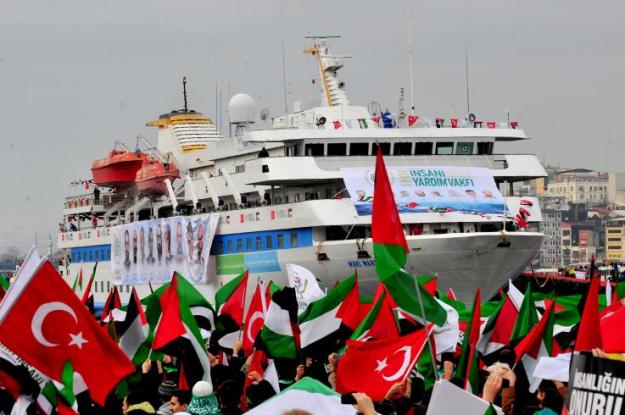
Mavi Marmara arrives at Sarayburnu port as people wave Turkish and Palestinian flags, 26 December 2010 [source]

An article posted on the website of IHH Humanitarian Relief Foundation on 14 July 2006 told of a massive funeral ceremony in Istanbul for Shamil Basayev, an al-Qaeda-linked Chechen jihadist. The original article has been removed, though a cached version is currently available. To avoid this being lost, the article is reproduced below. Before that is a brief outline of the context. Continue reading

The Fall of the Shah and the Rise of Islamism

By Kyle Orton (@KyleWOrton) on 17 January 2019

Forty years ago yesterday, Muhammad Reza Pahlavi, the Shah (King) of Iran, left his country for the last time as a year-long revolution crested. A month later, the remnants of the Imperial Government collapsed and Grand Ayatollah Ruhollah Khomeini was swept to power after his long exile, establishing the first Islamist regime. Andrew Scott Cooper’s 2016 book, The Fall of Heaven: The Pahlavis and the Final Days of Imperial Iran, charts how this happened. Continue reading

The Consequences of American Withdrawal from Syria

A version of this article was published at CapX

By Kyle Orton (@KyleWOrton) on 21 December 2018

President Trump in a Twitter video saying fallen soldiers agree with his plan to withdraw from Syria, 19 December 2018 [image source]

“We have won against ISIS”, declared President Donald Trump in a Twitter video on Wednesday night. “We’ve taken back the land. And now it’s time for our troops to come back home.” After a day of reporting that the United States has decided on a rapid, total withdrawal from Syria, here was the confirmation. It is a policy course fraught with danger and very likely to lead to outcomes unfavourable to Western interests, whether defined in humanitarian or strategic terms.
Continue reading

The Russian Relationship with Israel: A History

By Kyle Orton (@KyleWOrton) on 12 December 2018

© AP Photo / Jim Hollander, Pool

Essay: “Zionism is Making Us Stupid”: The Russian Relationship with Israel from the Soviets to Putin Continue reading

Al-Qaeda Attacks the Saudi Government’s Relationship With America

By Kyle Orton (@KyleWOrton) on 4 December 2018

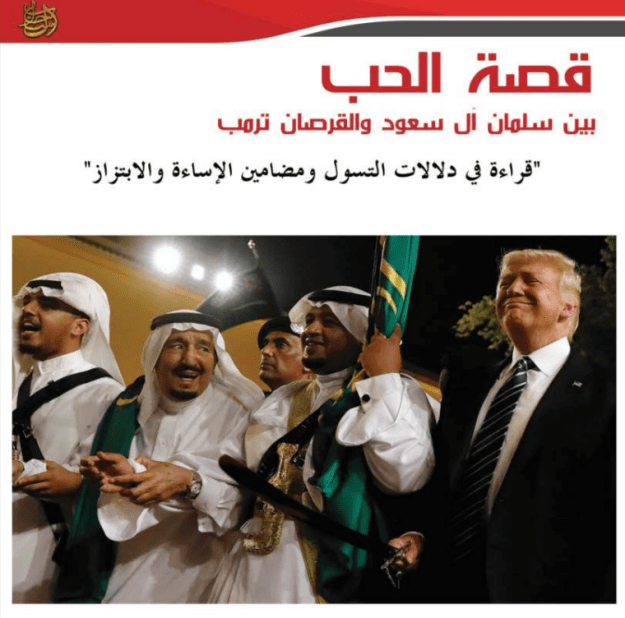
Al-Qaeda released a document on 23 October, “The Love Story Between Salman al-Saud and the Pirate Trump: A Reading of the Symptoms of Begging and the Significance of Wrong and Extortion”,[1] by Shaykh Awab Bin Hasan al-Hasni. Al-Qaeda’s Al-Sahab Foundation released an English translation of Al-Hasani’s essay on 26 November, which is reprinted below with some interesting sections highlighted in bold. Continue reading

America Losing Ground to the Iran-Russia Axis

Published at The Arab Weekly

By Kyle Orton (@KyleWOrton) on 27 November 2018

U.S. forces and members of the “Syrian Democratic Forces” (SDF) patrol Al-Darbasiya in northeastern Syria, 4 November 2018. (AFP)

Despite the change of rhetoric between US Presidents Barack Obama and Donald Trump, the United States has continued to lose influence, political and military, in the Middle East to the Iran-Russia axis. Continue reading

Islamic State Response to the Leaking of Abu Sulayman al-Utaybi’s Testimony

By Kyle Orton (@KyleWOrton) on 7 November 2018

On 24 November 2013, the day after Al-Qaeda leaked the full testimony of Abu Sulayman al-Utaybi, the chief judge of the Islamic State (IS) who made various charges against the leadership after he defected in 2007, a pro-IS response was issued, signed by one Mu’awiya al-Qahtani, entitled, “Refutation of the Letter Attributed to the Judge Abu Sulayman al-Utaybi—May God Accept Him—with Evidence and Proofs”. A translation of Al-Qahtani’s document is given below.

Continue reading

Examining Iran’s Long Relationship with Al-Qaeda

This article was originally published at The Brief

By Kyle Orton (@KyleWOrton) on 26 October 2018

At the beginning of September, New America published a paper, based on recovered al-Qaeda documents, which concluded that there was “no evidence of cooperation” between the terrorist group and the Islamic Republic of Iran. New America’s study lauds itself for taking an approach that “avoids much of the challenge of politicization” in the discussion of Iran’s relationship with al-Qaeda. This is, to put it mildly, questionable.

A narrative gained currency in certain parts of the foreign policy community during the days of the Iraq war, and gained traction since the rise of the Islamic State (IS) in 2014, that Iran can be a partner in the region, at least against (Sunni) terrorism, since Tehran shares this goal with the West. Under President Barack Obama, this notion became policy: the US moved to bring Iran’s revolutionary government in from the cold, to integrate it into the international system. Continue reading