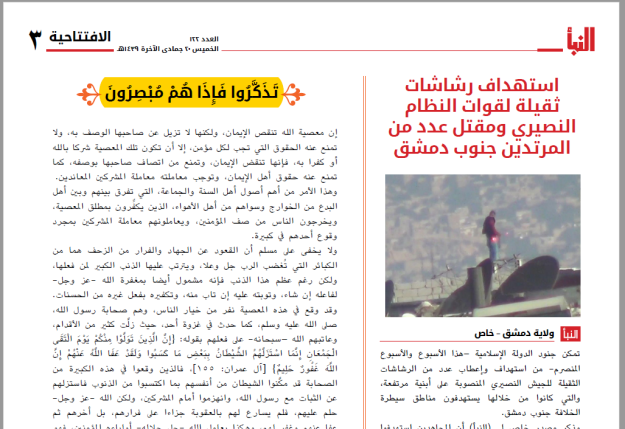
The 122nd edition of Al-Naba, the Islamic State’s weekly newsletter, was released on 9 March 2018 and contained an article, on page 3, suggesting that the use of takfir (excommunication) should be circumscribed. A rough translation is reproduced below. Continue reading →
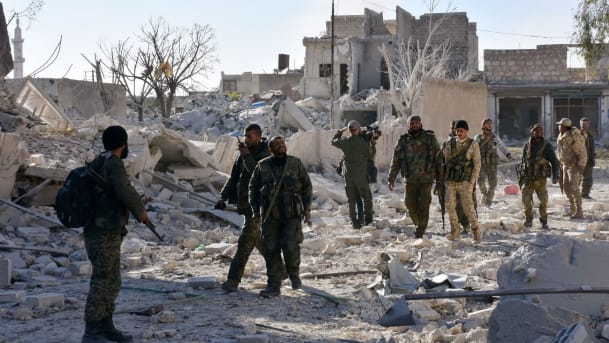
Syrian rebels in eastern Aleppo, November 2016 (image source)
Operation TIMBER SYCAMORE, the formally-covert program run by the Central Intelligence Agency (CIA), has, since approximately 2012, ostensibly provided support to vetted Syrian rebel units fighting against Bashar al-Asad’s regime. This program, begun by President Barack Obama, was never raised to a level that could alter the course of Syria’s conflict in favour of the opposition, and indeed one of its most concrete effects was denying certain categories of heavy weapons to the rebellion. While providing subsistence to some rebels, the program was mostly a political instrument, shielding Obama from criticism as he tilted U.S. policy in Asad’s favour by empowering his patron, Iran. President Donald Trump abandoned even this fig-leaf of opposition to Asad in July 2017, announcing the end of the program, a termination that went into effect last month. Continue reading →
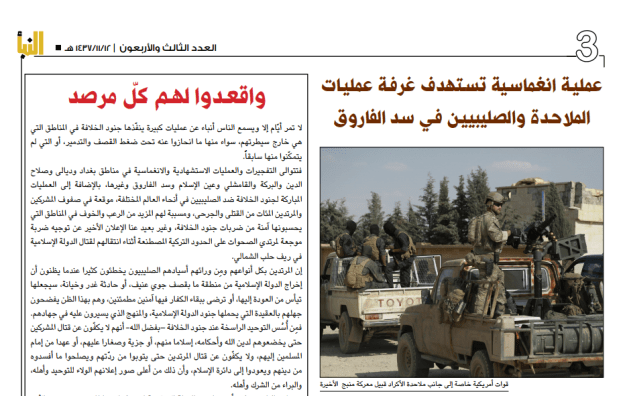
The Islamic State (IS) brought out the forty-third edition of Al-Naba, its newsletter, on 16 August 2016. On page 3 was an article that made reference to IS’s insurgent activities, which had already begun in areas it had lost. A rough copy is reproduced below.
At that time this article was published, IS was on the verge of losing Minbij, and had issued statements in May 2016 and June saying that the loss of the caliphate would not be the end of the group. By early 2017, IS’s insurgent operations were visibly mature, long before the formal declaration in October 2017 that IS was giving up its statelet and recommencing all-out insurgency. Continue reading →
Iraqi soldiers from the 1st Iraqi Army Division and U.S. Soldiers board a U.S. Marine Corps CH-53 Super Stallion helicopter at Camp Ramadi, 15 Nov. 2015 (DoD photo by Staff Sgt. Daniel St. Pierre, U.S. Air Force)
The leader of the Islamic State (IS) when it was declared in October 2006 was Hamid al-Zawi (Abu Umar al-Baghdadi). Al-Zawi was killed in April 2010 and replaced in May 2010 by the current leader of the IS movement, Ibrahim al-Badri (Abu Bakr al-Baghdadi), who more explicitly embraced the title of “caliph”. On 12 May 2009, al-Zawi gave his seventeenth speech, entitled Umala Kadhabun (عملاء كذابون), which translates to something like “Lying Agents” or “Deceitful Spies”. The speech was released by IS’s Al-Furqan Media Productions and a translation was made by a pro-IS online outlet, The Jihadist Media Elite. The transcript is reproduced below. Continue reading →
The 112th edition of the Islamic State’s newsletter, Al-Naba, released on 29 December 2017 contained an article on page 3, which reported that the reversion from statehood to insurgency was yielding results, particularly in the Diyala, Kirkuk, and Saladin provinces of Iraq. The article is reproduced below. Continue reading →
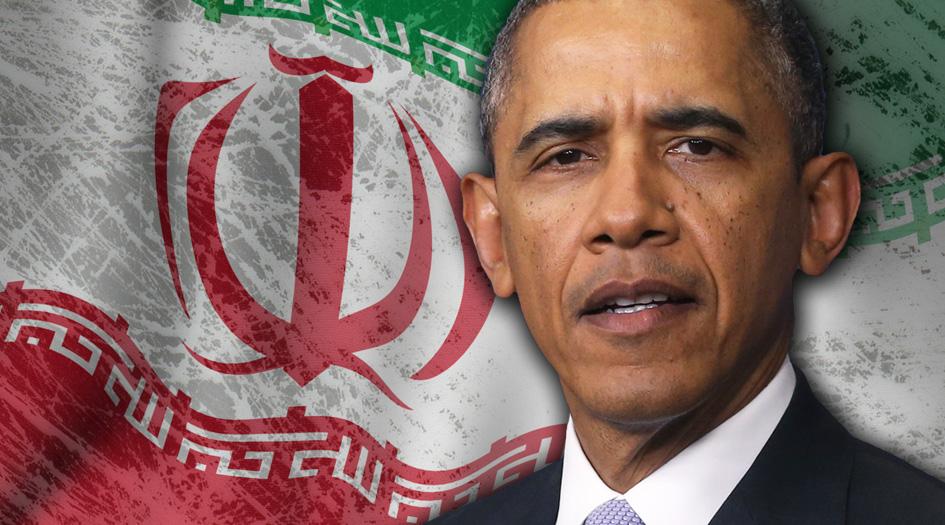
A widely reported, 15,000-word article by Josh Meyer in Politico on Sunday moves us another step closer to finding out the actual terms of President Barack Obama’s nuclear deal with the Islamic Republic of Iran.
Though the Obama administration sold the Iran deal on the narrowest possible terms as an arms control agreement, the reality was that this agreement was intended to facilitate a strategic tilt in Iran’s favour—against traditional allies—that left a regional balance requiring less American commitment.
Because the administration wanted the paper agreement, Iran had the leverage to threaten to walk away, and was therefore appeased on multiple fronts ostensibly unrelated to the nuclear issue.
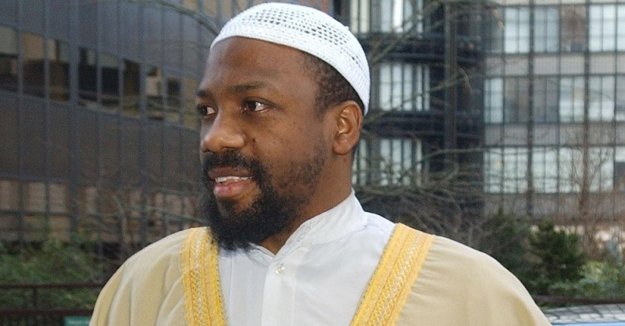
The U.S. Treasury Department sanctioned Abdullah Ibrahim al-Faisal (born: Trevor William Forrest), a Jamaican cleric who supports the Islamic State (IS) on 5 December. This was long overdue. Al-Faisal’s record of disseminating jihadist ideology, and influencing and/or interacting with terrorists, goes back several decades. And since 2014, al-Faisal has been one of IS’s influential English-language propagandist-recruiters. Continue reading →
The leader of al-Qaeda, Ayman al-Zawahiri, gave a thirty-five-minute speech on 28 November 2017, entitled: “Let Us Fight Them As A Solid Structure” (or “Let Us Fight Them As One Body” or “Let Us Fight Them With Solid Foundations”), dealing with the vexed question of al-Qaeda’s relationship with the Syrian jihadi group, Hay’at Tahrir al-Sham, a situation that escalated again in recent days. The mention of an impending Turkish intervention into Idlib—which began on 7 October—suggests that al-Zawahiri recorded this speech in the last days of September or the first few days of October. An English transcript of the speech was released by As-Sahab Media, and is reproduced below with some edits for syntax and transliteration. Continue reading →
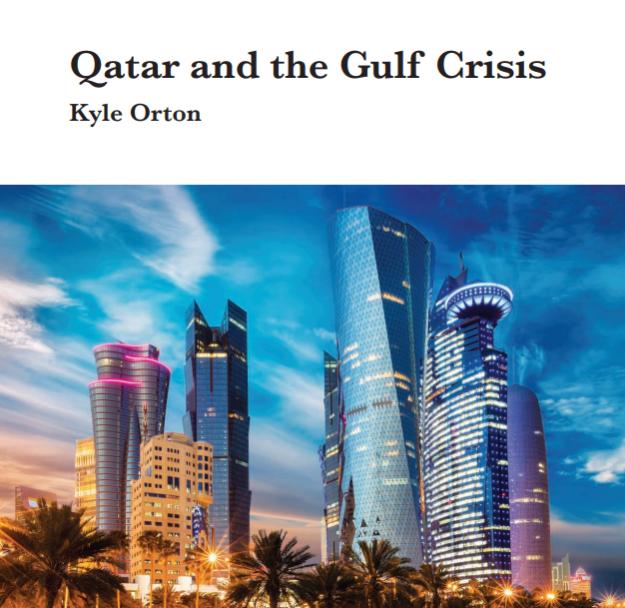
I released a report today, published by the Henry Jackson Society, Qatar and the Gulf Crisis. The intent was to examine the charges made against the Qatari government by its Gulf neighbours with regard to the funding of terrorism, the hosting of extremists, the dissemination of hate speech and incitement, among other things. Having separated fact from fiction with regards to he accusations against Qatar, the report proposes how Britain might proceed in such a way as to press Doha on issues of concern, while avoiding being drawn into the middle of the Gulf dispute, and trying to foster reconciliation between allies, especially at a time when a united front is necessary to oppose the far larger challenge of the Iranian theocracy. Continue reading →
Abdul Munim al-Badawi (Abu Hamza al-Muhajir), the “war minister” of the Islamic State of Iraq, the predecessor to ISIS, made a brief five-minute speech on 30 April 2007, entitled “Nada ila Ulema al-Umma” (نِدَاءٌ إِلَى عُلَمَاءِ الأُمَّةِ). “Ulema” refers to Islamic scholars, sometimes translated as “clerics”, a slightly misleading comparison with Christianity, and “umma” refers to the worldwide community of Muslims, so the title of the speech translates as, “An Appeal to the Community’s Scholars”. Al-Badawi’s basic point—made at a time when the Islamic State movement was beginning to suffer under the pressure of the Surge and Sahwa—was to condemn the regional ulema for not supporting, and not having supported, the jihadists in Iraq against the Americans and the Shi’is. Implicitly, Al-Badawi is criticising the ulema for holding back Muslims in regional States who might otherwise have joined the Iraqi jihad as foreign fighters and suicide bombers, potentially making a difference to the Islamic State’s military fortunes. A rough translation of the speech is reproduced below.




 Kyle Orton's Blog