Tag Archives: sectarianism

The Spokesman’s Response When the Islamic State Went to War With the Syrian Rebellion

By Kyle Orton (@KyleWOrton) on 24 May 2021

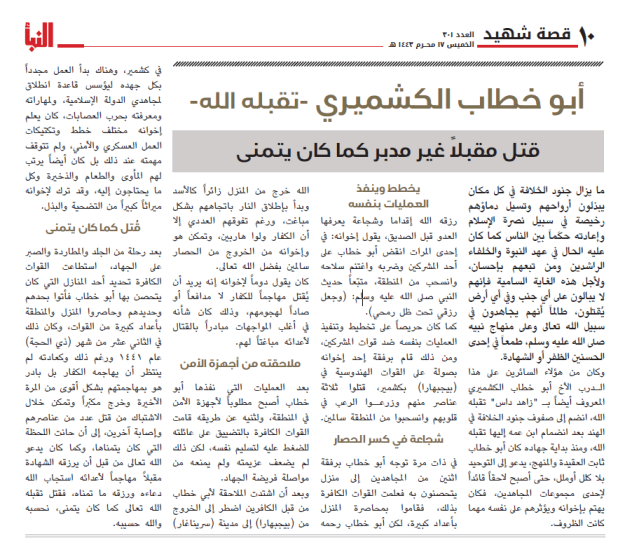
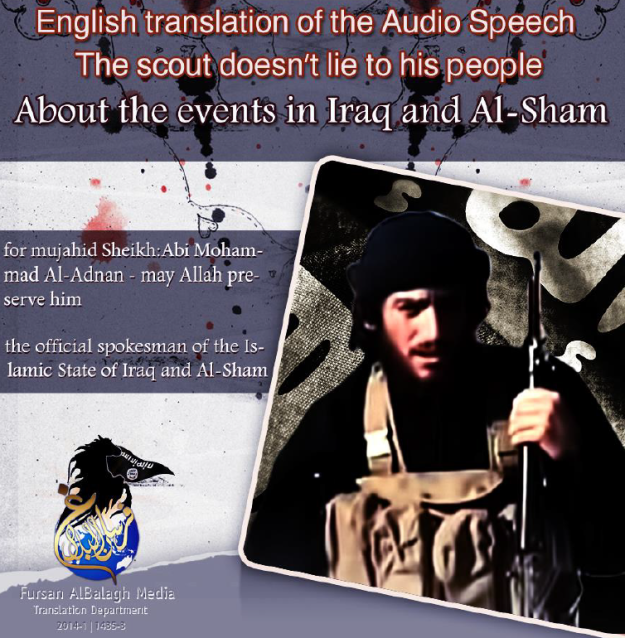
Taha Falaha (Abu Muhammad al-Adnani) is probably most famous for the September 2014 speech he made as the official spokesman for the Islamic State (IS) calling for international terrorist attacks, which initiated a wave of atrocities in Europe and beyond lasting about three years. But Falaha had been in office by that time, formally, since the summer of 2011, and in total he would make two-dozen speeches before he was killed at the end of August 2016. The twelfth speech, entitled, “The Scout Doesn’t Lie to His People”, and reproduced below,[1] was made on 7 January 2014, four days after the onset of a massive assault on IS by the Syrian rebellion that inter alia killed senior jihadist commanders like Samir al-Khlifawi (Haji Bakr or Abu Bakr al-Iraqi). What is interesting about this speech, as revealed in the recent Al-Naba profile of Falaha’s great friend and collaborator, the media emir Wael al-Ta’i (Abu Muhammad al-Furqan), is that Falaha composed this speech while he was besieged by the rebels in Aleppo. Al-Ta’i had evacuated the IS media department and their families, then slipped back into the area surrounded by the rebels to help Falaha compose IS’s first political counter-measure to this unexpected development in Syria, which was followed nearly a fortnight afterwards by a speech from the caliph himself, Ibrahim al-Badri (Abu Bakr al-Baghdadi). Continue reading

Islamic State Comments on the Gaza War and Escalates in Afghanistan

By Kyle Orton (@KyleWOrton) on 22 May 2021

Al-Naba 287, page three

The last two issues of Al-Naba, the weekly newsletter of the Islamic State (IS), had a number of interesting items, most obviously finally breaking its silence on the latest flare-up between Israel and HAMAS. Continue reading

Islamic State Newsletter Claims an Attack on Russia in Syria, Operations in Pakistan and Afghanistan

By Kyle Orton (@KyleWOrton) on 25 April 2021

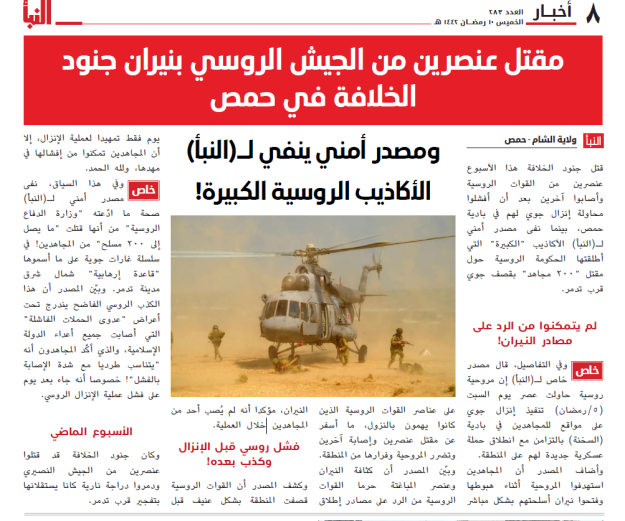
Al-Naba 283, p. 8

The 283rd edition of Islamic State’s (IS) weekly newsletter, Al-Naba, released on 22 April 2021, contained the usual reports on IS’s guerrilla and terrorist operations, stretching from Africa to Syria and Iraq at the “Centre” to South Asia, plus the main editorial and an ideological essay. Amid the reports was IS’s response to a controversial episode in eastern Syria involving the Russians, and a sign of an uptick in IS’s operations in Afghanistan and Pakistan as the U.S.-led NATO forces prepare to abandon Afghanistan. Continue reading

The First Speech of Abu Hamza al-Muhajir as Al-Qaeda in Iraq Emir

By Kyle Orton (@KyleWOrton) on 5 April 2021

Ahmad al-Khalayleh (Abu Musab al-Zarqawi), the infamous founder of the Islamic State movement, known at the time as Al-Qaeda in Iraq (AQI) and formerly part of the Mujahideen Shura Council (MSC), was killed on 7 June 2006. Zarqawi’s successor was officially announced five days later, in a written statement released on 12 June, as Abu Hamza al-Muhajir, an Egyptian with a long history in and around Al-Qaeda. The next day, 13 June 2006, Abu Hamza gave his first speech as AQI emir, entitled, “The Gathering Will Be Defeated and They Will Turn Their Backs [in Retreat]”, drawn from an ayat of the Qur’an (54:45). The statement and the speech are translated below.

Continue reading

The Islamic State Announces the “Axe of al-Khalil Campaign” to Destroy the “Idol” of Democracy

By Kyle Orton (@KyleWOrton) on 19 March 2021

Hamid al-Zawi, the leader of the Islamic State movement from 2006 to 2010, known only as Abu Umar al-Baghdadi during his lifetime, gave a speech on 19 March 2010 entitled, “The Soldiers’ Sermon for the Axe of al-Khalil Campaign” (Khutba al-Jund bi-Hamlat Fa’s al-Khalil). It was Al-Zawi’s twenty-second and, as it turned out, penultimate speech. Al-Zawi was killed almost exactly a month later, on 18 April 2010, alongside his deputy and “war minister”, Abd al-Munim al-Badawi (Abu Hamza al-Muhajir). A translation of the speech is published below.

Continue reading

The Islamic State’s Acknowledgement of the Deaths of Abu Umar al-Baghdadi and Abu Hamza al-Muhajir

By Kyle Orton (@KyleWOrton) on 18 March 2021

Continue reading

Islamic State Announces the “Harvest of the Good” Campaign

By Kyle Orton (@KyleWOrton) on 17 March 2021

Abu Umar al-Baghdadi, the implied caliph of the Islamic State movement between 2006 and 2010, gave his sixteenth speech on 17 March 2009. The title of the speech was, “Harvest of the Good (The Gathering Will Be Defeated, and They Will Turn Their Backs and Flee)”.[1]

Continue reading

Islamic State Denounces the Pope’s Visit to Iraq as a Conspiracy Against Islam

By Kyle Orton (@KyleWOrton) on 13 March 2021

Al-Naba 277, page 3

The Islamic State (IS) released the 277th edition of its weekly newsletter, Al-Naba, on 11 March 2021. The main editorial focused on the Catholic Pope Francis’ 5-8 March apostolic visit to Iraq, where inter alia a Roman Pontiff for the first time visited Ur, believed to be the birthplace of Abraham, and took Mass in the Chaldean rite (at the Cathedral of Saint Joseph in Baghdad). Continue reading

The First Cabinet of the Islamic State

By Kyle Orton (@KyleWOrton) on 5 March 2021

On 19 April 2007, seven months after the Islamic State (IS) movement declared its “State”, the official spokesman, Muharib al-Jaburi, announced the first “cabinet” for this “state”, appointing leaders for various “ministries”. Unusually for IS in this era, the speech was delivered as a video address—albeit (as can be seen) with Muharib’s face blurred out—rather than as an audio address. The reason for this was clearly to push back against the criticism of the IS movement that its leader could not be the “caliph” of all the Muslims, which at this stage IS was not overtly claiming, while being faceless and nameless, known only by his kunya.

Continue reading

The Munster Millenarians: Anabaptism and the Radical Reformation

By Kyle Orton (@KyleWOrton) on 21 February 2021

Execution of Jan Beuckelszoon // Illustration in a book by Lambertus Hortensius

In 1534, shortly after the onset of the Protestant Reformation, a radical sect from this new movement, the Anabaptists, seized the city of Munster in Germany and governed it for sixteen months as a millenarian cult in a manner so alarming it managed to bring together Catholic and Lutheran forces to put it down. The experience had a profound influence not only on the development of Anabaptism thereafter, but on the manner in which the Reformation more generally unfolded. Continue reading