By Kyle Orton (@KyleWOrton) on 11 January 2018

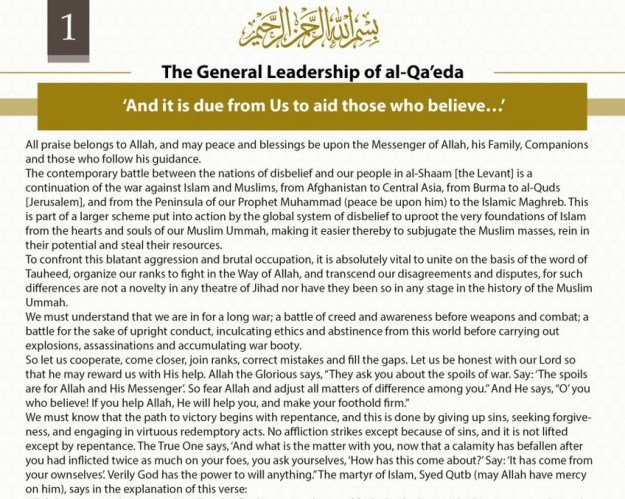
Al-Qaeda’s General Command issued a statement on 8 January 2018, entitled, “And it is Due from Us to Aid Those Who Believe”. The statement is reproduced below. Continue reading
By Kyle Orton (@KyleWOrton) on 11 January 2018

Al-Qaeda’s General Command issued a statement on 8 January 2018, entitled, “And it is Due from Us to Aid Those Who Believe”. The statement is reproduced below. Continue reading
By Kyle Orton (@KyleWOrton) on 11 January 2018

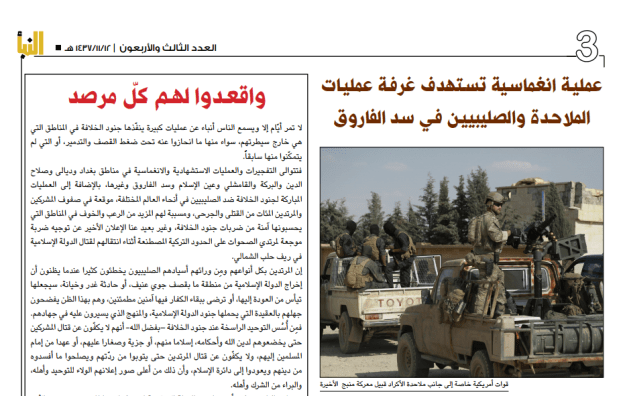
Al-Naba 43, page 3
The Islamic State (IS) brought out the forty-third edition of Al-Naba, its newsletter, on 16 August 2016. On page 3 was an article that made reference to IS’s insurgent activities, which had already begun in areas it had lost. A rough copy is reproduced below.
At that time this article was published, IS was on the verge of losing Minbij, and had issued statements in May 2016 and June saying that the loss of the caliphate would not be the end of the group. By early 2017, IS’s insurgent operations were visibly mature, long before the formal declaration in October 2017 that IS was giving up its statelet and recommencing all-out insurgency. Continue reading
By Kyle Orton (@KyleWOrton) on 6 January 2018

Iraqi soldiers from the 1st Iraqi Army Division and U.S. Soldiers board a U.S. Marine Corps CH-53 Super Stallion helicopter at Camp Ramadi, 15 Nov. 2015 (DoD photo by Staff Sgt. Daniel St. Pierre, U.S. Air Force)
The leader of the Islamic State (IS) when it was declared in October 2006 was Hamid al-Zawi (Abu Umar al-Baghdadi). Al-Zawi was killed in April 2010 and replaced in May 2010 by the current leader of the IS movement, Ibrahim al-Badri (Abu Bakr al-Baghdadi), who more explicitly embraced the title of “caliph”. On 12 May 2009, al-Zawi gave his seventeenth speech, entitled Umala Kadhabun (عملاء كذابون), which translates to something like “Lying Agents” or “Deceitful Spies”. The speech was released by IS’s Al-Furqan Media Productions and a translation was made by a pro-IS online outlet, The Jihadist Media Elite. The transcript is reproduced below. Continue reading
By Kyle Orton (@KyleWOrton) on 2 January 2018

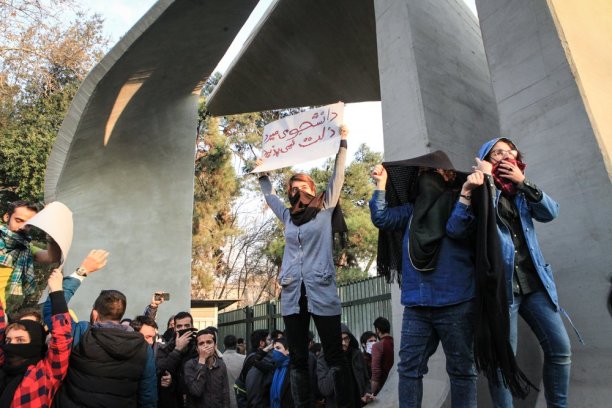
Protests in Tehran, Iran, 30 December 2017. (Photo by Stringer/Anadolu Agency/Getty Images)
Protests broke out against the Iranian government on 27 December, and have achieved a wider geographic spread in the country than even the massive uprising of June 2009, reaching into religiously conservative, working-class towns and districts traditionally regarded as pro-regime. It is likely these demonstrations will be suppressed, but that does not obviate the need for Western policy. To the contrary, the protests exposed several flawed assumptions in recent policy-making, and a course correction is urgently necessary. Continue reading
By Kyle Orton (@KyleWOrton) on 1 January 2018

Opposition protests against Jabhat al-Nusra, Marat al-Numan, March 2016
A recording was leaked on 28 November of a Syrian cleric, Abdul Halim al-Atwan, giving a lecture to Syrians in Idlib, condemning the current leader of Hay’at Tahrir al-Sham (HTS), the descendant of al-Qaeda’s Syrian branch Jabhat al-Nusra, for having distorted and destroyed the Syrian rebellion by infecting it with extremism and intra-insurgent fighting. Al-Atwan, the uncle of HTS leading shar’i Abd al-Rahim Atun (Abu Abdallah al-Shami), notes that al-Nusra intruded into Syria as a wing of the Islamic State in 2011. This is only a small demonstration of the continued resistance among Syria’s armed opposition to being co-opted by the HTS jihadists. Continue reading
By Kyle Orton (@KyleWOrton) on 30 December 2017

Al-Naba 112, page 3
The 112th edition of the Islamic State’s newsletter, Al-Naba, released on 29 December 2017 contained an article on page 3, which reported that the reversion from statehood to insurgency was yielding results, particularly in the Diyala, Kirkuk, and Saladin provinces of Iraq. The article is reproduced below. Continue reading
By Kyle Orton (@KyleWOrton) on 29 December 2017

The Astana track of Syrian “peace” negotiations began on 23 January 2017, under Russian guidance in the Kazakh capital, with Iran and Turkey also invited as “guarantor countries” of the various sides in Syria. The process, initiated in the shadow of the savage conquest of Aleppo city in December 2016 that signalled the total strategic defeat of the insurrection against the Bashar al-Asad regime, was an attempt by Moscow to convert the military gains it had enabled by Asad and Iran on the ground into political facts that could then be imported into the internationally-recognized Geneva process. This “Astana-isation of Geneva” was Russia’s bid to take control of the political process and redefine it: rather than having Asad’s removal as its end-goal, it would set the terms of reintegration into the Asad state. Abetted by a purblind Western campaign against the Islamic State (IS) and a strategic reorientation in Turkey, the pro-Asad coalition has more or less had its way for the last year. But there are now signs that this approach is beginning to unravel. Continue reading
By Kyle Orton (@KyleWOrton) on 29 December 2017

Aleppo city (source)
The Syrian opposition released a statement on 25 December 2017 making official its rejection of the upcoming Sochi conference, which, overseen by the Russian government, is intended to continue shaping the terms of a settlement in Syria. A translation of the statement was made by TNT and is reproduced below. Continue reading
By Kyle Orton (@KyleWOrton) on 19 December 2017

Maghaweer al-Thawra fighters next to American forces at at-Tanf. (Hammurabi’s Justice News/AP)
The U.S.-led Coalition against the Islamic State (IS) has killed several more leaders of the terrorist group, but continues to find that the campaign is hindered by the incompetence and/or complicity of the regime of Bashar al-Asad and his supporters in Iran and Russia. Continue reading
Originally published at Ahval
By Kyle Orton (@KyleWOrton) on 18 December 2017

Nearly a year into Donald Trump’s administration, the president has followed the track laid down by his predecessors in Syria, accelerating it in some cases, and reinforcing the negative trends of Barack Obama’s defective policy that will undo even apparent successes, like the destruction of the Islamic State’s (ISIS) “caliphate”. Continue reading