Tag Archives: Syrian Democratic Forces

Israel is Losing Ground to the Iran-Russia Axis

By Kyle Orton (@KyleWOrton) on 18 April 2019

Israeli opinion generally regards the country’s efforts to contain Iran, especially in Syria, as having been successful. In fact, the trendline runs the other way: Iran is constraining Israel, entrenching all around the Jewish state. Continue reading

If America is to Stay in Syria, What For?

This article was published at Ahval

By Kyle Orton (@KyleWOrton) on 12 March 2019

The wheel turns again. After U.S. President Donald Trump announced the withdrawal of U.S. forces from Syria in December, it seemed rapprochement with Turkey was on the cards. Now that looks less likely. Continue reading

What is Turkey Doing in Syria?

By Kyle Orton (@KyleWOrton) on 10 March 2019

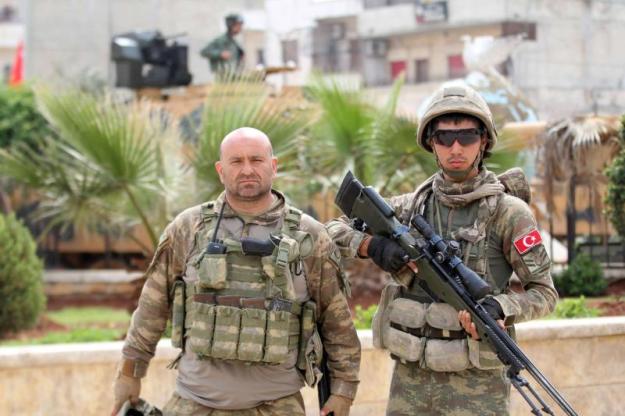
Turkish soldiers in Efrin, Syria, March 2018. (AFP)

Eight years ago, peaceful protests began against Syrian President Bashar Assad. Since then, outside powers — the Iran-Russia axis, the United States and Turkey — have become dominant in Syria.

The Iranians and Russians keeping Assad’s regime alive are clearly going nowhere. The Americans’ indecision on the point is apparently final. So, what of Turkey, which is the custodian of the remnants of the armed opposition? Continue reading

Islamic State Urges Defiance as the Caliphate Collapses, Attacks Other Islamists

By Kyle Orton (@KyleWOrton) on 9 March 2019

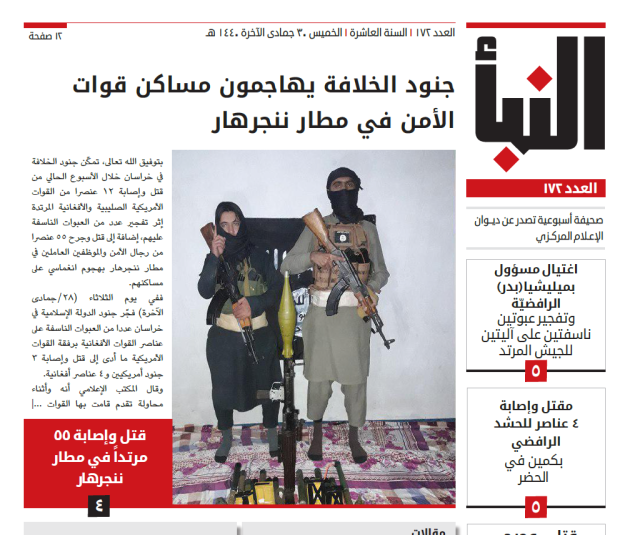
Al-Naba 172 front page

The Islamic State (IS) released the 172nd edition of Al-Naba, its newsletter, on 7 March 2019. Continue reading

Islamic State Newsletter Celebrates Guerrilla Campaign, Attacks Saudi Arabia as ‘Stalinist’

By Kyle Orton (@KyleWOrton) on 16 February 2019

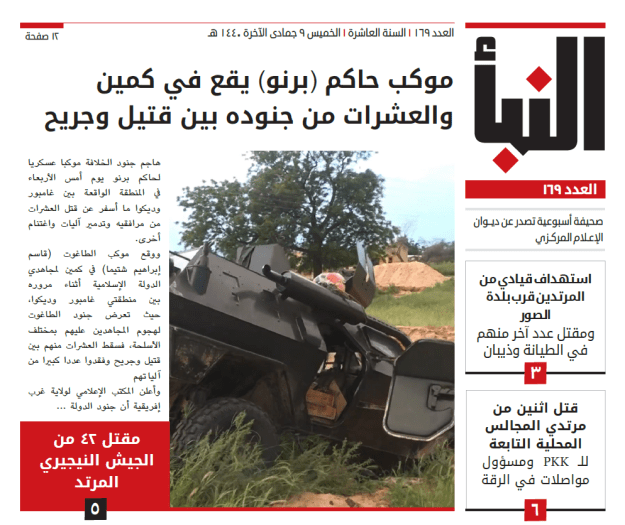
Front page Al-Naba 169

The Islamic State (IS) released the 169th edition of its newsletter, Al-Naba, on 14 February 2019. Al-Naba 169 leads with the attack on the governor of Borno in Nigeria by IS’s branch in that country. In terms of volume, much of the focus remains on the guerrilla campaign in Iraq and Syria, though there is an item on the last stand of the caliphate in Baghuz, the final village in eastern Syria. IS highlights its clashes with al-Qaeda in Yemen. There is a profile of a Russian-speaking atheist-turned-jihadist who was killed in Egypt. And perhaps most notable is an essay on Saudi Arabia, where IS has a terrorist infrastructure that is instructed to be patient. It is a question that likely is unanswerable until it is too late how strong IS is in Saudi Arabia. Continue reading

The Islamic State Newsletter Explains How it Killed American Soldiers in Syria

By Kyle Orton (@KyleWOrton) on 12 February 2019

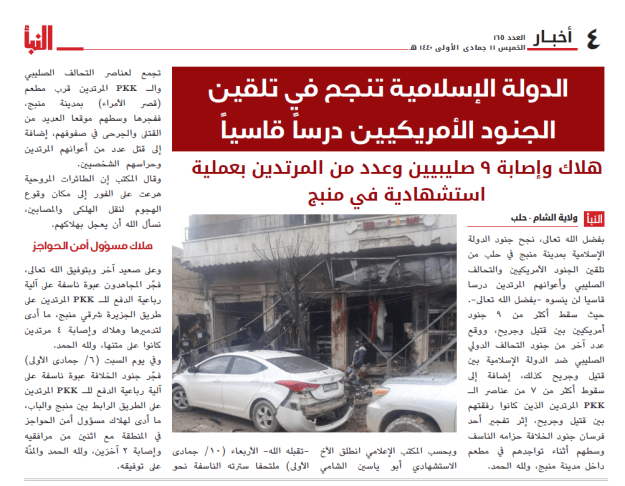
Al-Naba 165, page 4

In the 165th edition of Al-Naba, the weekly newsletter of the Islamic State (IS), was released on 17 January 2019. Al-Naba 165 contained a description of the suicide bombing at the Qasr al-Omara restaurant in Minbij, northern Syria, on 16 January, which killed four Americans: Army Chief Warrant Officer Jonathan Farmer; Navy Chief Petty Officer Shannon Kent; Defence Intelligence Agency (DIA) civilian Scott Wirtz; and Pentagon contractor and linguist Ghadir Taher. At least ten other people were killed, eight civilians and two officials from the “Syrian Democratic Forces“ (SDF). The newsletter also contains an interview with an IS official operating in the Minbij area, who explains how the group’s sleeper cells and surveillance apparatus tracked U.S. movements and made prior attempts to attack the U.S. and its allies. Continue reading

Can Russia Reconcile Turkey and Syria?

This article was published at Ahval under the headline, “Back to the Future for Turkey and Syria?”

By Kyle Orton (@KyleWOrton) on 1 February 2019

American base on the outskirts of Minbij, 26 December 2018. (Photo by Delil souleiman / AFP)

U.S. President Donald Trump’s surprise announcement that U.S. troops would be withdrawn from Syria came with many visible costs. The benefits the anti-Islamic State (ISIS) campaign has delivered to Syrian President Bashar Assad, Iran, and Russia were made permanent. There is also more space for ISIS and greater instability in northeast Syria as Turkey confronts Syrian Kurdish forces. And there is the political cost to the United States of leaving its Kurdish anti-ISIS partner to face Turkey and the pro-Assad coalition alone. Continue reading

The Consequences of American Withdrawal from Syria

A version of this article was published at CapX

By Kyle Orton (@KyleWOrton) on 21 December 2018

President Trump in a Twitter video saying fallen soldiers agree with his plan to withdraw from Syria, 19 December 2018 [image source]

“We have won against ISIS”, declared President Donald Trump in a Twitter video on Wednesday night. “We’ve taken back the land. And now it’s time for our troops to come back home.” After a day of reporting that the United States has decided on a rapid, total withdrawal from Syria, here was the confirmation. It is a policy course fraught with danger and very likely to lead to outcomes unfavourable to Western interests, whether defined in humanitarian or strategic terms.
Continue reading

Would Turkey Risk a Clash with America in Syria?

By Kyle Orton (@KyleWOrton) on 18 December 2018

Tel Abyad, Syria [source]

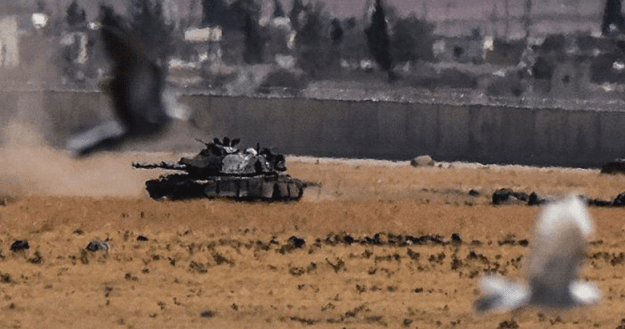
Turkish President Recep Tayyip Erdoğan has threatened a third military operation into Syria, this time in the east. The mobilisation of his proxies and other measures make clear that Erdoğan wants it to be believed he means it. The complication is that the intended target, the Syrian Democratic Forces (SDF), are the chosen partners of the United States-led coalition against Islamic State (ISIS), and U.S. soldiers are present in the area. Continue reading

What Are the Options in Idlib?

By Kyle Orton (@KyleWOrton) on 6 December 2018

This article was originally published at Ahval, headlined, “The Best Bad Outcome for Idlib”

The sun setting over Deraa, in southern Syria, 28 May 2018 (image source)

The Turkey-Russia Sochi Agreement in September won Idlib a reprieve from what had seemed to be an imminent and catastrophic offensive by Syrian President Bashar Assad’s forces and his Russian and Iranian patrons against the last insurgent-held province.

The ceasefire was meant to provide space for Turkey to dismantle the radical insurgents. Instead, those radicals consolidated their dominance in Idlib and the ceasefire has been visibly fraying. How to proceed is a matter of domestic security for the West. Continue reading