Tag Archives: terrorism

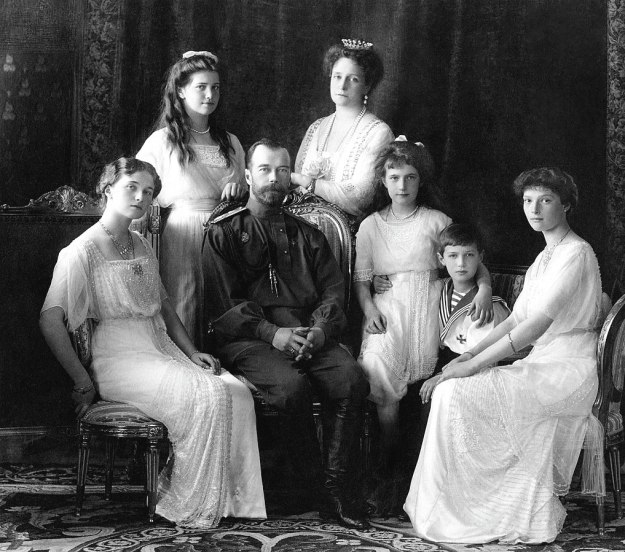
The Last Tsar and the Duty of Monarchy

By Kyle Orton (@KyleWOrton) on 30 December 2021

Grand Duke Alexander Mikhailovich in exile in France, February 1929

Grand Duke Alexander Mikhailovich (1866-1933), the brother-in-law of Tsar Nicholas II (r. 1894-1917), gives an interesting anecdote in the second volume of his memoirs, Always a Grand Duke, published in the year he died, 1933, showing how the last Russian Emperor conceived of the duties of his office. Continue reading

The February Revolution: The End of the Russian Monarchy

By Kyle Orton (@KyleWOrton) on 19 December 2021
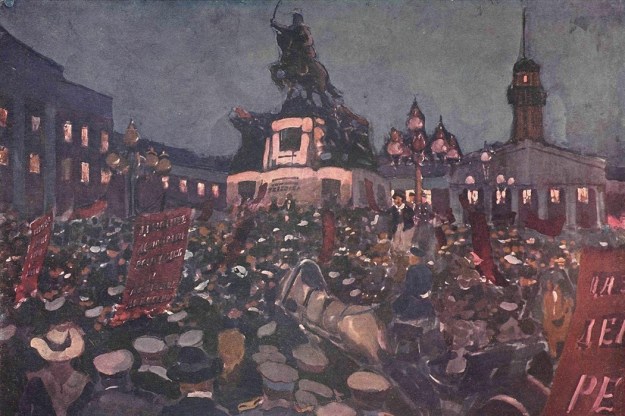
Skobelev Square during the February Revolution, painting by Aleksandr Gerasimov, 1917

The “February Revolution” is so-called because Russia at the time was on the Julian (Old Style (O.S.)) calendar. By the Gregorian (New Style (N.S.)) calendar, which Russia adopted in February 1918, these events take place in March 1917. And momentous events they were, leading to the abdication of the last Tsar, the end of a monarchy and an entire system of power and authority that dated back more than 350 years. For eight months in 1917, Russia struggled to extend the constitutionalist reforms that had begun under the Tsardom within a more liberal framework. The liberals never did gain the upper hand over the radicals, not even after the September 1917 de facto return to autocracy. In November 1917, a coup by the most extreme Leftist faction, the Bolsheviks, terminated the experiment, burying for seven decades even the aspirations in Russia for liberalism and democracy. Continue reading

The 2007 Islamic State Book “Informing Mankind” of its Justifications for the Caliphate

By Kyle Orton (@KyleWOrton) on 22 November 2021
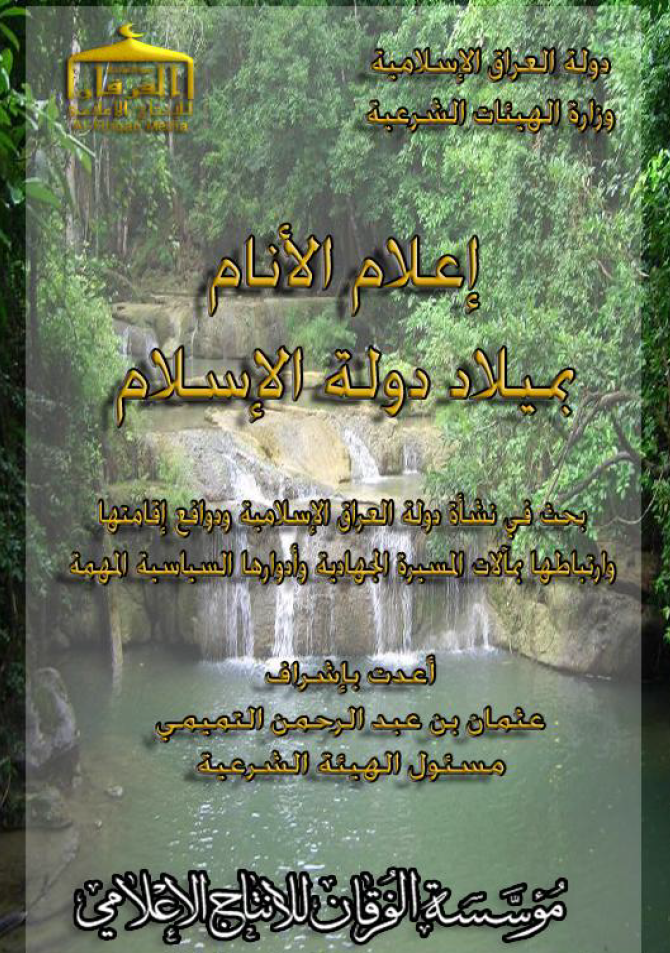
The Islamic State movement published an 87-page book, “Informing Mankind of the Birth of the Islamic State” or “Informing the People of the Birth of the Islamic State” (I’lam al-Anam bi-Milad Dawlat al-Islam), on 7 January 2007. The document was released by Al-Furqan Media Foundation, the central Islamic State propaganda institution, and first appeared on the World News Network website. A rough translation of the book appears below.

Continue reading

The Capture of the Islamic State “Finance Minister” and the Impact of Leadership Losses

By Kyle Orton (@KyleWOrton) on 22 October 2021

This article was originally published at European Eye on Radicalization

Sami Jassim al-Jaburi (Haji Hamid) | IMAGE SOURCE

Mustafa al-Khadhemi, the Iraqi Prime Minister, announced on the morning of 11 October that the Iraqi National Intelligence Service (INIS) had arrested Sami Jassim al-Jaburi (Haji Hamid), the effective finance emir of the Islamic State (ISIS), in “a complex external operation”. Continue reading

Hysteria and the Iranian Revolution

By Kyle Orton (@KyleWOrton) on 12 October 2021
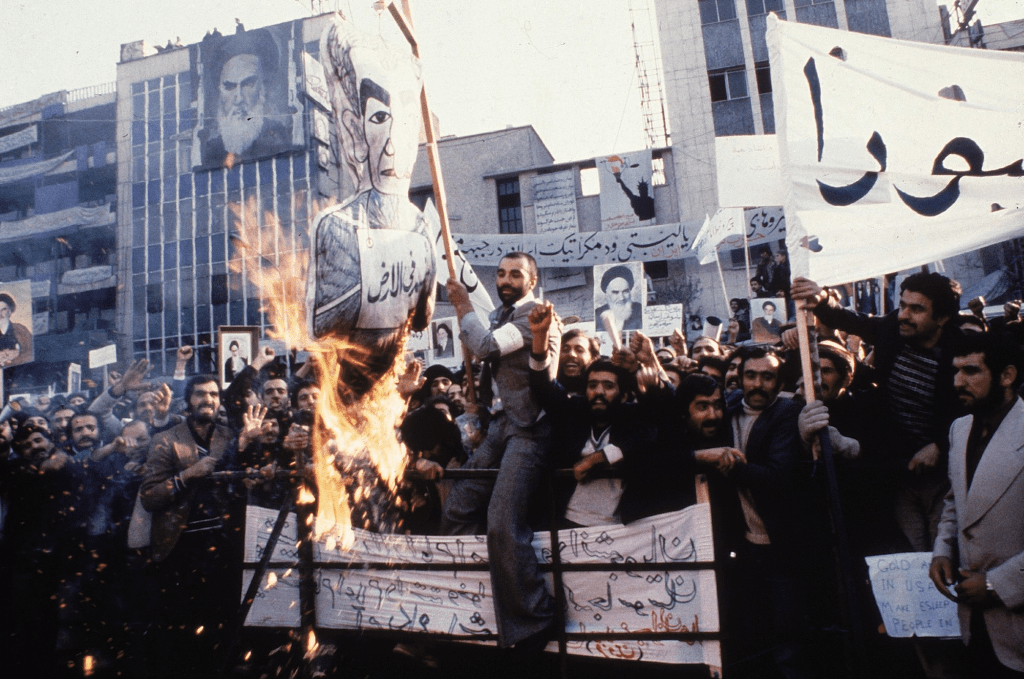
Iranian protesters burn an effigy of the Shah outside the American Embassy, 1979 [source]

There were immense political forces at work in the Iranian Revolution of 1978-79, and they have been covered in some depth on this blog before. In this brief piece, I want to look at the social aspect, specifically the social contagion aspect. People who were in Iran during the Islamic Revolution or who have studied it deeply in retrospect describe the country going “temporarily insane”,[1] and tend to use terms like “febrile” and “hysterical” when describing the atmosphere, especially by the summer of 1978, since, as everyone seems to acknowledge, the revolutionary fervour fed on itself the longer it was allowed to continue. Continue reading

Islamic State Escalates in Afghanistan

By Kyle Orton (@KyleWOrton) on 30 September 2021
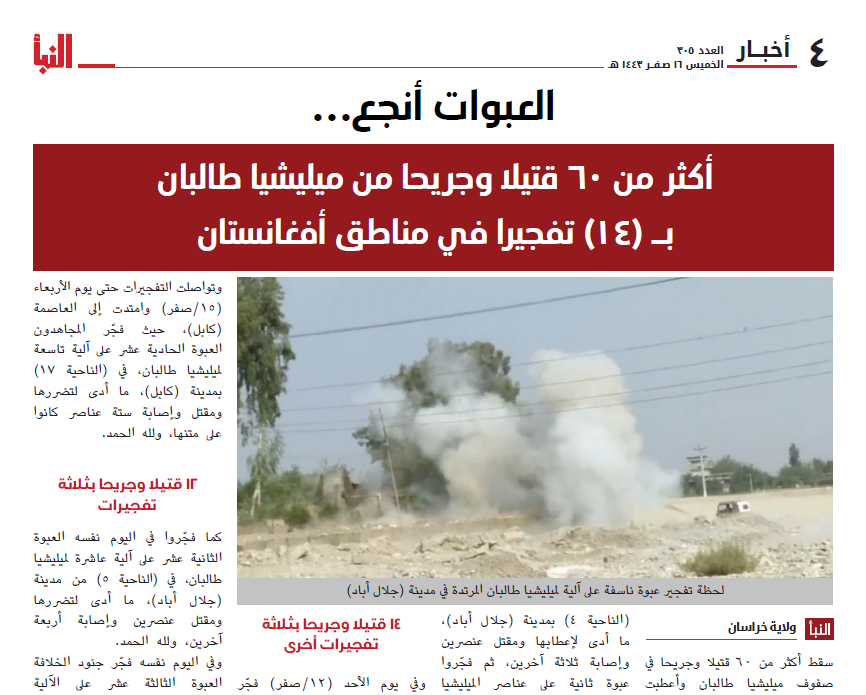
Al-Naba 305, page four. Caption on the picture reads: “The moment an explosive device blew up a vehicle of the apostate Taliban militia in the city of Jalalabad.”

The 305th edition of Al-Naba, the Islamic State (IS) newsletter, released on 23 September, documents the serious escalation in Islamic State Khorasan Province (ISKP) attacks over the preceding week. This consequence of the NATO withdrawal was entirely predictable—and predicted. Continue reading

Islamic State Profiles the Man Who Led the Last Stand of the Caliphate

By Kyle Orton (@KyleWOrton) on 20 September 2021

Al-Naba 304, page 10

The 304th edition of Al-Naba, the Islamic State’s (IS) weekly newsletter, published on 16 September, mostly consists of reports from the various wilayats (provinces) about military activities: at the Centre in Iraq and Syria, in Egypt, Nigeria, and even further south in Africa, in the Congo. Notably IS keeps quiet about Afghanistan in Al-Naba 304, perhaps related to the series of attacks by the Islamic State’s Khorasan Province (ISKP) over the weekend: ISKP is often silent before planned attacks. Al-Naba 304 devotes pages ten and eleven to a profile of a veteran Iraqi jihadist, Abu Umar al-Khlifawi, who led the jihadists for a time in the final pocket of the caliphate at Baghuz, Syria, despite previous injuries that nearly cost him his hand and blinded him in one eye, before he trekked on foot for a month back to Iraq and ended his life as the military emir of Fallujah. A summary of that profile is below.
Continue reading

The Special Risks to Britain from the Jihadist Takeover of Afghanistan

By Kyle Orton (@KyleWOrton) on 10 September 2021

Members of a Taliban Red Unit in the Alingar District of Laghman province in Afghanistan, 2020 || Image credit: Jim Huylebroek, The New York Times

The restoration of the Taliban-Qaeda regime in Afghanistan is a terrorism threat to the whole world, but Britain has some unique vulnerabilities, as MI5 Director general Ken McCallum warned today. Continue reading

The Haqqani Network, Al-Qaeda, and Pakistan’s Jihad in Afghanistan

By Kyle Orton (@KyleWOrton) on 7 September 2021

Anti-Taliban fighters watch U.S. airstrikes at Tora Bora, 16 December 2001 || REUTERS/Erik de Castro

The State Department spokesman Ned Price said, on 27 August, “The Taliban and the Haqqani Network are separate entities”. The next day, the Pentagon Press Secretary John Kirby slightly modulated this, having first tried to dismiss the question, by conceding there was “a certain amount of … commingling … there’s a marbling … of Taliban and Haqqani”, before saying he was “pushing back … [on] the relevance of that discussion”.

What these officials were trying to do was two-fold: (1) to refute press reports that U.S. officials in Kabul had shared “a list of names of American citizens, green card holders, and Afghan allies” with the Taliban, amounting to having “put all those Afghans on a kill list”, as one “defense official” put it; and (2) to deny that the U.S. coordination with the Taliban to evacuate people the jihadists wanted to kill—a surreal enough situation—had involved the additional political and legal problems of coordinating with a formally registered Foreign Terrorist Organization (FTO), as the Haqqani Network is. Continue reading

The Leaders of the Islamic State in Afghanistan

By Kyle Orton (@KyleWOrton) on 3 September 2021

The Islamic State’s “Khorasan Province” (ISKP) was announced in January 2015 and swiftly given formal, public recognition by IS-Centre, which had sent a high-level delegation to Afghanistan in November 2014 to oversee the final stages before they announced their project. ISKP has had seven leaders. Continue reading