By Kyle Orton (@KyleWOrton) on 9 October 2019
Interview with De Re Militari Journal. Continue reading
By Kyle Orton (@KyleWOrton) on 9 October 2019
Interview with De Re Militari Journal. Continue reading
This article was published at The New Turkey
By Kyle Orton (@KyleWOrton) on 1 October 2019
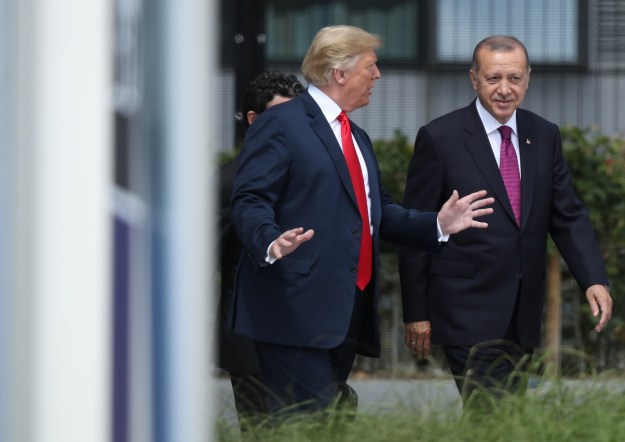
U.S. President Donald Trump and Turkish President Recep Tayyip Erdogan at the opening ceremony of the NATO Summit in Brussels, July 2018 // Getty Images
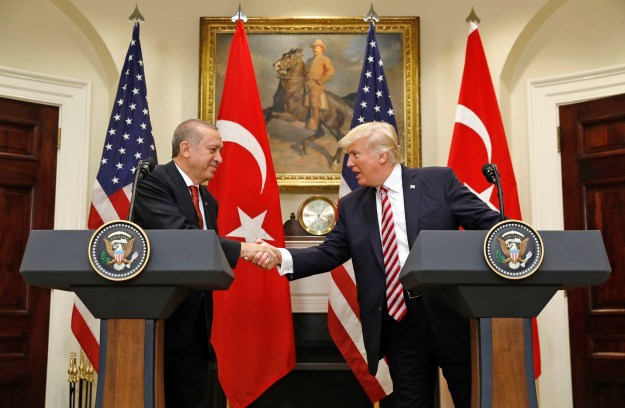
Turkey’s President Recep Tayyip Erdogan had said earlier in September that he would discuss the problems between Turkey and the United States when he met with the U.S. President Donald Trump on September 25, as part of his trip to New York for the opening of the United Nations General Assembly. But neither side has revealed what was discussed and if anything was resolved. Continue reading
By Kyle Orton (@KyleWOrton) on 22 July 2019

U.S. President Donald Trump and Turkey’s President Recep Tayyip Erdogan meeting during the G20 leaders summit in Osaka, Japan, 29 June 2019 [image source]
This article was published at Ahval
By Kyle Orton (@KyleWOrton) on 12 March 2019
The wheel turns again. After U.S. President Donald Trump announced the withdrawal of U.S. forces from Syria in December, it seemed rapprochement with Turkey was on the cards. Now that looks less likely. Continue readingBy Kyle Orton (@KyleWOrton) on 10 March 2019
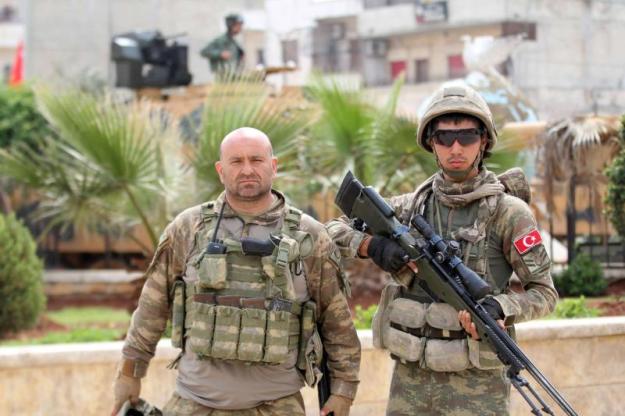
Turkish soldiers in Efrin, Syria, March 2018. (AFP)
Eight years ago, peaceful protests began against Syrian President Bashar Assad. Since then, outside powers — the Iran-Russia axis, the United States and Turkey — have become dominant in Syria.
The Iranians and Russians keeping Assad’s regime alive are clearly going nowhere. The Americans’ indecision on the point is apparently final. So, what of Turkey, which is the custodian of the remnants of the armed opposition? Continue reading
A version of this article was published at CapX
By Kyle Orton (@KyleWOrton) on 21 December 2018

President Trump in a Twitter video saying fallen soldiers agree with his plan to withdraw from Syria, 19 December 2018 [image source]
By Kyle Orton (@KyleWOrton) on 14 December 2018
The United States’ policy in Syria has been, as James Jeffrey, the Special Representative for Syria Engagement, explained recently, focused on “one mission”: the destruction of the Islamic State (Daesh).
The US attempted to pursue this counter-terrorism mission in isolation from the politics of the broader Syrian war. This failed, as it was bound to do, and it has laid the ground for a series of sub-conflicts, another of which might be about to erupt. Continue reading
By Kyle Orton (@KyleWOrton) on 6 December 2018
This article was originally published at Ahval, headlined, “The Best Bad Outcome for Idlib”

The sun setting over Deraa, in southern Syria, 28 May 2018 (image source)
The Turkey-Russia Sochi Agreement in September won Idlib a reprieve from what had seemed to be an imminent and catastrophic offensive by Syrian President Bashar Assad’s forces and his Russian and Iranian patrons against the last insurgent-held province.
The ceasefire was meant to provide space for Turkey to dismantle the radical insurgents. Instead, those radicals consolidated their dominance in Idlib and the ceasefire has been visibly fraying. How to proceed is a matter of domestic security for the West. Continue reading
This article was published at Ahval
By Kyle Orton (@KyleWOrton) on 13 November 2018

Joint patrols begin around Manbij (image source)
The United States has taken steps Syria in recent months that suggest a shift towards reconciliation with Turkey. Even if this is so, however, there is still such a deep divide over strategic outlook that these steps could be easily reversed, opening a new round of uncertainty in northern Syria as 2018 draws to a close. Continue reading
This article was published at The New Turkey
By Kyle Orton (@KyleWOrton) on 27 October 2018

Today in Istanbul, four governments—Turkey, Russia, Germany, and France—are meeting for a summit over Syria, attempting to consolidate the Sochi Agreement signed by Russia and Turkey over Idlib, and re-invigorate the international political process. There is little reason to think that these talks can succeed on either front. Continue reading

 Kyle Orton's Blog