Monthly Archives: November 2017

A Defection and the Dictatorship in Syrian Kurdistan

By Kyle Orton (@KyleWOrton) on 17 November 2017

Talal Silo

It was announced on 15 November that Talal Ali Silo, the official spokesman of the Syrian Democratic Forces (SDF), had fled to the EUPHRATES SHIELD zone in northern Aleppo, run by rebels operating under the Free Syrian Army (FSA) brand that are dependent on Turkey. The SDF is the partner force in Syria for the U.S.-led Coalition against the Islamic State (IS). Though the SDF presents itself as a multi-ethnic coalition of Kurds and Arabs, it was initiated as a front for the Kurdistan Workers’ Party (PKK). By attaching non-Kurdish units to a PKK core and using the SDF banner, it circumvented various legal and political obstacles for Coalition states. But all real power has remained in the hands of the PKK, which has systematically purged all genuinely independent power centres within the SDF. Silo, a Turkoman, helped further the narrative of the SDF’s ethnic inclusivity, and his defection underlines the reality of the organization’s political exclusivity. Continue reading
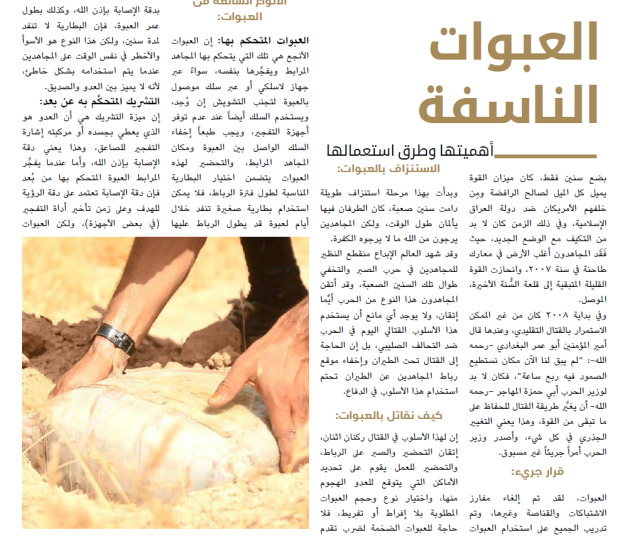
Islamic State Officially Gives Up the Caliphate, Returns to Insurgency

By Kyle Orton (@KyleWOrton) on 15 November 2017

Al-Naba 101, page 8

In the 101st edition of the Islamic State’s weekly newsletter al-Naba (page 8-9), released on 12 October 2017, the organisation gave some fascinating details about how they responded to the “defeat” inflicted on them in 2007-08 by the American surge and the tribal Sahwa (Awakening) forces. The article describes how IS switched wholly to insurgent-terrorist tactics, dismantling its conventional fighting units and even its sniper teams in March 2008, and training in hit-and-run bombings. The leadership at that time, the emir Hamid al-Zawi (Abu Umar al-Baghdadi) and his deputy, the “first minister” and the “war minister” Abdul Munim al-Badawi (Abu Hamza al-Muhajir), encountered some initial scepticism, but the rank-and-file soon came on board when they saw its effectiveness. IS says that it is time to return to this form of warfare. In short, IS marked a switch in al-Naba 101 entirely from the statehood and governance phase of its revolutionary warfare, back into insurgency mode. The article is reproduced below. Continue reading

The Coalition Removes Senior Islamic State Leaders, Military Officials, and External Terror Operatives

By Kyle Orton (@KyleWOrton) on 15 November 2017

The United States Department of Defence announced on 14 November that four more important operatives of the Islamic State (IS) had been killed in targeted airstrikes by the U.S.-led anti-IS Coalition. “The removal of these key terrorists disrupts ISIS’ weapons engineering activities and their ability to recruit and train terrorists,” the Pentagon said in a statement. “It also reduces their ability to plan and conduct terrorist attacks, both within Syria and Iraq and abroad.” Continue reading

The Controversial End of the Islamic State in Raqqa

By Kyle Orton (@KyleWOrton) on 14 November 2017

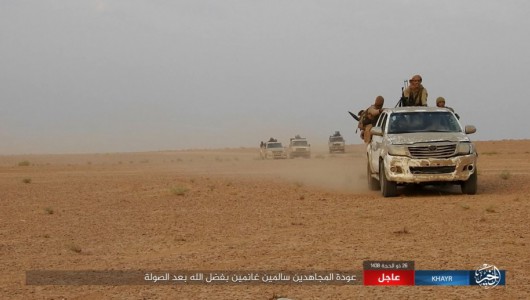
IS jihadists arriving south of Deir Ezzor city, September 2017

A deal was made between the “Syrian Democratic Forces,” the U.S.-led Coalition’s “partner force” in Syria that is wholly dominated by the Kurdistan Workers’ Party (PKK), and the Islamic State (IS), which ostensibly evacuated the remnants of the IS jihadists—said to be between 300 and 500 militants, plus 400 “hostages” (i.e. women and children)—from Raqqa by 15 October. The U.S.-led Coalition said at the time, “do not condone” the deal, but the Coalition acknowledged that its PKK partner had to make these tactical calls, and there was a lot of local pressure from local tribal leaders to reach this deal given the devastation visited on the city. It now transpires, however, that this deal was the worst of all worlds: the Coalition ruined the city in its efforts to overcome IS’s tactical adaptations to the air campaign, and then allowed a scandalous number of IS jihadists to escape. Continue reading

Profile of an Islamic State Media Emir: Abu Zahra al-Issawi

By Kyle Orton (@KyleWOrton) on 12 November 2017

The forty-fifth edition of the Islamic State’s “Distinguished Martyrs” series, published by al-Furqan Media in Rajab 1431 (June/July 2010), profiled Abu Zahra al-Issawi, the media emir or information minister of the organization between some point after July 2007, when Khalid al-Mashadani (Abu Zayd al-Mashadani) was arrested, and some point before September 2009, when Ahmad al-Ta’i was announced as holding the position. [UPDATE: Al-Ta’i turned out to be Abu Muhammad al-Furqan, and his real name was Wael al-Ta’i.] Continue reading

The Third Deputy of the Islamic State: Muhammad Khalaf Shakar

By Kyle Orton (@KyleWOrton) on 12 November 2017

Muhammad Shakar had, according to his martyr biography, “become influenced by Salafism in 1997-98 while serving as a part of [Saddam] Hussein’s Special Republican Guard”.[1] Quitting the military and returning to his home in Mosul, Shakar was harassed by the regime until he went to join Ansar al-Islam in the mountains of Kurdistan.[2]

Shakar, known as Abu Talha al-Ansari or Abu Talha al-Mawsuli, joined the predecessor to Islamic State either just before or just after Saddam fell, and he was arrested in Mosul on 14 June 2005. Continue reading

Hamza bin Ladin Presents Al-Qaeda As the Guardian of Revolution

By Kyle Orton (@KyleWOrton) on 9 November 2017

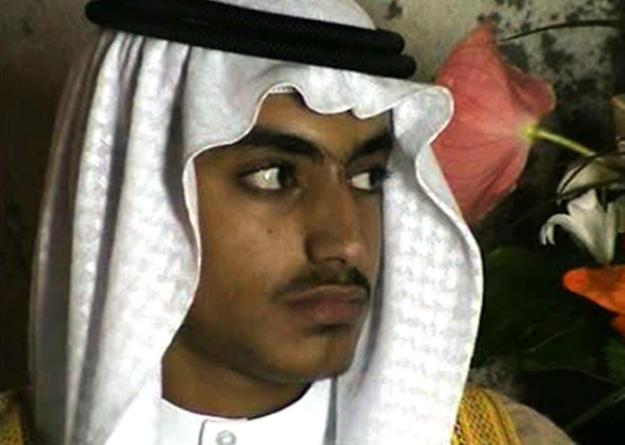
Hamza bin Ladin on his wedding day in Tehran, under the protection of the Quds Force, the expeditionary unit of the Islamic Revolutionary Guard Corps that attempts to spread the Iranian revolution through subversion and terrorism

Hamza bin Ladin, whose profile is being deliberately raised within al-Qaeda, released a speech on 7 November 2017, “The Fighter Against Invaders And The Inciter of Rebellion Against Tyrants”, an English transcript of which was produced by As-Sahab Media, and is reproduced below. Continue reading

Islamic State and Female Fighters

By Kyle Orton (@KyleWOrton) on 8 November 2017

The Khansaa Brigade, the all-female Islamic State espionage network and morality enforcement police, based in Raqqa city (image source)

A debate has been ongoing among analysts since the summer about the view the Islamic State (IS) has of mujahidat (female fighters). IS now seems to have settled the matter in its newsletter, Al-Naba. Continue reading

The Islamic State Claims the Manhattan Terror Attack

By Kyle Orton (@KyleWOrton) on 3 November 2017

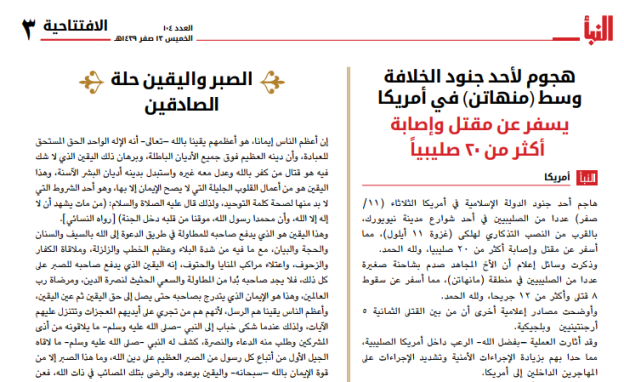
The Islamic State’s claim for the 31 Oct. 2017 Manhattan terror attack is on the right. (Al-Naba 140, 2 Nov. 2017, page 3.)

The Islamic State released the 140th edition of its newsletter, Al-Naba, on 2 November 2017, which contained an article claiming that the perpetrator of the vehicular ramming terrorist attack in New York city on Halloween night, Sayfullo Saipov, an Uzbek immigrant to the United States, was one of the caliphate’s “soldiers”. The Islamic State also repeated its much-contested claim that Stephen Paddock, whom it refers to as “Abu Abd al-Bir al-Amriki”, was motivated by its call when carrying out the massacre at the concert in Las Vegas on 1 October. The article is reproduced below.
Continue reading